
 100% FREE ACCESS
6th Standard Syllabus & Materials
6th Standard
TN 6th Tamil பருவம் 1 - இயல் 1 - மொழி -தமிழ்த்தேன் - இன்பத்தமிழ் Sample Question Papers Study Material - QB365 Set A
NEW6th Standard
TN 6th English T1 - Supplementary - The Apple Tree and The Farmer Sample Question Papers Study Material - QB365 Set A
NEW6th Standard
TN 6th English T1 - Prose - When The Trees Walked Sample Question Papers Study Material - QB365 Set A
NEW6th Standard
TN 6th Social Science T3 - CIV - Road Safety Sample Question Papers Study Material - QB365 Set A
NEW6th Standard
TN 6th Social Science T3 - CIV - Local Bodies - Rural and Urban Sample Question Papers Study Material - QB365 Set A
NEW6th Standard
TN 6th Social Science T3 - CIV - Democracy Sample Question Papers Study Material - QB365 Set A

Published on: 29/02/2020
6th Standard Social Science Important questions All Chapter 2020
Download Tamil Nadu 6th Standard Social Science question papers, model tests, one-mark questions, important questions, and public exam papers in PDF format. Free study materials and answer keys for TN State Board students.
Questions + Answers key
Take MCQ Social Science Test
1.
_________became republics or smaller kingdoms.
northern India
Kalinga
Janapadas
Magadha
2.
The intellectual and spiritual development in India, historian Will Durant has rightly called it_________
the shower of stars
to sacrificial rit
Tirthankara
3.
The Upanishads taught as alternative_________ were too philosophical, which a layperson could not understand.
the shower of stars
to sacrificial rites
Tirthankaras
4.
_________was the leader of the village
Gramani
Viz
Grama
5.
Aryans of the Rig Vedic Period were________
nomadic
semi-nomadic
developed
6.
People then move to a new piece of land for________
cultivation
industrial
manufactures
7.
Chandra Gupta Maurya abdicated the thrown and went to Sravanbelgola along with Jaina Saint ___________
Badrabahu
Stulabahu
Parswanatha
Rushabhanatha
8.
Which of the following are the sources of Mauryan period?
Artha Sastra
Indica
Mudrarakshasa
All
9.
Where was the third Buddhist Council convened?
Rajagriha
Vaishali
Pataliputra
Kashmir
10.
Our National Motto “Sathyameva Jayate” is taken from ___________
Brahmana
Veda
Aranyaka
Upanishad
11.
Aryans first settled in ___________ region.
Punjab
Middle Gangetic
Kashmir
North east
12.
Consider the following statements
(1) Universe is referred to Cosmos.
(2) The Sun is at the centre' of the solar system.
(3) Pluto is a dwarf planet.
1 and 2
2 and 3
1,2 and 3
1 only.
13.
The eleventh President of India was
Narasimha Rao
Man Mohan Singh
Dr. APJ Abdul Kalam
Lal Bahadur Sastri
14.
The land surrounded by water on three sides is called
Bay
Strait
Peninsula
Trench
15.
The International Mountain Day is
December 10th
December 11th
December 12th
December 13th
16.
___________is self luminous and gives light on its own
sun
Moon
Star
Earth
17.
Galaxy means the huge cluster of_____________
Planets
Asteroids
Stars
Meteors
18.
statement: Kanchi was an educational centre.
Reason: Hieun Tsang pursued his further studies at Kadigai.
Statement and Reason are wrong.
Statement correct but Reason is wrong
Both statements and Reason are correct
Statement is wrong but Reason is correct.
19.
Thoonga Nagaram refers to
Kanchi
Poompuhar
Madurai
Korkai
20.
Which is the oldest city among the following ones?
Chennai
Tiruppur
Poompuhar
Salem
21.
Who was the first ruler to give up war after victory
Bimbisar
Raja Raja Chola
Akbar
Ashoka
22.
Where did early man live?
mud house
under tree
caves
river banks
23.
Indus valley civilization is great, because
It had advanced sanitation and drainage system
Repeated floods affected this area
Indus people maintained a big army
They did not use iron
24.
Humans with the help of flint made __________.
sharp weapons
vessels
carts
boats
25.
Name the book/s written by A.P.J. Abdul Kalam
India 2020
Wings of Fire
Ignited Minds
All of these
26.
Discrimination done on the basis of gender is referred to as
gender discrimination
caste discrimination
religious discrimination
inequality
27.
Which one of the following is not the reason for Prejudice?
Socialization
Economic Benefits
Authoritarian personality
Geography
28.
‘Discovery of India’ – a book was written by
Rajaji
V.O.C
Nethaji
Jawaharlal Nehru
29.
Recognised official languages of India, as per VIIIth Schedule of Indian Constitution
25
23
22
26
30.
Which one of the following religion is not practised in India
Sikhism
Islam
Zoarastrianism
Confucianism
31.
Which of the following is the smallest ocean on Earth?
The Pacific Ocean
The Indian Ocean
The Atlantic Ocean
The Arctic Ocean
32.
The movement of the Earth on its axis is called
Revolution
Seasons
Rotation
Circulation
33.
Which one of the following is a Tamil city?
Iraq
Harappa
Mohenjo-Daro
Kancheepuram
34.
Which of the following region has a city more than 6500 years old?
Iraq
Indus Valley
Tamilagam
Thondaimandalam
35.
River valleys are said to be the cradle of civilisation because
Soil is very fertile.
They experience good climate
They are useful for transportation.
Many civilisations flourished on river valleys.
36.
Tanzania is situated in the continent of
Asia
Africa
America
Europe
37.
The process of evolution is _____________ .
direct
indirect
gradual
fast
38.
What was the step taken by the early man to collect his food?
Trade
Hunting
Painting
Rearing of animals
39.
Name the factors that determine whether a substance is a resource or not?
40.
Give an example for the human resources?
41.
What is meant by secondary acitivies?
42.
Place the following words in the appropriate column.
Words: Jina, Mahayana, Tirthankaras, Stupas Nirvana, Digambara, Tripitakas, Agama
| Jainism | Buddhism |
43.
Write a short note about Gurukula System of Education?
44.
How did the barter system prevalent?
45.
Name the new animal used by the Aryans?
46.
What is sustainable development?
47.
Define abiotic resources.
48.
When you arrange the continents in ascending order according to their size, which ranks third?
49.
Complete the given table with the help of an atlas. Follow the example
| S.No | Continent | Plateau | Plains |
| 1. | Asia | Tibetan Plateau | Yangtze Plain |
| 2. | North America | ||
| 3. | South America | ||
| 4. | Australia | ||
| 5. | Europe | ||
| 6. | Africa |
50.
What is discrimination?
51.
What is Prejudice?
52.
List out the names of continents according to their size.
53.
What are the types of diversity?
54.
Define diversity.
55.
Mention the other names of Madurai.
56.
Write about the kings who ruled Madurai.
57.
Mention the ancient cities of Tamil Nadu.
58.
How would you define archaeology?
59.
Describe the ancient methods of hunting?
60.
Name some tools used by early man to hunt animals.
61.
What are the benefits of a museum?
62.
What do you know about the pre historic period?
63.
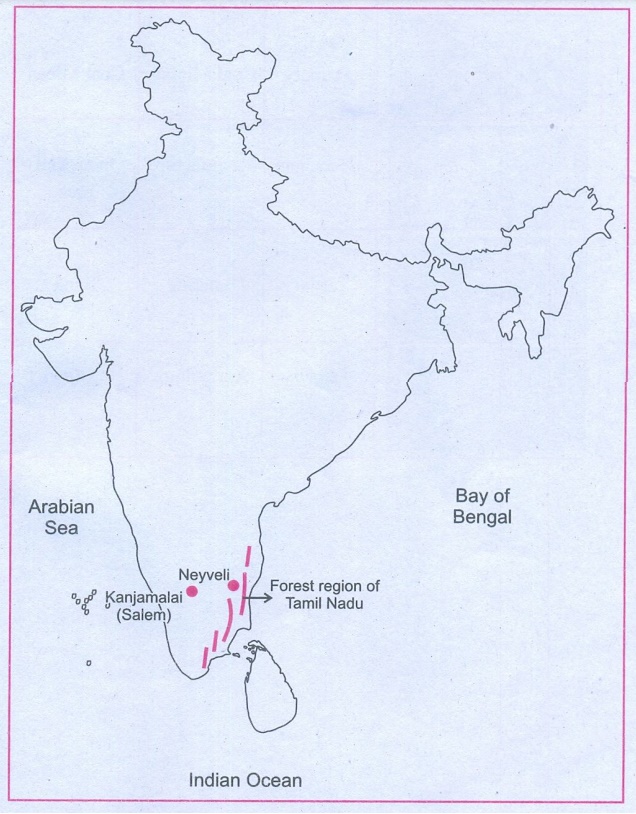
Mark the following in the outline map of India.
1. Neyveli
2. Bay of Bengal
3. Arabian Sea
4. Forest region of Tamil Nadu
5. Indian Ocean
6. Iron mining in Kanjamalai(Salem)
64.
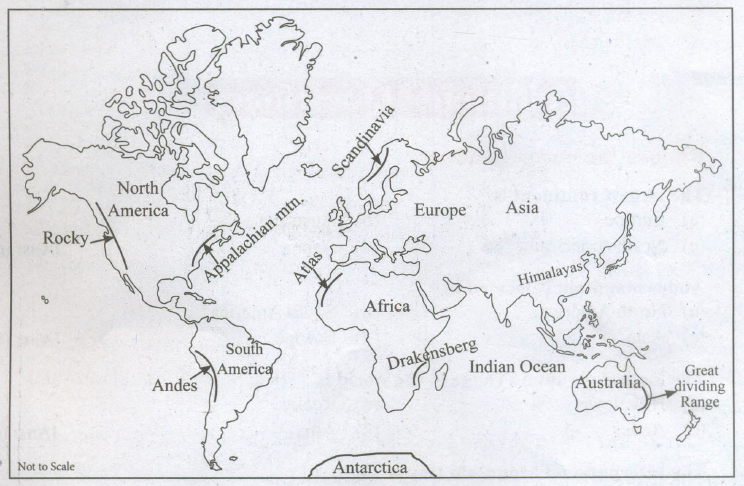
On the given outline map of the world, label the continents and mountain range.
65.
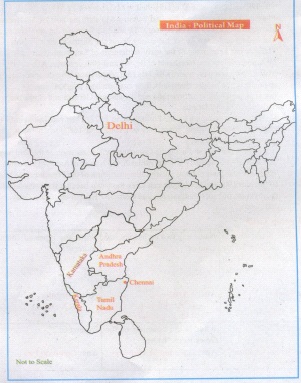
Mark the following places in the political map of India.
a. Delhi
b. Chennai
c. Tamil Nadu
d. Andhra Pradesh
e. Kerala
f. Karnataka
66.
Explain in detail classification on the basis of distribution.
67.
Make a Venn diagram to indicate similarities and dis-similarities of Jainism and Buddhism.
68.
Sentence inaking by using these new words.
Shruff, Gramani, Rashtras, Iron Age, Semi nomadic, Barter
69.
How can resources be conserved?
70.
What is the difference between manmade resources and human resources?
71.
Kalinga war became a turning point in Ashoka’s life. How?
72.
Write any three causes for the rise of Magadha.
73.
Write any three differences between Hinayana and Mahayana sects of Buddhism?
74.
You know the importance of conservation of forests. Do you think conservation of mountains is also equally important?
75.
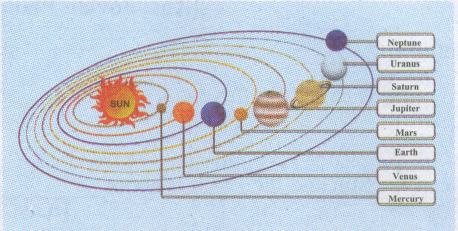
Study the picture and answer the given questions.
a. Which is the closest planet to the Sun?
b. Which is the largest planet?
c. Which is the fart~est planet from the Sun?
d. Which is the second smallest planet?
76.
A noval dockyard has been discovered in Lothal. What does it convey?
77.
Agriculture was one of their occupations. How can you prove this? (with findings)
78.
Observe the following features of Indus Civilisation and compare that with the present day.
a. Lamp post
b. Burnt bricks
c. Underground drainage system
d. Weights and measurement
e. Dockyard
79.
Write any two types of discrimination?
80.
Kancheepuram was famous for education. Prove this statement.
81.
Explain Linguistic diversity and cultural diversity.
82.
Write down the importance of oceans.
83.
What are the effects of rotation and revolution?
84.
| Poompuhar was located on which river bank? | Name the ancient city which had Tamil Sangam | Name a Sangam literary work |
| Which Greek historian gave accounts about the Pandya kingdom? | To which Tamil kingdom did the southern districts of Tamil Nadu belong to during the Sangam Age? | Name the Chinese traveler who stayed and studied in Nalanda University. |
| Thirunavukarasar mentioned Kanchi as | What is the name of evening market during the Sangam Age? | Name the temple built by Pallava king Rajasimha at Kanchi. |
| Which district is known as the district of lakes? | What is trade? | Name a port located on the shore of Bay of Bengal. |
1.
(c)
Janapadas
2.
(a)
the shower of stars
3.
(b)
to sacrificial rites
4.
(a)
Gramani
5.
(b)
semi-nomadic
6.
(a)
cultivation
7.
(a)
Badrabahu
8.
(d)
All
9.
(c)
Pataliputra
10.
(d)
Upanishad
11.
(a)
Punjab
12.
(c)
1,2 and 3
13.
(c)
Dr. APJ Abdul Kalam
14.
(c)
Peninsula
15.
(b)
December 11th
16.
(a)
sun
17.
(c)
Stars
18.
(c)
Both statements and Reason are correct
19.
(c)
Madurai
20.
(c)
Poompuhar
21.
(d)
Ashoka
22.
(c)
caves
23.
(a)
It had advanced sanitation and drainage system
24.
(a)
sharp weapons
25.
(d)
All of these
26.
(a)
gender discrimination
27.
(d)
Geography
28.
(d)
Jawaharlal Nehru
29.
(c)
22
30.
(d)
Confucianism
31.
(d)
The Arctic Ocean
32.
(c)
Rotation
33.
(d)
Kancheepuram
34.
(b)
Indus Valley
35.
(d)
Many civilisations flourished on river valleys.
36.
(b)
Africa
37.
(c)
gradual
38.
(b)
Hunting
39.
Time and Technology
40.
People are also referred to as resources
41.
Primary resources transforming of raw materials into finished goods is called Secondary Activities.
42.
| Jainism | Buddhism |
| Jina, Tirthankaras, Digambara,Agama | Mahayana, Stupas Nirvana,Tripitakas, |
43.
(i) The gurukula system is an ancient learning method.
(ii) The word Gurukula is a combination of the Sanskrit Word Guru (teacher or master) and Kula (family or home).
(iii) The shishyas resided with their guru and served them and simultaneously learnt and gained knowledge.
(iv) The students received education through oral tradition meaning rote learning, and were required to memorise everything.
44.
(i) Barter system was prevalent (exchange of goods).
(ii) They used Nishka, Satmana (gold coins) and Krishnala (silver coins) for business transactions.
45.
(i) In the later Vedic period the Aryans tamed elephants, apart from cow, goat, sheep and horse.
46.
The present needs of resources are met and the conserving of resources for the future are balanced, we call it sustainable development.
47.
(i) Abiotic resources are non-living things.
(ii) Land, water, air and minerals are abiotic resources.
48.
Antarctica.
49.
| S.No | Continent | Plateau | Plains |
| 1. | Asia | Tibetan Plateau | Yangtze Plain |
| 2. | North America | Colorado Plateau | Great Plains |
| 3. | South America | Altiplano Plateau | Pampas |
| 4. | Australia | Western Plateau known as Australian shield | Nullarbor |
| 5. | Europe | Hardangervidda | North European Plain |
| 6. | Africa | East African Plateau | Serengeti Plains |
50.
(i) Discrimination can be defined as negative actions towards people.
(ii) Discrimination can happen the basis of colour, class, religion and gender.
51.
Prejudice means to judge other people in a negative or inferior manner, without knowing much about them. It happens when people have false belief and ideas.
52.
From the largest to the smallest, they are Asia, Africa, North America, South America, Antartica, Europe and Australia.
53.
The types of diversity are
(i) Land forms and Lifestyle diversity
(ii) Social diversity
(iii) Religions diversity
(iv) Linguistic diversity
(v) Cultural diversity
54.
People speak different languages, eat different kinds of food, celebrate their own festivals and different cultures, worship in different ways, yet we live together. This is known as diversity.
55.
(i) Sangam Valartha Nagaram
(ii) Thoonga Nagaram (the city that never sleeps).
(iii) Koodal nagar are the other names of Madurai.
56.
(i) Pandyas, the Cholas and later the Kalabras ruled Madurai in the ancient period.
(ii) During medieval times, later Cholas and later Pandyas followed by the Nayaks ruled this historic town.
57.
(i) Madurai
(ii) Kancheepuram
(iii) Poompuhar
58.
Archaeology is the study of pre historic humans remained materials used by pre historic humans.
59.
(i) Go as a group and hunt the prey.
(ii) Dig a pit and trap the animals and hunt.
60.
(i) Bones and horns of the Animals
(ii) Sharphened and crude stone weapens
(iii) Sharphened branches of trees.
61.
(i) We should understand the life style of olden Age people with the help of museum.
(ii) Research students are get more information for museum
62.
(i) The period between the use of first stone tools and the invention of writing systems is pre-history.
(ii) Stone tools, excavated materials and rock paintings are the major sources of prehistory.
63.
64.
65.
66.
ON THE BASIS OF DISTRIBUTION:
On the basis of distribution, resources can be classified into localized resources and universal resources.
(i) When resources are present in specific regions they are called localized resources.
(e.g.) Minerals.
(ii) Some resources are present everywhere Such resources are called universal resources.
(e.g.) Sunlight and air.
(ii) On National resources are resources within the political boundaries and oceanic area of a country.
(e.g.) Tropical forest regions of India.
67.
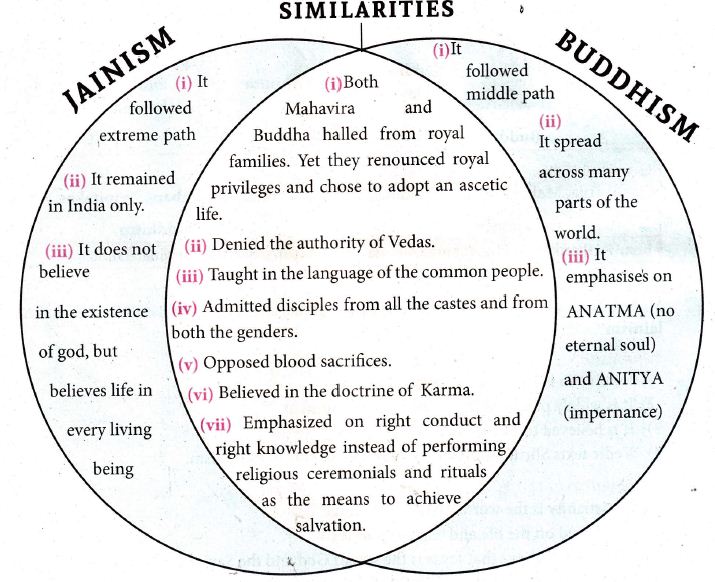
68.
Shruti - 'Shrutis' means listening (or unwritten) ones that was transmitted orally through generations.
Gramani - Gramani was the head of a village called Grama
Rashtras - Rasthras were tribal Kingdoms during Rig vedic period. (Bharatas. Matsyas, Puras)
Iron Age - Towards the end of Iron age, people stepped into what is known as Megalithic culture.
Semi nomadic - Semi nomadic people lived usually in portable or temporary dwellings.
Border - Under border system people exchanged services and goods for other services and goods in turn.
69.
Sustainable development can take place when
(i) The reasons of depletion are identified.
(ii) Wastage and excess consumption is prevented.
(iii) Reusable resources are recycled.
(iv) Pollution is prevented.
(v) Environment is protected.
(vi) Natural vegetation and wild life are preserved.
(vii) Alternative resources are used.
70.
| S.No | Man-Made resources | Human resources |
| 1. | Natural resources are modified or processed by technology into man-made resources. | Human resources are groups of individuals who use nature to create more resources. |
| 2. | (e.g.) Bridges, Houses, Roads. | (e.g.) Doctors, Teachers, Scientists. |
71.
(i) Ashoka fought the Kalinga war in 261 B.C.
(ii) He won the war and captured Kalinga.
(iii) The horror of war was described by the king himself in the Rock Edict XIII.
(iv) After the battle of Kalinga, Ashoka became a Buddhist.
(v) He under took tours to different parts of the country instructing people on policy of Dhamma.
(vi) Ashoka sent his son Mahindra and his daughter Sanghamitra to Srilanka to propagate Buddhism.
(vii) He took importance in the welfare of the people like hospitals, laying roads, irrigation, etc.
(viii) So, Ashoka was considered as a great emperor of ancient India.
72.
The Causes for the Rise of Magadha
(i) Magadha was located onthe lower part of the Gangetic plain. The plain was fertile which ensured the rich agricultural yield. This provided regular and substantial income to the state.
(ii) The thick forests supplied timber for construction of buildings and elephants for army.
(iii) Abundance of natural resources especially iron enabled them to equip themselves with weapons made of iron.
(iv) Growing trade and commerce facilitated movement of people as well as settlement of people in centres of arts and crafts.
(v) The outcome was urbanization and emergence of Magadha as an empire.
73.
| S.No | HINAYANA | MAHAYANA |
| 1. | Did not worship idols or images of Buddha. | Worshiped images of Buddha. |
| 2. | Practiced austerity | Observed elaborate rituals. |
| 3. | Believed that salvation of the individual as its goal. | Believed that salvation of all beings as its |
| 4. | Used Prakrit language. | Used Sanskrit language. |
| 5. | Confined to India. | Spread to Central Asia, Ceylon, Burma, Nepal, Tibet China, Japan, where middle path was accepted. |
74.
(i) Mountains make up more than a quarter of the planet's land mass. These surfaces provide resources for nearly 700 million people through out the world.
(ii) Mountains provide energy resources, food and water to people all around the world.
(iii) But climate change could cause mountains to shrink.
(iv) Deforestation has also been a threat while natural disasters often damage many mountains.
(v) Mountains are among the most beautiful land masses in the world. So like conservation of forests, conservation of mountains also equally important.
75.
a. Mercury
b. Jupiter
c. Uranus
d. Mars
76.
(i) A naval dockyard has been discovered in Lothal in Gujarat. It shows the maritime activities of the Indus people.
(ii) Cylindrical seals similar to those found in Persian Gulf and mesopotamia have also been found in the Indus area.
(iii) This shows the trade links between these two areas.
77.
Agriculture was one of their occupation:
(i) Granaries were used to store food grains.
(ii) The remains of wheat, barley, millets, sesame and pulses have been found there.
(iii) A granary with walls made of mud bricks, which are still in a good condition, has been discovered in Rakhigarhi, a village in Haryana, belonging to mature Harappan phase.
78.
(a) Lamp post
(i) Each house and street had a lamp post in Indus civilisation.
(ii) Now a days there is no electric lamp post in deep rural area.
(b) Burnt bricks
(i) The houses were built using baked bricks and mortar.
(ii) Present days we built varity of houses like concrete house, thatch house, etc....
(c) Underground drainage system
(i) Many of these cities in Indus has covered drains. The drains were covered with slabs or bricks.
(ii) Now a days underground drainage system is functioning only major cities.
(d) Weights and measurement
(i) Indus people had developed a systern of standardised weights and measures.
(ii) Present day we used electronic weighing machine also.
(e) Dockyard
(i) A naval dockyard has been discovered in Lothal in Gujarath. It shows the manitime activities of the Indus people.
(ii) Now a days there are so many seaports spread in all over India.
79.
Types of discrimination:
(a) Caste discrimination
(b) Gender discrimination
(c) Religious discrimination
(a) Gaste discrimination:
(i) Caste system is the most dominant reason for inequality and discrimination in India.
(ii) Many people in India have fought against caste oppression.
(iii) The most prominent among them was Dr.B.R.Ambedkar.
(iv) He fought actively for equality among the citizens of India.
(b) Gender discrimination:
(i) Gender discrimination refers to health, education, economic and political inequalities between men and women in India.
(ii) For example a girl is not allowed to go to college after finishing her schooling.
(iii) Most of the girls are not allowed to select a career of their choice, rather they are forced into marriage.
(iv) In some families, girls are not allowed to wear modern dresses while boys in such families often wear modern dresses.
(c) Religious discrimination:
(i) Religions discrimination is unequal treatment of an individual or group based on their beliefs.
(ii) Religious discrimination has been around for a long time.
(iii) There have been problems between people of different religions for thousands of years.
(iv) Some people are not allowed to enter in public places; especially the places of worship, because they belong to another religion.
(v) Some religious people often end up in conflict with each other because of their rituals and way of life.
80.
(i) A place of learning is called school.
(ii) Several schools were established in great numbers for the first time in Kancheepuram.
(iii) Jains studied in Jainapalli, and Buddhists studied in Viharas.
(iv) The greatness of Kanchi as an educational centre can be understand from the fact that the chinese traveller Hieun Tsang who studied at Nalanda University visited Kanchi 'Kadigai' to pursue his further studies.
(v) Poet kalidasa says, "Kanchi is the best of the towns".
(vi) Tamil poet saint Thirunavukarasar praises kanchi as "Kalviyil Karai illatha Kanchi".
81.
(i) According to census of India 2001, India has 122 major languages and 1599 other languages.
(ii) Four major Indian language families are Indo-Aryan, Dravidian, Austroasiatic, and Sino Tibetian. Tamil is the oldest Dravidian language.
(iii) Historically, the Portuguese, the Dutch, the British, the Danish and the French came to India for trade and their occupation of India or some parts of it has left behind a certain impact upon the culture and language of the people.
(iv) Because the British ruled over the entire country for over three hundred years before independence in 1947, the English language gained prominence in India. In due course, English has emerged as an important language and a medium of instruction in schools and colleges.
(v) It is widely used in official communication and daily life.
Cultural Diversity :
(i) The term 'culture' refers to customs and practices of people, their language, their dress code, cuisine, religion, social habits, music, art, and architecture.
(ii) The culture of a group of people is reflected in their social behavior and interactions.
(iii) The group identity fostered by social patterns is unique to a group.
(iv) Art and architecture are an integral part of every community.
(v) It develops as a part of culture and tradition of a community.
(vi) Each of the 29 states and 7 Union territories of India has rich traditions and unique ways of artistic expression.
82.
(i) The oceans cover over 70% of the Earth's surface.
(ii) It carry out about 50% of global primary production and support the greatest biodiversity on the Earth.
(iii) They are also one of the largest carbon reservoirs in the Earth system.
(iv) It regulate climate and weather climate.
(v) They vital role in transportation in sea trade.
(vi) Ocean currens are playing a keyrole in climatic control in coastal regions.
83.
Rotation:
(i) It is the spinning movement of the earth on its axis.
(ii) The rotation of the earth causes day and night.
(iii) As the earth is spherical in shape, only one half of it is illuminated by the sun at a time.
(iv) The other half remains dark.
(v) The illuminated portion of the earth experiences day, whereas the darkened part of the earth experiences night.
Revolution:
(i) It is the movement of the earth around the sun on its elliptical path.
(ii) The inclination of the earth on its axis and its revolution around the sun cause different seasons.
84.
| Poompuhar was located on which river bank? Cauvery |
Name the ancient city which had Tamil Sangam Madurai |
Name a Sangam literary work Pattinappallai |
| Which Greek historian gave accounts about the Pandya kingdom? Megasthanese |
To which Tamil kingdom did the southern districts of Tamil Nadu belong to during the Sangam Age? Pandya Nadu |
Name the Chinese traveller who stayed and studied in Nalanda University. Hieun Tsang |
| Thirunavukarasar mentioned Kanchi as Kalviyil Kayaillatha Kanchi |
What is the name of evening market during the Sangam Age? Allangadi |
Name the temple built by Pallava king Rajasimha at Kanchi. Kailasanathar TempIe |
| Which district is known as the district of lakes? Kancheepuram |
What is trade? The action of buying and selling goods and services |
Name a port located on the shore of Bay of Bengal. Poompuhar Port |

6th Standard Syllabus & Materials
6th Standard
TN 6th Social Science T3 - GEO - Understanding Disaster Sample Question Papers Study Material - QB365 Set A
NEW6th Standard
TN 6th Social Science T3 - GEO - Globe Sample Question Papers Study Material - QB365 Set A
NEW6th Standard
TN 6th Social Science T3 - GEO - Asia and Europe Sample Question Papers Study Material - QB365 Set A
NEW6th Standard
TN 6th Social Science T3 - HIS - South Indian Kingdoms Sample Question Papers Study Material - QB365 Set A



Tamilnadu Stateboard 6th Standard Subjects
Tamilnadu Stateboard Standards



