
 100% FREE ACCESS
6th Standard Syllabus & Materials
6th Standard
TN 6th Tamil பருவம் 1 - இயல் 1 - மொழி -தமிழ்த்தேன் - இன்பத்தமிழ் Sample Question Papers Study Material - QB365 Set A
NEW6th Standard
TN 6th English T1 - Supplementary - The Apple Tree and The Farmer Sample Question Papers Study Material - QB365 Set A
NEW6th Standard
TN 6th English T1 - Prose - When The Trees Walked Sample Question Papers Study Material - QB365 Set A
NEW6th Standard
TN 6th Social Science T3 - CIV - Road Safety Sample Question Papers Study Material - QB365 Set A
NEW6th Standard
TN 6th Social Science T3 - CIV - Local Bodies - Rural and Urban Sample Question Papers Study Material - QB365 Set A
NEW6th Standard
TN 6th Social Science T3 - CIV - Democracy Sample Question Papers Study Material - QB365 Set A

Published on: 04/01/2019
TERM 3 SA MODEL QUESTION 2018-2019
Download Tamil Nadu 6th Standard Social Science question papers, model tests, one-mark questions, important questions, and public exam papers in PDF format. Free study materials and answer keys for TN State Board students.
Questions + Answers key
Take MCQ Social Science Test
1.
The total number of lines of latitude are
171
161
181
191
2.
The 23 ½° N line of latitude is called _____________
Tropic of Capricorn
Tropic of Cancer
Arctic Circle
Antarctic Circle
3.
Who among the following built the VaikundaPerumal temple?
Narasimhavarma II
Nandivarma II
Dantivarman
Parameshvaravarma
4.
The famous ancient paintings at Ajanta were painted on __________.
walls of caves
ceilings of temples
rocks
papyrus
5.
The head of a corporation is called a_______-
Mayor
Commissioner
Chair Person
President
6.
__________ was the first Indian to explain the process of surgery.
Charaka
Sushruta
Dhanvantri
Agnivasa
7.
_________ was the greatest of all the Kushana emperors.
Kanishka
Kadphises I
Kadphises II
Pan-Chiang
8.
The ascending order of the administrative division in the ancient Tamizhagam was
Ur˂ Nadu ˂ Kurram ˂ Mandalam
Ur ˂ Kurram ˂ Nadu ˂Mandalam
Ur ˂Mandalam ˂ Kurram ˂ Nadu
Nadu ˂ Kurram ˂ Mandalam ˂Ur
9.
The rule of Pandyas was followed by _______
Satavahanas
Cholas
Kalabhras
Pallavas
10.
The Taurus and the Pontine ranges radiate from the _________ knot
11.
The line of latitude which is known as the Great Circle is ______________.
12.
The music inscriptions in ____________and ____________show Pallavas interest in music.
13.
The official language of the Guptas was_____ .
14.
The earliest Tamil grammar work of the Sangam period was_____________.
15.
The Virupaksha temple was built on the model of Kanchi Kailasanatha Temple.
16.
The greatest king of the Rashtrakuta dynasty was Pulakesin II.
17.
Harsha belonged to Hinayana school of thought.
18.
Simuka waged a successful war against Magadha.
19.
Kizhar was the village chief.
20.
What are the significant lines of latitude? Explain the zones found between them.
21.
Give an account on Western Chalukyas of Kalyani.
22.
Prepare slogans for road safety.
23.
What did Indian scientists achieve in astronomy and mathematics during the Gupta period?
24.
Write a note on Prashasti.
25.
Find out the number of local bodies in your district and list them.
26.
Prepare a questionaire to interview a local body representative
27.
Local bodies play an important role in the development of villages and cities. How?
28.
Give an account of the religious policy of Kanishka.
29.
What do you know of Gondopharid dynasty?
30.
Find out your area's representative’s names and write down
a. MP b. MLA 3. Local body member
31.
Compare and contrast direct democracy and representative democracy.
32.
The period of Kalabhra is not a dark age. Give reasons.
33.
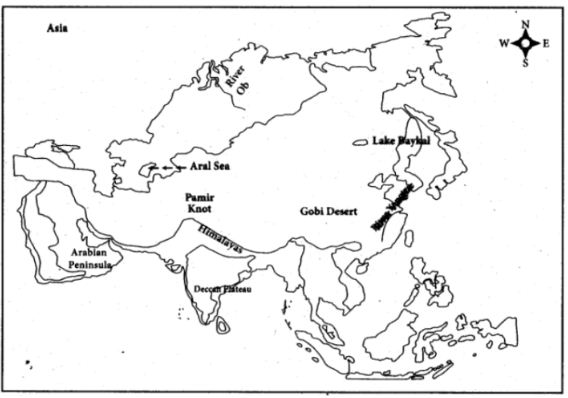
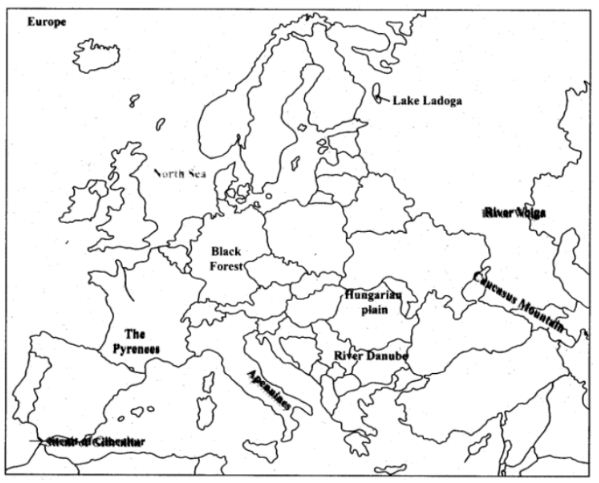
Mark the following in the outline map of Asia and Europe
Asia: Ural mountain, Himalayas, Pamir knot, Gobi Desert, Arabian Peninsula, Deccan plateau, River Yangtze, River Ob, Aral Sea and Lake Baykal.
Europe: The Pyrenees, Black forest, Apennines, Hungarian Plain, Caucasus Mountain, River Volga, River Danube, Strait of Gibraltar, Lake Ladoga, North Sea
34.
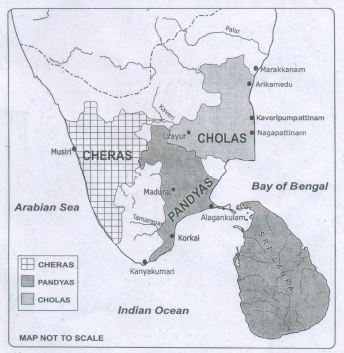
Mark and colour the extent of Chera, Chola and Pandya empires on the river map of South India.
35.
Name the important festivals celebrated in Europe
36.
Name the four hemispheres of the Earth.
37.
What is a geoid?
38.
Differentiate: Landslide – Avalanche
39.
Write a short note on ‘Thunder and lightning’.
40.
List out a few means of revenue of village Panchayats.
41.
What is the need for local bodies?
42.
What are the salient features of our constitution that you have understood?
43.
Mesopotomian Plain
44.
90° line of latitude
45.
180° line of longitude
46.
Western Chalukyas
47.
Pallavas
48.
Intermontane plateaus and southern plateaus.
1.
(c)
181
2.
(b)
Tropic of Cancer
3.
(b)
Nandivarma II
4.
(a)
walls of caves
5.
(a)
Mayor
6.
(b)
Sushruta
7.
(a)
Kanishka
8.
(b)
Ur ˂ Kurram ˂ Nadu ˂Mandalam
9.
(c)
Kalabhras
10.
()
Armenian
11.
()
Equator
12.
()
Kudumianmalai and Thirumayam temple
13.
()
Sanskrit
14.
()
Tholkappiyam
15.
(a)
16.
(b)
17.
(b)
18.
(b)
19.
(a)
20.
Important lines of latitude:
1. North pole 90o N.
2. Tropic of Capricorn 231/2o S.
3. Arctic Circle 661/2o N.
4. Antartic Circle 661/2o S.
5. Tropic of Cancer 231/2o N.
6. South Pole 90o S.
7. Equator 0o.
Zones of the Earth:
Torrid zone:
(i) It lies 0o to 231/2o North and South latitude.
(ii) The Sun's rays fall vertically over this region and the average temperature is very high.
Temperate zone:
(i) It lies 231/2o N to 661/2o North and South latitude.
(ii) The Sun's rays fall slantingly. Moderate temperature prevails in this region.
Frigid zone:
(i) It lies 661/2o N to 90o North and South latitude.
(ii) The Sun's rays fall further inclined, throughout the year. The temperature is very low.
21.
(i) The Western Chalukya empire ruled most of the western deccan, South India, between the 10th and 12th Centuries.
(ii) They were the descendants of Badami chalukyas ruled from kalyani (modern day Basavakalyan)
(iii) In 1973, Tariapa - II, a feudatory of the Rashtrakuta ruling from Bijapur region defeated Parmara of Malwa.
(iv) Tailapa - II occupied Kalyani his fimasty quickly grew into an empire under Someswara - I.
(v) Someswara - I moved the capital from Manyakheta to Kalyani.
(vi) For over a century, the western chalukyas and the chola dynasty of Thanjavur, fought many fierce battles to control the fertile region of vengi.
(vii) During the rule of Vikramaditya VI in the late 1le century vast areas between the Narmada River in the north and Kaveri River in the south came under Chalukyas control.
(viii) The Kasi Visweshvara Temple at Lakkundi, the Mallikarjuna temple at Kuruvatti, the Kalleshwara temple at Bagali and the Mahadeva Temple at Itagi represeni well known examples of the architecture of western Chaitrkyas of Kalyani.
22.
(i) Safety ever; Accident never.
(ii) Start early, Drive slowly, Reach safely.
(iii) Be a safety hero; score an accident zero.
(iv) East or west safety is first.
23.
(i) Invention of zero and the consequent evolution of the decimal system were the legacy of Guptas to the modem world.
(ii) Aryabhatta, Varahamihira and Brahmagupta were. foremost astronomers and mathematicians of the time.
(iii) Aryabhatta, in his book Surya Siddhanta, explained the true causes of solar and lunar eclipses.
(iv) He was the first Indian astronomer to declare that the earth revolves around its own axis.
(v) Dhanvantriwas a famous scholar in the field of medicine. He was a specialist in Ayurveda. Charaka was a medical scientist. Susruta was the first Indian to explain the process of surgery.
24.
(i) Prashasti is a Sanskrit word, meaning commendation or 'in praise of'.
(ii) Court poets flattered their kings listing out their achievements.
(iii) These accounts were later engraved on pillars so that the people could read them.
25.
| Name of the District | Village Panchayat | Panchyat Union | District Panchayat | Town Panchayat | Municipality | Corporation |
| Kanchipuram | 648 | 13 | 0 | 24 | 10 | 0 |
26.
27.
Local bodies play an important role in the development of villages and cities, because there are many services provided by local bodies to the people like drinking water supply, street lighting, Drainage and sewage pipe system, Laying down roads and maintenance, laying public parks, libraries, play grounds, etc. The main work of local bodies is activation of central and state government schemes to the common people.
28.
The religious policy of Kanishka:
(i) Kanishka was an ardent Buddhist.
(ii) Kanishka's empire was a Buddhist empire
(iii) Kanishka adopted Buddhism under the influence of Asvaghosha, a celebrated monk from Pataliputra
(iv) Though a great warrior and an empire builder, Kanishka was as equal as the exponent and champion of Mahayanism
(v) Kanishka made Buddhism as the state religion and built many stupas and monasterie in Mathura, Taxila and many other Parts of his kingdom
(vi) He sent Buddhist missionaries to Tibet, China and many countries of central Asia for the propagation of buddha's gospel
(vii) He organised the fourth Buddhist Council at Kundalavana near Srinagar.
29.
Rulers of Indo - parthians (Pahlavas):
1. Indo-Parthian kingdom or Gondopharid dynasty was founded by Gondophemes.
2. The domain of Indo-Parthians comprised Kabul and Gandhara. The name of Gondophemes is associated with the Christian apostle St.Thomas.
3. According to Christian tradition, St.Thomas visited the court of Gondophemes and converted him to Christianity.
30.
31.
| S.No | DIRECT DEMOCRACY | REPRESENTATIVE DEMOCRACY |
| 1. | In a direct democracy, only the citizens can make laws. | Elected members only can make laws. |
| 2. | All changes have to be approved by the citizen. |
Council of legislative changes the laws. |
| 3. | The politicians only rule over parliamentary procedure. |
Members of parliament rule the country. |
32.
(i) Following the sangam Period, the kalabhra had occupied the Tamil country for about two and half centuries.
(ii) We have very little information about kalabhras. They left neither artefacts nor monuments. But there is evidence of their rule in literary texts.
(iii) The literary sources for this period includes Tamil Navalar charithai, yapernkalam and Peria Puranam.
(iv) Seevaka chinthamani and kundalakesi were also written during this period.
(v) In Tamilzhagam, Jainism and Buddhism became prominent during this period.
(vi) Introduction of sanskrit and Prakrit languages had resulted in the development of a new script called vattezhuththu.
(vii) Many works under Pathinenkeezhkanakku were composed.
(viii) Trade and commerce continued to flourish during this period. So the Kalabhra period is not a dark age as it is portrayed.
33.
34.
35.
Christmas, Easter, Good Friday, the Saint Day, Redentore, Tomatina and Carnival are the important festivals of Europe.
36.
(i) Northern hemisphere
(ii) Southern hemisphere
(iii) Eastern hemisphere
(iv) Western hemisphere
37.
(i) The Earth which is spherical, is flat at the poles and bulges at the Equator.
(ii) The Earth cannot be compared with any other geometrical shape as it has a very unique shape.
(iii) Hence, its shape is called a geoid.
38.
| Landslide | Avalanches |
| The movement of a mass of rocks, debris, soil etc., down slope is celled landslide. | A large amount of ice, snow and rock falling quickly down the side of a mountain is called an Avalanches. |
39.
(i) Thunder is a series of sudden electrical discharge resulting from atmospheric conditions.
(ii) This discharge results in sudden flashes of light and trembling sound waves which are commonly known as thunder and lightning.
40.
(i) House tax
(ii) Professional tax
(iii) Tax on shops
(iv) Water charges
(v) Specific fees for property tax
(vi) Specific fees for transfer of immovable property
(vii) Funds from Central and State Governments, etc.
41.
(i) The services provided can be divided as obligatory functions and discretionary functions.
(ii) These are provided by the local bodies.
42.
(i) The structure of the government institutions and methods the rules and regulations to be followed and the powers and responsibilities.
(ii) It fixes the Rights and Duties and the Directive Principles of the citizens.
43.
Euphrates & Tigris
44.
Pole
45.
International Date Line
46.
Kalyani
47.
Kanchi
48.
| S.No | Intermontane plateaus | Southern plateaus |
| 1. | Intermontane plateaus are wide tablelands that are formed or situated between mountain ranges, when a plateau is surrounded by mountains on all sides, it is refers to an Intermontane plateaus | The southern plateaus are relatively lower than the northern plateaus. |
| 2. | Eg: Tibetan Plateau, Bolivian plateaus. | The four important southern plateaus are the Arabian Plateau, Deccan Plateau, Shan Plateau and the Yunnan Plateau. |

6th Standard Syllabus & Materials
6th Standard
TN 6th Social Science T3 - GEO - Understanding Disaster Sample Question Papers Study Material - QB365 Set A
NEW6th Standard
TN 6th Social Science T3 - GEO - Globe Sample Question Papers Study Material - QB365 Set A
NEW6th Standard
TN 6th Social Science T3 - GEO - Asia and Europe Sample Question Papers Study Material - QB365 Set A
NEW6th Standard
TN 6th Social Science T3 - HIS - South Indian Kingdoms Sample Question Papers Study Material - QB365 Set A



Tamilnadu Stateboard 6th Standard Subjects
Tamilnadu Stateboard Standards



