
 100% FREE ACCESS
6th Standard Syllabus & Materials
6th Standard
TN 6th Tamil பருவம் 1 - இயல் 1 - மொழி -தமிழ்த்தேன் - இன்பத்தமிழ் Sample Question Papers Study Material - QB365 Set A
NEW6th Standard
TN 6th English T1 - Supplementary - The Apple Tree and The Farmer Sample Question Papers Study Material - QB365 Set A
NEW6th Standard
TN 6th English T1 - Prose - When The Trees Walked Sample Question Papers Study Material - QB365 Set A
NEW6th Standard
TN 6th Social Science T3 - CIV - Road Safety Sample Question Papers Study Material - QB365 Set A
NEW6th Standard
TN 6th Social Science T3 - CIV - Local Bodies - Rural and Urban Sample Question Papers Study Material - QB365 Set A
NEW6th Standard
TN 6th Social Science T3 - CIV - Democracy Sample Question Papers Study Material - QB365 Set A

Published on: 08/08/2019
Download Tamil Nadu 6th Standard Social Science question papers, model tests, one-mark questions, important questions, and public exam papers in PDF format. Free study materials and answer keys for TN State Board students.
Questions + Answers key
Take MCQ Social Science Test
1.
B.R. Ambedkar was conferred Bharat Ratna in the year
1990
1989
1988
1987
2.
Which one of the following is not the reason for Prejudice?
Socialization
Economic Benefits
Authoritarian personality
Geography
3.
India consists of____________States and ___________Union territories.
27, 9
29, 7
28, 7
28, 9
4.
Water management system of Tamils are known from
Kallanai
Tanks in Kancheepuram
Prakirama Pandyan Tank
River Cauvery
5.
What was the step taken by the early man to collect his food?
Trade
Hunting
Painting
Rearing of animals
6.
Deltas are _______ order landforms.
7.
A.P.J. Abdul Kalam was born in _________.
8.
Tamil was declared as classical language in the year _______
9.
_______________ is the centre of the solar system.
10.
The Old Stone Age man lived mostly in _____________ .
11.
Bodhi Dharmar belonged to Kancheepuram.
12.
The earliest form of writings was developed by Chinese.
13.
Homo erectus (Java man) had the knowledge of fire.
14.
The materials used by the ancient people are preserved in the museums by the Archaeological Department.
15.
What are the types of diversity?
16.
Mention the ancient cities of Tamil Nadu.
17.
Why did humans move from place to place?
18.
Name some tools used by early man to hunt animals.
19.
Mark the following places in the political map of India.
a. Delhi
b. Chennai
c. Tamil Nadu
d. Andhra Pradesh
e. Kerala
f. Karnataka
20.
City of temples. Give short notes.
21.
“India is a land of diversity, yet we are all united”. Discuss.
22.
Distinguish between inner and outer planets.
23.
The Andes, the Rockies, the Everest, the Himalayas
24.
Pluto, Eris, Ceres, Io
25.
Oxen, sheep, buffaloes, pigs, horses
26.
a. Paintings were drawn on rocks and caves.
b. There were paintings depicting hunting scenes.
c. It was drawn to show his family members about hunting.
d. The paintings were painted by using many colours.
27.
Article 17
28.
Coastal areas
29.
Bronze
30.
Red Planet
31.
Written records
1.
(a)
1990
2.
(d)
Geography
3.
(b)
29, 7
4.
(d)
River Cauvery
5.
(b)
Hunting
6.
()
Second
7.
()
1931
8.
()
2004
9.
()
Sun
10.
()
Caves
11.
(a)
12.
(b)
13.
(a)
14.
(a)
15.
The types of diversity are
(i) Land forms and Lifestyle diversity
(ii) Social diversity
(iii) Religions diversity
(iv) Linguistic diversity
(v) Cultural diversity
16.
(i) Madurai
(ii) Kancheepuram
(iii) Poompuhar
17.
Humans moved to another place in search of food.
18.
(i) Bones and horns of the Animals
(ii) Sharphened and crude stone weapens
(iii) Sharphened branches of trees.
19.
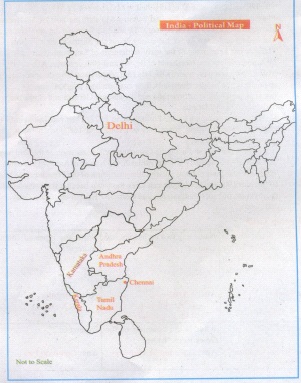
20.
(i) Kanchi is also known as the temple city.
(ii) The famous temple of great architectural beauty, Kailasanathar temple, was built by later pallava king Rajasimha II at Kanchi.
(iii) During the Pallava period, a large number of cave temples were built.
(iv) Some temples are situated at Kancheepuram like Ekambaranather Temple, Ulaganath Perumal Temple, Varatharaja Perumal Temple.
21.
(i) Diversities are seen in landscapes, climate, natural vegetation and soil.
(ii) Diversities are seen in languages, races, religion, customs and caste.
(iii) And also diversities are seen in habits and heritage, food and dress, art and architecture.
(iv) Irrespective of differences in all the above, we all take pride in calling ourselves as Indians.
(v) The feeling of oneness and unity among the people of various religious, castes of a country is called unity in diversity.
22.
| S.No | Inner planets | Outer planets |
| 1 | The four planets nearer to the sun are called Inner or Terrestrial planets. |
The last four plangts are called as Outer planets of Jovian planets. |
| 2 | Mercury, venus, earth and mars. | Jupiter, Saturn, Uranus and Neptune. |
| 3 | The inner planets are comparatively smaller in size and are compased of rocks |
They are also called Gaseous Giants. |
| 4 | The surface of inner planets has mountains, volcanoes and craters |
An asteriod belt is found between mars and jupiter. |
23.
the Everest
24.
Io
25.
horses
26.
d. The paintings were painted by using many colours.
27.
abolition of untouchability
28.
Fishery
29.
alloy
30.
Mars
31.
copper plates

6th Standard Syllabus & Materials
6th Standard
TN 6th Social Science T3 - GEO - Understanding Disaster Sample Question Papers Study Material - QB365 Set A
NEW6th Standard
TN 6th Social Science T3 - GEO - Globe Sample Question Papers Study Material - QB365 Set A
NEW6th Standard
TN 6th Social Science T3 - GEO - Asia and Europe Sample Question Papers Study Material - QB365 Set A
NEW6th Standard
TN 6th Social Science T3 - HIS - South Indian Kingdoms Sample Question Papers Study Material - QB365 Set A



Tamilnadu Stateboard 6th Standard Subjects
Tamilnadu Stateboard Standards



