
 100% FREE ACCESS
6th Standard Syllabus & Materials
6th Standard
TN 6th Tamil பருவம் 1 - இயல் 1 - மொழி -தமிழ்த்தேன் - இன்பத்தமிழ் Sample Question Papers Study Material - QB365 Set A
NEW6th Standard
TN 6th English T1 - Supplementary - The Apple Tree and The Farmer Sample Question Papers Study Material - QB365 Set A
NEW6th Standard
TN 6th English T1 - Prose - When The Trees Walked Sample Question Papers Study Material - QB365 Set A
NEW6th Standard
TN 6th Social Science T3 - CIV - Road Safety Sample Question Papers Study Material - QB365 Set A
NEW6th Standard
TN 6th Social Science T3 - CIV - Local Bodies - Rural and Urban Sample Question Papers Study Material - QB365 Set A
NEW6th Standard
TN 6th Social Science T3 - CIV - Democracy Sample Question Papers Study Material - QB365 Set A

Published on: 15/09/2018
Model Question 1
Download Tamil Nadu 6th Standard Science question papers, model tests, one-mark questions, important questions, and public exam papers in PDF format. Free study materials and answer keys for TN State Board students.
Questions + Answers key
Take MCQ Science Test1.
____________can live for many days without drinking water.
Dog
Elephant
Cow
Camel
2.
Lizards are walk with four legs and is known as
Bipedal
Tripedal
Monopedal
quadripedal
3.
One dot that you make with Your pen has more than ___________ Lakh Molecule
One
Two
Four
Three
4.
The study of living beings or organisms is called
Psychology
Biology
Zoology
Botany
5.
6.
Length of one’s chest can be measured by using meter scale.
7.
We can say that mass of an object is 126 kg.
8.
What is the full form of SI system?
9.
Tabulate the vitamins and their corresponding deficiency diseases.
10.
Describe the various features which help Camel dwell well in the desert.
11.
How will you measure the volume of irregular objects?
12.
Explain two methods that you can use to measure the length of a curved line.
13.
Turtle: Hibernation
________ ? : Aestivation
14.
Vitamin K : Clotting of blood :: Vitamin E____________
15.
Fish oil: Vitamin D :: Vegetable oil__________
16.
Water: Liquid: : Apple:_______
17.
Sweet peas : Tendril climber
Clitoria : _____________.
18.
Rainfall 25 - 200 cm : Forest habitat
Rainfall below 25 cm : __________.
19.
Vitamin D : Rickets :: Vitamin C :_____.
20.
Height of a person : cm :: Length of your sharpened pencil lead :___?
21.
In washing machines this principle is used to squeeze out dirt from cloth and the method is called_______________
22.
Data is ____________ information.
23.
Primary organs of photosynthesis are _____________.
24.
Water obtained from tube wells is usually ___________ water.
25.
Chillies are removed from ‘upma’ by ___________ method.
26.
A rubber ball changes its shape on pressing. Can it be called a solid?
27.
Distinguish between terrestrial and aquatic habitats.
28.
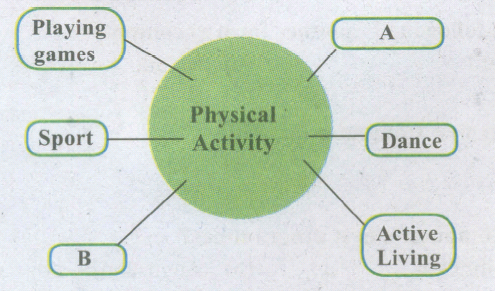
29.
Complete the Diagram
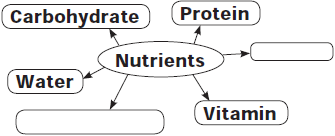
30.
What formula is used to measure area of your class room?
31.
The force which acts on an object without physical contact._______
1.
(d)
Camel
2.
(d)
quadripedal
3.
(b)
Two
4.
(b)
Biology
5.
(b)
6.
False
Correct Statement : Length of one's chest can be measured by using a measuring tape.
7.
True
8.
International System of Units.
9.
| S.no | Property | deficiency disease |
| 1 | vitamin A | Night blindness |
| 2 | vitamin B | Beri beri |
| 3 | vitamin C | Scurvy |
| 4 | vitamin D | Rickets |
| 5 | vitamin E | Nervous weakness, dimming of eyesight |
| 6 | vitamin K | Weakness of the bones, teeth etc. |
10.
(1) The camel has long legs which help it to keep its body away from the hot sand in the desert.
(2) It can store large amount of water in its body.
(3) it loses very little water from its body through excretion.
(4) A camel's hump has fat stored in it. It ups the stored fat when required.
(5) It has large and flat padded feet to walk easily on soft sand.
(6) It has long eye lashes and hairs to protect its eyes and ears from the blowing dust.
(7) It can keep its nostrils closed to avoid dust.
11.
Measuring the volume of irregular solid by displacement method.
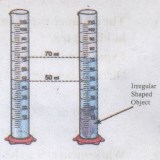
(i) Take a graduated measuring cylinder and a stone.
(ii) Fill with water to certain level and mark it.
(iii) Tie the stone with a piece of fine thread.
(iv) Immerse the stone completely in to the water.
(v) We can observe the water level and mark it.
(vi) The water level is increased.
(vii) Find the increased level of water.
(vii) It would be equal to the space taken by stone.
(viii) This will be the volume of irregular stone.
12.
Method 1:
(i) Place a string along the curved line, Make sure that the stringcovers every bit of the curved line.
(ii) Mark the points where the curved line begins and ends on the string.
(iii) Now, stretch the string along the length of a meter scale and measure the distance between the two markings of the string.
(iv) This will give us the length of a curved line.
Method 2:
(i) Draw a curved line AB on a piece of paper.
(ii) Separate the legs of the divider by 0.5 cm or 1 cm using a ruler.
(iii) Place it on the curved line starting from one end. Mark the position of the other end. Move it along the line again and again cutting the line into number of segments of equal lengths. The remaining parts of the line can be measured using a scale.
(iv) Count the number of segments.
(v) Therefore, the length of the line = (number of segments x length of each segment) + length of the left over part.
13.
snail
14.
Fertility
15.
Vitamin E
16.
Solid
17.
Twiners
18.
Desert habittat
19.
Scurvy.
20.
mm (milli metre)
21.
()
centrifugation
22.
()
Collection of
23.
()
leaves
24.
()
safety pins
25.
()
hand picking
26.
(i) Yes, a rubber ball can be called a solid because it doesn't flow away like liquids or gases.
(ii) But the rigidity of the rubber ball is less than the external force. So it changes its shape.
27.
| Terrestrial plant | Aquatic plant |
| (i) Terrestrial habitats are the ones that are found on land like forest, grassland and desert. | (i) Aquatic habitat includes area that are permanently covered by water and surrounding areas that are occationally covered by water. |
| (ii) They are classified into three types. 1. Desert habitat 2. Grassland habitat 3. Forest habitat |
(ii) They are two types 1. Fresh water habitat 2. Marine water habitat |
28.
A - Exercise;
B - Yoga;
29.
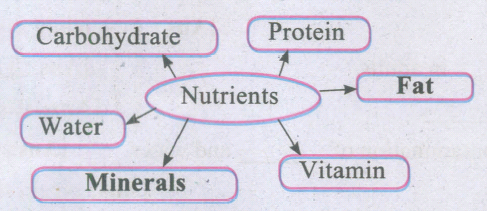
30.
My class room area = Length x Breadth
31.
Non contact force

6th Standard Syllabus & Materials
6th Standard
TN 6th Social Science T3 - GEO - Understanding Disaster Sample Question Papers Study Material - QB365 Set A
NEW6th Standard
TN 6th Social Science T3 - GEO - Globe Sample Question Papers Study Material - QB365 Set A
NEW6th Standard
TN 6th Social Science T3 - GEO - Asia and Europe Sample Question Papers Study Material - QB365 Set A
NEW6th Standard
TN 6th Social Science T3 - HIS - South Indian Kingdoms Sample Question Papers Study Material - QB365 Set A



Tamilnadu Stateboard 6th Standard Subjects
Tamilnadu Stateboard Standards




