
 100% FREE ACCESS
6th Standard Syllabus & Materials
6th Standard
TN 6th Tamil பருவம் 1 - இயல் 1 - மொழி -தமிழ்த்தேன் - இன்பத்தமிழ் Sample Question Papers Study Material - QB365 Set A
NEW6th Standard
TN 6th English T1 - Supplementary - The Apple Tree and The Farmer Sample Question Papers Study Material - QB365 Set A
NEW6th Standard
TN 6th English T1 - Prose - When The Trees Walked Sample Question Papers Study Material - QB365 Set A
NEW6th Standard
TN 6th Social Science T3 - CIV - Road Safety Sample Question Papers Study Material - QB365 Set A
NEW6th Standard
TN 6th Social Science T3 - CIV - Local Bodies - Rural and Urban Sample Question Papers Study Material - QB365 Set A
NEW6th Standard
TN 6th Social Science T3 - CIV - Democracy Sample Question Papers Study Material - QB365 Set A

Published on: 15/09/2018
Model Question 2
Download Tamil Nadu 6th Standard Science question papers, model tests, one-mark questions, important questions, and public exam papers in PDF format. Free study materials and answer keys for TN State Board students.
Questions + Answers key
Take MCQ Science Test1.
__________is an ancient Indian astronomer
C.V. Raman
Aryabatta
Usain Bolt
Edison
2.
__________is a smallest particle
Molecule
Element
Atom
Substance
3.
Length of Nile river is_____________
6560 km
6650 km
6506 km
5606 km
4.
Which of the following is another form of computer?
Blackboard
Mobile
Radio
Book
5.
Who is the father of computer?
Martin Luther King
Graham Bell
Charlie Chaplin
Charles Babbage
6.
Filtration method is effective in separating ___________ mixture
solid-solid
solid-liquid
liquid-liquid
liquid-gas
7.
_________is essential to perform winnowing activity.
Rain
Soil
Water
Air
8.
Gita rides with her father’s bike to her uncle’s house which is 40 km away from her home. She takes 40 minutes to reach there.
Statement 1: She travels at a speed of 1 km/minute.
Statement 2: She travels at a speed of 1 km/hour.
Statement 1 alone is correct.
Statement 2 alone is correct.
Both statements are correct.
Neither statement 1 nor statement 2 is correct.
9.
The correct relation among the following is
Speed = distance × time
Speed = distance / time
Speed = time / distance
Speed = 1 / (distance × time)
10.
Which among the following is an oscillatory motion?
Rotation of the earth about its axis
Revolution of the moon about the earth
To and fro movement of a vibrating string
All of these.
11.
12.
Explain in detail above the applications of computer.
13.
Tabulate the vitamins and their corresponding deficiency diseases.
14.
Describe the various features which help Camel dwell well in the desert.
15.
Complete the map by filling the blanks
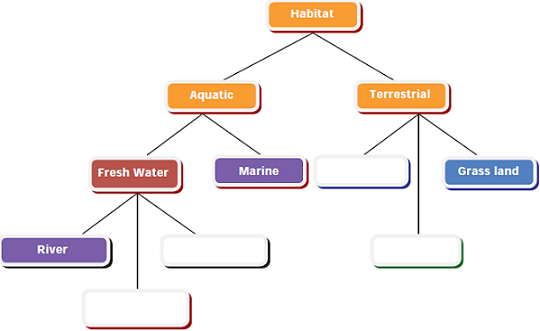
16.
Fill with examples:
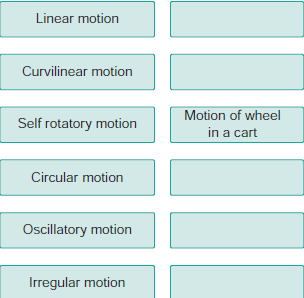
17.
Fill up the following chart.
| Property | Definition | Basic unit | Instrument used for measuring |
| Length | |||
| Mass | |||
| Volume | |||
| Time |
18.
Mention any two output devices
19.
Give any two examples of operating software
20.
Mention the two types of softwares.
21.
What is a Computer?
22.
Mention any two viral diseases.
23.
Why should fruits and vegetables not be washed after cutting?
24.
Rotation of the earth is a periodic motion. Justify.
25.
If you are sitting in a moving car, will you be at rest or motion with respect your friend sitting next to you?
26.
Name different types of motion based on the path.
27.
Define force.
28.
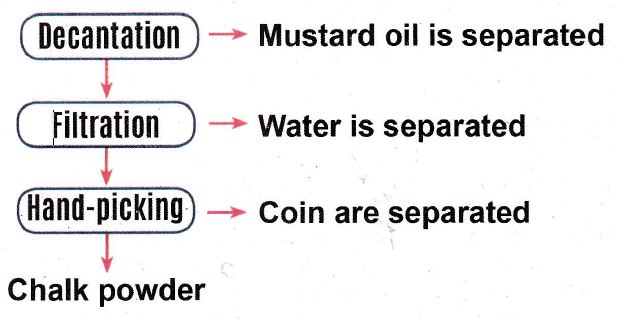
Using suitable apparatus from your laboratory separate the mixture of chalk powder, mustard oil, water and coins. Draw a flow chart to show the separation process
29.
Distinguish the properties of solid, liquid and gas. Draw a suitable diagram.
30.
Mr. Raghu returns home on a hot summer day and wants to have buttermilk. Mrs. Raghu has only curd. What can she do to get buttermilk? Explain
31.
32.
Find the answer for the following questions within the grid.
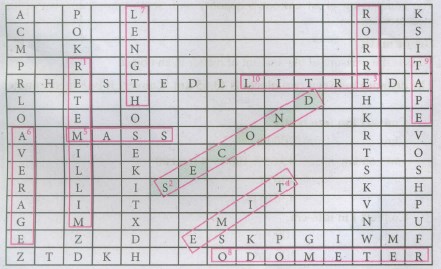
1. 10-3 is one_____
2. SI Unit of time is_____
3. Cross view of reading a measurement leads to______
4. ____is the one what a clock reads.
5. _____is the amount of substance present in an object.
6. ______can be taken to get the final reading of the recordings of different students for a single measurement.
7. ______is a fundamental quantity.
8. _____shows the distance covered by an automobile
9. A tailor uses to take______ measurements to stitch the cloth.
10. Liquids are measured with this physical quantity.
1.
(b)
Aryabatta
2.
(c)
Atom
3.
(b)
6650 km
4.
(b)
Mobile
5.
(d)
Charles Babbage
6.
(b)
solid-liquid
7.
(d)
Air
8.
(a)
Statement 1 alone is correct.
9.
(b)
Speed = distance / time
10.
(c)
To and fro movement of a vibrating string
11.
(b)
12.
(i) Computers are used in various fields.
(ii) In textile shop it is used for billing.
(iii) Computers are used to control large and small machines.
(iv) Computers are most important educational tools for teachers and learners.
(v) In Railways it is useful to book tickets and for other purposes.
(vi) It is also used in banks, ATM's, Post offices and in many places.
(vii) We can save many data and convert it into information.
13.
| S.no | Property | deficiency disease |
| 1 | vitamin A | Night blindness |
| 2 | vitamin B | Beri beri |
| 3 | vitamin C | Scurvy |
| 4 | vitamin D | Rickets |
| 5 | vitamin E | Nervous weakness, dimming of eyesight |
| 6 | vitamin K | Weakness of the bones, teeth etc. |
14.
(1) The camel has long legs which help it to keep its body away from the hot sand in the desert.
(2) It can store large amount of water in its body.
(3) it loses very little water from its body through excretion.
(4) A camel's hump has fat stored in it. It ups the stored fat when required.
(5) It has large and flat padded feet to walk easily on soft sand.
(6) It has long eye lashes and hairs to protect its eyes and ears from the blowing dust.
(7) It can keep its nostrils closed to avoid dust.
15.
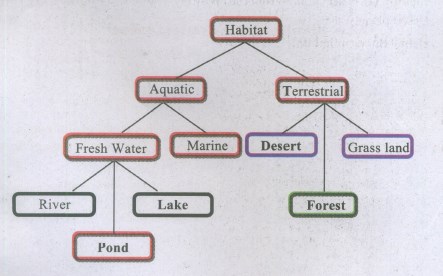
16.
Linear motion - A coconut falling from a tree
Curvilinear motion - A car driving around a curve
Self rotatory motion - Motion of the wheel in a cart
Circular motion - Athlete running around a track
Oscillatory motion - Swinging of a pendulum
Irregular motion - Movement of people in a bazaar
17.
| Property | Definition | Basic unit | Instrument used for measuring |
| Length | The distance between one end and the other desired end. | Metre | Ruler, Measuring tape. |
| Mass | The amount of matter in an object | Kilogram | Beam balance,Electronic balance |
| Volume | The amount of space a substance occupies | cubic metre (or) litre |
measuring jar, Pipetter buret etc |
| Time | Interval between two events | Second | Stop clock Electronic clock; etc |
18.
Printers and Monitors are output devices.
19.
Windows and Linux are operating software
20.
(i) Operating software
(ii) Application software
21.
A computer is an electronic device that process the data and information according to our needs.
22.
i) Common cold
ii) Influenza
23.
We should not wash the fruits and vegetables after cutting because they lose some of their nutrients and thus their nutritional value gets reduced.
24.
Rotation of the Earth about its axis repeats its motion after a fixed interval of time of 24 hours. So the rotation of the earth is a periodic motion
25.
I will be at rest with respect to my friend sitting next to me.
26.
The different tyes of motion based on the path are:
1) Linear motion
2) Curvilinear motion
3) Circular motion
4) Rotatory motion
5) Oscillatory motion
6) Zigzag or Irregular motion
27.
Force is push or pull by an animate or inanimate agency.
28.
(i) Using beakers, the mustard oil is separated by the process of decantation, because oil being lighter than water, floats on water.
(ii) Next filtration is using a funnel and filter paper and thus water gets separated from chalk powder and coins.
(iii) By hand-picking method, the coins are separated frorn chalk powder.
29.
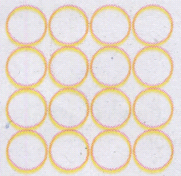
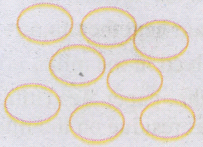
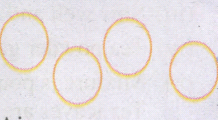
| PARTTCLES IN A SOLID |
PARTICLES IN A LIQUID | PARTICLES IN GASEOUS |
 |
 |
 |
| S.No. | SOLID STATE | LIQUID STATE | GASEOUS STATE |
| 1. | Definite shape and volume | No definite shape, liquids attain the shape of the vessel in which they are kept. | Gases have neither a definite shape nor a definite volume. |
| 2. | Incompressible | Compressible to a small extent. | Highly compressible |
| 3. | There is little space between the particles of solid. | These particles have a greater space between them. | The space between gas particles is the greatest. |
| 4. | These particles attract each other very strongly. | The force of attraction between liquid particles is lesser than solid particles. | Thd force of attraction is least between gaseous particles. |
| 5. | Particles of solid cannot move freely. | These particles move freely. | Gaseous particles are in a continuous, random motion. |
30.
(i) By churning the curd, the solid butter will be collicted on the sides of the vessel.
(ii) The insoluble butter will be separated from the buttermilk and thus the buttermilk will be obtained.
31.
32.
1. Millimetre
2. Second
3. Error
4. Time
5. Mass
6. Average
7. Length
8. Odometer
9. Tape
10. Litre

6th Standard Syllabus & Materials
6th Standard
TN 6th Social Science T3 - GEO - Understanding Disaster Sample Question Papers Study Material - QB365 Set A
NEW6th Standard
TN 6th Social Science T3 - GEO - Globe Sample Question Papers Study Material - QB365 Set A
NEW6th Standard
TN 6th Social Science T3 - GEO - Asia and Europe Sample Question Papers Study Material - QB365 Set A
NEW6th Standard
TN 6th Social Science T3 - HIS - South Indian Kingdoms Sample Question Papers Study Material - QB365 Set A



Tamilnadu Stateboard 6th Standard Subjects
Tamilnadu Stateboard Standards




