
 100% FREE ACCESS
7th Standard Syllabus & Materials
7th Standard
TN 7th Tamil பருவம் -1 இயல் 1 - அமுதத்தமிழ் - ஒன்றல்ல இரண்டல்ல Important Questions And Answers Study Material - QB365 Set A
NEW7th Standard
TN 7th Tamil பருவம் -1 இயல் 1 - அமுதத்தமிழ் - எங்கள் தமிழ் Important Questions And Answers Study Material - QB365 Set A
NEW7th Standard
TN 7th English T1 - Poem - Your Space Important Questions And Answers Study Material - QB365 Set A
NEW7th Standard
TN 7th English T1 - Prose - A Prayer to the Teacher Important Questions And Answers Study Material - QB365 Set A
NEW7th Standard
TN 7th English T1 - Poem - The Listeners Important Questions And Answers Study Material - QB365 Set A
NEW7th Standard
TN 7th English T1 - Prose - The Wind on Haunted Hill Important Questions And Answers Study Material - QB365 Set A

Published on: 13/05/2022
QB365 provides detailed and simple solution for every book back questions in class 7 Maths subject.It will helps to get more idea about question pattern in every book back questions with solution.
latest Book back QuestionsDownload Tamil Nadu 7th Standard Maths question papers, model tests, one-mark questions, important questions, and public exam papers in PDF format. Free study materials and answer keys for TN State Board students.
Questions + Answers key
Take MCQ Maths Test1.
Each day, the workers drill down 22 feet further until they hit a pool of water. If the water is at 110 feet, on which day will they hit the pool of water?
2.
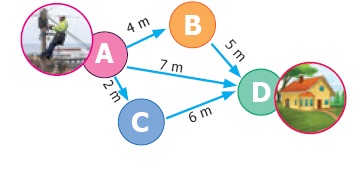
A telephone exchange worker wants to give the telephone connection to Amutha's house. Shows all the possibilities of cable connections. Find the route which requires minimum cable?
3.
In an examination, a student scores 4 marks for every correct answer and loses one mark for every wrong answer. If he answers 60 questions in all and gets 130 marks, find the number of questions he answered correctly.
4.
Find two consecutive natural numbers whose sum is 75.
5.
Are 3 x [(–4) + 6] and [3 x(–4)] + (3 x 6) equal? Mention the property.
6.
Prove that [(–2) x 3] x (–4) = (–2) x [3 x(–4)].
7.
Prove that (–7) x (+8) is an integer and mention the property.
8.
A fruit seller sold 5kg of mangoes at a profit of Rs. 15 per kg and 3kg of apples at a loss of Rs. 30 per kg. Find whether it is a profit or loss.
9.
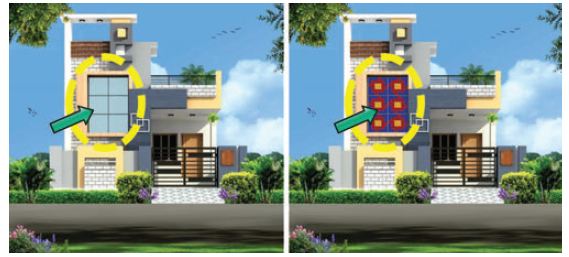
Raghavan wants to change the front elevation of his house using the tiles made up of tetromino shapes
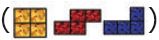
1. How many tetrominoes are there in a tile JPG.JPG) ?
?
2. If the cost of a square tile is Rs. 52 then what will be the cost of the tiles that Raghavan buys for the front elevation?
10.
The area of a trapezium is 352 sq. cm and the distance between its parallel sides is 16 cm. If one of the parallel sides is of length 25 cm then find the length of the other side.
11.
The parallel sides of a trapezium are 23 cm and 12 cm. The distance between the parallel sides is 9 cm. Find the area of the trapezium
12.
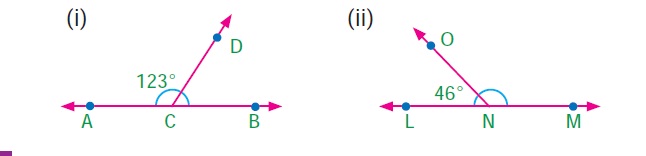
Find the missing angle.
13.
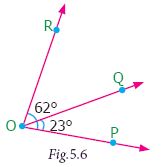
If \(\angle\)POQ = 23° and \(\angle\)POR = 62° then find \(\angle\)QOR
14.
A car travels 90 km in 2hours 30 minutes. How much time is required to cover 210 km?
15.
If 15 chart papers together weigh 50 grams, how many of the same type will be there in a pack of 2\(\frac {1}{2}\) kilogram?
16.
If x = 3, y = 2 find the value of
(i) 4x + 7y
(ii) 3x + 2y − 5
(iii) x − y
17.
Identify the variables, terms and number of terms in each of the following expressions:
(i)12 −x
(ii) 7 + 2y
(iii) 29 + 3x + 5y
(iv) 3x – 5 + 7z
18.
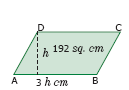
The base of the parallelogram is thrice its height. If the area is 192 sq. cm, find the base and height
19.
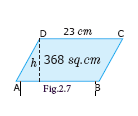
Find the height 'h' of the parallelogram whose area and base are 368 sq. cm and 23 cm respectively
20.
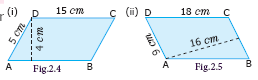
Find the area and perimeter of the parallelogram given in the figures
.
21.
Mention the property for the following equations:
(i) (-45) + (-12) = -57
(ii) (-15) +7 = (7) + (-15)
(iii) −10 + 3 = −7
(iv) (-7) + (-5) = (-5) + (-7)
(v) (-7) + [(-4) + (-3)] =[(-7) + (-4)] + (-3)
(vi) 0 + (-7245) = -7245
22.
Sita saved Rs. 225.00 and she has spent Rs. 400 on credit basis for the purchase of stationery. Find her due amount.
23.
Add:
(i) (–70) and (–12)
(ii) 103 and 39.
24.
Add the following integers using number line
(i) 10 and –15
(ii) –7 and –9
25.
(i) Are 120 + 51 and 51 + 120 equal?
(ii) Are(-5) + [(-4) + (-3)] and [(-5) + (-4)] + (-3) equal?
1.
Depth drilled in one day = –22 feet
Depth of water = –110 feet
Number of days required = –110 ÷ –22 = 5
Hence the workers wil reach resource in 5 days.

2.
Distance from A to D = 7 m
Distance from A to D (via B) = 4 + 5 = 9 m
Distance from A to D (via C) = 2 + 6 = 8 m
Therefore, the route directly from A to D requires minimum cable of length 7 m.
3.
Let the number of correct answers be x
Thus the number of wrong answers = 60 − x
Then, 4x − 1 (60 − x) = 130
4x − 60 + x = 130
4x + x − 60 + 60 = 130 + 60 [Add 60 on both sides]
5x + 0 = 190
5x = 190
Divide by 5 on both the sides,
\(\frac { 5x }{ 5 } =\frac { 190 }{ 5 } \)=38
x = 38
Hence, the number of correct answer is 38.
4.
The numbers are natural and consecutive. Let the numbers be x and x + 1.
Given that,
x + (x + 1) = 75
2x + 1 = 75
2x + 1 − 1 = 75 − 1 [Subtract 1 on both sides]
2x + 0 = 74
\(\frac {2x }{2 } =\frac { 74 }{ 2 } \) [Divide 2 at both sides]
x = 37 and x + 1 = 38
Therefore, the required numbers are 37 and 38.
5.
Consider, [3 x (–4) + 6],3 x [(–4) + 6] = 3 x 2 = 6
Consider, [3 x(–4)] + [3 x 6],[3 x(–4)] + [3 x 6] = –12 + 18 = 6
Therefore, [3 x [(–4) + 6] and [3 x (–4)] + 3 x 6 are equal.
It is the distributive property of multiplication over addition.
6.
In the first case (–2) and (3) are grouped together and in the second case (3) and (–4) are grouped together
L.H.S = [(–2) 3] x (–4)
= (–6) x (–4) = 24
R.H.S = (–2) x [3 x (–4)]
= (–2) x (–12) = 24
Therefore, L.H.S. = R.H.S.
[(–2) x 3] x (–4) = (–2) x [3 x (–4)]
Hence it is proved.
7.
(–7) x (+8) = (–56)
Hence, –56 is an integer.
Therefore, (–7) x (+8) is closed under multiplicaton.
8.
Profit of 1 kg mangoes = Rs. 15
Profit of 5 kg mangoes = Rs. 15 x 5
= Rs. 75
Loss of 1 kg apples = Rs. 30
Loss of 3 kg apples = 30 x 3
= Rs. 90
Loss = Rs. 90 − Rs. 75
= Rs. 15
9.
1.
.JPG)
Therefore, there are nine tetrominoes in a tile.
2. Given, the cost of a tile is Rs. 52
There are six tiles in the front elevation
Therefore, the total cost = 6 x 52 = Rs. 312
10.
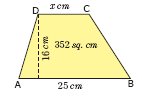
Let, the length of the required side be ‘x’ cm.
Then, area of the trapezium = \(\cfrac { 1 }{ 2 } \times h\left( a+b \right) sq.units\)
= \(\cfrac { 1 }{ 2 } \times 16(25+x)\)
= 200 + 8x
But, the area of the trapezium = 352 sq. cm (given)
Therefore, 200 + 8x = 352
\(\Rightarrow\) 8x = 352 – 200
\(\Rightarrow\) 8x = 152
\(\Rightarrow\) \(x=\cfrac { 152 }{ 8 } \)
x = 19
Therefore, the length of the other side is 19 cm.
11.
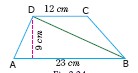
Given, height (h) = 9 cm
Parallel sides are (a) = 23 cm and (b) = 12 cm
Area of the trapezium = \(\cfrac { 1 }{ 2 } \times h(a+b)\)
= \(\cfrac { 1 }{ 2 } \times 9\left( 23+12 \right) \)
= \(\cfrac { 1 }{ 2 } \times 9(35)\)
= 157.5 sq. cm
Therefore, Area of the trapezium is 157.5 sq. cm.
12.
(i) Since the angles are linear pair, \(\angle\)ACD + \(\angle\)BCD = 180°
123° + \(\angle\)BCD = 180°
Subtracting 123° on both sides
123° + \(\angle\)BCD – 123° = 180° – 123°
\(\angle\)BCD = 57°
(ii) Since the angles are linear pair, \(\angle\)LNO + \(\angle\)MNO = 180°
46° + \(\angle\)MNO = 180°
Subtracting 46° on both sides
46° + \(\angle\)MNO – 46° = 180° – 46°
\(\angle\)MNO = 134°
13.
We know that \(\angle\)POR = \(\angle\)POQ + \(\angle\)QOR
62° = 23° + \(\angle\)QOR
Subtracting 23° on both sides
62° – 23° = 23° + \(\angle\)QOR – 23°
\(\angle\)QOR = 39°
14.
Time taken to cover 90 km = 2hrs 30mins
= 150 minutes [\(\begin{matrix} 1hour=60minutes \\ 2hour=120mnutes \end{matrix}\)]
Time taken to cover 1 km = \(\frac { 150 }{ 90 } \) x 210 minutes
= 350 minutes
= 5 hours 50 minutes
Thus, the time taken to travel 210 km is 5 hours 50 minutes.
15.
Let x be the required number of charts.
As weight increases, the number of charts also increases. So the quantities are in direct proportion.
Hence \(\frac { { x }_{ 1 } }{ { y }_{ 1 } } =\frac { { x }_{ 2 } }{ { y }_{ 2 } } \)
| Number of chart papers | 15 | x |
| Weight in grams | 50 | 2500 |
\(\frac { 15 }{ 50 } =\frac { x }{ 2500 } \)
15 x 2500 = x \(\times\) 50
x \(\times\) 50 = 15 x 2500
x = \(\frac { 15\times 2500 }{ 50 } \) = 750
Therefore, 750 charts will weigh 2\(\frac {1}{2}\) kilogram.
16.
i) 4x + 7y = 4 (3) + 7 (2) = 12 + 14 = 26
ii) 3x + 2y – 5 = 3 (3) + 2 (2) – 5 = 9 + 4 – 5 = 8
iii) x – y = 3 – 2 = 1
17.
| S.No | Expressions | Variables | Terms | No. of terms |
| (i) | 12-x | x | 12, -x | 2 |
| (ii) | 7+2y | y | 7, 2y | 2 |
| (iii) | 29 + 3 x+ 5y | x, y | 29, 3x, 5y | 3 |
| (iv) | 3x - 5 + 7z | x, z | 3x, -5, 7z | 3 |
18.
Let the height of the parallelogram = h cm
Then the base of the parallelogram = 3h cm
Area of the parallelogram = 192 sq. cm
b x h = 192
3h x h = 192
3h² = 192
h² = 64
h x h = 8 x 8
h = 8 cm
base = 3h = 3 x 8 = 24 cm
Therefore, base of the parallelogram is 24 cm and height is 8 cm.
19.
Given: Area = 368 sq. cm , base b = 23 cm
Area of the parallelogram = 368 sq. cm
b × h = 368
23 × h = 368
\(h=\cfrac { 368 }{ 23 } \)
Thus, the height of the parallelogram = 16 cm.
20.
(i) From the Fig.2.4
Base of a parallelogram (b) = 15 cm, Height of a parallelogram (h) = 4 cm
Area of a parallelogram = b x h sq.units. Therefore, Area = 15 × 4 = 60 sq. cm.
Thus, area of the parallelogram is 60 sq. cm.
Perimeter of the parallelogram = sum of the length of the four sides.
= (15 + 5 +15 + 5) = 40 cm.
(ii) From the Fig.2.5
Base of a parallelogram (b) = 9 m, Height of a parallelogram (h) = 16 cm.
Area of a parallelogram = b × h sq.units Therefore, Area = 9 × 16 = 144 sq. cm
Thus, area of the parallelogram is 144 sq. cm.
Perimeter of the parallelogram = sum of the length of the four sides.
= (18 + 9 +18 + 9) = 54 cm.
21.
(i) Closure Property
(ii) Commutative Property
(iii) Closure Property
(iv) Commutative Property
(v) Associative Property
(vi) Additive Identity
22.
The amount Sita has Rs. 225
The amount spent for stationery on credit = Rs. 400
The due amount to be paid = Rs. 225 – Rs. 400 = – Rs.175
Therefore, Sita has to pay Rs. 175
23.
(i) (–70) + (–12) = –70 – 12 = – 82
(ii) 103 + 39 = 142
24.
Let us add the intergers using number line
(i) 10 and –15
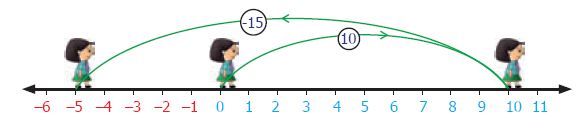
On the number line we first start at zero facing positive direction and move 10 steps forward, reaching 10. Then we move 15 steps backward to represent –15 and reach at –5. Thus, we get 10 + (–15) = –5.
(ii) –7 and –9
.JPG)
On the number line we first start at zero facing positive direction and move 7 steps backward, reaching –7. Then we move 9 steps backward to represent –9 and reach at –16. Thus, we get (–7) + (–9) = –16.
25.
(i) When we add, 120 + 51 = 171 ; 51 + 120 = 171
In both the cases we get same answer. This means that integers can be added in any order. Hence, addition of integers is commutative.
(ii) (-5) + [(-4) + (-3)] and [(-5) + (-4)] + (-3)
In (–5) + [(–4) + (–3)], (–4) and (–3) are added first and their result is then added with(–5).
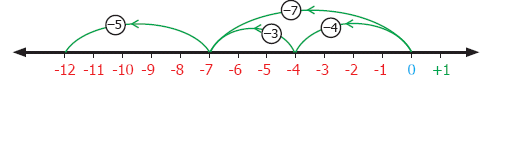
(–5) + [(–4) + (–3)] = –12
Whereas in [(-5) + (-4) + (-3), (–4) and (–3) are added first and then the result is added with (–5)

In both the cases, we get −12
That is (–5) + [(–4) + (–3)] = (–5) + [(–4) + (–3)]
So, addition is associative.

7th Standard Syllabus & Materials
7th Standard
TN 7th English T1 - Supplementary - On Monday Morning Important Questions And Answers Study Material - QB365 Set A
NEW7th Standard
TN 7th English T1 - Prose - Eidgah Important Questions And Answers Study Material - QB365 Set A
NEW7th Standard
TN 7th Social Science T1 - ECO - Production Important Questions And Answers Study Material - QB365 Set A
NEW7th Standard
TN 7th Social Science T1 - GEO - Interior of the Earth Important Questions And Answers Study Material - QB365 Set A



Tamilnadu Stateboard 7th Standard Subjects
Tamilnadu Stateboard Standards




