
 100% FREE ACCESS
7th Standard Syllabus & Materials
7th Standard
TN 7th Tamil பருவம் -1 இயல் 1 - அமுதத்தமிழ் - ஒன்றல்ல இரண்டல்ல Important Questions And Answers Study Material - QB365 Set A
NEW7th Standard
TN 7th Tamil பருவம் -1 இயல் 1 - அமுதத்தமிழ் - எங்கள் தமிழ் Important Questions And Answers Study Material - QB365 Set A
NEW7th Standard
TN 7th English T1 - Poem - Your Space Important Questions And Answers Study Material - QB365 Set A
NEW7th Standard
TN 7th English T1 - Prose - A Prayer to the Teacher Important Questions And Answers Study Material - QB365 Set A
NEW7th Standard
TN 7th English T1 - Poem - The Listeners Important Questions And Answers Study Material - QB365 Set A
NEW7th Standard
TN 7th English T1 - Prose - The Wind on Haunted Hill Important Questions And Answers Study Material - QB365 Set A

Published on: 16/06/2021
QB365 provides detailed and simple solution for every book back questions in class 7 Maths subject.It will helps to get more idea about question pattern in every book back questions with solution.
Download Tamil Nadu 7th Standard Maths question papers, model tests, one-mark questions, important questions, and public exam papers in PDF format. Free study materials and answer keys for TN State Board students.
Questions + Answers key
Take MCQ Maths Test1.
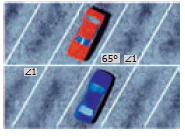
In the parking lot shown, the lines that mark the width of each space are parallel. If \(\angle\)1 = (x + 39)°, \(\angle\)2 = (2x – 3y)°, find x and y.
2.
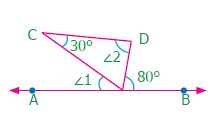
In the figure AB is parallel to DC. Find the value of \(\angle\)1 and \(\angle\)2. Justify your answer
3.
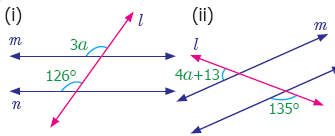
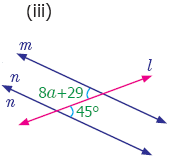
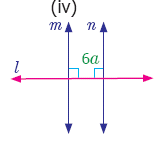
Find the value of angle a in each of the following figures.
4.
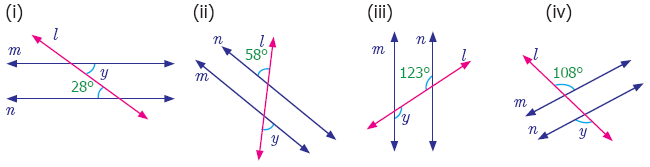
Find the measure of angle y in each of the following figures.
5.
Construct the following angles using protractor and draw a bisector to each of the angle using ruler and compass.
(a) 60°
(b) 100°
(c) 90°
(d) 48°
(e) 110°
1.
From this figure
<1 = 180o - 65o
x + 39o = 115o
x = 115o - 39o
x = 76o
<2 = 65o
2x - 3y = 65o
2 x 76 - 3y = 65o
152 - 3y = 65o
3y = 152o - 65o
3y = 87o
y = 29o
2.
From the figure
<1 = 30o and <2 = 80o [Alternate interior angles]
3.
(i) 3a = 126°
a = \(\frac{126°}{3} \) = 42°
a = 42°
(ii) 4a + 13o + 135° = 180°
4a + 148° = 180°
4a = 180° - 148°
4a = 32°
a = \(\frac{32°}{4}\)
a = 8°
(iii) 8a + 29° = 45°
8a = 45° - 29o
8a = 16°
a = 2°
(iv) 6a = 90°
a = \(\frac{32°}{4}\)
a = -15°
4.
From all the figures, all the pair of angles are alternate interior (or) exterior angle.
i) y = 28o
ii) y = 58o
iii) y = 123o
iv) y = 108o
5.
(a) 60° c
Construction:
Step 1 : Drawn the given angle ∠ABC with the measure 60° using protractor.
Step 2: With B as centre and convenient radius, drawn an arc to cut BA and BC. Marked the points of intersection as E on BA and F on BC.
Step 3: With the same radius and E as centre drawn an arc in the interior of ∠ABC and another arc of same measure with centre at F to cut the previous arc.
Step 4: Marked the point of intersection as G. Drawn a ray BX through G. BG is the required bisector of the given ∠ABC
Now ∠ABG = ∠CBG = 30°
.JPG)
(b) 100°
Construction:
Step 1: Drawn the given angle ∠ABC with the measure 100° using protractor.
Step 2: With B as centre and convenient radius, drawn an arc to cut BA and BC. Marked the points of intersection as E on BA and F on BC.
Step 3: With the same radius and E as centre drawn an arc in the interior of ∠ABC and another arc of the same measure with centre at F to cut the previous arc.
Step 4: Marked the point of intersection at G. Drawn a ray BX through G. BG is the required bisector of angle ∠ABC
∠ABG = ∠GBC = 50°
.JPG)
(c) 90°
Construction :
Step 1: Drawn the given angle ∠ABC with the measure 90° using protractor.
Step 2: With B as center and convenient radius, drawn an arc to cut BA and BC. Marked the points of intersection as E on BA and F on BC
Step 3: With the same radius and E as center drawn an arc in the interior of ∠ABC and another arc of same measure with center at F to cut the previous arc
Step 4: Mark the point of interaction as G. Drawn a ray BX through G BG is the required bisector of the given angle ∠ABC
∠ABG = ∠GBC = 45°
.JPG)
(d) 48°
Construction:
Step 1: Drawn the given angle ∠ABC with the measure 48° using protractor.
Step 2: With B as center and convenient radius, drawn an arc to cut BA and BC. Marked the points of intersection as E on BA and F on BC.
Step 3: With the same radius and E as center drawn an arc in the interior of ∠ABC and another arc of the same measure with center at F to cut the previous arc.
Step 4: Marked the point of intersection as G. Drawn a ray BX through G. BG is the required bisector of the given angle ∠ABC
Now ∠ABC = ∠GBC = 24°
.JPG)
(e) 110°
Construction:
Step 1: Drawn the given angle ∠ABC with the measure 110° using protractor
Step 2: With B as center and convenient radius, drawn an arc to cut BA and BC. Marked points of intersection as E on BA and F BC.
Step 3: With the same radius and E as center, drawn an arc in the interior of ∠ABC and another arc of same measure with center at F to cut the previous arc.
Step 4: Mark the point of intersection as G. Drawn a ray BX through G. BG is the required bisector of the given angle ∠ABC
∠ABG = ∠GBC = 55°.
.JPG)

7th Standard Syllabus & Materials
7th Standard
TN 7th English T1 - Supplementary - On Monday Morning Important Questions And Answers Study Material - QB365 Set A
NEW7th Standard
TN 7th English T1 - Prose - Eidgah Important Questions And Answers Study Material - QB365 Set A
NEW7th Standard
TN 7th Social Science T1 - ECO - Production Important Questions And Answers Study Material - QB365 Set A
NEW7th Standard
TN 7th Social Science T1 - GEO - Interior of the Earth Important Questions And Answers Study Material - QB365 Set A



Tamilnadu Stateboard 7th Standard Subjects
Tamilnadu Stateboard Standards




