
 100% FREE ACCESS
7th Standard Syllabus & Materials
7th Standard
TN 7th Tamil பருவம் -1 இயல் 1 - அமுதத்தமிழ் - ஒன்றல்ல இரண்டல்ல Important Questions And Answers Study Material - QB365 Set A
NEW7th Standard
TN 7th Tamil பருவம் -1 இயல் 1 - அமுதத்தமிழ் - எங்கள் தமிழ் Important Questions And Answers Study Material - QB365 Set A
NEW7th Standard
TN 7th English T1 - Poem - Your Space Important Questions And Answers Study Material - QB365 Set A
NEW7th Standard
TN 7th English T1 - Prose - A Prayer to the Teacher Important Questions And Answers Study Material - QB365 Set A
NEW7th Standard
TN 7th English T1 - Poem - The Listeners Important Questions And Answers Study Material - QB365 Set A
NEW7th Standard
TN 7th English T1 - Prose - The Wind on Haunted Hill Important Questions And Answers Study Material - QB365 Set A

Published on: 30/10/2019
Term 1 Geometry
Download Tamil Nadu 7th Standard Maths question papers, model tests, one-mark questions, important questions, and public exam papers in PDF format. Free study materials and answer keys for TN State Board students.
Questions + Answers key
Take MCQ Maths Test1.
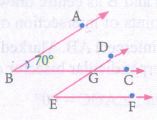
In the given figure, the arms of two angles are parallel. If ∠ABC = 70°, then find
(i) ∠DGC
(ii) ∠DEF
2.
In the figure EF parallel to GH
3.
Can two lines intersect in more than one point?
4.
Two angles are in the ratio 3:2. If they are linear pair, find them.
5.
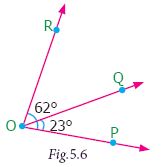
If \(\angle\)POQ = 23° and \(\angle\)POR = 62° then find \(\angle\)QOR
6.
In the adjoining figure, the lines \(\overleftrightarrow { AB } \) and \(\overleftrightarrow { CD } \) intersect at 'O'. If ∠COD = 50°, find the measures of the other three angles.
7.
In the following figure, show that CDIIEF
8.
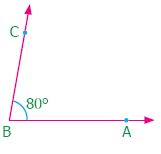
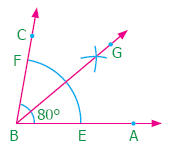
Construct bisector of the ∠ABC with the measure 80°.
9.
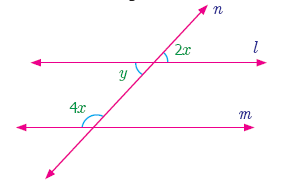
If l is parallel to m, find the measure of x and y in the figure.
10.
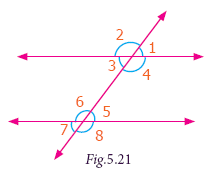
(i) Name the angle that corresponds to \(\angle\)1.
(ii) Name the angle that is alternate interior to \(\angle\)3.
(iii) Name the angle that is alternate exterior to \(\angle\)8.
(iv) Name the angle that corresponds to \(\angle\)8.
(v) Name the angle that is alternate exterior to \(\angle\)7.
(vi) Name the angle that is alternate interior to \(\angle\)6.
1.
We have ABIIED and BC||EF
(i) BC is transversal
∠DGC = ∠ABC [corresponding angles]
But ∠ABC = 70°
∴ ∠DGC = 70°
(ii) ED is a transversal to BC|lEF
∴ ∠DEF = ∠DGC [corresponding]
∠DGC = 70°
∠DEF = 70°
2.
LEAB = 60° and LACD = 105°
Determine
(i) LCAF and
(ii) LBAC
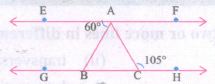
(i) Since EF II GH and AC is a transversal
⇒ LCAF + LACH = 180
⇒ LCAF + 105° = 180°
=75°
(ii) ∴ EF II GH and AC is transversal.
∴ LEAC = LACH
⇒ LBAC = 105°
⇒ LBAC + LBAB = 105°
⇒ LBAC + 60° = 105°
⇒ LBAC = 105°- 60°
= 45°
∴ LCAF = 75° and LBAC = 45°
3.
No, two lines cannot intersect in more than one point.
4.
Let the angles be 3x and 2x
Since they are linear pair of angles, their sum is 180°.
Therefore,
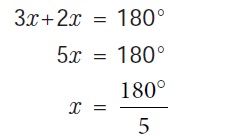
x = 36°
The angles are 3x = 3 x 36 = 108°
2x = 2 x 36 = 72°
5.
We know that \(\angle\)POR = \(\angle\)POQ + \(\angle\)QOR
62° = 23° + \(\angle\)QOR
Subtracting 23° on both sides
62° – 23° = 23° + \(\angle\)QOR – 23°
\(\angle\)QOR = 39°
6.
∠COB = 50°
∠AOD = 50° (vertically opposite angles)
Now ∠AOC and ∠COB form a linear pair
Thus ∠AOC + ∠COB = 180°
⇒ ∠AOC + 50° = 180°.
∠AOC = 180° - 50° = 130°
Also ∠AOC and ∠BOD are vertically opposite angles
∠BOD = ∠AOC = 130°
Thus the three angles are
∠AOD = 50°
∠AOC = 130°
∠BOD = 130°
7.
∠BAD = ∠BAE + ∠EAD
= 40° + 30° = 70°.
and LCDA = 70°
∠BAD = ∠CDA
But they form a pair of alternate angles
⇒ AB || CD
Also ∠BAE + ∠AEF = 40° + 140° = 180° -------(1)
But they form a pair of interior opposite angles.
⇒ AB II EF
From (1) and (2), we get ---(2)
AB || CD || EF
⇒ CD II EF
8.
Step 1: Draw the given angle ∠ABC with the measure 80° using protractor.
Step 2: With B as center and convenient radius, draw an arc to cut BA and BC. Mark the points of intersection as E on BA and F on BC.
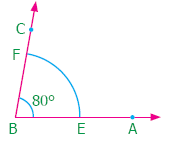
Step 3: With the same radius and E as center, draw an arc in the interior of ∠ABC and another arc of same measure with center at F to cut the previous arc.
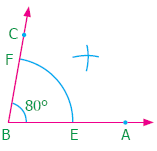
Step 4: Mark the point of intersection as G. Draw a ray BX through G. BG is the required bisector of the given angle ∠ABC
9.
Given l is parallel to m and n is transversal to l and m.
We get, y = 2x [Vertically opposite angles are equal]
y + 4x = 180° [sum of interior angles that lie on the same side of the transversal]
2x + 4x = 180° [since y = 2x]
6x = 180°
Dividing by 6 on both sides
\(\frac{x}{6}=\frac{180^o}{6}\)gives, x = 30°
Now, y = 2(30°) = 60°.
10.
(i) The angle that corresponds to \(\angle\)1 is \(\angle\)5
(ii) The angle that is alternate interior to \(\angle\)3 is \(\angle\)5
(iii) The angle that is alternate exterior to \(\angle\)8 is \(\angle\)2
(iv) The angle that corresponds to \(\angle\)8 is \(\angle\)4
(v) The angle that is alternate exterior to \(\angle\)7 is \(\angle\)1
(vi) The angle that is alternate interior to \(\angle\)6 is \(\angle\)4

7th Standard Syllabus & Materials
7th Standard
TN 7th English T1 - Supplementary - On Monday Morning Important Questions And Answers Study Material - QB365 Set A
NEW7th Standard
TN 7th English T1 - Prose - Eidgah Important Questions And Answers Study Material - QB365 Set A
NEW7th Standard
TN 7th Social Science T1 - ECO - Production Important Questions And Answers Study Material - QB365 Set A
NEW7th Standard
TN 7th Social Science T1 - GEO - Interior of the Earth Important Questions And Answers Study Material - QB365 Set A



Tamilnadu Stateboard 7th Standard Subjects
Tamilnadu Stateboard Standards




