
 100% FREE ACCESS
12th Standard Syllabus & Materials
12th Standard
TN 12th Computer Applications மின்னணு தரவு பரிமாற்றம் Sample Question Papers Study Material - QB365 Set A
NEW12th Standard
TN 12th Computer Applications மின் - வணிக பாதுகாப்பு அமைப்புகள் Sample Question Papers Study Material - QB365 Set A
NEW12th Standard
TN 12th Computer Applications மின்னணு செலுத்தல் முறைகள் Sample Question Papers Study Material - QB365 Set A
NEW12th Standard
TN 12th Computer Applications மின் - வணிகம் Sample Question Papers Study Material - QB365 Set A
NEW12th Standard
TN 12th Computer Applications திறந்த மூல கருத்துருக்கள் Sample Question Papers Study Material - QB365 Set A
NEW12th Standard
TN 12th Computer Applications வலையமைப்பு வடமிடல் Sample Question Papers Study Material - QB365 Set A

Published on: 02/09/2022
QB365 provides a detailed and simple solution for every Possible Creative Questions in Class 12 Physics Subject - Retirement and Death of a Partner, English Medium. It will help Students to get more practice questions, Students can Practice these question papers in addition to score best marks.
Download Tamil Nadu 12th Standard Physics question papers, model tests, one-mark questions, important questions, and public exam papers in PDF format. Free study materials and answer keys for TN State Board students.
Questions + Answers key
Take MCQ Physics Test1.
Give the applications photocell.
2.
Red light however bright it is, cannot produce the emission of electrons from a clean zinc surface, but even weak ultraviolet radiation can do so; why?
3.
de Broglie wavelength associated with an electron accelerated through a potential difference V is \(\lambda\). What will be the de Broglie wavelength when the accelerating potential is increased to 4 V?
4.
Two metals A and B have work functions 4eV and 10eV respectively. Which metal has the higher threshold wavelength?
5.
The frequency V of incident radiation is greater than threshold frequency (vo) in a photocell. How will the stopping potential vary if frequency (v) is increased, keeping other factors constant?
6.
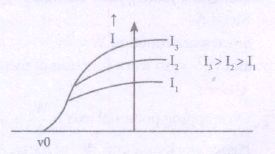
(i) Draw a graph showing variation of photoelectric current (I) with anode potential (V) for different intensities of incident radiation. Name the characteristic of the incident radiation that is kept constant in this experiment.
(ii) If the potential difference used to accelerate electrons is doubled, by what factor does the de-Broglie wavelength associated with the electrons change?
7.
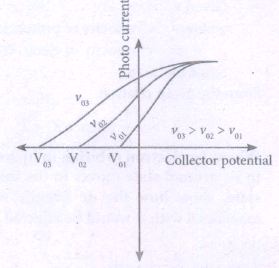
Show the variation of photocurrent with collector plate potential for different frequencies but same intensity of incident radiation.
8.
An electron and a proton have the same kinetic energy. Which one of the two has the larger de Broglie wavelength and why?
9.
The graph shows the variation of stopping potential with frequency of incident radiation for two photosensitive metals A and B. Which one of the two has higher value of workfunction? Justify your answer.
10.
When the electron orbiting in a hydrogen atom in its ground state moves to the third excited state, show how the de Broglie wavelength associated with it would be affected?
11.
A proton and an electron have same velocity. Which one has greater de Broglie wavelength and why?
12.
List out the laws of photoelectric effect. (or) Write any three Laws of Photoelectric Effect
13.
(a) Define the term 'intensity of radiation' in terms of photon picture of light.
(b) Two monochromatic beams, one red and the other blue; have the same intensity. In which case
(i) the number of photons per unit area per second is larger,
(ii) the maximum kinetic energy of the photoelectrons is more? Justify you answer.
14.
Derive an expression for De Broglie wave length.
1.
(i) Photo cells are used as switches and sensors.
(ii) Automatic switch on and off of street lights.
(iii) They are used for reproduction of sound in motion pictures
(iv) They are used as timers to measure the speed of athletes during a race.
(v) In photography, they are used to measure the intensity of the given light and to calculate the exact time of exposure.
2.
(i) The photoemission of electrons does not depend on the intensity but it depends on the frequency and hence on the energy of a photon of incident light.
(ii) If the energy of a photon is greater than the work function, the photoemission of electrons results however weak the incident radiation may be.
(iii) The energy of a photon of red light is less than the work function of zinc, so red light cannot emit photoelectrons.
(iv) The energy of a photon of ultraviolet light is greater than the work function of zinc, so ultraviolet light can emit photoelectrons.
3.
\(\frac{\lambda}{2}\)
Reason: de Broglie wavelength associated with the electron is
\(\lambda =\frac { h }{ \sqrt { 2mqV } } \Rightarrow \lambda \alpha \frac { 1 }{ \sqrt { V } } \\ \)
Obviously, when accelerating potential becomes 4 V, the de- Broglie wavelength reduces to half.
4.
Work function W = hvo = \(\frac{hc}{\lambda_o}\)
\({ \lambda }_{ o }\alpha \frac { 1 }{ W } \)
As WA
i.e., the threshold wavelength of metal A is higher.
5.
From Einstein's photoelectric equation, stopping potential Vo is
eVo = hv - hvo Vo = \(\frac{h}{e}(v-v_o)\)
Given > vo, so with increase of frequency v, stopping potential increases.
6.
1) The frequency of incident radiation was kept constant.
2) de Broglie wavelength,
\(\lambda =\frac { h }{ \sqrt { 2mqV } } \alpha \frac { 1 }{ V } \)
If potential difference V is doubled, the de-Broglie wavelength is decreased to \(\frac { 1 }{ \sqrt { 2 } } \) time.
7.
8.
An electron has a larger wavelength.
Reason: de- Broglie wavelength in terms of kinetic energy \(\lambda =\frac { h }{ \sqrt { 2m{ E }_{ K } } } \alpha \frac { 1 }{ \sqrt { m } } \) is for the same kinetic energy.
As an electron has a smaller mass than a proton, an electron has a larger de Broglie wavelength than a proton for the same kinetic energy.
9.
Metal A
Since work function W = hvo
and vo > Vo so work function of metal A is more.
Aliter :
On stopping potential axis \(-\frac { { W }_{ o }^{ ' } }{ e } >-\frac { { W }_{ o } }{ e } \)
Hence work function W'o of metal A is more.
10.
we know,
de Broglie wavelength,
\(\lambda =\frac { h }{ p } =\frac { h }{ mv } \Rightarrow \lambda \alpha \frac { 1 }{ v } \)
Also \(v\alpha \frac { 1 }{ n } \)
\(\lambda \alpha n\)
∴ de Broglie wavelength will increase
11.
de Broglie wavelength (\(\lambda\)) is given is \(\lambda\) = \(\frac{h}{m}\)
Given vp = ve
where vp = velocity
ve = velocity of electron
Since mp > me
From the given relation
\(\lambda \alpha \frac { 1 }{ m } ,hence\quad { \lambda }_{ p }<{ \lambda }_{ e }\)
12.
Laws of photoelectric effect:
(i) For a given surface, the emission of photoelectrons takes place only if the frequency of incident light is greater than a certain minimum frequency called the threshold frequency.
(ii) For a given frequency of incident light, the number of photoelectrons emitted is directly proportional to the intensity of the incident light. The saturation current is also directly proportional to the intensity of incident light.
(iii) Maximum kinetic energy of the photoelectrons is independent of the intensity of the incident light.
(iv) Maximum kinetic energy of the photoelectrons from a given metal is directly proportional to the frequency of incident light.
(v) There is no time lag between the incidence of light and the ejection of photoelectrons.
13.
a) The number of photons incident normally per unit area per unit time is determined by the intensity of radiations.
b) (i) Red light, because the energy of red light is less than that of blue light
(hv)R < (hv)B
(ii) Blue light, because the energy of blue light is greater than that of red light
(hv)B > (hv)R
14.
i) The momentum of photon of frequency v is given by,
\(p=\frac { hv }{ c } =\frac { h }{ \lambda } \)
ii) The wavelength of a photon in terms of its momentum is,
\(\lambda =\frac { h }{ p } \)
iii) According to de Broglie, the above equation is completely a general one and this is applicable to material particles as well. Therefore, for a particle of mass m traveling with speed u, the wavelength is given by,
\(\lambda =\frac { h }{ mv } =\frac { h }{ p } \)
iv) This wavelength of the matter waves is known as de Broglie wavelength. This equation relates the wave character (the wavelength \(\lambda\)) and the particle character (the momentum p) through Planck's constant.

12th Standard Syllabus & Materials
12th Standard
TN 12th Computer Applications களப்பெயர் முறைமை (DNS) Sample Question Papers Study Material - QB365 Set A
NEW12th Standard
TN 12th Computer Applications வலையமைப்பு எடுத்துக்காட்டுகள் மற்றும் நெறிமுறைகள் Sample Question Papers Study Material - QB365 Set A
NEW12th Standard
TN 12th Computer Applications கணினி வலையமைப்பு ஓர் அறிமுகம் Sample Question Papers Study Material - QB365 Set A
NEW12th Standard
TN 12th Computer Applications PHP-உடன் MySQL-ஐ இணைத்தல் Sample Question Papers Study Material - QB365 Set A



Tamilnadu Stateboard 12th Standard Subjects

Maths

Chemistry
Physics

Biology

Computer Science

Business Maths and Statistics

Economics

Commerce

Accountancy

History

Computer Applications
Biology
Computer Technology
Computer Applications
Computer Science
Business Maths and Statistics
Commerce
Economics
Maths
Chemistry
Physics
Computer Technology
History
Accountancy

Tamil

English

French
Tamilnadu Stateboard Standards

