
 100% FREE ACCESS
8th Standard CBSE Syllabus & Materials
8th Standard CBSE
CBSE 8th Social Science Theme D - Factors of Production - New Model Questions Papers Study Material - QB365 Set A
NEW8th Standard CBSE
CBSE 8th Social Science Theme C - Universal Franchise and India's Electoral System - New Model Questions Papers Study Material - QB365 Set A
NEW8th Standard CBSE
CBSE 8th Social Science Theme B - The Rise of the Marathas - New Model Questions Papers Study Material - QB365 Set A
NEW8th Standard CBSE
CBSE 8th Social Science Theme B - Reshaping India's Political Map - New Model Questions Papers Study Material - QB365 Set A
NEW8th Standard CBSE
CBSE 8th Social Science Theme A - Natural Resources and Their Use - New Model Questions Papers Study Material - QB365 Set A
NEW8th Standard CBSE
CBSE 8th Science Keeping Time with Skies - New Model Questions Papers Study Material - QB365 Set A

Published on: 03/12/2018
In this question paper, the questions are covered from the chapter Direct & Inverse Proportions.
Teachers can subscribe and get plenty of question paper with answer key.
Students also subscribe and practice with more number of questions to score high marks in the examination.
Download CBSE Class 8th Standard CBSE Mathematics question papers, sample papers, important questions, and previous year solved papers in PDF format. Get free study materials, NCERT solutions, and exam preparation resources for Class 8th Standard CBSE Mathematics
Questions + Answers key
Take MCQ Mathematics Test
1.
A machine fills 540 bottles in six hours. How many bottles will it fill in five hours?
2.
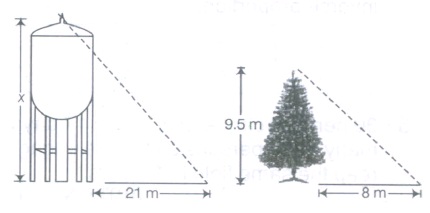
A water tank casts a shadow 21 m long. A tree of height 9.5 m casts a shadow 8 m long at the same time. The lengths of the shadows are directly proportional to their heights. Find the height of the tank.
3.
Observe the following tables and find, if x and y are directly proportional
| x | 20 | 17 | 14 | 11 | 8 | 5 | 2 |
| y | 40 | 34 | 28 | 22 | 16 | 10 | 4 |
4.
Think of a few more examples for direct proportion.
5.
A contractor estimates that 5 persons complete a task in 4 days. If he uses 4 persons instead of 5, how long should they take to complete the task?
6.
A contractor undertook a contract to complete a part of a stadium in 9 months with a team of 560 persons. Later on, it was required to complete the job in 5 months. How many extra persons should he employ to complete the work?
7.
In a camp, there is enough flour for 300 persons for 42 days. How long will the flour last, if 20 more persons join the camp?
8.
A mixture of paint is prepared by mixing 1 part of red pigment with 8 parts of base. In the following table, find the parts of base that need to be added.
| Parts of red pigment | 1 | 4 | 7 | 12 | 20 |
| Parts of base | 8 | ... | ... | ... | ... |
if 1 part of a red pigment requires 75 mL of base, how much red pigment should we mix with 1800 mL of base?
9.
A school has 9 periods a day each of 40 minutes duration. How long would each period be, if the school has 8 periods a day, assuming the number of school-hours to be the same?
10.
A car takes 1.5 hours to reach a destination by travelling at the speed of 80 km/h. How long will it take when the car travels at the speed of 60 km/hr?
11.
4 persons can build a room in 3 days. If there are only 3 persons to be engaged in the building task, then how long should they take to complete the task?
12.
A loaded truck travels 168 km in 5 hours. How far can it travel in 25 minutes?
13.
6 pipes are required to fill a tank in I hour 20 minutes. How long will it take if only 5 pipes of the same type are used?
14.
If x and y vary inversely and x = 32, where y = 9, then find x when y= 48.
15.
In which of the following cases, there are direct variation between the two given quantities?
Cloth was purchased at Rs.8 per metre. How much will 19 m of cloth cost?
16.
If a box of sweets is divided amongst 18 children, then they will get 8 sweets each. How many would each get, if the number of the children is reduced by 6?
17.
If the area of a circle, whose radius is 5 cm is increased to four times, then find the changed radius?
18.
From the following table, determine x and y are in direct proportion or not?
| x | 3 | 6 | 15 | 20 | 30 |
| y | 12 | 24 | 45 | 60 | 120 |
19.
40 cows can graze a field in 16 days. How many cows will graze the same field in 10 days?
60
64
80
75
20.
If x and y are in 'inverse variation' then:
\(\frac { x }{ y } \) is constant
(x - y) is constant
xy is constant
(x + y) is constant
21.
If 'x' and 'y' are in an inverse variation then which of the following is correct?
x - y = constant
x + y = constant
xy = constant
\(\frac { x }{ y } \) = constant
22.
Both x and y are in direct proportion,then \(\frac{1}{x}\)and \(\frac{1}{y}\)are
in direct proportion
in inverse proportion
neither in direct nor in inverse proportion
sometimes in direct and sometimes in inverse proportion
23.
If two quantities p and q vary inversely with each other, then
\(\frac{p}{q}\)
p + q remains constant
p x q remains constant
p - q remains constant
24.
Two quantities are said to vary_____________with each other, if an increase in one causes, a decrease in the other in such a manner that the product of their corresponding values remains constant.
25.
The perimeter of a circle and its diameter vary___________with each other.
26.
When the speed remains constant, the distance travelled is______________ proportional to the time.
27.
x and y are said to vary directly with each other, if for some positive number k,...................=k
28.
Let x varies directly as y2, for y = 3, x = 2. If y = 5 then x is____________
1.
| Numbers of bottles filled | Number of hours |
| 540 x |
6 5 |
Let the required number of bottles to be filled in 5 hours be x
Since, more number of bottles, more number of hours would be required.
\(\therefore\) The given quantities very directly
\(\therefore \ \frac { 540 }{ x } =\frac { 6 }{ 5 } \Rightarrow 6\times x=5\times 540\)
\(\Rightarrow \ x=\frac { 5\times 540 }{ 6 } =5\times 90=450\)
Thus, the required number of bottles = 450
2.
It is given that, a water tank casts a shadow 21 m long and a tree of height 9.5 m casts a shadow 8 m long at the same time. Here the lengths of the shadows are directly proportional to their heights.
Let height = h and the length of shadow = l
Here, h1 = 9.5 m, l1= 8 m, h2 = X, l2 = 21 m
For direct proportion,
\(\frac{h_1}{l_1}=\frac{h_2}{l_2} \Rightarrow \frac{9.5}{8}=\frac{x}{21}\)
∴ x = \(\frac{9.5\times 21}{8}=24.9\)m
∴ The height of the tank is 24.9 m.
3.
When x = 20,y= 40, then
\(\frac { x }{ y } =\frac { 20 }{ 40 } =\frac { 20\div 20 }{ 40\div 20 } \) [.: HCF of 20 and 40 = 20]
\(\Rightarrow \frac { x }{ y } =\frac { 1 }{ 2 } \)
When x = 17,y = 34, then
\(\frac { x }{ y } =\frac { 17 }{ 34 } =\frac { 17\div 17 }{ 34\div 17 } =\frac { 1 }{ 2 } \) [HCF of17 and 34 = 17]
When x = 14,y = 28, then
\(\frac { x }{ y } =\frac { 14 }{ 28 } =\frac { 14\div 14 }{ 28\div 14 } =\frac { 1 }{ 2 } \) [HCF of 14 and 28 = 14]
When x = 11,y = 22, then
\(\frac { x }{ y } =\frac { 11 }{ 22 } =\frac { 11\div 11 }{ 22\div 11 } =\frac { 1 }{ 2 } \) [HCF of 11 and 22=11]
When x = 8,y = 16,then
\(\frac { x }{ y } =\frac { 8 }{ 16 } =\frac { 8\div 8 }{ 16\div 8 } =\frac { 1 }{ 2 } \) [HCF of 8 and 16=8]
When x = 5,y = 10,then
\(\frac { x }{ y } =\frac { 5 }{ 10 } =\frac { 5\div 5 }{ 10\div 5 } =\frac { 1 }{ 2 } \) [HCFof 5and10=5]
When x = 2,y = 4, then
\(\frac { x }{ y } =\frac { 2 }{ 4 } =\frac { 2\div 2 }{ 4\div 2 } =\frac { 1 }{ 2 } \) [HCF of 2 and 4 = 2]
From above,we can say that the values of \(\frac { x }{ y } \) is same,in everycaseit is \(\frac { 1 }{ 2 } \) So, these values of x and y are directly proportional.
4.
Few more examples for direct proportion are as follows:
(i) Length of the cloth purchased and its total cost.
(ii) Number of months and total salary.
(iii) Number of hours of production and the amount of the commodity produced
5.
More is the number of persons, less is the time to complete the task.
\(\therefore\) It is a case of inverse variation,
Now, we have:
| Number of persons | Number of days to complete the task |
| 5 | 4 |
| 4 | x |
\(\therefore \ 5\times 4=4\times x\Rightarrow x=\frac { 5\times 4 }{ 4 } =5\)
Thus, the required number of days = 5.
6.
448 persons
7.
As number of persons increases, number of days will decreases for finishing the same amount of flour.
This is a case of inverse proportion.
Let number of persons = n
Number of days = d
\(n\propto \frac { 1 }{ d } \)
Here, n1 = 300, d1 = 42 days.
n2 = 300 + 20 = 320, d2 = ?
300 \(\times\) 42 = 320 \(\times\) d2
\({ d }_{ 2 }=\frac { 300\times 42 }{ 320 } =\frac { 315 }{ 8 } =39\frac { 3 }{ 8 } days\)
8.
Let the number of parts of red pigment be x and the amount of base = y mL
Here, x1 = 1,y1 = 75 and y2 = 1800, x2 = ?
\(\Rightarrow \frac { 1 }{ 75 } =\frac { { x }_{ 2 } }{ 1800 } \Rightarrow { x }_{ 2 }\times 75=1\times 1800\)
\({ x }_{ 2 }=\frac { 1800 }{ 75 } =24\Rightarrow { x }_{ 2 }=24\)
Hence, 24 parts of red pigment should be mixed with 1800 mL of base.
9.
45 minutes
10.
2 hours
11.
4 days
12.
14 km
13.
Let the desired time to fill the tank be x minutes. Thus, we have the following table.
| Number of pipes | 6 | 5 |
| Time (in minutes) | 80 | x |
Lesser the number of pipes, more will be the time required by it to fill the tank. So, this is a case of inverse proportion.
Hence, 80 × 6 = x × 5 [x1 y1 = x2 y2 ]
or \(\frac{80 \times 6}{5}=x\)
or x = 96
Thus, time taken to fill the tank by 5 pipes is 96 minutes or 1 hour 36 minutes.
14.
x = 6
15.
Direct
16.
24 sweets
17.
Change in radius = 10cm
18.
No
19.
40 x 16 = ? x 10 ⇒ ? = 64.
20.
(c)
xy is constant
21.
(c)
xy = constant
22.
(a)
in direct proportion
23.
(c)
p x q remains constant
24.
()
inversely
25.
()
Directly
26.
()
directly
27.
()
\(\frac{x}{y}=k\)
28.
()
\(x=5\frac{5}{9}\)

8th Standard CBSE Syllabus & Materials
8th Standard CBSE
CBSE 8th Science Particulate Nature of Matter - New Model Questions Papers Study Material - QB365 Set A
NEW8th Standard CBSE
CBSE 8th Science Pressure, Winds, Stroms and Cyclones - New Model Questions Papers Study Material - QB365 Set A
NEW8th Standard CBSE
CBSE 8th Mathematics Quadrilaterals - New Model Questions Papers Study Material - QB365 Set A
NEW8th Standard CBSE
CBSE 8th Mathematics A story of Numbers - New Model Questions Papers Study Material - QB365 Set A



CBSE 8th Standard CBSE Subjects
CBSE Standards




