
 100% FREE ACCESS
8th Standard CBSE Syllabus & Materials
8th Standard CBSE
CBSE 8th Social Science Theme D - Factors of Production - New Model Questions Papers Study Material - QB365 Set A
NEW8th Standard CBSE
CBSE 8th Social Science Theme C - Universal Franchise and India's Electoral System - New Model Questions Papers Study Material - QB365 Set A
NEW8th Standard CBSE
CBSE 8th Social Science Theme B - The Rise of the Marathas - New Model Questions Papers Study Material - QB365 Set A
NEW8th Standard CBSE
CBSE 8th Social Science Theme B - Reshaping India's Political Map - New Model Questions Papers Study Material - QB365 Set A
NEW8th Standard CBSE
CBSE 8th Social Science Theme A - Natural Resources and Their Use - New Model Questions Papers Study Material - QB365 Set A
NEW8th Standard CBSE
CBSE 8th Science Keeping Time with Skies - New Model Questions Papers Study Material - QB365 Set A

Published on: 23/09/2019
Rational Numbers
Download CBSE Class 8th Standard CBSE Mathematics question papers, sample papers, important questions, and previous year solved papers in PDF format. Get free study materials, NCERT solutions, and exam preparation resources for Class 8th Standard CBSE Mathematics
Questions + Answers key
Take MCQ Mathematics Test
1.
Find three rational numbers between \(\frac { 1 }{ 2 } \) and \(\frac { 1 }{ 5 } \)
2.
One fruit salad recipe requires \(1\over2\) of sugar. Another recipe for the same fruit salad requires 2 tablespoons of sugar. If 1 tablespoon is equivalent to \(1\over16\) cup. Then, how much more sugar does the first recipe require?
3.
One fruit salad recipe requires \(1\over2\) of sugar. Another recipe for the same fruit salad requires 2 tablespoons of sugar. If 1 tablespoon is equivalent to \(1\over16\) cup. Then, how much more sugar does the first recipe require?
4.
Four friends had a competition to see how far could they hop on one foot. The table given shows the distance covered by each
| Name | Distance covered (in km) |
| Seema | \({1\over25}\) |
| Nancy | \({1\over32}\) |
| Megha | \({1\over40}\) |
| Soni | \({1\over20}\) |
(a) How farther did Soni hop than Nancy?
(b) What is the total distance covered by Seema and Megha?
(c) Who walked farther Nancy or Megha?
(d) What is the benefit of competition?
5.
Simplify each of the following by using suitable property. Also name the properties.
\({-3\over5}\times\{{3\over7}+({-5\over6})\}\)
6.
Give one example each to show that the rational numbers are closed under addition, subtraction and multiplication. Are rational numbers closed under division? Give two examples in support of your answer
7.
Divide the sum of\({25\over12}\) and \({5\over3}\) bv their difference.
8.
Represent the following rational numbers on the number line. \(2\over5\)
9.
Rearrange suitably and find the sum in each of the following:
\({-5\over7}+{5\over6}+{1\over7}+3+{-13\over6}\)
10.
Using and associativity of addition of rational numbers, express the following as a rational number.
\({5\over2}+{-3\over7}+{1\over2}+{4\over7}\)
11.
Find the value of \({x\over y }+xy\) , using appropriate property and name it \(x={1\over3},y={2\over 5}\)
1.
Rational numbers between \(\frac { 1 }{ 2 } \) and \(\frac { 1 }{ 5 } \)
= \(\left( \frac { 1 }{ 2 } +\frac { 1 }{ 5 } \right) \div 2\frac { 7 }{ 10 } \times \frac { 1 }{ 2 } =\frac { 7 }{ 20 } \)
.png)
Rational number between \(\frac { 1 }{ 5 } \) and \(\frac { 7 }{ 10 } \)
= \(\left( \frac { 1 }{ 5 } +\frac { 7 }{ 20 } \right) \div 2=\frac { 11 }{ 20 } \times \frac { 1 }{ 2 } =\frac { 11 }{ 40 } \)
.png)
Rational number between \(\frac { 7 }{ 20 } \) and \(\frac { 1 }{ 2 } \)
= \(\left( \frac { 7 }{ 20 } +\frac { 1 }{ 2 } \right) \div 2=\frac { 17 }{ 20 } \times \frac { 1 }{ 2 } =\frac { 17 }{ 40 } \)
.png)
Thus, the three rational numbers \(\frac { 11 }{ 40 } ,\frac { 7 }{ 20 } ,\frac { 17 }{ 40 } \) lie between \(\frac { 1 }{ 5 } \) and \(\frac { 1 }{ 2 } \)
2.
Given, sugar required for one fruit salad =\({1\over2}\) cup
Sugar required for another salad = 2\(\times{1\over16}={2\over16}cup\)
\(\therefore\) Required sugar =\({1\over2}-{2\over16}={18-2\over16}={6\over16}={3\over8}cup\)
3.
Given, sugar required for one fruit salad =\({1\over2}\) cup
Sugar required for another salad = 2\(\times{1\over16}={2\over16}cup\)
\(\therefore\) Required sugar =\({1\over2}-{2\over16}={18-2\over16}={6\over16}={3\over8}cup\)
4.
Now, we have, \({1\over25},{1\over32},{1\over40},{1\over20}\)
Now, making same denominator, we get
\({1\over25}={32\over800},{1\over32}={25\over800},{1\over40}={20\over800},{1\over20}={40\over800}\)
(a) Soni hop more than Nancy with distance
\(={40\over800}-{25\over800}={15\over800}={3\over160}Km\)
(b) Total distance covered by Seema and Megha
\(={32\over800}+{20\over800}={52\over800}={13\over200}Km\)
(c) Clearly, Nancy walked farther than Megha.
(d) By competition, we make ourself relate with the surrounding in terms of compatibility of our quality. It helps to enrich our strength.
5.
\({-3\over5}\times\{{3\over7}+({-5\over6})\}={-3\over5}\times{3\over7}+({-3\over5})\times ({-5\over6})\)
[using distributive property]
\(={-9\over35}+{15\over30}={-54+105\over210}={51\over210}={17\over70}\)
6.
We know that, rational numbers are closed under addition, subtraction and multiplication. We can understand this from the following examples:
Rational numbers are closed under
Addition
\(eg.{4\over7}+{1\over2}={8+7\over14}={15\over14}\)
which is a rational number.
Subtraction
\(eg.{4\over7}-{1\over2}={8-7\over14}={1\over14}\)
which is a rational number.
Multiplication
\(eg.{4\over7}\times{1\over2}={4\over14}={2\over7}\)
which is a rational number.
But rational numbers are not closed under division. If zero is excluded from the collection of rational numbers, then we can say that rational numbers are closed under division.
Now, we see the examples given below:
\({4\over7}\div{1\over2}={4\over7}\times2={8\over7}{}\)
which is a rational number.
Also, \({1\over2}\div0={1\over2}\times{1\over0}\)
which is not defined and so, it is not a rational number.
Also, \({1\over2}\div0={1\over2}\times{1\over0}\)
which is not defined and also not a rational number.
7.
9
8.
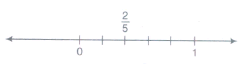
9.
\(23\over21\)
10.
\(22\over7\)
11.
\({29\over30}\)

8th Standard CBSE Syllabus & Materials
8th Standard CBSE
CBSE 8th Science Particulate Nature of Matter - New Model Questions Papers Study Material - QB365 Set A
NEW8th Standard CBSE
CBSE 8th Science Pressure, Winds, Stroms and Cyclones - New Model Questions Papers Study Material - QB365 Set A
NEW8th Standard CBSE
CBSE 8th Mathematics Quadrilaterals - New Model Questions Papers Study Material - QB365 Set A
NEW8th Standard CBSE
CBSE 8th Mathematics A story of Numbers - New Model Questions Papers Study Material - QB365 Set A



CBSE 8th Standard CBSE Subjects
CBSE Standards




