
 100% FREE ACCESS
8th Standard CBSE Syllabus & Materials
8th Standard CBSE
CBSE 8th Social Science Theme D - Factors of Production - New Model Questions Papers Study Material - QB365 Set A
NEW8th Standard CBSE
CBSE 8th Social Science Theme C - Universal Franchise and India's Electoral System - New Model Questions Papers Study Material - QB365 Set A
NEW8th Standard CBSE
CBSE 8th Social Science Theme B - The Rise of the Marathas - New Model Questions Papers Study Material - QB365 Set A
NEW8th Standard CBSE
CBSE 8th Social Science Theme B - Reshaping India's Political Map - New Model Questions Papers Study Material - QB365 Set A
NEW8th Standard CBSE
CBSE 8th Social Science Theme A - Natural Resources and Their Use - New Model Questions Papers Study Material - QB365 Set A
NEW8th Standard CBSE
CBSE 8th Science Keeping Time with Skies - New Model Questions Papers Study Material - QB365 Set A

Published on: 06/12/2018
From this post important questions with solutions for CBSE Class 8 Maths Chapter 10 - Visualising Solid Shapes prepared by expert Mathematics teachers from the latest edition of CBSE(NCERT) books.
Questions from very important topics are covered by NCERT Exemplar Class 8. You also get the idea about the type of questions and method to answer in your Class 8th examination. Here you can get Class 8 Important Questions Maths based on NCERT Textbook for Class VIII. Maths Class 8 Important Questions are very helpful to score high marks in board exams. Here we have covered Important Questions on Visualising Solid Shapes for Class 8 Maths subject.
In this question paper, questions are covered from the chapter Visualising Solid Shapes and questions are prepared as per NCERT guidelines. Questions are covered from NCERT solutions and NCERT Exemplar.
The latest sample papers have been designed as per the latest blueprints, syllabus and examination trends. Sample papers should be practiced in examination condition at home or school and also show it to your teachers for checking or compare with the answers provided.
Download CBSE Class 8th Standard CBSE Mathematics question papers, sample papers, important questions, and previous year solved papers in PDF format. Get free study materials, NCERT solutions, and exam preparation resources for Class 8th Standard CBSE Mathematics
Questions + Answers key
Take MCQ Mathematics Test
1.
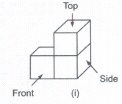
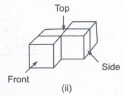
Following solids are made by joining cubes. Draw their different views.
2.
Why the following solids are not polyhedron?
(i) A sphere
(ii) A cone
(iii) A cylinder
3.
Find number of faces of a polyhedron, which has 27 edges and 17 vertices.
4.
A polyhedron has 7 faces and 10 vertices. How many edges does the polyhedron have?
5.
The actual width of a classroom is 900 cm. If the scale chosen to make it drawing is 1: 30. Then, what will be the width of the room in the drawing?
6.
Draw two figures for each 1-D, 2-D and 3- D.
7.
What is Euler's formula? Verify the Euler's formula for a pentagonal prism.
8.
A polyhedron has 40 edges and 30 vertices. Find the number of its faces.
9.
How many vertices does the following solids have?
Octagonal pyramid
10.
Find the number of vertices in a polyhedron which has 30 edges and 12 faces.
11.
Draw a map of your class room using proper scale and symbols for different objects.
12.
The actual width of a store room is 320 cm. If the scale chosen to make its drawing is 1:4, then find the width of the room in the drawing.
13.
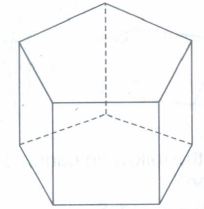
Determine the number of edges, vertices and faces in the following figure. Also, verify your answer.
14.
Which of the following is the base of a tetrahedron?
a square
a rectangle
a circle
a triangle
15.
Which of the following is the number of vertices of sphere?
0
1
2
4
16.
Which of the following is the number of vertices of a cone?
1
2
3
none of these
17.
Side of a square garden is 40 m. If the scale used to draw its picture is 1 cm: 8 m, then the perimeter of the square in the picture is
15 cm
25 cm
20 cm
32 cm
18.
We have 4 congruent equilateral triangles. What do we need more to make a pyramid?
An equilateral triangle
A square with same side length as of triangle
2 squares with side length same as triangle
2 equilateral triangles with side length same as triangle
19.
According to the Euler's formula, we have F + V - E = ________
20.
A ........ has 7 faces.
21.
A flat surface of a three-dimensional figure is a ....... and an is where two faces meet.
22.
The net of a ....... has 6 rectangles.
23.
A pyramid on m sided polygon has ........... faces.
24.
What is a triangular pyramid? What is a pyramid called if its base is a square?
25.
Write the number of edges.
26.
Write the number of faces.
27.
A polyhedron has 30 edges and 12 vertices. How many faces does it have?
1.
(i) 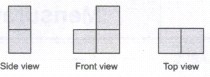
(ii) 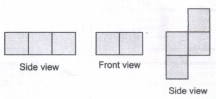
2.
Since, a polyhedron is a solid shape bounded by polygons. However,
(i) a sphere
(ii) a cone and
(iii) a cylinder are not polyhedron because they are not made of polygons, i.e. their faces are not polygons.
3.
Number of faces = 12
4.
For any polyhedron, F + V - E = 2
Here, F = 7, V = 10, E = ?
Using above formula, 7 + 10 - E = 2 ⇒ 17-E = 2 ⇒17 - 2 = E ⇒ E = 15
∴ The polyhedron has 15 edges.
5.
30 cm
6.
7.
If a polyhedron is having number of faces as F, number of edges as E and the number of vertices as V, then the relationship
F+ V=E+2
is known as Euler's formula. Following figure is a solid pentagonal prism.
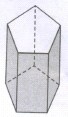
It has:
Number of faces (F) = 7
Number of edges (E) = 15
Number of vertices (V) = 10
Substituting the values of F, E and V in the relation,
F+ V=E+2
We have
7 + 10 = 15 + 2
⇒ 17 = 17
which is true, the Euler's formula is verified.
8.
12
9.
In an octagonal pyramid, there are 9 vertices
10.
For any polyhedron,
F + V - E = 2
Here, F =12, V = ?, E = 30
Using above formula,
12 + V - 30 = 2 ⇒ V - 18 = 2
V = 2 + 18 ⇒ V = 20
11.
A map of a classroom is given below:
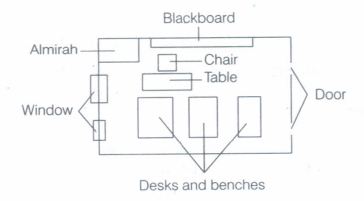
12.
80 cm
13.
The polygonal regions are called faces, hence there are 7 faces. The line segment formed by the intersection of two faces is called edges, hence there are 15 edges. Edges meet at vertices which are points, hence there are 10 vertices.
Verification
The above answer is verified using Euler's Formula.
F + V = E + 2
For the above problem,
F = 7, V = 10 and E = 15
F + V = 7 + 10 = 17
⇒ E + 2 = 15 + 2 = 17
Hence, F + V = E + 2 is verified.
14.
(d)
a triangle
15.
(a)
0
16.
(a)
1
17.
(c)
20 cm
18.
(b)
A square with same side length as of triangle
19.
()
2
20.
()
A pentagonal prism have 7 faces. Since, in a prism, there are two parallel congruent bases.
21.
()
In a 3D-figure, face is the flat surface and where two faces meet, is edge which is a line segment.
22.
()
The net of a rectangular prism has 6 faces as 6 rectangles.
23.
()
Since, a pyramid is a polyhedron that has one base. The base can be any polygon. The other faces are triangles. So, a pyramid on m sided polygon will have (m + 1) faces.
24.
()
Square pyramid
25.
()
9
26.
()
5
27.
()
20

8th Standard CBSE Syllabus & Materials
8th Standard CBSE
CBSE 8th Science Particulate Nature of Matter - New Model Questions Papers Study Material - QB365 Set A
NEW8th Standard CBSE
CBSE 8th Science Pressure, Winds, Stroms and Cyclones - New Model Questions Papers Study Material - QB365 Set A
NEW8th Standard CBSE
CBSE 8th Mathematics Quadrilaterals - New Model Questions Papers Study Material - QB365 Set A
NEW8th Standard CBSE
CBSE 8th Mathematics A story of Numbers - New Model Questions Papers Study Material - QB365 Set A



CBSE 8th Standard CBSE Subjects
CBSE Standards




