
 100% FREE ACCESS
8th Standard CBSE Syllabus & Materials
8th Standard CBSE
CBSE 8th Social Science Theme D - Factors of Production - New Model Questions Papers Study Material - QB365 Set A
NEW8th Standard CBSE
CBSE 8th Social Science Theme C - Universal Franchise and India's Electoral System - New Model Questions Papers Study Material - QB365 Set A
NEW8th Standard CBSE
CBSE 8th Social Science Theme B - The Rise of the Marathas - New Model Questions Papers Study Material - QB365 Set A
NEW8th Standard CBSE
CBSE 8th Social Science Theme B - Reshaping India's Political Map - New Model Questions Papers Study Material - QB365 Set A
NEW8th Standard CBSE
CBSE 8th Social Science Theme A - Natural Resources and Their Use - New Model Questions Papers Study Material - QB365 Set A
NEW8th Standard CBSE
CBSE 8th Science Keeping Time with Skies - New Model Questions Papers Study Material - QB365 Set A

Published on: 17/10/2019
Mensuration
Download CBSE Class 8th Standard CBSE Mathematics question papers, sample papers, important questions, and previous year solved papers in PDF format. Get free study materials, NCERT solutions, and exam preparation resources for Class 8th Standard CBSE Mathematics
Questions + Answers key
Take MCQ Mathematics Test
1.
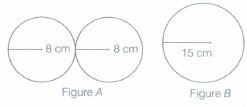
Below are the drawing two of cross-sections of two different pipes used to fill the swimming pools. Figure A is combination of 2 pipes each having radius of 8 cm. Figure B is a pipe having a radius of 15 cm. If the force of the flow of water coming out of the pipes is the same in both the cases, which will fill the swimming pool faster?
2.
A rectangular sheet of a paper is rolled in two different ways to form two different cylinders. Find the volume of cylinders in each case, if the sheet measures 44 cm\(\times\)33 cm.
3.
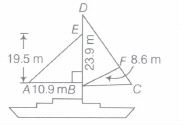
Most of the sailboats have two sails, the jib and the mainsail. Assume that the sails are triangles. Find the total area of each sail of the sailboats to the nearest tenth
4.
Horse stable is in the form of a cuboid, whose external dimensions are 70 m\(\times\)35 m\(\times\)40 m, surrounded by a cylinder halved vertically through diameter 35 m and it is open from one rectangular face 70 m\(\times\)40 m. Find the cost of painting the exterior of the stable at the rate of Rs 2 per m2. Also, verify your answer.
5.
A company sells biscuits. For packing purpose, they are using cuboidal boxes: box A⟶ 3 cm\(\times\) 8 cm\(\times\)20 cm and box B ⟶ 4 cm\(\times\)12 cm\(\times\)10 cm. What size of the box will be economical for the company? Why? Can you suggest any other size (dimensions) which has the same volume but is more economical than these?
6.
How will you arrange 12 cubes of equal length to form a cuboid of smallest surface area?
7.
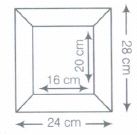
Diagram of the adjacent picture frame has outer dimensions 24 cm \(\times\) 28 cm and inner dimensions 16 cm \(\times\) 20 cm.Find the area of each section of the frame, it the width of each section is same.
8.
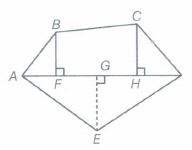
Polygon ABCDE is divided into parts as shown Find its area, if AD = 8 cm, AH=6cm, AG = 4cm, AF= 3cm and perpendiculars BF = 2 cm, CH= 3 cm, EG = 2. 5cm Areaof polygon ABCD = Area of ΔAFB+...
Area of ΔAFB =\(\frac { 1 }{ 2 } \times \) AF\(\times\) BF=\(\frac { 1 }{ 2 } \times \) 3\(\times\) 2 = ..
Area of trapezium FBCH = FH \(\times\)\(\frac { (BF+CH) }{ 2 } \)
= \(3\times \frac { (2+3) }{ 2 } \) +.... [∵ FH=AH-AF]
Area of ΔCHD =\(\frac { 1 }{ 2 } \times \) HD \(\times\) CH
Area of ΔADE =\(\frac { 1 }{ 2 } \times \) AD\(\times\) GE = ...
So,the area of polygon ABCDE =...
9.
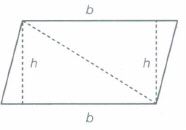
We know that parallelogram is also a quadrilateral. Let us also split such a quadrilateral into two triangles, find their areas and hence that of the parallelogram. Does this agree with the formula that you know already?
10.
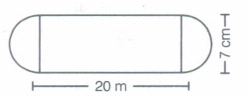
The shape of a garden is rectangular in the middle and semi-circular at the ends as shown in the diagram. Find the area and the perimeter of this garden. Length of rectangle is 20- (3.5+ 3.5) m.
11.
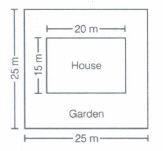
Mrs. Kaushik has a square plot with the measurement as shown in the figure. She wants to construct a house in the middle of the plot. A gardenis developed around the house. Find the total cost of developing a garden around the house at the rate of Rs.55 per m2
12.
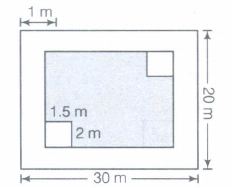
A rectangular park, whose length is 30 m and width is 20 m is shown in the following figure
(i) What is the total length of the fence surrounding it?
(ii) How much land is occupied by the park?
(iii) A path of 1 m width running inside along the perimeter of the park has to be cemented. How many bags of cement would be required to construct the cemented path, if 1 bag of cement is required to cement 4 m2area?
(iv) There are two rectangular flower beds of size 1.5 m \(\times\) 2 m each in the park as shown in the given figure and the rest has grass on it. Find the area covered by grass.
1.
Area of figure A, for radius 8 cm
=\(\pi\)r2h = \(\frac { 22 }{ 7 } \times \)8\(\times\)8=201.14 cm2
Since, there are two pipes.
∴ Area = 2\(\times\)201.14 = 402.28 cm2
Now, area of figure B, for radius 15 cm
=\(\pi\)r2 =\(\frac { 22 }{ 7 } \times \) 15\(\times\)15 = 707.14 cm2
Hence, pipe B fill the swimming pool faster.
2.
There are two cases
Case I When the rectangular sheet is rolled along its length, then length of the sheet forms the circumference of its base and breadth of sheet becomes the height of cylinder.
Let r cm be the radius of the base and h cm be the height.
Then, h = 33 cm
and circumference of the base = 44 cm
⇒2\(\pi\)r =44 2\(\times\)\(\frac { 22 }{ 7 } \)\(\times\)r⇒ =44
⇒ r =\(\frac { 44\times 7 }{ 2\times 22 } \)⇒ r = 7 cm
∴ Volume of the cylinder r =\(\pi\)r2h =\(\frac { 22 }{ 7 } \) \(\times\)7\(\times\)7\(\times\)33
= 5082 cm3
Case II When the rectangular sheet is rolled along its breadth, then breadth of the sheet forms the circumference of its base and length of the sheet becomes the height of the cylinder.
Now,h = 44 cm and circumference = 33 cm
⇒2\(\pi\)r =33⇒ 2\(\times\)\(\frac { 22 }{ 7 } \)\(\times\)r= 33 ⇒ r=33
⇒ r=\(\frac { 33\times 7 }{ 2\times 22 } \)⇒ r =\(\frac { 21 }{ 4 } \) cm
∴ Volume of the cylinder =\(\pi\)r2h= \(\frac { 22 }{ 7 } \times \frac { 21 }{ 4 } \times \frac { 21 }{ 4 } \times 4\)
= 3811.5 cm3
3.
In II-nd sailboat, area of sails is calculated below:
Area of ΔABE =\(\frac { 1 }{ 2 } \times \) Base\(\times\)Height
=\(\frac { 1 }{ 2 } \times \)10.9\(\times\)19.5 = 106.3 m2
Similarly, area of ΔBCD = 23.9\(\times\)8.6
= 102.8 m2
4.
We know that, the dimensions of cuboid, l=70 m, b = 35 m, h = 40 m,
diameter of cylinder is 35 m and cost of painting is Rs. 2 per m2
Area of cylindrical to be painted
\(\frac { 1 }{ 2 } \)\(\times\)Total surface area =\(\frac { 1 }{ 2 } \) [2\(\pi\) r(r+h)]
= \(\frac { 1 }{ 2 } \left[ 2\times \frac { 22 }{ 7 } \times \frac { 35 }{ 2 } \left( \frac { 35 }{ 2 } +70 \right) \right] \)=4812.5 m2
Area of cuboid to be painted = Area of three walls = lh+2bh
= 70\(\times\)40 + 2\(\times\)40\(\times\)35 = 2800 + 2800
= 5600 m2
Total area to be painted = 4812.5 + 5600=10412.5 m2
∵ Cost of painting per m2 = Rs. 2
∴ Cost of painting 10412.5 2 = Rs. 10412.5\(\times\)2 = Rs. 20825
Verification Verify your answer by adopting some other plan i.e. here in this problem instead of taking area in two steps, let us find in one step.
Area to be painted= Area of three walls + Area of cylindrical part
= 2bh+lh +\(\frac { 1 }{ 2 } \)[2\(\pi\)rh+2\(\pi\)r2]
= h[2b+l]+ [\(\pi\)R(r+h)]
= 40 [2\(\times\)35+70]+ \(\frac { 22 }{ 7 } \frac { 35 }{ 2 } \left( \frac { 35 }{ 2 } +70 \right) \)
= 40 [140] + 55\(\times\)87.5
= 5600+ 4812.5=10412.5m2
∴ Final cost (similar as in previous method) = Rs. 20825
5.
For box A,
Given, length of box = 20 cm
Breadth of box = 8 cm
and height of box = 3 cm
∴ Volume of the box = I \(\times\)b \(\times\)h = 20\(\times\)8\(\times\)3 cm3 =480 cm3
Total surface area of the box = 2(lb + bh + hl)
= 2(20\(\times\) 8 + 8\(\times\)3 + 3\(\times\)20) = 2\(\times\)(160+24+60) =2\(\times\)244 = 488 cm3
For box B,
Given, length of box = 12 cm
Breadth of box = 10 cm and height of box = 4 cm
∴ Volume of the box = I \(\times\) b \(\times\) h = 12 \(\times\) 10 \(\times\) 4 = 480 cm3
Total surface are of the box = 2 (lb + bh + hl)
= 2(120 + 40 + 48) = 2\(\times\)208 = 416cm2
It is clear from above that both boxes have same volume, but the surface area of type B box is less than that of type A box.
Thus, material required for box B is less.
∴ Box B is more economical than box A.
Now, let another box of size be 12 cm\(\times\)8 crn\(\times\)5cm
Volume of this box = 12\(\times\)8\(\times\)5 = 480 cm3
and its surface area =2(lb + bh + hl) = 2(12\(\times\)8 + 8\(\times\)5 + 5\(\times\)12)
= 2(96 + 40 + 60) = 2\(\times\)196 = 392
Clearly, surface area of this box is less than that of box B
Hence, we can suggest any other box of size 12 cm\(\times\)8 cm \(\times\)5 crn, which has the same volume buts is more economical than the given boxes.
6.
There are some cases in which we can arrange 12 cubes of equal length say b to form a cuboid, as follows:
Case I: We can arrange 12 cubes of equal length as shown in the figure.
Here, length (L) = 2b, breadth (B) = band height (H) = 6b
∴ Total surface area of the cuboid
= 2(LB + BH + HL)
= 2(2b\(\times\)b + b\(\times\)6b + 6b\(\times\)2b)
= 2(2b2 + 6b2 + 12b2)
= 2\(\times\)20b2 = 40b2
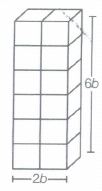
Case II We can arrange 12 cubes of equal length as shown in the figure.
Here, length (L) = 6b, breadth (B) = b and height (H) = 2b
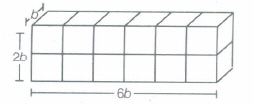
∴ Total surface area of the cuboid = 2(LB + BH + HL)
= 2(6b\(\times\)b+ 2b+2b\(\times\)6b)
= 2(6b2+2b2+12b2) = 2\(\times\)20b2 =40b2
Case III We can arrange 12 cubes of equal length as shown in the figure.
Here, length, L = 4 b, breadth, B = band height, H = 3b
∴ Total surface area of the cuboid
=2(LB+BH+HL)
= 2(4b\(\times\)b+b\(\times\)3b+3b\(\times\)4b)
=2(4b2+3b2+12b2) = 2 19b2 = 38b2
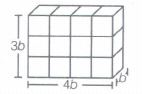
Case IV
We can arrange 12 cubes of equal length as shown in the figure. Here, length (L) = 3b,breadth (B) = 2b and height (H) = 2b
∴ Total surface area of the cuboid
= 2(LB + BH + HL) = 2(3b\(\times\)2b + 2b\(\times\)2b + 2b\(\times\)3b)
= 2(6b2 + 4b2 + 6b2) = 216b2 =32b2
It is clear from the above cases that in Case IV, we get minimum surface area.
So, we arrange 12 cubes according to Case IV to get smallest surface area.
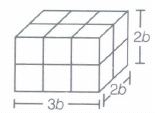
7.
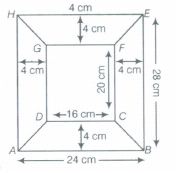
The diagram of the picture frame is as shown in the figure: The picture frame has four trapezium shaped sections, which are ABCD, BEFC, EHGF and HADG.
Out of these four sections, the area of opposite sections will be same
i.e area of section ABCD = Area of section EHGF and area of section BEFC = Area of section HADG
Width of section ABCD =\(\frac { (AH-DG) }{ 2 } =\frac { (28-20) }{ 2 } =\frac { 8 }{ 2 }\) = 4cm
[∵ width of EFGH and ABCD is same]
Then, width of each section is 4 cm.
Now, area of trapezium ABCD
=\(\frac { 1 }{ 2 } \) (AB+CD)\(\times\) Width of frame
= \(\frac { 1 }{ 2 } \)\(\times\)(24+16)\(\times\) 4 =\(\frac { 1 }{ 2 } \) 40\(\times\) 4 = 80 m2
and area of trapezium BEFC
= \(\frac { 1 }{ 2 } \)(BE + CF) \(\times\)Width of frame
= \(\frac { 1 }{ 2 } \)(28 + 20)\(\times\) 4 =\(\frac { 1 }{ 2 } \) \(\times\)48\(\times\) 4 = 96m2
∴ Area of section ABCD =Area of section EHGF = 80 cm2 and area of section BEFC = Area of section HADG = 96 cm2
8.
Given, polygon ABCDE is divided into four parts, so it is clear from given figure that
Area of polygon ABCDE =Area of ΔAFB + Area of trapezium FBCH + Area of ΔCHD+ Area of ΔADE ....(i)
Also, AD =8 cm, AH=6cm, AG = 4cm, AF=3 cm,BF = 2 cm, CH = 3 cm and EG = 2.5 cm
Now, area of ΔAFB = AF \(\times\)BD =\(\frac { 1 }{ 2 } \times \) 3\(\times\) 2 = 3 cm2
Area of trapezium FBCH = \(\frac { 1 }{ 2 } \times \)FH \(\times\)(BF+CH)
= \(\frac { 1 }{ 2 } \times \)3 \(\times\)(2+3)
[∵ FH= AH - AF=6 -3 =3 cm ]
=\(\frac { 1 }{ 2 } \times \) 3 \(\times\)5 = =7.5 cm2
Area of ΔCHD =\(\frac { 1 }{ 2 } \times \) HD \(\times\)CH
=\(\frac { 1 }{ 2 } \times \) (AD-AH)\(\times\) CH [∵ HD=AD-AH]
=\(\frac { 1 }{ 2 } \times \) (8-6)\(\times\)3 =\(\frac { 1 }{ 2 } \times \) 2\(\times\)3 = 3 cm2
Now, area of ΔADE =\(\frac { 1 }{ 2 } \times \) AD\(\times\) GE =\(\frac { 1 }{ 2 } \times \) 8\(\times\) 2.5
= 4\(\times\) 2.5 = 10 cm2
On putting all these values in Eq. (i), we get
Area of polygon ABCDE = (3 + 7.5 + 3 + 10) = 23.5 cm2
9.
Let ABCD be a given quadrilateral, which is a parallelogram. Join the diagonal BD of the parallelogram ABCD and it divides the parallelogram into two ΔABD and ΔBCD.
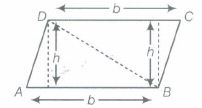
Then, area of parallelogram ABCD = Area of ABD + Area of ΔBCD.
= \(\frac { 1 }{ 2 } \)\(\times\)AB\(\times\) h + CD\(\times\) h
= \(\frac { 1 }{ 2 } \)\(\times\) b \(\times\)h + b \(\times\)h
= \(\frac { bh }{ 2 } +\frac { bh }{ 2 } =\frac { bh+bh }{ 2 } =\frac { 2bh }{ 2 } \) = bh sq units
We know that,
Area of parallelogram = Base \(\times\) Height
= b \(\times\)h = bh sq units
We also know that, a parallelogram can also be a trapezium.
∴ Area of trapezium ABCD =\(\frac { 1 }{ 2 } \) \(\times\)(Sum of parallel lines) \(\times\)(Perpendicular distance between the parallel sides)
=\(\frac { 1 }{ 2 } \)\(\times\) (b + h) \(\times\)h
=\(\frac { 1 }{ 2 } \) \(\times\)2b\(\times\)h = bh sq units
Hence, we can say that the above relation agrees with formula that we know already.
10.
Given, the shape of a garden is rectangular in middle and semi-circular at both ends.
Also, diameter of circular part = 7 m
∴ Radius of circular part = \(\frac { 7 }{ 2 } \)= 3.5 m
Then, length of rectangular part = 20m -(3.5+3.5)m and breadth of rectangular part = 7 m
Now,area of one semi-circular part = \(\frac { 1 }{ 2 } { \pi r }^{ 2 }\)
where, r is the radius of semi-circle.
∴ Area of both semi-circular parts = \(2\times \frac { 1 }{ 2 } { \pi r }^{ 2 }={ \pi r }^{ 2 }\)
= \(\frac { 22 }{ 7 } \times \left( \frac { 7 }{ 2 } \right) ^{ 2 }\) \(\left[ \because \pi =\frac { 22 }{ 7 } \right] \)
= \(\frac { 22 }{ 7 } \times \frac { 49 }{ 7 } =\frac { 77 }{ 2 } \) m2
Area of rectangular part = Length \(\times\) Breadth
= 13m\(\times\) 7m = 91m2
∴ Area of garden = Area of both circular parts + Area of rectangular part
=\(\frac { 77 }{ 2 } \) + 91 m2
=\(\left( \frac { 77+182 }{ 2 } \right) { m }^{ 2 }\)= 129.5 m2
Now, Perimeter of one semi-circle part = \(\frac { 2\pi r }{ 2 } =\pi r\)
∴ Perimeter of both semi-circle parts = \(2\times \frac { 22 }{ 7 } \times \frac { 7 }{ 2 } \) =22m
Here, rectangular part is in between two semi-circular parts, so for perimeter of garden, we will take only length of rectangular part.
∴ Perimeter of garden = Perimeter of both circular parts + 22 \(\times\) Length of rectangular part
= 22 + 2 \(\times\)13 = (22+26) m = 48m
11.
Given side of square plot = 25 m
∴ Area of square plot = (Side)2 = 25\(\times\) 25 = 625 m2
From the figure, it is clear that constructed portion, i.e. house is in rectangular shape. It has length 20 m and breadth 15 m.
So, area of the constructed house = Length\(\times\) Breadth
= 20 \(\times\)15 = 300 m2
∴ Area of the garden = Area of square plot - Area of constructed house
= 625 - 300 = 325 m2
It is given that, the cost of developing the garden
= Rs 55 per m2
∴ Total cost of developing the garden
= Rs (55 \(\times\)325) = Rs.17875
12.
(i) Total length of the fence surrounding it = Perimeter of -he park = 30m + 20m + 30m + 20m = 100 m
(ii) Land occupied by the park = Area of the park = (30 \(\times\) 20) m2 = 600 m2
(iii) Area of cemented path = Area of the park - Area of the park left after cementing the path
= 600 m2 - [(30 - 2) \(\times\) (20 - 2)] m2 = 600 m2 - (28 \(\times\) 18) m2 = 600 m2 - 504 m2 = 96 m2
Number of cement bags = \(\frac { Area\quad of\quad the\quad path }{ Area\quad cemented\quad by\quad 1\quad bag } =\frac { 96 }{ 4 } \)=24
(iv) Area covered by the grass =Area of the park left after cementing the path - Area of rectangular beds
= 504 m2 -2(1.5 2)m2= 504m2-6m2=498m2

8th Standard CBSE Syllabus & Materials
8th Standard CBSE
CBSE 8th Science Particulate Nature of Matter - New Model Questions Papers Study Material - QB365 Set A
NEW8th Standard CBSE
CBSE 8th Science Pressure, Winds, Stroms and Cyclones - New Model Questions Papers Study Material - QB365 Set A
NEW8th Standard CBSE
CBSE 8th Mathematics Quadrilaterals - New Model Questions Papers Study Material - QB365 Set A
NEW8th Standard CBSE
CBSE 8th Mathematics A story of Numbers - New Model Questions Papers Study Material - QB365 Set A



CBSE 8th Standard CBSE Subjects
CBSE Standards




