
 100% FREE ACCESS
8th Standard CBSE Syllabus & Materials
8th Standard CBSE
CBSE 8th Social Science Theme D - Factors of Production - New Model Questions Papers Study Material - QB365 Set A
NEW8th Standard CBSE
CBSE 8th Social Science Theme C - Universal Franchise and India's Electoral System - New Model Questions Papers Study Material - QB365 Set A
NEW8th Standard CBSE
CBSE 8th Social Science Theme B - The Rise of the Marathas - New Model Questions Papers Study Material - QB365 Set A
NEW8th Standard CBSE
CBSE 8th Social Science Theme B - Reshaping India's Political Map - New Model Questions Papers Study Material - QB365 Set A
NEW8th Standard CBSE
CBSE 8th Social Science Theme A - Natural Resources and Their Use - New Model Questions Papers Study Material - QB365 Set A
NEW8th Standard CBSE
CBSE 8th Science Keeping Time with Skies - New Model Questions Papers Study Material - QB365 Set A

Published on: 17/10/2019
Chemical Effects of Electric Current
Download CBSE Class 8th Standard CBSE Science question papers, sample papers, important questions, and previous year solved papers in PDF format. Get free study materials, NCERT solutions, and exam preparation resources for Class 8th Standard CBSE Science
Questions + Answers key
Take MCQ Science Test
1.
What is electroplating? What are its advantages?
2.
One day Ram was performing and experiment. He was trying to design an electric circuit in which he included tester, bulb and a battery. He had so much eagerness regarding this experiment that in so much hurry, he forgot to take the connecting wires of aluminium. He took the wires without any coating of PVC on them, so it could be dangerous for him. Any how, he managed to design an electric circuit but the moment, he switched ON the circuit, a spark produces and bulb get fused with a small sound. He was about to touch those wires and heated bulb with his bare hands, at the same time, his teacher suggested him to perform the experiment by taking precautions.
(a) Explain, what could be happened, if Ram would touch the electric bulb with his bare hands.
(b) Mention why should he use the aluminium wires in his experiment.
(c) State the values shown by Ram's teacher here.
3.
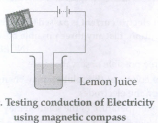
Observing that the bulb does not glow in the circuit shown in Fig. (a) Boojho changed the circuit as shown in Fig. (b). He observed deflection in the magnetic compass.
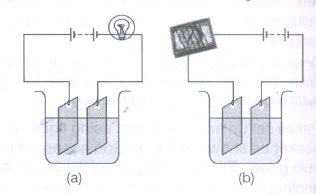
(a) What does the deflection in magnetic compass indicate?
(b) Why did the bulb not glow in Fig. (a)?
(c) What would be the effect of increase in the number of turns in the coil wound around the magnetic compass in Fig. (b)?
4.
Observe the circuit given in figure.
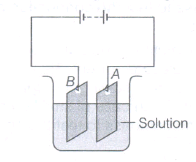
Boojho set up this circuit for purification of copper. What will be the nature of
(a) plate A
(b) plate B
(c) and the solution. Explain the process of purification
5.
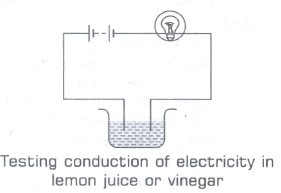
Prove that lemon juice and vinegar are good conductors of electricity.
6.
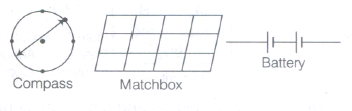
You are provided with a magnetic compass, an empty matchbox, a battery of two cells and connecting wires. Using these objects, how will you make a tester for testing an electric circuit? Draw the necessary circuit diagram and explain.
7.
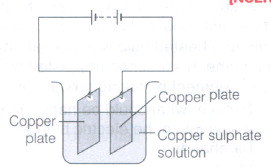
In the circuit given in the figure, Boojho observed that copper is deposited on the electrode connected to the negative terminal of the battery. Paheli tried to repeat the same experiment. But she could find only one copper plate. Therefore, she took a carbon rod as negative electrode. Will copper be still deposited on the carbon rod? Explain your answer.
8.
Discuss two methods of testing a conductor or an insulator
1.
Electroplating is the process of depositing a layer of any desired metal on another metal by means of electricity.
Advantages of electroplating:
(i) It is used to coat a desired metal on another metal.
(ii) It protects the metals from corrosion.
(iii)It also prevents the metallic surface from rusting.
(iv) Some cheap and dull metals are coated with costly and shinning metals for ornamental use.
(v) It can make more reactive metals like iron less reactive.
(vi) Coating of chromium on metals gives luster to object
2.
(a) If Ram touched the heated electric bulb, then his hands could get a serious burn and he would not be able to perform the experiment again with the same desire.
(b) Since aluminium is a good conductor of electricity and mostly, it has been seen that aluminium wires are used for performing the experiment instead of wires without having PVC coating on them.
(c) Ram's teacher has a great concern towards Ram, so that he can perform the experiment carefully and can get its fruitful conclusion
3.
(a) The deflection in the magnetic compass shows that the current is flowing in the circuit.
(b) The bulb did not glow, it may be because of the current passing through the circuit could be weak. Also, it may happen because of other reasons like due to bulb fused or the connections may be loose.
(c) Increase in the number of turns in the coil wound around the magnetic compass would increase the magnetic field around the magnetic compass which will result in the flowing of large amount of current through the circuit.
4.
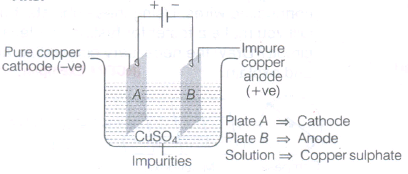
We take CuS04 solution and dip a pure copper plate as cathode (-ve) and impure copper plate as anode (+ve). Due to voltage of battery, the impurities from the impure sample slowly deposit at the bottom and the copper plate becomes purified .
5.
Take a few plastics or rubber caps of bottles. Put one teaspoon of lemon juice or vinegar in one cap. Now, bring the tester over the cap and let the ends of the tester dip into lemon juice or vinegar. So, we see that bulb starts to glow. It indicates that lemon juice and vinegar are good conductors of electricity.
6.
Take the tray from the inside of a discarded matchbox. Wrap an electric wire a few times around the tray. Place a small compass needle inside it. Now connect one free end of the wire to the one terminal of a battery. Leave the other end free.
Take another piece of wire and connect it to the other terminal of the battery. Join the free ends of two wires momentarily. The compass needle should show deflection. Your tester with two free ends of the wire is ready.
7.
Copper will not be deposited on the carbon rod because carbon rod is a poor conductor of electricity. For electroplating, the circuit must be completed and that can be completed only by using the conducting material. Instead of carbon rod, it should be any metal, then only it can be electroplated.
8.
The following methods are used to test the conduction:
(i)The conductivity of substance can be checked by using electric bulb. When the liquid between the two ends of the tester allows the electric current to pass, the circuit of the tester becomes complete. The current flows in the circuit and the bulb glows. If the circuit of tester is not complete the bulb does not glow. This method does not work when current is very small.
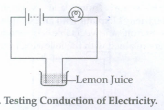
(ii) We can use another effect of electric current to test the conduction. A magnetic tester is also used to test conductivity. When current is allowed to pass through it, it creates a magnetic field and the compass shows that the current is passing through circuit

8th Standard CBSE Syllabus & Materials
8th Standard CBSE
CBSE 8th Science Particulate Nature of Matter - New Model Questions Papers Study Material - QB365 Set A
NEW8th Standard CBSE
CBSE 8th Science Pressure, Winds, Stroms and Cyclones - New Model Questions Papers Study Material - QB365 Set A
NEW8th Standard CBSE
CBSE 8th Mathematics Quadrilaterals - New Model Questions Papers Study Material - QB365 Set A
NEW8th Standard CBSE
CBSE 8th Mathematics A story of Numbers - New Model Questions Papers Study Material - QB365 Set A



CBSE 8th Standard CBSE Subjects
CBSE Standards




