
 100% FREE ACCESS
8th Standard CBSE Syllabus & Materials
8th Standard CBSE
CBSE 8th Social Science Theme D - Factors of Production - New Model Questions Papers Study Material - QB365 Set A
NEW8th Standard CBSE
CBSE 8th Social Science Theme C - Universal Franchise and India's Electoral System - New Model Questions Papers Study Material - QB365 Set A
NEW8th Standard CBSE
CBSE 8th Social Science Theme B - The Rise of the Marathas - New Model Questions Papers Study Material - QB365 Set A
NEW8th Standard CBSE
CBSE 8th Social Science Theme B - Reshaping India's Political Map - New Model Questions Papers Study Material - QB365 Set A
NEW8th Standard CBSE
CBSE 8th Social Science Theme A - Natural Resources and Their Use - New Model Questions Papers Study Material - QB365 Set A
NEW8th Standard CBSE
CBSE 8th Science Keeping Time with Skies - New Model Questions Papers Study Material - QB365 Set A

Published on: 15/12/2018
The important questions provided below will also make students familiar with the marking scheme and the difficulty level of the exam. The important questions for CBSE class 8 Social Science are prepared by subject experts according to the latest syllabus of CBSE. Students are advised to solve these important questions which can make them more focused on their exam and also bring a sense of discipline and seriousness in their exam preparation.
The Central Board of Secondary Education (CBSE) is a prestigious educational board which comes under the Union Government of India. Here, you will get the clue that from where and how the questions are being framed from the chapter Judiciary for CBSE class 8 Social Science. These questions can provide students a chapter wise preparation strategy so that they can prepare for their exam more efficiently.
The National Council of Education and Training sets the curriculum for all schools that follow the Central Board of Secondary Education (CBSE) across the nation. Creative questions were added in this question paper in order to enhance the student's knowledge and get the idea that how to answer strategic questions asked in the board exams. This question paper is designed based on the academic syllabus. Sample papers should be practiced in examination condition at home or school and also show it to your teachers for checking or compare with the answers provided.
Download CBSE Class 8th Standard CBSE Social Science question papers, sample papers, important questions, and previous year solved papers in PDF format. Get free study materials, NCERT solutions, and exam preparation resources for Class 8th Standard CBSE Social Science
Questions + Answers key
Take MCQ Social Science Test
1.
What values can be learned from the functioning of Indian Judiciary?
2.
The Judiciary has played a crucial role in democratic India. Justify the statement.
3.
Write two sentences of what you understand about the appellate system from the case .
4.
There are 29 States but only:
24 High Courts
25 High Courts
26 High Courts
27 High Courts
5.
To ensure the independence of the judiciary in India:
The Parliament can give judgement in criminal cases.
The judges can be easily removed.
Our Constitution has various provisions that keep it free from the influence of the legislature and executive.
The executive can overrule the judgement given by the Supreme/High courts.
6.
Civil cases are related to :
kidnapping
cheating
disputes over property
robberies
7.
An individual can go to the Supreme Court to appeal against the judgement of the :
Lok Adalats
Nyaya Panehayats
High Court
District Court
8.
The Supreme Court of India consists of the Chief Justice and:
28 other judges
27 other judges
25 other judges
26 other judges
9.
Which is the highest judicial authority in a state?
The Supreme Court
The High Court
The District Court
Subordinate Court
10.
What is the full form of PAC?
Private Armed Constabulary
Provincial Armed Constabulary
Provincial Art Collection
Public Art Community
11.
Which Article of the Constitution established the Right to Life?
Article 14
Article 15
Article 18
Article 21
12.
Which two states share a common High Court?
Punjab and Haryana
Delhi and Punjab
Delhi and Haryana
Madhya Pradesh and Chhattisgarh
13.
Total number of High Courts is India
19
24
25
28
14.
Which organisation filed the PIL in the Supreme Court against government for the food shortage in year 2001?
15.
What is referred to as the supreme law of the land?
16.
What is rule of law?
17.
Which is the highest judicial authority in a state?
18.
What are judicial precedents ?
19.
What is judiciary ?
20.
How many levels of courts are there in our country?
21.
What do you mean by apex court?
22.
Name some issues which come under civil law.
23.
Where is the Supreme Court located?
24.
Describe different branches of legal system.
25.
The structure of the courts from the lower to the highest level is such that it resembles a pyramid, Having read the description above, can you fill out which type of courts would exist at which level in the following diagram?

26.
Are the decisions made by Supreme Court binding on other courts including Supreme Court itself ?
27.
What is court of record?
28.
Why is judiciary important?
29.
How has judicial activism influenced our political system?
1.
One must conclude after examining the functions of Indian Judiciary that it plays a critical role in its democracy. It protects the citizens of the country against any possible misuse of authority by the Legislature and Executive.
Moreover, a citizen can go to the Judiciary directly to seek justice in case his/her Fundamental Rights have been violated.
From this, I have learned the value and importance of Indian Judiciary in strengthening the country's democracy besides my personal well-being.
2.
The Judiciary has played a crucial role in democratic India in the following ways:
(i) It serves as a check on the powers of the Executive and Legislature.
(ii) It protects the Fundamental Rights of citizens against other citizens and the state.
3.
1. The appellate system of the Indian Judiciary is one through which an appeal is made in the higher court against the judgement of the lower court if the person is not satisfied with the verdict.
2. In the case 'State (Delhi Administration) Vs Laxma n Kumar and others', the three accused went to the High Court to appeal against the verdict of the Trial Court and later women's organisation appealed against the High Court decision in the Supreme Court through the Indian Federation of women lawyers.
4.
(a)
24 High Courts
5.
(c)
Our Constitution has various provisions that keep it free from the influence of the legislature and executive.
6.
(c)
disputes over property
7.
(c)
High Court
8.
(c)
25 other judges
9.
(b)
The High Court
10.
(b)
Provincial Armed Constabulary
11.
(d)
Article 21
12.
(a)
Punjab and Haryana
13.
(b)
24
14.
()
People's Union of Civil Liberties (PUCL) had filed the PIL in the Supreme Court against government for the food shortage in year 2001.
15.
()
The Constitution is referred to as the supreme law of the land
16.
()
Both rulers and the ruled are subject to the same law and the government does not rule in an arbitrary manner.
17.
()
High Court.
18.
()
Past judicial decisions which serve as a guide for the future are known as judicial precedents.
19.
()
Judiciary is an organ of government which settles disputes through interpretation of law.
20.
()
There are three different levels of courts in our country.
21.
()
Apex court refers to the court at the highest level in the Indian judicial system i.e. the Supreme Court
22.
()
Disputes related to sale or purchase of land or other goods, rent matters, divorce cases etc. come under civil law.
23.
()
The Supreme Court is located at Mathura Road in New Delhi.
24.
Criminal Law:
(i) Deals with conduct or acts that the law defines as offences. For example, theft, harassing a woman to bring more dowry, murder, etc.
(ii) It usually begins with the lodging of a First Information Report (FIR) with the police who investigate the crime, after which a case is filed in the court.
(iii) If found guilty, the accused can be sent to jail and can also be fined.
Civil Law:
(i) Deals with any harm or injury to rights of individuals. For example, disputes relating to sale of land, purchase of goods, rent matters, divorce cases, etc.
(ii) A petition has to be filed before the relevant court by the affected party only. In a rent matter, either the landlord or tenant can file a case.
(iii) The court gives the specific relief asked for. For instance, in a case between a landlord and a tenant, the court can order the flat to be vacated and pending rent to be paid.
25.
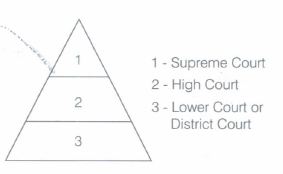
26.
Decisions made by the Supreme Court are binding on all others courts within the territory of India. Orders passed by it are enforceable throughout the country. The Supreme Court itself is not bound by its decision and can, at any time, review it. Besides, if there is a case of contempt of Supreme Court, then the Supreme Court itself decides such a case.
27.
The Supreme Court also acts as a Court of Record. Its decisions are printed and they act as precedent in other cases. The Supreme Court is empowered to punish a person even for contempt of court.
28.
Judiciary is important as it settles disputes and performs several other interpretative functions. Independence of judiciary is necessary to protect the liberty of individuals. It is the foundation stone of democracy.
29.
Judicial activism has influenced our political system in many ways. It has democratised the judicial system by giving not just individuals, but also groups access to the courts. Secondly, it has forced executive accountability. Thirdly, it has also made an attempt to make the electoral system much more free and fair.The Court asked candidates contesting elections to file affidavits indicating their assets and income along with educational qualifications, so that people could elect their representatives based on accurate knowledge.

8th Standard CBSE Syllabus & Materials
8th Standard CBSE
CBSE 8th Science Particulate Nature of Matter - New Model Questions Papers Study Material - QB365 Set A
NEW8th Standard CBSE
CBSE 8th Science Pressure, Winds, Stroms and Cyclones - New Model Questions Papers Study Material - QB365 Set A
NEW8th Standard CBSE
CBSE 8th Mathematics Quadrilaterals - New Model Questions Papers Study Material - QB365 Set A
NEW8th Standard CBSE
CBSE 8th Mathematics A story of Numbers - New Model Questions Papers Study Material - QB365 Set A



CBSE 8th Standard CBSE Subjects
CBSE Standards




