
 100% FREE ACCESS
8th Standard CBSE Syllabus & Materials
8th Standard CBSE
CBSE 8th Social Science Theme D - Factors of Production - New Model Questions Papers Study Material - QB365 Set A
NEW8th Standard CBSE
CBSE 8th Social Science Theme C - Universal Franchise and India's Electoral System - New Model Questions Papers Study Material - QB365 Set A
NEW8th Standard CBSE
CBSE 8th Social Science Theme B - The Rise of the Marathas - New Model Questions Papers Study Material - QB365 Set A
NEW8th Standard CBSE
CBSE 8th Social Science Theme B - Reshaping India's Political Map - New Model Questions Papers Study Material - QB365 Set A
NEW8th Standard CBSE
CBSE 8th Social Science Theme A - Natural Resources and Their Use - New Model Questions Papers Study Material - QB365 Set A
NEW8th Standard CBSE
CBSE 8th Science Keeping Time with Skies - New Model Questions Papers Study Material - QB365 Set A

Published on: 27/07/2019
Ruling the Countryside
Download CBSE Class 8th Standard CBSE Social Science question papers, sample papers, important questions, and previous year solved papers in PDF format. Get free study materials, NCERT solutions, and exam preparation resources for Class 8th Standard CBSE Social Science
Questions + Answers key
Take MCQ Social Science Test
1.
The British smuggled and sold:
Indigo to China
Cotton to China
Opium to China
Coffee to China
2.
The Permanent Settlement of Bengal was introduced by Lord Cornwallis in:
1763
1773
1783
1793
3.
Cinchona trees provide raw material for making:
Quinine
Mats and ropes
Rubber
Beverages.
4.
The Permanent Settlement was introduced at the time of
Charles Cornwallis
Thomas Munro
Lord Dalhousie
Warren Hastings
5.
In 1788, only about 30 per cent of the indigo was exported to Britain from India which rose to which per cent by 1810?
70 per cent
80 per cent
95 per cent
85 per cent
6.
Who was the Governor of Madras in 1819 to 1826?
Thomas Munro
William Bentinck
Thomas Disilva
Warren Hastings
7.
In which of the following states about ten million people were killed in the terrible femine of 1770?
Bengal
Punjab
Bihar
Odisha
8.
The French began cultivating indigo in Brazil and Jamaica.
9.
Mahatma Gandhi visited Champaran in 1917.
10.
Gomasthas were the agents appointed by planters.
11.
Industrialization was not the cause of growing demand of indigo in the end of the eighteenth century
12.
The conditions of under-tenants in Bengal was described by H.T. Colebrook in 1806.
13.
A fermenting of storage vessel
14.
A unit of measurement of land
15.
Nij
16.
12th August 1765
17.
1819-26
18.
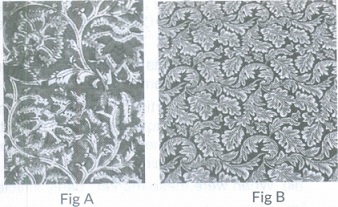
(i) Who designed and produced the floral cotton design in the pictures of Fig A and Fig B?
(ii) How was the blue in these prints produced?
(iii) What do you know about Kalamkari art?
19.
Why was there great demand for Indian indigo in foreign market?
20.
Why do you think Colebrook is concerned with the conditions of the under-ryots in Bengal? Read the preceding pages and suggest possible reasons.
21.
The two main systems of Indigo cultivation were _____ and ______.
22.
The French began cultivating Indigo in _____
23.
India was the biggest supplier of ____ in the world.
24.
By the late eighteenth century, the company was trying its best to expand the cultivation of _____ and ______
25.
______ felt that the village was an important social institution in north Indian society.
26.
The Champaran movement was against .................
27.
The international demand for indigo was affected by the discovery of .................
28.
Growers of woad in Europe saw ..................... as a crop which would provide competition to their earnings.
29.
Who was Amani?
30.
When was permanent settlement introduced in India?
31.
How did Company purchase goods in India before 1865?
32.
When did the Mahalwari system come into existence?
1.
(c)
Opium to China
2.
(d)
1793
3.
(a)
Quinine
4.
(a)
Charles Cornwallis
5.
(c)
95 per cent
6.
(a)
Thomas Munro
7.
(a)
Bengal
8.
(b)
9.
(a)
10.
(a)
11.
(b)
12.
(b)
13.
()
Vat
14.
()
Bigha
15.
()
Cultivation on planter's own land
16.
()
The Company got Diwani of Bengal
17.
()
Period of Thomas Munro
18.
(i) The picture in Fig A is Kalamkari print. It was created by weavers of Andhra Pradesh in India. The picture in Fig B is a floral cotton print. It was designed and produced by William Morris, a famous poet and artist of 19th century Britain.
(ii) In both of these prints, the blue colour was produced by indigo. This indigo gave rich blue colour and was produced in India.
(iii) Kalamkari is a type of hand-painted or block-printed cotton textile, produced in parts of India. It is also produced in Iran. There are two distinctive styles of Kalamkari art in India.
19.
(i) The European cloth manufacturers used indigo to dye the clothes.
(ii) It produced a rich blue colour which was used for the purpose of dyeing.
(iii) Indigo plant grows only in the tropical regions and it was impossible to grow indigo in temperate climate of Europe.
20.
Colebrook is concerned with the conditions of the under-ryots or under-tenants in Bengal. These depressing conditions are due to some social economic reasons which are as follows:
In 1765, the British East India Company got the Diwani of Bengal.
The Company was only interested to collect a large amount of revenue with which it could purchase fine cotton and silk from India.
Artisans were paid very low prices, so they fled from villages.
Agricultural production collapsed, the under-ryots could not pay the high rate of revenues.
About one-third population of Bengal was wiped out in famine of 1770.
The Permanent Settlement (1793) fixed a high rate of revenue which was not changeable in any condition.
Zamindars had no interest in improving the conditions of land .
21.
()
Nij, Ryoti
22.
()
St. Domingue
23.
()
Indigo
24.
()
Opium, Indigo
25.
()
Holt Mackenzie
26.
()
indigo planters
27.
()
synthetic dyes
28.
()
indigo
29.
()
The person appointed by the Government in the south to collect land revenue was called Amani.
30.
()
It was introduced in 1793.
31.
()
Before 1865, the East India Company had purchased goods in India by importing gold and silver from Britain.
32.
()
In 1822, the Mahalwari system came into existence.

8th Standard CBSE Syllabus & Materials
8th Standard CBSE
CBSE 8th Science Particulate Nature of Matter - New Model Questions Papers Study Material - QB365 Set A
NEW8th Standard CBSE
CBSE 8th Science Pressure, Winds, Stroms and Cyclones - New Model Questions Papers Study Material - QB365 Set A
NEW8th Standard CBSE
CBSE 8th Mathematics Quadrilaterals - New Model Questions Papers Study Material - QB365 Set A
NEW8th Standard CBSE
CBSE 8th Mathematics A story of Numbers - New Model Questions Papers Study Material - QB365 Set A



CBSE 8th Standard CBSE Subjects
CBSE Standards




