
 100% FREE ACCESS
8th Standard CBSE Syllabus & Materials
8th Standard CBSE
CBSE 8th Social Science Theme D - Factors of Production - New Model Questions Papers Study Material - QB365 Set A
NEW8th Standard CBSE
CBSE 8th Social Science Theme C - Universal Franchise and India's Electoral System - New Model Questions Papers Study Material - QB365 Set A
NEW8th Standard CBSE
CBSE 8th Social Science Theme B - The Rise of the Marathas - New Model Questions Papers Study Material - QB365 Set A
NEW8th Standard CBSE
CBSE 8th Social Science Theme B - Reshaping India's Political Map - New Model Questions Papers Study Material - QB365 Set A
NEW8th Standard CBSE
CBSE 8th Social Science Theme A - Natural Resources and Their Use - New Model Questions Papers Study Material - QB365 Set A
NEW8th Standard CBSE
CBSE 8th Science Keeping Time with Skies - New Model Questions Papers Study Material - QB365 Set A

Published on: 30/07/2019
Tribals, Dikus and the Vision of a Golden Age
Download CBSE Class 8th Standard CBSE Social Science question papers, sample papers, important questions, and previous year solved papers in PDF format. Get free study materials, NCERT solutions, and exam preparation resources for Class 8th Standard CBSE Social Science
Questions + Answers key
Take MCQ Social Science Test
1.
What did Birsa mean when he talked of a 'Golden Age'?
2.
What problems did shifting cultivators face under British rule?
3.
Find out whether the conditions of work in the mines have changed now. Check how many people die in mines every year and what are the reasons for their death.
4.
The golden age of the Mundas was when:
they were free from the oppression of 'dikus'
they collected forest produce
they went to herd animals
British officials did not enter their villages
5.
Most tribals like Khonds of Orissa:
practised shifting cultivation
lived by herding and rearing of animals
practised subsistence farming
collected and sold forest products
6.
___________ were flowers used to dye clothes and color leather.
Mahua and sal
Kusum and sleeper
Palash and kusum
Palash and rnahua
7.
Where does the term 'Bewar' mean shifting cultivation?
Jharkhand
Madhya Pradesh
North-East India
Andhra Pradesh
8.
The Mahua is a flower
used to flavour food cooked by the tribals.
used for dyeing the clothes by the tribals.
used to make alcohol.
blooms in summer.
9.
What do you mean by the term ' Hut'?
10.
When was Inner Line Regulation introduced?
11.
Name the four geographic regions where Adivasis predominantly live in.
12.
Where did khonds live?
13.
What privileges did the tribal chiefs lose with the arrival of the British?
14.
What were the problems faced by tribals during British rule?
15.
How were the traders and moneylenders the major cause of the tribals' misery?
16.
Tribals went to work in the of________ Assam and the__________ in Bihar.
17.
The tribal chiefs got ___________ titles in Central India under the British land settlements.
18.
The method of sowing seeds in jhum cultivation is known as___________
19.
The British described the tribal people as_________
20.
Birsa spent some time in the company of a prominent ___________ preachers.
21.
Birsa Munda died in 1906
22.
The revolt of Songram Sangma took place in 1906.
23.
Reserved forests produced timber which the Britishers wanted.
24.
Cocoons were bought from the Santhals and sold by the traders at five times the purchase price.
25.
Jhum cultivators plough the land and sow seeds.
26.
A tribal group of Orissa
27.
Worshippers of Vishnu
28.
A flower used to colour clothes
29.
A tribal group who were shepherds
30.
A place where cocoons were reared
31.
How did the tribals react against the forest laws?
32.
This is a picture of Santhal girl carrying firewood. On the basis of the given picture, answer the following questions:
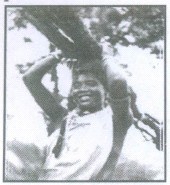
(i) What is the occupation of the Santhals?
(ii) Why were the Santhai unhappy under the British Raj?
1.
Birsa meant by the 'Golden Age', a satyug (the age of truth). In this age, Mundas lived a good life, constructed embankments, tapped natural springs, planted trees and orchards, practised cultivation to earn their living. They did not kill their brothers and relatives. They lived honestly. Birsa also wanted people to once again work on their land, settle down and cultivate their fields.
2.
The problems faced by shifting cultivators under British rule were:
(i) The life of shifting cultivators was directly connected to the forest. So, when the British brought changes in forest law, their life was badly affected.
(ii) The British extended their control over all forests and declared that forests were state property.
(iii) Some forests were classified as Reserved forests for their produced timber which the British wanted. In these forests, people were not allowed to move freely and the jhum cultivators. Many cultivators had to move to other areas in search of work.
3.
The conditions of work in the mines have changed now. But still there are accidents but less as in past.Many miners die in mines every year. The main reasons for this are:
(i) Flooding of the coal mines
(ii) Caving in the mine walls.
(iii) Breaking out of fire in the mines.
4.
(a)
they were free from the oppression of 'dikus'
5.
(d)
collected and sold forest products
6.
(c)
Palash and kusum
7.
(b)
Madhya Pradesh
8.
(c)
used to make alcohol.
9.
()
The term 'Hut' refers to freedom struggle in Santhali dialect
10.
()
It was introduced in 1873
11.
()
The Adivasis predominantly live in :
(i) Foothills of Himalayas
(ii) North-eastern states
(iii) Central India
(iv) Southern India
12.
()
In the forests of Odisha.
13.
()
The tribal chiefs lost the authority they earlier had over their people and also were unable to fulfill their traditional functions.
14.
(i) Before British rule, tribal people had tribal chiefs who were important and had certain amount of economic power and had their own police as well as rules at some places, but they lost considerable powers when Britishers arrived.
(ii) Britishers wanted that moving tribal groups should settle down and become peasant cultivators as settled tribes were easier to control.
(iii)The Britishers tried to settle down Jhum cultivators but they were unsuccessful.
(iv) Some forest areas were declared as reserved forests which would provide timber to Britishers.
(v) The traders and money lenders started coming in forests. They wanted to buy forest products at very cheap prices which caused problem.
(vi) Britishers declared the forest as a state property.
15.
The traders and moneylenders were the major cause of the tribals' misery as:
The tribals needed to buy some goods for their daily necessities which were not produced by them. The traders exploited them by selling them these goods at very high prices in exchange for forest produce or others goods produced by tribals. These goods were bought at very low prices by the traders for sale in other places at very high rates. In case the tribals did not have goods worth enough to exchange with traders, they borrowed cash from moneylenders at very high-interest rates, adding to the debt burden of the tribals.Both the traders and moneylenders exploited the tribal people. Thus, the tribal people believed the moneylenders and traders as evil outsiders and the cause of their misery.
16.
()
tea plantations, coal mines
17.
()
land
18.
()
broadcasting
19.
()
savage
20.
()
Vaishnav
21.
(b)
22.
(a)
23.
(a)
24.
(a)
25.
(b)
26.
()
Dongria Kandh
27.
()
Vaishnav
28.
()
Kusum
29.
()
Gaddis
30.
()
Hazaribagh
31.
(i) Many tribal groups reacted against the colonial forest laws.
(ii) They disobeyed the new rules, continued with the practices that were declared illegal, and at times, rose in an open rebellion such as the revolt of Songram Sangma in 1906 in Assam and the forest Satyagraha of the 1930sin the Central Provinces
32.
(i) The primary occupation of the Santhals is agriculture, though food gathering and hunting are their important subsidiary occupations. They also engage in fishing and making musical instruments, mats, and baskets from plants.
(ii) The Santhals were unhappy due to the following reasons:
(a) Under the British rule, the familiar ways of life of the Santhals seemed to be disappearing. There was greater mobility of the non-tribals in the tribal community.
(b) Under British rule, a number of Anglican and Catholic missions appeared, which were considered as a threat to their religion.
(c) The moneylenders and the zamindars that first appeared to them as mere businessmen gave them loans, cheated them and turned them into slaves; thus, they threatened their livelihoods

8th Standard CBSE Syllabus & Materials
8th Standard CBSE
CBSE 8th Science Particulate Nature of Matter - New Model Questions Papers Study Material - QB365 Set A
NEW8th Standard CBSE
CBSE 8th Science Pressure, Winds, Stroms and Cyclones - New Model Questions Papers Study Material - QB365 Set A
NEW8th Standard CBSE
CBSE 8th Mathematics Quadrilaterals - New Model Questions Papers Study Material - QB365 Set A
NEW8th Standard CBSE
CBSE 8th Mathematics A story of Numbers - New Model Questions Papers Study Material - QB365 Set A



CBSE 8th Standard CBSE Subjects
CBSE Standards




