
 100% FREE ACCESS
8th Standard CBSE Syllabus & Materials
8th Standard CBSE
CBSE 8th Social Science Theme D - Factors of Production - New Model Questions Papers Study Material - QB365 Set A
NEW8th Standard CBSE
CBSE 8th Social Science Theme C - Universal Franchise and India's Electoral System - New Model Questions Papers Study Material - QB365 Set A
NEW8th Standard CBSE
CBSE 8th Social Science Theme B - The Rise of the Marathas - New Model Questions Papers Study Material - QB365 Set A
NEW8th Standard CBSE
CBSE 8th Social Science Theme B - Reshaping India's Political Map - New Model Questions Papers Study Material - QB365 Set A
NEW8th Standard CBSE
CBSE 8th Social Science Theme A - Natural Resources and Their Use - New Model Questions Papers Study Material - QB365 Set A
NEW8th Standard CBSE
CBSE 8th Science Keeping Time with Skies - New Model Questions Papers Study Material - QB365 Set A

Published on: 21/10/2025
Download CBSE Class 8th Standard CBSE Mathematics question papers, sample papers, important questions, and previous year solved papers in PDF format. Get free study materials, NCERT solutions, and exam preparation resources for Class 8th Standard CBSE Mathematics
Questions + Answers key
Take MCQ Mathematics Test
1.
By repeated subtraction of odd number starting from 1, find whether the following numbers are perfect squares or not. If the number is a perfect square, then find its square root. 36
2.
\({1\over6}\) of the class students are above average,\({1\over4}\) are average and rest are below average. If there are 48 students in all, how many students are below average in the class?
3.
Find five rational numbers between \({1\over4}and\ {1\over2}\)
4.
Lakshmi is a cashier in a bank. She has currency notes of denominations Rs. 100, Rs 50 and Rs. 10, respectively. The ratio of the number of these notes is 2 : 3 : 5. The total cash with Lakshmi is Rs. 400000. How many notes of each denomination does she have?
5.
Three consecutive integers add upto 51. What are these integers?
6.
During a mass drill exercise, 6250 students of different schools are arranged in rows such that the number of students in each row is equal to the number of rows. In doing so, the instructor finds out that 9 children are left out. Find the number of children in each row of the square. What is the value depicted from the exercise?
7.
To collect rain water, Aditya made a cubical tank which can hold 91125 m3 water. He uses this water for watering the plants of his garden.
(a) What is the height of the tank?
(b) What is the value depicted here?
8.
Rearrange suitably and find the sum in each of the following:
\({2\over 3}+{9\over2}+{7\over4}+{-6\over3}+{-3\over2}\)
9.
I have a total of Rs. 300 in coins of denomination Rs. 1, Rs.2 and Rs. 5. The number of Rs. 2 coins is 3 times the number of Rs.5 coins. The total number of coins is 160.How many coins of each denomination are with me?
10.
Find three rational numbers between \(\frac{1}{4} \text { and } \frac{1}{2} \text {. }\)
11.
The perimeter of a rectangle is 13 cm. If its width is \(2{3\over 4}\) cm, then find its length.
12.
Find the smallest number by which each of the following numbers must be divided to obtain a perfect cube.
128
13.
Check which of the following are perfect cubes.What pattern do you observe in these perfect cubes?
2700
14.
How many numbers lie between squares of the following numbers? 12 and 13
15.
Which of the following statements is true?
Natural numbers are not associative for multiplication
Whole numbers are not associative for multiplication
Integers are associative for multiplication
Rational numbers are not associative for multiplication.
16.
The greatest two digit-square number is
99
90
81
72
17.
Which of the following is the difference between the squares of 21 and 22?
21
22
42
43
18.
If a number is doubled, then which of the following is a correct statement?
its cube is two times the cube of the given number
its cube is three times the cube of the given number
its cube is six times the cube of the given number
its cube is eight times the cube of the given number.
19.
The value of \(\sqrt [ 3 ]{ 512 } \times \sqrt [ 3 ]{ -27 } \) is
24
-24
48
-48
1.
(i) 36 - 1 = 35
(ii) 35 - 3 = 32
(iii) 32 - 5 = 27
(iv) 27 - 7 = 20
(v) 20-9 = 11
(vi) 11 - 11 = 0
Since from 36 we subtracted successive odd numbers starting from 1 and obtained 0 at the 6th step, therefore \(\sqrt { 36 } \) = 6
2.
Number of above average students=\({1\over6}\) of the class student
Number of average students= \({1\over4}\)of the class student
\(\therefore\) Number of below average students \(=1-[{1\over6}+{1\over4}]\) of the class student
\(=-[{2+3\over12}]=1-{5\over12}={7\over12}\)of the class student
Since, number of students in the class = 48
\(\therefore\)Number of below average students
\(={7\over12}\times48=28\)
So, Number of below average students= 28
3.
Converting \(\frac { 1 }{ 4 } \) and \(\frac { 1 }{ 2 } \) rational numbers with the same denominations , we have
\(\frac { 1 }{ 4 } \times \frac { 8 }{ 8 } =\frac { 8 }{ 32 } \) and \(\frac { 1 }{ 2 } \times \frac { 16 }{ 16 } =\frac { 16 }{ 32 } \)
Five rational numbers between \({8\over32}=({1\over4})and{16\over32}=({1\over2})are{9\over32},{10\over32},{11\over32},{12\over32},{13\over32}\)
4.
Let the number of currency notes of denominations
Rs 100, Rs. 50 and Rs. 10 be 2x, 3x and 5x, respectively.
The amount she has from Rs.100 notes
= 2x x 100 = 200x
The amount she has from Rs. 50 notes = 3x x 50 = 150x
The amount she has from Rs. 10 notes = 5x x 10 = 50x
According to the question,
Total amount = 400000
\(\Rightarrow\) 200x + 150x + 50x = 400000
\(\Rightarrow\) 400x = 400000
\(\Rightarrow\) \(x=\frac { 400000 }{ 400 } =1000\)
\(\therefore\) Number of Rs.100 notes = 2x = 2 x 1000 = 2000
N umber of Rs. 50 notes = 3x = 3 x 1000 = 3000
and number of Rs. 10 notes = 5x = 5 x 1000 = 5000
Hence, she has 2000, 3000 and 5000 notes of denominations Rs. 100, Rs. 50 and Rs. 10, respectively
5.
Let the three consecutive integers be x, (x + 1)and (x + 2).
According to the question,
Sum of consecutive integers = 51
\(\Rightarrow\) x + (x + 1)+ (x + 2) = 51
\(\Rightarrow\) x + x + l + x + 2 = 51
\(\Rightarrow\) 3x + 3 = 51 \(\Rightarrow\) 3x = 51 - 3 [transposing 3 to RHS]
\(\Rightarrow\) 3x = 48 \(\Rightarrow\) x = \(\frac { 48 }{ 3 } =16\) [dividing both sides by 3]
\(\therefore\) First integer = x = 16
second integer = x + 1= 16 + 1= 17
and third integer = x + 2 = 16 + 2 = 18
Hence, the required integers are 16, 17 and 18.
6.
Total number of students = 6250
Number of students forming a square = 6250 - 9
= 6241
Thus, 6241 students form a big square which has number of rows equal to the number of students in each row.
Let the number of students in each row be x, then the number of rows will be x.
Therefore, x x x = 6241 \(\Rightarrow\) x = \(\sqrt { 6241 } \) = 79
Hence, there are 79 students in each row of the square formed.
The value depicted here is that exercise is essential for good health. It makes our body fit and strong.
7.
Volume of the cubical tank
=91125 m3
Let the length of each side of cubical tank be x m.
We know that, Volume of a cube
= (Side)3
SO, (x)3 =91125
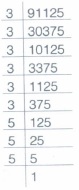
x = \(\sqrt [ 3 ]{ 91125 } \)
x = \(\sqrt [ 3 ]{ \begin{matrix} \underline { 3\times 3\times 3 } \times \underline { 3\times 3\times 3 } \times \underline { 5\times 5\times 5 } \\ x=3\times 3\times 5 \end{matrix} } \)
x = 3 x 3 x 5
x = 45 m
Hence, the height of the tank will be 45 m.
(b) The value depicted here is that Aditya is conscious environment. He saves water by reserving rain water.
8.
\(41\over12\)
9.
Let the number of Rs. 5 coins be x.
Then, the number of Rs. 2 coins = 3x
The total number of coins is 160 .
The number of coins of Rs. 1= 160 - (x + 3x)
= (160 - 4x)
The amount that I have from Rs. 5 coins = 5 x x = 5x
The amount that I have from Rs. 2 coins = 2 x 3x = 6x
The amount that I have from Rs. 1 coins
= 1 x (160 - 4x) = 160 - 4x
According to the question,
Total amount = 300
\(\Rightarrow\) 5x + 6x + (160 - 4x) = 300
\(\Rightarrow\) 5x +6x +160 - 4x = 300
\(\Rightarrow\) 7x + 160 = 300 [transposing 160 to RHS]
\(\Rightarrow\) 7x = 300 -160 [transposing 160 to RHS]
\(\Rightarrow\) 7x = 140
\(\Rightarrow\) x = \(\frac { 140 }{ 7 } \) = 20 [dividing both sides by 7]
Number of Rs. 5 coins = x = 20
Number of Rs. 2 coins = 3x = 3 x 20 = 60
and number of Rs.1 coins = 160 - 4x = 160 - 4 x 20
= 160 - 80 = SO
Hence, I have SO,60 and 20 coins of denomination Rs.1, Rs. 2 and Rs 5, respectively.
10.
We find the mean of the given rational numbers.
As given in the above example, the mean is \(\frac{3}{8} \text { and } \frac{1}{4}<\frac{3}{8}<\frac{1}{2} \text {. }\)
We now find another rational number between \(\frac{1}{4} \text { and } \frac{3}{8}\) For this, we again find the mean of \(\frac{1}{4} \text { and } \frac{3}{8}\). That is, \(\left(\frac{1}{4}+\frac{3}{8}\right) \div 2=\frac{5}{8} \times \frac{1}{2}=\frac{5}{16}\)
Now find the mean of \(\frac{3}{8} \text { and } \frac{1}{2}\). We have, \(\left(\frac{3}{8}+\frac{1}{2}\right) \div 2=\frac{7}{8} \times \frac{1}{2}=\frac{7}{16}\)
Thus we get \(\frac{1}{4}<\frac{5}{16}<\frac{3}{8}<\frac{7}{16}<\frac{1}{2}\)
Thus, \(\frac{5}{16}, \frac{3}{8}, \frac{7}{16}\) are the three rational numbers between \(\frac{1}{4} \text { and } \frac{1}{2}\)
11.
Assume the length of the rectangle to be x cm.
The perimeter of the rectangle = 2 x (length + width)
\(
=2 \times\left(x+2 \frac{3}{4}\right) \)
\(=2\left(x+\frac{11}{4}\right)
\)
The perimeter is given to be 13 cm. Therefore,
\(2\left(x+\frac{11}{4}\right)=13\)
\(
x+\frac{11}{4} =\frac{13}{2}
\)
\(x =\frac{13}{2}-\frac{11}{4}
\)
\(=\frac{26}{4}-\frac{11}{4}=\frac{15}{4}=3 \frac{3}{4}\)
12.
We have, 128
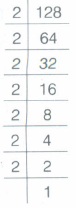
Resolving 128 into prime factors, we get
128 = 2 x 2 x 2 x 2 x 2 x 2 x 2
The prime factor 3 does not appear in a group of three. So, 128 is not a perfect cube.
Thus, we will divide the number by 3.
∴ 128 ÷ 2 =64 = 2 x 2 x 2 x 2 x 2 x 2
Hence, the smallest number by which 128 should be divided to make it a perfect cube is 2.
13.
We have, 2700
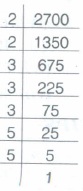
Resolving 2700 into prime factors,
we get
2700 = 2 x 2 x 3 x 3 x 3 x 5 x 5
Clearly, the prime factors of 2 and 5 do not appear in groups of three (triples).
So, 2700 is not a perfect cube.
14.
Given, two consecutive numbers are 12 and 13.
Here, n = 12 and n + 1= 13
We know that, total numbers lie between n2 and (n+1)2 = 2n
\(\therefore\) The total numbers lie between squares of 12 and 13
= 2 x 12 = 24
Hence, the total numbers lie between square of 12 and 13 is 24.
15.
(c)
Integers are associative for multiplication
16.
(c)
81
17.
(d)
43
18.
(d)
its cube is eight times the cube of the given number.
19.
(b)
-24

8th Standard CBSE Syllabus & Materials
8th Standard CBSE
CBSE 8th Science Particulate Nature of Matter - New Model Questions Papers Study Material - QB365 Set A
NEW8th Standard CBSE
CBSE 8th Science Pressure, Winds, Stroms and Cyclones - New Model Questions Papers Study Material - QB365 Set A
NEW8th Standard CBSE
CBSE 8th Mathematics Quadrilaterals - New Model Questions Papers Study Material - QB365 Set A
NEW8th Standard CBSE
CBSE 8th Mathematics A story of Numbers - New Model Questions Papers Study Material - QB365 Set A



NCERT Books

Syllabus

Exam Pattern

Sample Question Papers

Previous year Question Papers

Important Notes

MCQ Practice test

NCERT Exemplers

Case study Questions

Image Based Questions

Passage based Questions

HOT Questions

Value Based Questions

Model Questions Papers
NCERT ( Book Back ) Questions

Assertion and Reason
Important Questions And Answers

CBSE 8th Standard CBSE Subjects
CBSE Standards


