
 100% FREE ACCESS
8th Standard CBSE Syllabus & Materials
8th Standard CBSE
CBSE 8th Social Science Theme D - Factors of Production - New Model Questions Papers Study Material - QB365 Set A
NEW8th Standard CBSE
CBSE 8th Social Science Theme C - Universal Franchise and India's Electoral System - New Model Questions Papers Study Material - QB365 Set A
NEW8th Standard CBSE
CBSE 8th Social Science Theme B - The Rise of the Marathas - New Model Questions Papers Study Material - QB365 Set A
NEW8th Standard CBSE
CBSE 8th Social Science Theme B - Reshaping India's Political Map - New Model Questions Papers Study Material - QB365 Set A
NEW8th Standard CBSE
CBSE 8th Social Science Theme A - Natural Resources and Their Use - New Model Questions Papers Study Material - QB365 Set A
NEW8th Standard CBSE
CBSE 8th Science Keeping Time with Skies - New Model Questions Papers Study Material - QB365 Set A

Published on: 21/10/2025
Download CBSE Class 8th Standard CBSE Mathematics question papers, sample papers, important questions, and previous year solved papers in PDF format. Get free study materials, NCERT solutions, and exam preparation resources for Class 8th Standard CBSE Mathematics
Questions + Answers key
Take MCQ Mathematics Test
1.
Express 72 as the sum of two consecutive integers
40 + 9
24 + 25
36 + 13
32 + 17
2.
If all the four sides of a parallelogram are equal and the adjacent angles are of 120° and 60°, then the name of the quadrilateral is
rectangle
square
rhombus
kite
3.
The measures of the three angles of a quadrilateral are 65°, 75° and 85°. The measure of the fourth angle is
65°
75°
85°
135°
4.
The multiplicative identity for rational numbers is
-1
1
0
none of these.
5.
The root of the equation 3x =\(\frac{z}{4}\)-x is
\(\frac{10}{27}\)
\(\frac{10}{21}\)
-\(\frac{5}{7}\)
\(\frac{5}{7}\)
6.
What is the one's digit in the cube root of the cube number 8000?
0
2
4
8
7.
The one's digit of the cube of the number 111 is
1
2
3
9
8.
If 'x' is an even number, then which of the following is the next odd number?
x + 1
x + 2
x - 1
x - 2
9.
Which of the following is the number of non-perfect square numbers between the squares of the numbers nand n + 1?
n + 1
n
2n
2n+1
10.
in the interval (0-10), 10 is called the
Lower limit
upper limit
range
frequency
11.
The class-mark of the class 20-30 is:
20
30
25
10
12.
Which of the following is not true?
rational numbers are closed under addition
rational numbers are closed under subtraction.
rational numbers are closed under multiplication
rational numbers are closed under division
13.
Arrange the numbers from 1 to 20 in a row such that the sum of any two adjacent numbers is a perfect square.
14.
Write four rational numbers between 0 and -2
15.
Find the cube root of 46656 by estimation method.
16.
What could be the possible one's digits of the square root of each of the following numbers? 657666025
17.
Find the one's digit of the cube of each of the following numbers.
8888
18.
Numbers 1 to 10 are written on ten separate slips (one number on one slip), kept in a box and mixed well. One slip is chosen from the box without looking into it. What is the probability of getting a number greater than 6?
19.
Explain why a rectangle is a convex quadrilateral?
20.
Write the rational numbers that are equal to their reciprocals.
21.
Solve the following equations 17 + 6p =9
22.
The size of each sector is proportional to the __________ or __________ it represents.
23.
The difference between the upper class limit and lower class limit is called ______.
24.
The square of 0.9 is ______________
25.
The reciprocal of a positive rational number is _________________
26.
The numbers _________________and ________________ are their own reciprocals
27.
Look at the following circle graph and answer the questions given below:
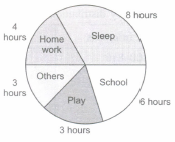
(i) Find the fraction of the circle representing each of these given information.
(ii) What is the central angle corresponding to the activities "Play" and "Home work"?
28.
To collect rain water, Aditya made a cubical tank which can hold 91125 m3 water. He uses this water for watering the plants of his garden.
(a) What is the height of the tank?
(b) What is the value depicted here?
29.
Find the least number, which is a perfect square and has 7936 as one of its factors.
30.
A rectangular MORE is shown below:
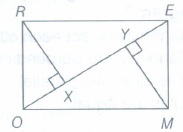
Answer the following questions by giving appropriate reason.
(i) Is RE = OM?
(ii) Is ㄥMYO = ㄥRXE?
(iii) Is ㄥMOY = ㄥREX?
(iv) Is ΔMYO ≅ RXE?
(v) Is MY = RX?
31.
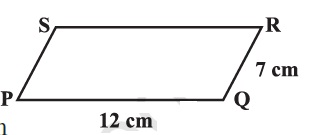
Find the perimeter of the parallelogram PQRS.
32.
Find \(\frac{-1}{2}+[\frac{3}{7}+(\frac{-4}{3})]\) and \([\frac{-1}{2}+\frac{3}{7}]+(\frac{-4}{3})\). Are the two sums equal ?
33.
Show that \(\Delta\) ABC and \(\Delta\) ADC are congruent. What do we infer from this?
34.
Fill in the blanks in the following table:
| Number | Closed Under | |||||
| Addition | Subtraction | Multuplication | Division | |||
| Rational numbers | Yes | Yes | ... | No | ||
| Integers | ... | Yes | ... | No | ||
| Whole numbers | ... | ... | Yes | ... | ||
| Natural numbers | ... | No | ... | ... | ||
35.
Find the cube root of 614125 through estimation.
36.
Every rhombus is a square
37.
All rhombuses are parallelograms.
38.
Leela invited some friends for tea on her birthday. Her mother placed some plates and some puris on a table to be served. If Leela places 4 puris in each plate 1 plate would be left empty. But if she places 3 puris in each plate 1puri would be left. Find the number of plates and number of puris on the table.
39.
Present the following data in the form of a grouped frequency distribution table having 6 classes of equal size (one of the class being 40-48):
| 30 | 39 | 58 | 17 | 34 | 50 | 23 | 37 |
| 42 | 49 | 55 | 59 | 19 | 28 | 47 | 49 |
| 18 | 60 | 56 | 36 | 58 | 35 | 55 | 37 |
| 25 | 34 | 39 | 61 | 53 | 33 | 36 | 53 |
| 61 | 62 | 39 | 53 | 21 | 18 | 28 | 23 |
1.
\({7^2-1\over 2}=24, {7^2+1\over 2}=25\)
2.
(c)
rhombus
3.
Fourth angle = 360° - (65° + 75° + 85°)
= 135°.
4.
(b)
1
5.
3x =\(\frac{20}{7}\)-x \(\Rightarrow\)3x +x =\(\frac{20}{7}\)
\(\Rightarrow\)4x = \(\frac{20}{7}\)x \(\Rightarrow\) x=\(\frac{20}{7\times4}\)=\(\frac{5}{7}\)
6.
0\(\times\)0\(\times\)0=0
7.
1\(\times\)1\(\times\)1=1.
8.
(a)
x + 1
9.
(c)
2n
10.
(b)
upper limit
11.
(c)
25
12.
(d)
rational numbers are closed under division
13.
The required arrangement is
19, 17, 8, 1, 15, 10, 6, 3, 13, 12, 4, 5, 11, 14, 2, 7, 9, 16, 20
14.
We can write 0 as \(\frac { 0 }{ 10 } \).
We can write (-2) as \(\left( \frac { 20 }{ 10 } \right) \)
Thus the rational numbers between 0 and -2 are
\(\frac { -1 }{ 10 } ,\frac { -2 }{ 10 } ,\frac { -3 }{ 10 } ,\frac { -4 }{ 10 } ,\frac { -5 }{ 10 } ,\frac { -6 }{ 10 } ,...,\frac { -19 }{ 10 } \)
We may take any four of these
15.
36
16.
The possible one's digits of the square root of the numbers.
In a given number 657666025, one's digit is 5.
We know that, square of5 gives out 5 in one's digit.
Hence, possible one's digit of the square root digit is 5.
17.
We have, 8888
One's digit of 8888 = 8
Now, cube of the one's digit of 8888 = (8)3 = 8 x 8 x 8 =512
Hence,one's digit in the cube of 8888 is 2.
18.
There are ten separate slips having 1 to 10 numbers (one number on one slip) out of which one slip can be chosen in 10ways.
So, total number of outcomes = 10
Here, the numbers greater than 6 are 7, 8, 9 and 10. So, one slip having number greater than 6 can be chosen in 4 ways.
So, favourable outcomes = 4
\(\therefore\) Probability of getting a number greater than 6 = \(\frac{Favourable\ outcomes}{Total\ number\ of\ outcomes}=\frac{4}{10}=\frac{2}{5}\)
19.
We know that, a convex quadrilateral have angle of measure less than 180° and no portions of their diagonals in their exteriors.
So, a rectangle is a convex quadrilateral because the measure of its each angle is less than 180° and both the diagonals lie in its interior.
20.
The rational numbers 1 and (-1) are equal to their reciprocals, respectively
21.
p = \(\frac { -4 }{ 3 } \)
22.
()
23.
()
width or size
24.
()
0.81
25.
()
positive
26.
()
The numbers 1and -1 are their own reciprocals
27.
(i) The proportion of the sector for hours:
in sleeping = \(Number\ of\ sleeping\ hours\over Whole\ day\)
\(={8\ hours\over 24\ hours}={1\over3}\)
in school =\({6\ hours\over 24\ hours}={1\over4}\)
in home work = \({4\ hours\over 24\ hours}={1\over 6}\)
in play = \({3\ hours\over 24\ hours}={1\over 8}\)
in others = \({3\ hours\over 24\ hours}={1\over 8}\)
(ii) ∵ Total angle at the centre of a circle
= 360°
i.e., Central angle for 1 (whole) = 360°
∴ Central angle for play
(\(1\over8\)th part of Whole) = \(1\over8\) x 360° = 45°
Similarly, central angle for home work
(\(1\over6\) th part of Whole) = \(1\over6\) x 360° = 60°
28.
Volume of the cubical tank
=91125 m3
Let the length of each side of cubical tank be x m.
We know that, Volume of a cube
= (Side)3
SO, (x)3 =91125
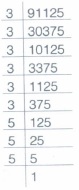
x = \(\sqrt [ 3 ]{ 91125 } \)
x = \(\sqrt [ 3 ]{ \begin{matrix} \underline { 3\times 3\times 3 } \times \underline { 3\times 3\times 3 } \times \underline { 5\times 5\times 5 } \\ x=3\times 3\times 5 \end{matrix} } \)
x = 3 x 3 x 5
x = 45 m
Hence, the height of the tank will be 45 m.
(b) The value depicted here is that Aditya is conscious environment. He saves water by reserving rain water.
29.
246016
30.
(i) Yes, RE = OM
Given, the above rectangle, opposite sides are equal. .
(ii) Yes, ㄥMYO = ㄥRXE
Here, MY and RX are perpendicular to OE.
Since, ㄥRXO = 90° ⇒ ㄥRXE = 900
and ㄥMYE = 90° ⇒ ㄥMYO = 90°
(iii) Yes, ㄥMOY = ㄥREX
Since, these are alternate interior angles.
∵ RE || OM and EO is a transversal.
∴ ㄥMOE = ㄥOER
⇒ ㄥMOY = ㄥREX
(iv) Yes, ΔMYO ≅ RXE
In ΔMYO and ΔRXE, we see that
MO=RE [proved]
ㄥMOY = ㄥREX [proved]
ㄥMYO = ㄥRXE [proved]
∴ ΔMYO ≅ ΔRXE [by AAS]
(v) Yes, MY = RX
Since, these are corresponding part of congruent triangles.
31.
In a parallelogram, the opposite sides have same length.
Therefore, PQ = SR = 12 cm and QR = PS = 7 cm
So, Perimeter = PQ + QR + RS + SP
= 12 cm + 7 cm + 12 cm + 7 cm = 38 cm
32.
\(\frac{-1}{2}+[\frac{3}{7}+(\frac{-4}{3})] = \frac{-1}{2}+(\frac{-19}{21})=\frac{-59}{42}\)
\([\frac{-1}{2}+\frac{3}{7}]+(\frac{-4}{3})=\frac{-1}{14}+(\frac{-4}{3})=\frac{-59}{42}\)
So, Yes ; \(\frac{-1}{2}+[\frac{3}{7}+(\frac{-4}{3})]=[\frac{-1}{2}+\frac{3}{7}]+(\frac{-4}{3})\)
i.e., the two sums are equal.
33.
In \(\Delta\) ABC and \(\Delta\) ADC
AB = AD
| One pair of consecutive sides BC = DC
| Other pairs of consecutive sides AC = AC | Common
\(\therefore\) \(\Delta\) ABC \(\cong \) \(\Delta\) ADC
| SSS Congruence Axiom
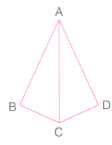
\(\therefore \angle BAC=\angle DAC\) | CPCT
\(\angle BCA=\angle DCA\) | CPCT
i.e., diagonal AC bisects \(\angle BAD\) and \(\angle BCD\) each.
34.
Using the closure property over addition, subtraction, multiplication and division for rational numbers, integers, whole-numbers and natural numbers, we have:
| Number | Closed Under | |||||
| Addition | Subtraction | Multuplication | Division | |||
| Rational numbers | Yes | Yes | Yes. | No | ||
| Integers | Yes | Yes | Yes | No | ||
| Whole numbers | Yes | Yes | Yes | No | ||
| Natural numbers | Yes | No | Yes | No | ||
35.
Given, number is 614125.
So, groups of 614125 are
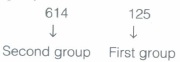
In the first group, the number 125 ends with 5. We know that, 5 comes at the unit's place of a number only when its cube ends in 5.
So, 5 will come at unit's place.
Now, in the second group, the number is 614
∵ (8)3 = 512 and (9)3=729
and 512 < 614 < 729
So, ten's place of required cube root is 8.
Hence, \(\sqrt [ 3 ]{ 614125 } \) = 85
36.
(b)
37.
(a)
38.
Let the number of plates on the table be y and the number of puris be x.
Then, according to the first condition of the problem
4(y - 1) = x ...(1)
and, according to the second condition of the
problem
3y + 1= x ... (2)
From (1) and (2), we have
4(y - 1) = 3y + 1
⇒ 4y - 4 = 3y + 1
⇒ 4y - 3y = 1 + 4
⇒ y=5
Put y = 5 in (1), we get
x = 4(5) - 4 = 20 - 4 = 16
Hence, the number of plates and number of puris on the table are 5 and 16 respectively.
39.
The highest observation = 62
The lowest observation = 17
One of the class intervals = 40-48
∴ Class size = Upper class limit - Lower class limit
= 48 - 40 = 8
∴ The appropriate classes can be:
16-24, 24-32, 32-40, 40-48, 48-56, 56-64
Thus, the frequency distribution table for the above data can be shown using the Tally marks
| Groups [Class intervals] | Tally marks | Frequency |
|---|---|---|
| 16-24 | .jpg) || || |
7 |
| 24-32 | |||| | 4 |
| 32-40 | | |
11 |
| 40-48 | || | 2 |
| 48-56 | |||| |
9 |
| 56-64 | || |
7 |
| Total | 40 |

8th Standard CBSE Syllabus & Materials
8th Standard CBSE
CBSE 8th Science Particulate Nature of Matter - New Model Questions Papers Study Material - QB365 Set A
NEW8th Standard CBSE
CBSE 8th Science Pressure, Winds, Stroms and Cyclones - New Model Questions Papers Study Material - QB365 Set A
NEW8th Standard CBSE
CBSE 8th Mathematics Quadrilaterals - New Model Questions Papers Study Material - QB365 Set A
NEW8th Standard CBSE
CBSE 8th Mathematics A story of Numbers - New Model Questions Papers Study Material - QB365 Set A



NCERT Books

Syllabus

Exam Pattern

Sample Question Papers

Previous year Question Papers

Important Notes

MCQ Practice test

NCERT Exemplers

Case study Questions

Image Based Questions

Passage based Questions

HOT Questions

Value Based Questions

Model Questions Papers
NCERT ( Book Back ) Questions

Assertion and Reason
Important Questions And Answers

CBSE 8th Standard CBSE Subjects
CBSE Standards


