
 100% FREE ACCESS
8th Standard CBSE Syllabus & Materials
8th Standard CBSE
CBSE 8th Social Science Theme D - Factors of Production - New Model Questions Papers Study Material - QB365 Set A
NEW8th Standard CBSE
CBSE 8th Social Science Theme C - Universal Franchise and India's Electoral System - New Model Questions Papers Study Material - QB365 Set A
NEW8th Standard CBSE
CBSE 8th Social Science Theme B - The Rise of the Marathas - New Model Questions Papers Study Material - QB365 Set A
NEW8th Standard CBSE
CBSE 8th Social Science Theme B - Reshaping India's Political Map - New Model Questions Papers Study Material - QB365 Set A
NEW8th Standard CBSE
CBSE 8th Social Science Theme A - Natural Resources and Their Use - New Model Questions Papers Study Material - QB365 Set A
NEW8th Standard CBSE
CBSE 8th Science Keeping Time with Skies - New Model Questions Papers Study Material - QB365 Set A

Published on: 21/10/2025
Download CBSE Class 8th Standard CBSE Mathematics question papers, sample papers, important questions, and previous year solved papers in PDF format. Get free study materials, NCERT solutions, and exam preparation resources for Class 8th Standard CBSE Mathematics
Questions + Answers key
Take MCQ Mathematics Test
1.
Which of the following is not a Pythagorean triplet?
3, 4, 5
6, 8, 10
5, 12, 13
2, 3, 4.
2.
Observe the pie chart and answer the following question:
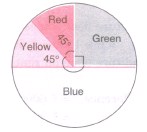
The difference of the central angles for green and blue is
45°
90°
180°
22\(\frac { { 1 }^{ 0 } }{ 2 } \).
3.
The root of the equation \(\frac{3}{2}\)x=-27 is
6
12
18
-18
4.
The measures of each of the four angles of a quadrilateral are equal. Find the measure of each angle
45°
30°
60°
90°
5.
The measures of the three angles of a quadrilateral are 65°, 75° and 85°. The measure of the fourth angle is
65°
75°
85°
135°
6.
Which of the following statements is true?
Natural numbers are closed under division
Whole numbers are not closed under division
Integers are closed under division
Rational numbers are closed under division.
7.
Find the smallest number by which the number 1296 must be divided to obtain a perfect cube.
6
2
4
3
8.
If 6 is added to 3 times of a number, it becomes 15. This statement in the form of an equation is
3x + 6 = 15
3x - 6 = 15
3x + 15 = 6
\(\frac{3x}{5}\)=15.
9.
What is the one's digit in the cube root of the cube number 1728?
1
2
3
9
10.
If a number of n-digits is perfect square and 'n' is an odd, then which of the following is the number of digits of its square root?
\(\frac{n-1}{2}\)
\(\frac{n}{2}\)
\(\frac{n+1}{2}\)
2n
11.
A geometric representation showing the relationship between a whole and its parts is a
pie chart
bar graph
histogram
pictograph
12.
The numerical expression \({3 \over 8} + {(-5)\over 7}={-19\over 56}\) shows that
rational numbers are closed under addition
rational numbers are not closed under addition
rational numbers are closed under multiplication
addition of rational numbers is not commutative.
13.
Find the square of the following numbers without actual multiplication.
42
14.
The volume of a cubical box is 117.649 m3. Find the length of a side of the box.
15.
Find the square root of 841
16.
Find the one's digit of the cube of each of the following numbers.
53
17.
Simplify : \({7\over8}+{1\over16}-{1\over12}\)
18.
Multiply \({6\over13}\) by the reciprocal of \({-7\over16}\)
19.
Write the additive inverse of the following \({2\over-9}\)
20.
If three angles of a quadrilateral are 90°, 100° and 110°, then find the measure of fourth angle.
21.
Find the root the following equations \(2p+9=\frac { -17 }{ 7 } \)
22.
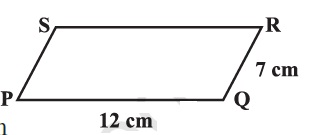
Find the perimeter of the parallelogram PQRS.
23.
By prime factorisation, find the cube roots of 1331
24.
Solve the followings:
\(({-3\over7}\div{9\over14})\div({-5\over2})\)
25.
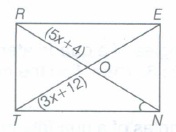
If RENT is a rectangle. Its diagonals are meet at O. Find the value of x, if OR = (5x + 4) and OT = (3x + 12).
26.
Using appropriate properties, find \({-2\over3}\times{3\over5}+{5\over2}-{3\over5}\times{1\over6}\)
27.
_____________ gives the number of times that a particular entry occurs.
28.
\(\sqrt { 2.89 } \) = _____________
29.
In a __________ experiment, the outcomes can not be predicted exactly in advance.
30.
The reciprocal of a positive rational number is _________________
31.
The numbers _________________and ________________ are their own reciprocals
32.
Complete the following crossword puzzle using the given direction.
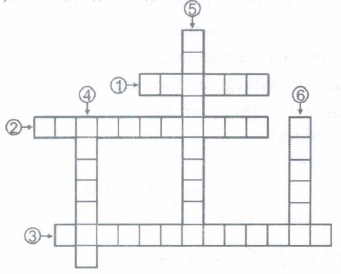
Direction:
Across:
(1) The product of number by itself two times, is called its _______
(2) If three numbers a, band c are such that a2 + b2= c2 then they are called _____ Triplets.
(3) A number is a when it is a product of the same two numbers.
Down: (4) The numbers 2n, n2-1 and n2 + 1 where n is a natural number show Pythagorean______.
(5) Finding is the inverse operation of squaring a number.
(6) A number which divides a _______ given number exactly is called a or divisor of that number.
33.
Is 9720 a perfect cube? If not, find the smallest number by which, it should be divided to get a perfect cube.
34.
Study the following graph carefully to answer the question that follows.
Number of soldiers recruited (in thousand) in three different forces in six different years.
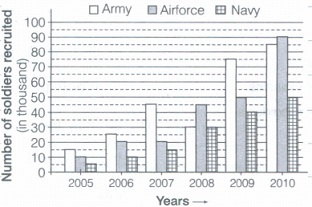
(a) Number of soldiers recruited in Navy in the year 2009 was what percentage of number of soldiers required in Army in the year 2006?
(b) If 30% of soldiers recruited in Airforce in the year 2010 was female, then what is the number of males recruited in Airforce in that year?
35.
In the following figure, AB II DC and AD = BC. Find the value of x.
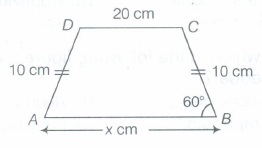
36.
Every square is a rhombus
37.
All rhombuses are parallelograms.
38.
Leela invited some friends for tea on her birthday. Her mother placed some plates and some puris on a table to be served. If Leela places 4 puris in each plate 1 plate would be left empty. But if she places 3 puris in each plate 1puri would be left. Find the number of plates and number of puris on the table.
39.
Present the following data in the form of a grouped frequency distribution table having 6 classes of equal size (one of the class being 40-48):
| 30 | 39 | 58 | 17 | 34 | 50 | 23 | 37 |
| 42 | 49 | 55 | 59 | 19 | 28 | 47 | 49 |
| 18 | 60 | 56 | 36 | 58 | 35 | 55 | 37 |
| 25 | 34 | 39 | 61 | 53 | 33 | 36 | 53 |
| 61 | 62 | 39 | 53 | 21 | 18 | 28 | 23 |
1.
22 + 32 ≠ 42
2.
Central angle for blue = 180°
Central angle for green = 90°
∴ Difference = 180° - 90° = 90°.
3.
(d)
-18
4.
Measure of each angle = \({360^\circ\over 4}=90^\circ\)
5.
Fourth angle = 360° - (65° + 75° + 85°)
= 135°.
6.
(b)
Whole numbers are not closed under division
7.
1296 = 2\(\times\) 2\(\times\) 2 \(\times\) 2 \(\times\) 3 \(\times\) 3 \(\times\) 3 \(\times\) 3
= 23 \(\times\) 2\(\times\) 33 \(\times\) 3.
8.
Let the number be x.
9.
2\(\times\)2\(\times\)2=8
10.
(c)
\(\frac{n+1}{2}\)
11.
(a)
pie chart
12.
(a)
rational numbers are closed under addition
13.
422 = (40 + 2)2 = 40(40 + 2) + 2(40 + 2)
= 402 + 40 x 2 + 2 x 40 + 22
= 1600 + 80 + 80 + 4 = 1764
14.
4.9 m
15.
29
16.
We have, 53
One's digit of 53 = 3
Now, cube of one's digit of 53 = (3)3 = 3 x 3 x 3 = 27
Hence, the one's digit in the cube of 53 is 7.
17.
\(41\over48\)
18.
Reciprocal of \({-7\over16}\) is \({-16\over7}\)
According to the question
\({6\over13} \times (Reciprocal \ of {-7\over16})={6\over13} \times [{-16\over 7}] \)
\(\\ ={6\over13} \times{-16\over 7}={6\times(-16)\over 13\times 7}={-96\over91}\)
19.
we have, \({2\over-9}\) so, additive inverse of \({2\over-9}\) is \({2\over9}\)
20.
60°
21.
\(p=-5\frac { 5 }{ 7 } \)
22.
In a parallelogram, the opposite sides have same length.
Therefore, PQ = SR = 12 cm and QR = PS = 7 cm
So, Perimeter = PQ + QR + RS + SP
= 12 cm + 7 cm + 12 cm + 7 cm = 38 cm
23.
11
24.
We have, \((-{3\over7}\div{9\over14})\div({5\over2})\)
\(=(-{3\over7}\times{14\over9})\times({-2\over5})=(-{2\over3})\times({-2\over5}) ={4\over15}{}\)
25.
Since, diagonals of rectangle bisect each other and OR=\(\frac { 1 }{ 2 } \)RN and OT=\(\frac { 1 }{ 2 } \)TE
Also, diagonals of a rectangle are equal.
∴ RN=TE
⇒ \(\frac { 1 }{ 2 } \)RN = \(\frac { 1 }{ 2 } \)TE ⇒ OR=OT
⇒ 5x+4=3x+12
⇒ 5x-3x=12-4=8 ⇒ 2x=8 ⇒ x=4
26.
We have, \({-2\over3}\times{3\over5}+{5\over2}-{3\over5}\times{1\over6}={-2\over3}\times{3\over5}-{3\over5}\times{1\over6}+{5\over2}\) [by associativity]
\(={3\over5}\times{-2\over3}+{3\over5}\times{-1\over6}+{5\over2}\) [by commutativity]
\(={3\over5}\times({-2\over3}-{1\over6})+{5\over2}\)
[by distributivity, taking \({3\over5}\) as common factor]
\(={3\over5}\times({-4-1\over6})+{5\over2} \ \ \ \ [\because LCM \ of \ 3 \ and \ 6=6] \)
\(\\ ={3\over5}\times({-5\over6})+{5\over2}={3\over5}\times {-5\over6}+{5\over2}={-1\over2}+{5\over2}={-1+5\over2}\)
\(\\ ={4\over2}=2\)
27.
()
Frequency
28.
()
1.7
29.
()
Random
30.
()
positive
31.
()
The numbers 1and -1 are their own reciprocals
32.
1.SQUARE
2.PYTHAGOREAN
3.PERFECT SQUARE
4.TRIPLET
5.SQUARE ROOT
6.FACTOR
33.
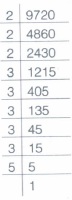
Resolving 9720 into prime factors, we get
9720 =2 x 2 x 2 x 3 x 3 x 3 x 3 x 3 x 5
The prime factors 3 and 5 are not forming a group of three (triples).
So, 9720 is not a perfect cube.
In prime factorisation of 9720, two factors 3 and 5 remain ungrouped.
So, if we divide the number by 3 x 3 x 5, then the prime factorisation of the quotient will not contain 45.
∴ 9720 + 45 = 216 =(6)3
= 2 x 2 x 2 x 3 x 3 x 3
Hence, the smallest number by which 9720 should be divided to get a perfect cube is 45.
34.
(a) 16%
(b) 63000
35.
Draw a line parallel to BC from 0 which cuts AB at E
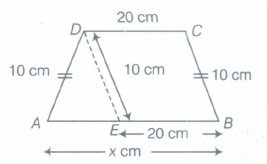
Thus, DC II EB and BC II DE
which gives a parallelogram DCBE.
∴ DC = EB = 20 cm and BC = DE = 10 cm
Now, in ΔADE, we have
AD=DE =10 cm
ㄥDAE = ㄥDEA = 60°
So, by angle sum property in ΔADE, we have
ㄥDAE + ㄥAED + ㄥEDA = 180°
or ㄥEDA = 180° - (ㄥDAE + ㄥAED)
= 180° - (60° + 60°)
= 180° - 120° = 60°
So, ADE is an equilateral triangle.
Now, AD=DE=EA=10 cm
AB=AE + EB
or x = 10 + 20 = 30 cm
So, the value of x is 30 cm.
36.
(a)
37.
(a)
38.
Let the number of plates on the table be y and the number of puris be x.
Then, according to the first condition of the problem
4(y - 1) = x ...(1)
and, according to the second condition of the
problem
3y + 1= x ... (2)
From (1) and (2), we have
4(y - 1) = 3y + 1
⇒ 4y - 4 = 3y + 1
⇒ 4y - 3y = 1 + 4
⇒ y=5
Put y = 5 in (1), we get
x = 4(5) - 4 = 20 - 4 = 16
Hence, the number of plates and number of puris on the table are 5 and 16 respectively.
39.
The highest observation = 62
The lowest observation = 17
One of the class intervals = 40-48
∴ Class size = Upper class limit - Lower class limit
= 48 - 40 = 8
∴ The appropriate classes can be:
16-24, 24-32, 32-40, 40-48, 48-56, 56-64
Thus, the frequency distribution table for the above data can be shown using the Tally marks
| Groups [Class intervals] | Tally marks | Frequency |
|---|---|---|
| 16-24 | .jpg) || || |
7 |
| 24-32 | |||| | 4 |
| 32-40 | | |
11 |
| 40-48 | || | 2 |
| 48-56 | |||| |
9 |
| 56-64 | || |
7 |
| Total | 40 |

8th Standard CBSE Syllabus & Materials
8th Standard CBSE
CBSE 8th Science Particulate Nature of Matter - New Model Questions Papers Study Material - QB365 Set A
NEW8th Standard CBSE
CBSE 8th Science Pressure, Winds, Stroms and Cyclones - New Model Questions Papers Study Material - QB365 Set A
NEW8th Standard CBSE
CBSE 8th Mathematics Quadrilaterals - New Model Questions Papers Study Material - QB365 Set A
NEW8th Standard CBSE
CBSE 8th Mathematics A story of Numbers - New Model Questions Papers Study Material - QB365 Set A



NCERT Books

Syllabus

Exam Pattern

Sample Question Papers

Previous year Question Papers

Important Notes

MCQ Practice test

NCERT Exemplers

Case study Questions

Image Based Questions

Passage based Questions

HOT Questions

Value Based Questions

Model Questions Papers
NCERT ( Book Back ) Questions

Assertion and Reason
Important Questions And Answers

CBSE 8th Standard CBSE Subjects
CBSE Standards


