
 100% FREE ACCESS
8th Standard CBSE Syllabus & Materials
8th Standard CBSE
CBSE 8th Social Science Theme D - Factors of Production - New Model Questions Papers Study Material - QB365 Set A
NEW8th Standard CBSE
CBSE 8th Social Science Theme C - Universal Franchise and India's Electoral System - New Model Questions Papers Study Material - QB365 Set A
NEW8th Standard CBSE
CBSE 8th Social Science Theme B - The Rise of the Marathas - New Model Questions Papers Study Material - QB365 Set A
NEW8th Standard CBSE
CBSE 8th Social Science Theme B - Reshaping India's Political Map - New Model Questions Papers Study Material - QB365 Set A
NEW8th Standard CBSE
CBSE 8th Social Science Theme A - Natural Resources and Their Use - New Model Questions Papers Study Material - QB365 Set A
NEW8th Standard CBSE
CBSE 8th Science Keeping Time with Skies - New Model Questions Papers Study Material - QB365 Set A

Published on: 21/10/2025
Download CBSE Class 8th Standard CBSE Mathematics question papers, sample papers, important questions, and previous year solved papers in PDF format. Get free study materials, NCERT solutions, and exam preparation resources for Class 8th Standard CBSE Mathematics
Questions + Answers key
Take MCQ Mathematics Test
1.
A shopkeeper purchased 200 bulbs for Rs 10 each. However 5 bulbs were fused and had to be thrown away. The remaining were sold at Rs 12 each. Find the gain or loss percent.
2.
A school has 9 periods a day each of 50 minutes duration. How many period will there be, if the duration of every period is reduced by 5 minutes?
3.
A contractor estimates that 5 persons complete a task in 4 days. If he uses 4 persons instead of 5, how long should they take to complete the task?
4.
In a PG House, the food provision for 20 persons is for 10 days. How long would the food provision last if there were 5 more persons in that PG house?
5.
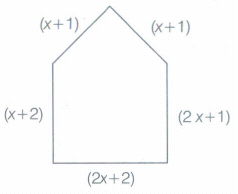
For what value of x, the perimeter of shape is 77 cm?
6.
The organisers of an essay competition decide that a winner in the competition gets a prize of Rs. 500 and a participant, who does not win, gets a prize of Rs.100. The total prize money distributed is 4800. Find the number of winners, if the total number of participants is 36.
7.
A man sold an article of Rs 495 and gained 10% on it. Find the cost price of the article.
8.
Construct a quadrilateral GAME, where GA = 4 cm, AM = 5 cm, ME = 4.5 cm, \(\angle\)A = 60° and \(\angle\)M = 90°.
9.
Construct a quadrilateral TEAM with the given measurements TE = 5 cm, EA = 3 cm, AM = 10 cm, MT = 6 cm, \(\angle \)M = 45°.
10.
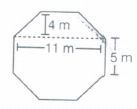
Top surface of a raised platform is in the shape of a regular octagon as shown in the figure. Find the area of the octagonal surface.
11.
Simplify:(4m + 5n)2 + (5m+ 4n)2
12.
Simplify:(7m - 8n)2 + (7m + 8n)2
13.
Add 2x (z- x- y) and 2y (z- y- x).
14.
Subtract 4a - 7ab + 3b + 12 from 12a- 9ab+ 5b- 3.
15.
The square of 0.9 is ______________
16.
1m2 = ___________ cm2
17.
1000 = ____________
18.
a13 x a-10 = _________
19.
Rational number \({-3\over5}\) lies between consecutive integers -1 and ______________________
20.
The reciprocal of -5 is _________________
21.
The multiplicative inverse of (- 3)2 is 3-2.
22.
There are 2401 students in a school. P.T. teacher wants to stand them in such a manner that number of rows and columns are the same. Find the number of rows.
23.
Area of a square plot is 2304m2. Find the side of the square.
24.
Find the square root of 6400.
25.
Draw a linear graph for the following data:
| Month | May | June | July | August |
| Rainfall(in cm) | 5 | 7 | 4 | 6 |
26.
Read the following circle graphs and answer the questions given below:
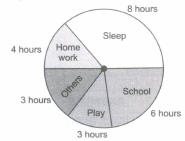
(a) The time spent by a child during a day:
(i) On which activity maximum number of hours are spent?
(ii) On which two activities does he spend equal number of hours?
(iii) Find the central angles for each sector of activities
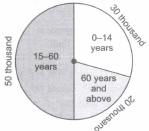
(b) Age group of people in a town:
(i) In which age group are the maximum number of people?
(ii) How many people are there is the '0-14 years' group?
(iii) Find the central angle of the sector corresponding to the age group 15-60 years'.
1.
Cost price of 200 bulbs = RS. 200 x 10 = RS. 2000
5 bulbs were fused. Hence, number of bulbs left = 200 – 5 = 195
These were sold at RS. 12 each.
The SP of 195 bulbs = RS. 195 x 12 = RS. 2340
He obviously made a profit (as SP > CP).
Profit = RS. 2340 – RS. 2000 = RS. 340
On RS. 2000, the profit is RS. 340.
Profit \(=\frac{340}{2000} \times 100 \%=17 \%\)
2.
Present duration each period = (50 - 5) minutes = 45 minutes.
Let the present number of period be 'x'.
Since, more the number of periods, less is the duration of a period.
\(\therefore\) It is a case of inverse variation.
We have:
| Number of periods | Duration of each period (in minutes) |
| 9 | 50 |
| x | 45 |
\(\therefore \ 9\times 50=x\times 45\Rightarrow x=\frac { 9\times 50 }{ 45 } =10\)
Thus the required number of periods = 10.
3.
More is the number of persons, less is the time to complete the task.
\(\therefore\) It is a case of inverse variation,
Now, we have:
| Number of persons | Number of days to complete the task |
| 5 | 4 |
| 4 | x |
\(\therefore \ 5\times 4=4\times x\Rightarrow x=\frac { 5\times 4 }{ 4 } =5\)
Thus, the required number of days = 5.
4.
Number of persons added = 5
\(\therefore\) Present number of persons = 20 + 5 = 25
Since, for more persons, the food will last less number of days
\(\therefore\) It is a case of inverse variation.
\(\therefore \ 25\times x=20\times 10\Rightarrow x=\frac { 20\times 10 }{ 25 } =8\)
\(\therefore\) The food will now last for 8 days.
5.
We have, perimeter = 77 cm
\(\therefore\) (x + 1)+ (x + 2) + (2x + 2) + (2x + 1)+ (x + 1) = 77
7x + 7= 77 7x = (77 - 7)
7x = 70 x = 70 x\(\frac { 1 }{ 7 } \)
Hence, the required value of x is 10 cm
6.
Let the number of winners be x.
Then, the number of participants who did not win = 36-x
Amount spent on x prizes = Rs. 500 x x = Rs. 500x
Amount spent on (36 - x) prizes = Rs. 100 x (36 - x) =
= Rs. (3600 -100x)
But 500x + (3600 -100x) = 4800
\(\Rightarrow\) 500x + 3600 -100x = 4800
\(\Rightarrow\) 400x = 4800 - 3600
\(\Rightarrow\) x = 1200 x \(\frac { 1 }{ 400 } \Rightarrow x=3\)
So, the number of winners is 3
7.
Rs.450
8.
Letus draw a rough sketch of the quadrilateral.
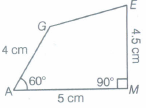
Steps of construction
Step I Draw AM = 5 cm.
Step II Construct \(\angle\)MAX = 60° and \(\angle\)AMY = 90°.
StepIII Cut the length of AG = 4 cm from AX and the length of EM = 4.5 cm from MY.
StepIV Join GE.
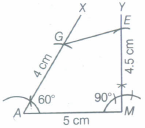
Thus, we get the quadrilateral GAME by construction.
9.
Steps of construction
StepI Draw MT = 6 cm and draw \(\angle\)TMX = 45°.
StepII Cut MA from MX, so that MA = 10 cm.
StepIII Draw an arc of 5 cm with centre T and draw an arc of 3 cm with centre A.
StepIV Mark the intersection point of both the arcs as E. Join TE and AE.
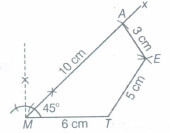
Thus, quadrilateral TEAM is constructed.
10.
Let ABCDEFGH be the regular octagonal surface as shown below in the figure:
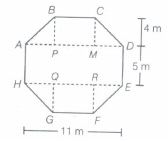
Given, each side of octagon = 5m,AD = 11 m
perpendicular from B to AD i.e. BP =4m .Join HE
Since, it is a regular octagon, so trapeziums ABCD and HEFG will be congruent and ADEH is a rectangle.
Now, area of trapezium ABCD = Area of trapezium HEFG
= (AD+BC)BP
= \(\frac { 1 }{ 2 } \)(11+5)\(\times\) 4 =\(\frac { 1 }{ 2 } \) \(\times\)16\(\times\)4
= 8 \(\times\)4 =32 m2
and area of rectangle ADEH = AD\(\times\) DE =11 \(\times\)5 =55m2
Now, area of octagon ABCDEFGH
= Area of trapezium ABCD +Area of rectangle ADEH +Area of trapezium HFGH
= 32 + 55 + 32= 119 m2
Hence, required area of octagonal surface is 119 m2
11.
[(4m)2 + 2(4m)(5n) + (5n)2] + [(5m)2 + 2(5m)(4n) +(4n)2]
= 16m2 + 40mn + 25n2 + 25m2 + 40mn + 16n2
= (16 + 25)m2+ (40 + 40)mn + (25 + 16)2
= 41m2 + 80mn + 41n2
12.
(7m - 8n)2 + (7m + 8n)2
= [(7m)2 - 2(7m)(8n) + (8n)2] + [(7m)2 + 2(7m)(8n) + (8n)2]
and (a-b)2= a2 -2ab+b2
= (49m2 -112mn + 64n2)+(49m2 +112mn + 64n2)
= 49m2 -112mn + 64n2 + 49m2 +112mn + 64n2
= 98m2 + 128n2
13.
First expression = 2x(z - x - y)
= (2x) x z - (2x) x (x) - (2x) xy
= 2xz - 2x2 - 2xy
Second expression = 2y(z - y - x)
= (2y)x(z)-(2y) x (y)-(2y)x(x)
= 2yz - 2y2 - 2yx
On adding above expressions, we get
2xz - 2x2 - 2xy
+ -2yx + 2yz - 2y2
_________________________
2xz - 2x2 - 4xy + 2yz - 2y2
__________________________
14.
For subtraction, write the like terms one below the other, we get
12a -9ab +5b -3
+4a - 7ab + 3b + 12
(-) (+) (-) (-)
_________________
8a - 2ab + 2b -15
_________________
Thus, the required answer is 8a - 2ab + 2b - 15.
15.
()
0.81
16.
()
10000
17.
()
1
18.
()
a3
19.
()
Zero
20.
()
The reciprocal of -5 is \({-1\over5}\)
21.
(b)
22.
()
Let the number of rows be x
So, the number of columns = x
Therefore, number of students = x × x = x2
Thus, x2 = 2401 gives x = \(\sqrt{2401}=\) 49
The number of rows = 49.
23.
()
Area of square plot = 2304 m2
Therefore, side of the square plot = \(\sqrt{2304}\)m
We find that, \(\sqrt{2304}\) = 48
Thus, the side of the square plot is 48 m.
24.
()
Write 6400 = 2 x 2 x 2 x 2 x 2 x 2 x 2 x 2 x 5 x 5
Therefore \(\sqrt{6400}=2 \times 2 \times 2 \times 2 \times 5=80\)
25.
()
Yes
26.
()
(i) Sleep (ii) Play and others
(iii) Sleep 120°, school 90°, home work 60°; play 45°, others 45°

8th Standard CBSE Syllabus & Materials
8th Standard CBSE
CBSE 8th Science Particulate Nature of Matter - New Model Questions Papers Study Material - QB365 Set A
NEW8th Standard CBSE
CBSE 8th Science Pressure, Winds, Stroms and Cyclones - New Model Questions Papers Study Material - QB365 Set A
NEW8th Standard CBSE
CBSE 8th Mathematics Quadrilaterals - New Model Questions Papers Study Material - QB365 Set A
NEW8th Standard CBSE
CBSE 8th Mathematics A story of Numbers - New Model Questions Papers Study Material - QB365 Set A



NCERT Books

Syllabus

Exam Pattern

Sample Question Papers

Previous year Question Papers

Important Notes

MCQ Practice test

NCERT Exemplers

Case study Questions

Image Based Questions

Passage based Questions

HOT Questions

Value Based Questions

Model Questions Papers
NCERT ( Book Back ) Questions

Assertion and Reason
Important Questions And Answers

CBSE 8th Standard CBSE Subjects
CBSE Standards


