
 100% FREE ACCESS
8th Standard CBSE Syllabus & Materials
8th Standard CBSE
CBSE 8th Social Science Theme D - Factors of Production - New Model Questions Papers Study Material - QB365 Set A
NEW8th Standard CBSE
CBSE 8th Social Science Theme C - Universal Franchise and India's Electoral System - New Model Questions Papers Study Material - QB365 Set A
NEW8th Standard CBSE
CBSE 8th Social Science Theme B - The Rise of the Marathas - New Model Questions Papers Study Material - QB365 Set A
NEW8th Standard CBSE
CBSE 8th Social Science Theme B - Reshaping India's Political Map - New Model Questions Papers Study Material - QB365 Set A
NEW8th Standard CBSE
CBSE 8th Social Science Theme A - Natural Resources and Their Use - New Model Questions Papers Study Material - QB365 Set A
NEW8th Standard CBSE
CBSE 8th Science Keeping Time with Skies - New Model Questions Papers Study Material - QB365 Set A

Published on: 21/10/2025
Download CBSE Class 8th Standard CBSE Mathematics question papers, sample papers, important questions, and previous year solved papers in PDF format. Get free study materials, NCERT solutions, and exam preparation resources for Class 8th Standard CBSE Mathematics
Questions + Answers key
Take MCQ Mathematics Test
1.
Observe the pie chart and answer the following question:
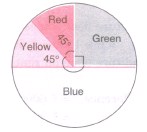
A die is thrown. What is the probability of getting an even prime number?
\(\frac{1}{6}\)
\(\frac{1}{4}\)
\(\frac{1}{3}\)
\(\frac{1}{2}\)
2.
Which of the following statements is true?
Natural numbers are associative for addition
Whole numbers are not associative for addition
Integers are not associative for addition
Rational numbers are not associative for addition.
3.
Observe the following bar graph carefully and answer the following question:
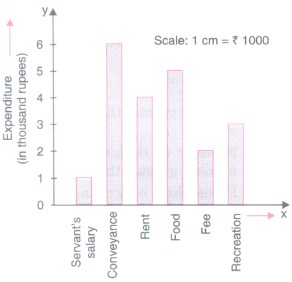
On which item has the maximum expenditure been done?
Conveyance
Rent
Fee
Servant's salary.
4.
The one's digit of the cube of the number 123 is
3
6
9
7
5.
Which of the following is the value of [(-1)-1]-1 ?
0
1
-1
none of these
6.
If one member of a Pythagorean triplet is 2m, then other two members are
m, m2 + 1
m2 + 1, m2 - 1
m2, m2 - 1
m2 , m+1
7.
The value of \((-\frac{5}{8})^{3}\) is equal to
\(-\frac{125}{512}\)
\(\frac{512}{-125}\)
\(\frac{125}{512}\)
1
8.
The value of \(\sqrt [ 3 ]{ 512 } \times \sqrt [ 3 ]{ -27 } \) is
24
-24
48
-48
9.
A coin is tossed 300 times and head appeared 180 times. The probability of getting a head in this experiment in
\(\frac{2}{5}\)
\(\frac{1}{5}\)
\(\frac{3}{5}\)
\(\frac{4}{5}\)
10.
Multiplicative inverse of a negative rational number is
0
-1
a negative rational number
a positive rational number
11.
Find \(\frac{3}{7}+\left(\frac{-6}{11}\right)+\left(\frac{-8}{21}\right)+\left(\frac{5}{22}\right)\)
12.
Show that 384 is not a perfect cube
13.
Find the cube root of 17576 through estimation
14.
Find the square root of 324 by the method of repeated subtraction.
15.
Find the square roots of 169 by the method of repeated subtraction.
16.
Use the distributivity of multiplication of rational numbers over addition to simplify:
\({2\over7}\times[{7\over16}-{21\over4}]\)
17.
Given below is a frequency distribution table. Read it and answer the questions that follow:
| Class Interval | Frequency |
| 10 - 20 | 15 |
| 20 - 30 | 10 |
| 30 - 40 | 14 |
| 40 - 50 | 15 |
| 50 - 60 | 12 |
(a) Whatis the lower limit of the second class interval?
(b) Whatis the upper limit of the last class interval?
(c) What is the frequency of the third class?
(d) Which interval has a frequency of 15?
(e) Which interval has a lowest frequency?
(f) What is the class size?
18.
The number of hours for which students of a particular class watched television during holidays is shown through the given graph.
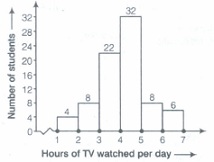
Answer the following:
(i) For how many hours did the maximum number of students watch TV?
(ii) How many students watched TV for less than 4 h?
(iii) How many students spent more than 5 h in watching TV?
19.
Find three rational numbers between \(\frac{1}{4} \text { and } \frac{1}{2} \text {. }\)
20.
Is \(5 \times [(-7)\times (-8)]\)=\([5 \times (-7)]\times (-8)\)?
21.
Is 1188 a perfect cube? If not, by which smallest natural number should 1188 be divided so that the quotient is a perfect cube?
22.
Find the cube root of each of the following numbers by prime factorisation method.
175616
23.
Find the square of the following numbers. 71
24.
Evaluate 3-2
25.
Which of 1232,772,822,1612,1092 would end with digit 1?
26.
Write the equivalent rational number of \(-13\over17\) whose denominator is 289.
27.
Numbers 1 to 10 are written on ten separate slips (one number on one slip), kept in a box and mixed well. One slip is chosen from the box without looking into it. What is the probability of getting a number 6?
28.
You have a bag with five identical balls of different colours and you are to pull out (draw) a ball without looking at it. List the outcomes you would get in adjoining figure.
.png)
1.
Even prime number = 2
∴ Probability = \(\frac{1}{2}\).
2.
(a)
Natural numbers are associative for addition
3.
The height of the bar corresponding to conveyance is the maximum.
4.
3 \(\times\)3 \(\times\) 3 = 27.
5.
(c)
-1
6.
(b)
m2 + 1, m2 - 1
7.
(a)
\(-\frac{125}{512}\)
8.
(b)
-24
9.
(c)
\(\frac{3}{5}\)
10.
(c)
a negative rational number
11.
\(\frac{3}{7}+\left(\frac{-6}{11}\right)+\left(\frac{-8}{21}\right)+\left(\frac{5}{22}\right)\)
\(=\frac{198}{462}+\left(\frac{-252}{462}\right)+\left(\frac{-176}{462}\right)+\left(\frac{105}{462}\right)\) (Note that 462 is the LCM of 7, 11, 21 and 22)
\(=\frac{198-252-176+105}{462}=\frac{-125}{462}\)
We can also solve it as.
\(\frac{3}{7}+\left(\frac{-6}{11}\right)+\left(\frac{-8}{21}\right)+\frac{5}{22}\)
\(=\left[\frac{3}{7}+\left(\frac{-8}{21}\right)\right]+\left[\frac{-6}{11}+\frac{5}{22}\right]\) (by using commutativity and associativity)
\(=\left[\frac{9+(-8)}{21}\right]+\left[\frac{-12+5}{22}\right]\) (LCM of 7 and 21 is 21; LCM of 11 and 22 is 22)
\(=\frac{1}{21}+\left(\frac{-7}{22}\right)=\frac{22-147}{462}=\frac{-125}{462}\)
12.
30
13.
The given number is 17576.
Step 1 Form groups of three starting from the rightmost digit of 17576.
17 576. In this case one group i.e., 576 has three digits whereas 17 has only two digits.
Step 2 Take 576.
The digit 6 is at its one’s place.
We take the one’s place of the required cube root as 6.
Step 3 Take the other group, i.e., 17.
Cube of 2 is 8 and cube of 3 is 27. 17 lies between 8 and 27.
The smaller number among 2 and 3 is 2.
The one’s place of 2 is 2 itself. Take 2 as ten’s place of the cube root of 17576.
Thus, \(\sqrt[3]{17576}\) = 26
14.
Here, 324 -1 = 323,323 - 3 = 320
320 - 5 = 315,315 -7 = 308
308 - 9 = 299, 299 - 11 = 288
288 -13 = 275,275 -15 = 260
260 - 17 = 243, 243 - 19 = 224
224 - 21 = 203,203 - 23 =180
180 - 25 =155, 155 - 27 =128
128 - 29 = 99, 99 - 31 = 68
68 - 33 = 35, 35 - 35 = 0
So, to get 0, we use 18 steps.
Hence, square root of 324 is 18.
15.
To find the square root of 169, we subtract successive odd number starting from 1 as follows:
169 -1 = 168, 168 - 3 = 165,165 - 5 = 160
160 - 7 = 153, 153 - 9 = 144, 144 -11 = 133
133 -13 = 120, 120 -15 = 105, 105 -17 = 88
88 - 19 = 69, 69 - 21 = 48,48 - 23 = 25
25 - 25 = 0
We observe that the number 100 reduced to zero after subtracting first 13 odd numbers.
So, 169 is a perfect square.
\(\therefore \ \sqrt { 169 } =13\)
Hence, the square root of 169 is 13.
16.
\(-{11\over8}\)
17.
(a) The lower limit of the second class interval 20 - 30 is 20.
(b) The upper limit of the last class interval.ls 60.
(c) The frequency of the third class is 14.
(d) The interval 10 - 20 has a frequency of 15.
(e) The interval which has the lowest frequency is 20 - 30.
(f) The class size is 20 - 10 = 10.
18.
(i) Here, maximum height of the bar is 32 for the interval 4 - 5, so the maximum number of students watching TV is 32 and they watch TV for 4 to 5 h.
(ii) It is clear from the given graph that, students watch TV for 1 - 2, 2 - 3, 3 - 4, 4 - 5, 5 - 6 and 6 - 7 h. So, students who watch TV for less than 4 h lie in the intervals 1 - 2, 2 - 3 and 3 - 4. Also, their corresponding frequencies are 4,8 and 22.
\(\therefore\) Number of students watching TV for less than 4 h
= 4 +8 + 22 =34
(iii) Students who watch TV for more than 5 h lie in the intervals 5 - 6 and 6 - 7. Also, their corresponding frequencies are 8 and 6.
\(\therefore\) Number of students watching TV for more than 5 h
= 8 + 6 = 14.
19.
We find the mean of the given rational numbers.
As given in the above example, the mean is \(\frac{3}{8} \text { and } \frac{1}{4}<\frac{3}{8}<\frac{1}{2} \text {. }\)
We now find another rational number between \(\frac{1}{4} \text { and } \frac{3}{8}\) For this, we again find the mean of \(\frac{1}{4} \text { and } \frac{3}{8}\). That is, \(\left(\frac{1}{4}+\frac{3}{8}\right) \div 2=\frac{5}{8} \times \frac{1}{2}=\frac{5}{16}\)
Now find the mean of \(\frac{3}{8} \text { and } \frac{1}{2}\). We have, \(\left(\frac{3}{8}+\frac{1}{2}\right) \div 2=\frac{7}{8} \times \frac{1}{2}=\frac{7}{16}\)
Thus we get \(\frac{1}{4}<\frac{5}{16}<\frac{3}{8}<\frac{7}{16}<\frac{1}{2}\)
Thus, \(\frac{5}{16}, \frac{3}{8}, \frac{7}{16}\) are the three rational numbers between \(\frac{1}{4} \text { and } \frac{1}{2}\)
20.
Yes; \(5 \times [(-7)\times (-8)]\)=\([5 \times (-7)]\times (-8)\) = 280.
21.
1188 = 2 x 2 x 3 x 3 x 3 x 11
The primes 2 and 11 do not appear in groups of three. So, 1188 is not a perfect cube. In the factorisation of 1188 the prime 2 appears only two times and the prime 11 appears once. So, if we divide 1188 by 2 x 2 x 11 = 44, then the prime factorisation of the quotient will not contain 2 and 11.
Hence the smallest natural number by which 1188 should be divided to make it a perfect cube is 44.
22.
By prime factorisation,
we have
175616 = 2 x 2 x 2 x 2 x 2 x 2 x 2 x 2 x 2 x 7x 7 x 7 = 2 x 2 x 2 x 7 = 56
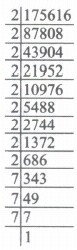
Thus, the cube root of 175616 is 56.
23.
71 = 70 + 1
Therefore, 712 = (70 + 1)2
= 70 (70 + 1) + 1 (70 + 1)
= 4900 + 70 + 70 + 1
= 5041
24.
3-2=\(\frac{1}{3^{2}}=\frac{1}{9}\) [∵ \(a^{-m}=\frac{1}{a^{m}}\)]
25.
We know that, if a number has 1 or 9 in the unit's place, then its square ends with digit 1. Therefore,1612 and 1092 would end with digit 1.
26.
We know that, 289 = 17 x 17
\(\therefore\) Equivalent rational number of
\({-13\over17}={-13\times17\over17\times 17}={-221\over289}\)
27.
There are ten separate slips having 1 to 10 numbers (one number on one slip) out of which one slip can be chosen in 10ways.
So, total number of outcomes = 10
Here, a slip containing the number 6 can be chosen in one way only.
So, favourable outcomes = 1
\(\therefore\) Probability of getting the number 6 = \(\frac{Favourable\ outcomes}{Total\ number\ of\ outcomes}=\frac{1}{10}\)
28.
Here, number of balls is 5, which are of different colours. If we pull out a ball, then it may be R, W, B, G or Y. So, possible outcomes are R, W, B, G or Y.

8th Standard CBSE Syllabus & Materials
8th Standard CBSE
CBSE 8th Science Particulate Nature of Matter - New Model Questions Papers Study Material - QB365 Set A
NEW8th Standard CBSE
CBSE 8th Science Pressure, Winds, Stroms and Cyclones - New Model Questions Papers Study Material - QB365 Set A
NEW8th Standard CBSE
CBSE 8th Mathematics Quadrilaterals - New Model Questions Papers Study Material - QB365 Set A
NEW8th Standard CBSE
CBSE 8th Mathematics A story of Numbers - New Model Questions Papers Study Material - QB365 Set A



NCERT Books

Syllabus

Exam Pattern

Sample Question Papers

Previous year Question Papers

Important Notes

MCQ Practice test

NCERT Exemplers

Case study Questions

Image Based Questions

Passage based Questions

HOT Questions

Value Based Questions

Model Questions Papers
NCERT ( Book Back ) Questions

Assertion and Reason
Important Questions And Answers

CBSE 8th Standard CBSE Subjects
CBSE Standards


