
 100% FREE ACCESS
8th Standard CBSE Syllabus & Materials
8th Standard CBSE
CBSE 8th Social Science Theme D - Factors of Production - New Model Questions Papers Study Material - QB365 Set A
NEW8th Standard CBSE
CBSE 8th Social Science Theme C - Universal Franchise and India's Electoral System - New Model Questions Papers Study Material - QB365 Set A
NEW8th Standard CBSE
CBSE 8th Social Science Theme B - The Rise of the Marathas - New Model Questions Papers Study Material - QB365 Set A
NEW8th Standard CBSE
CBSE 8th Social Science Theme B - Reshaping India's Political Map - New Model Questions Papers Study Material - QB365 Set A
NEW8th Standard CBSE
CBSE 8th Social Science Theme A - Natural Resources and Their Use - New Model Questions Papers Study Material - QB365 Set A
NEW8th Standard CBSE
CBSE 8th Science Keeping Time with Skies - New Model Questions Papers Study Material - QB365 Set A

Published on: 21/10/2025
Download CBSE Class 8th Standard CBSE Mathematics question papers, sample papers, important questions, and previous year solved papers in PDF format. Get free study materials, NCERT solutions, and exam preparation resources for Class 8th Standard CBSE Mathematics
Questions + Answers key
Take MCQ Mathematics Test
1.
What could be the possible one's digit of the square root of 121?
1, 9
3, 4
6, 7
7, 8
2.
ABeD is a rectangle. Its diagonals meet at O.
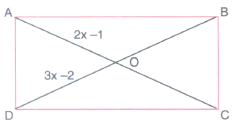
OA = 2x - 1, OD = 3x - 2. Find x
1
2
3
-1
3.
In a kite, what is false?
The diagonals are perpendicular to each other
The diagonals bisect each other
Only one pair of opposite angles is equal
All the four sides are equal
4.
The measure of each exterior angle of a regular polygon of 15 sides is
30°
45°
60°
24°
5.
Which of the following statements is false?
Natural numbers are closed under subtraction
Whole numbers are not closed under subtraction
Integers are closed under subtraction
Rational numbers are closed under subtraction.
6.
Find the smallest number by which the number 100 must be multiplied to obtain a perfect cube.
5
2
4
10
7.
Observe the following bar graph carefully and answer the following question:
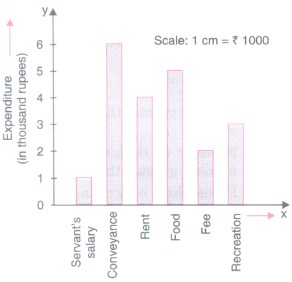
Rs 5000 is the expenditure done on
rent
food
fee
recreation
8.
The one's digit of the cube of the number 326 is
2
3
6
4
9.
Which of the following numbers is not a perfect cube?
1331
343
512
100
10.
If \({x\over 3}+1={7\over 15}\), then which of the following is correct?
\({x\over 3}={7\over 15}-1\)
\({x\over 3}={-7\over 15}+1\)
\({{x\over 3}}={-7\over 15}-1\)
none of these
11.
Which of the following are the next-two square-numbers: 1, 4, 9,16,______ and______
13 and 25
5 and 15
24 and 32
25 and 36
12.
Which of the following quadrilaterals has all angles as right angles, opposite sides equal and diagonals bisect each other?
rectangle
rhombus
square
none of these.
13.
Which of the following can be the square of a natural number 'n'?
sum of the squares of first n natural numbers
sum of the first n natural numbers
sum of first (n - 1) natural numbers
sum of first 'n' odd natural numbers.
14.
Which of the following is the product of \(\frac { 7 }{ 8 } \) and \(\frac { -2 }{ 21 } ?\)
\(\frac { -1 }{ 12 } \)
\(\frac { 1 }{ 12 } \)
\(\frac { -16 }{ 63 } \)
\(\frac { -147 }{ 16 } \)
15.
Which of the following is the multiplicative identity for rational numbers?
1
-1
0
None of these
16.
A graph showing two sets of data simultaneously is called a
double bar graph
pie chart
histogram
pictograph
17.
Listed below are the temperature °C for 10 days. -6, -8, 0, 3, 2, 0, 1, 5, 4, 4 What is the range of the data?
8°C
13°C
10°C
12°C
18.
The range of the data 18, 20, 22, 19, 17,35,44, 46, 38, 40 is
24
29
46
31
19.
Arpita's present age is thrice of Shilpa. If Shilpa's age 3 yr ago was x. Then, Arpita's present age is
3(x - 3)
3x + 3
3x - 9
3(x + 3)
20.
Which of the following statements is always true?
\(\frac{x-y}{2}\) is a rational number between x and y
\(\frac{x+y}{2}\) is a rational number between x and y
\(\frac{x\times y}{2}\) is a rational number between x and y
\(\frac{x\div y}{2}\) is a rational number between x and y
21.
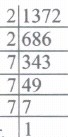
Is 1372 a perfect cube? If not, find the smallest natural number by which 1372 must be multiplied so that the product is a perfect cube.
22.
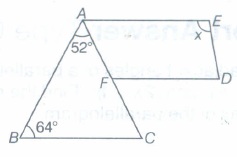
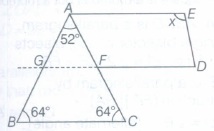
In the following figure, FD II BC II AE and AC II ED. Find the value of x.
23.
Write the rational number for each point labelled with a letter

24.
Find using distributivity. \(\{ {9\over16}\times {4\over12} \} +\{ {9\over 16}\times {-3\over 9} \}\)
25.
Read the following bar graph and answer the following questions.
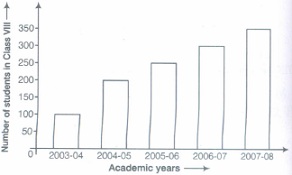
(i) What is the information given by the bar graph?
(ii) In which year is the increase in the number of students maximum?
(iii) In which year is the number of students maximum?
(iv) State whether true of false:
'The number of students during 2005 - 06 is twice that of 2003 - 04.'
26.
The sum of three consecutive multiples of 11 is 363. Find the multiples.
27.
Two opposite angles of a parallelogram are (5x - 8)° and (2x + 82)°. Find the measures of each angle of the parallelogram.
28.
Find the value of \(\sqrt { \frac { 324 }{ 81 } } +\sqrt { \frac { 324 }{ 81 } } \)
29.
Find the square root of 841
30.
Is 1188 a perfect cube? If not, find the smallest number by which 1188 must be multiplied to get a perfect cube.
31.
Find the one's digit of the cube of each of the following numbers.
1005
32.
Represent \({-7\over 4}\)on the number line
33.
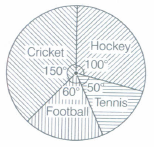
The pie chart (as shown) represents the amount spenton different sports by a sports club in a year. If the total money spend. by the club on sports in Rs 300000, then find the amount spend on each sport.
34.
Verify that -(-x) = x, for x = \(11\over15\)
35.
What is the maximum exterior angle possible for a regular polygon?
36.
How many sides does a regular polygon have, if each of its interior angles is 165°?
37.
What is the smallest number by which 648 must be multiplied so that the product is a perfect cube?
38.
Each student of Class VIII contributed some money for a picnic. The money contributed by each student was equal to square of the total number of students. If the total collected amount was 2209, then find the total numbers students. What value depict here?
39.
Evaluate \(\sqrt [ 3 ]{ 27 } +\sqrt [ 3 ]{ 0.008 } +\sqrt [ 3 ]{ 0.064 } \).
40.
The following pie chart show that the analysis result of an examination in which the candidate have failed is five. Study the pie chart and answer the question given below.
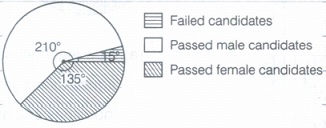
(a) Find the total number of examinees.
(b) Find the percentage of passed female candidates with respect to the total examinees.
41.
Leela invited some friends for tea on her birthday. Her mother placed some plates and some puris on a table to be served. If Leela places 4 puris in each plate 1 plate would be left empty. But if she places 3 puris in each plate 1puri would be left. Find the number of plates and number of puris on the table.
1.
1 x 1 = 1
9 x 9 = 81
2.
3x - 2 = 2x - 1 \(\Rightarrow\) x = 1.
3.
(d)
All the four sides are equal
4.
Required measure = \({360^\circ\over 15}=24^\circ\)
5.
(a)
Natural numbers are closed under subtraction
6.
100=2\(\times\)2\(\times\)5\(\times\)5
7.
\(\frac{5000}{1000}\) =5 cm is the height of the bar corresponding to food.
8.
6\(\times\)6\(\times\)6=216
9.
100 = 2 \(\times\) 2 \(\times\) 5 \(\times\) 5 = 22\(\times\) 52.
10.
(a)
\({x\over 3}={7\over 15}-1\)
11.
(d)
25 and 36
12.
(a)
rectangle
13.
(d)
sum of first 'n' odd natural numbers.
14.
(a)
\(\frac { -1 }{ 12 } \)
15.
(a)
1
16.
(a)
double bar graph
17.
(b)
13°C
18.
(b)
29
19.
(d)
3(x + 3)
20.
(b)
\(\frac{x+y}{2}\) is a rational number between x and y
21.
We have 1372 = 2 x 2 x 7 x 7 x 7
Since, the prime factor 2 does not appear in a group of triples.
\(\therefore\) 1372 is not a perfect cube.
Obviously, to make it a perfect cube we need one more 2 as its factor
i.e., [1372] x 2 = [2 x 2 x 7 x 7 x 7] x 2
or 2744 = 2 x 2 x 2 x 7 x 7 x 7
which is a perfect cube.
Thus, the required smallest number = 2.
22.
In ΔABC, ㄥC = 180° - (52° + 64°) =180° -116° =64°
Now, we see that, DG II BC and DG II AE
∴ ㄥACB = ㄥAFG
[∴ FG II BC and FC is a transversal, so corresponding anqles]
⇒ 64°= ㄥAFG
Also,GFD is a straight line.
∴ ㄥGFA + ㄥAFD =180° ⇒ 64° + ㄥAFD =180°
⇒ ㄥAFD = 180° - 64 ° = 116°
Also, FD II AE and AF II ED
So,AEDF is a parallelogram.
∴ ㄥAFD = ㄥAED
[∵ opposite angles in a parallelogram are equal]
or ㄥAED = 116° = x
23.
We can draw the number line accordingly

24.
We have,\(\{ {9\over16}\times {4\over12} \} +\{ {9\over 16}\times {-3\over 9} \} = {9\over16} \times [{4\over12}+({-3\over9})] \)
[by distributivity, taking \( {9\over16}\) as common factor]
\(={9\over16}\times[{4\over12}-{3\over9}]={9\over16}\times[{12-12\over36}]\)
\([\because LCM \ of\ 12\ and \ 9=36]\)
\(={9\over16}\times {0\over36}\)
\(= {9\over16}\times0=0\)
25.
From the given bar graph, we find that,
i) The information given by the bar graph is the number of students in Class VIII in various academic years in the school.
(ii)In the year 2004-05, increase in the number of students is maximum.
(iii) The number of students is maximum in the year 2007 - 08.
(iv) False, because the number of students during 2005-06 is more than twice that of 2003-04.
26.
If x is a multiple of 11, the next multiple is x + 11. The next to this is x + 11 + 11 or x + 22. So we can take three consecutive multiples of 11 as x, x + 11 and x + 22.
It is given that the sum of these consecutive multiples of 11 is 363. This will give the following equation:
x + (x + 11) + (x + 22) = 363
or x + x + 11 + x + 22 = 363
or 3x + 33 = 363
or 3x = 363 – 33
or 3x = 330
\(x=\frac{330}{3}\)
= 110
Hence, the three consecutive multiples are 110, 121, 132
27.
142o, 38o, 142o, 38o
28.
4
29.
29
30.
No, 242
31.
We have, 1005
One's digit of 1005 = 5
Now, cube of one's digit of 1005 = (5)3 = 5 x 5 x 5 = 125
Hence,one's digit in the cube of 1005 is 5.
32.
To represent\({-7\over 4}\) on the number line, we make 7 markings each of a distance equal to 1/4 on the left of zero. The 7th point represents the rational number\({-7\over 4}\) as shown below on the number line.

The point P is \(-7\over4\)
33.
On cricket spent money = Rs.125000
On hockey spent money = Rs. 83333.3
On football spent money = Rs. 50000
On tennis sent money = Rs. 41666.7
34.
We have, x =\(11\over15\)
LHS = -(-x) = -\(({11\over15})={11\over15}=X=RHS\)
S0, - (-x) = x is verified for x =\(11\over15\)
35.
Since, an equilateral triangle has minimum interior angles, so the maximum exterior angle possible for a regular polygon = 180° - 60° = 120°.
36.
Firstly,find the measure of exterior angle by subtracting measureof interior angle from 180°.
37.
64cm3
38.
Total amount =2209 [given]
According to the question,
Money Contributed by each student
= Square of the total number of students
\(\therefore\) Total number of students
\(=\sqrt { 2209 } =\sqrt { 47\times 47 } =47\)
The value depicted from student's activities is that all students are very cooperative in nature.
39.
Given, \(\sqrt [ 3 ]{ 27 } +\sqrt [ 3 ]{ 0.008 } +\sqrt [ 3 ]{ 0.064 } \)
Now, \(\sqrt [ 3 ]{ 27 } =\sqrt [ 3 ]{ 3\times 3\times 3 } =3\)
Now \(\sqrt [ 3 ]{ 0.008 } =\sqrt [ 3 ]{ \frac { 8 }{ 1000 } } \)
= \(\sqrt [ 3 ]{ \frac { 2\times 2\times 2 }{ 2\times 2\times 2\times 5\times 5\times 5 } } =\frac { 2 }{ 10 } \)
Now, \(\sqrt [ 3 ]{ 0.064 } =\sqrt [ 3 ]{ \frac { 64 }{ 1000 } } \)
= \(\sqrt [ 3 ]{ \frac { 2\times 2\times 2\times 2\times 2\times 2 }{ 2\times 2\times 2\times 5\times 5\times 5 } } =\frac { 4 }{ 10 } \)
So, \(\sqrt [ 3 ]{ 27 } +\sqrt [ 3 ]{ 0.008 } +\sqrt [ 3 ]{ 0.064 } \)
= \(3+\frac { 2 }{ 10 } +\frac { 4 }{ 10 } \)
LCM of 1 and 10 is 10.
Then, \(\frac { 30+2+4 }{ 10 } =\frac { 36 }{ 10 } \) = 3.6


40.
(a) 120
(b) 37.5%
41.
Let the number of plates on the table be y and the number of puris be x.
Then, according to the first condition of the problem
4(y - 1) = x ...(1)
and, according to the second condition of the
problem
3y + 1= x ... (2)
From (1) and (2), we have
4(y - 1) = 3y + 1
⇒ 4y - 4 = 3y + 1
⇒ 4y - 3y = 1 + 4
⇒ y=5
Put y = 5 in (1), we get
x = 4(5) - 4 = 20 - 4 = 16
Hence, the number of plates and number of puris on the table are 5 and 16 respectively.

8th Standard CBSE Syllabus & Materials
8th Standard CBSE
CBSE 8th Science Particulate Nature of Matter - New Model Questions Papers Study Material - QB365 Set A
NEW8th Standard CBSE
CBSE 8th Science Pressure, Winds, Stroms and Cyclones - New Model Questions Papers Study Material - QB365 Set A
NEW8th Standard CBSE
CBSE 8th Mathematics Quadrilaterals - New Model Questions Papers Study Material - QB365 Set A
NEW8th Standard CBSE
CBSE 8th Mathematics A story of Numbers - New Model Questions Papers Study Material - QB365 Set A



NCERT Books

Syllabus

Exam Pattern

Sample Question Papers

Previous year Question Papers

Important Notes

MCQ Practice test

NCERT Exemplers

Case study Questions

Image Based Questions

Passage based Questions

HOT Questions

Value Based Questions

Model Questions Papers
NCERT ( Book Back ) Questions

Assertion and Reason
Important Questions And Answers

CBSE 8th Standard CBSE Subjects
CBSE Standards


