
 100% FREE ACCESS
8th Standard CBSE Syllabus & Materials
8th Standard CBSE
CBSE 8th Social Science Theme D - Factors of Production - New Model Questions Papers Study Material - QB365 Set A
NEW8th Standard CBSE
CBSE 8th Social Science Theme C - Universal Franchise and India's Electoral System - New Model Questions Papers Study Material - QB365 Set A
NEW8th Standard CBSE
CBSE 8th Social Science Theme B - The Rise of the Marathas - New Model Questions Papers Study Material - QB365 Set A
NEW8th Standard CBSE
CBSE 8th Social Science Theme B - Reshaping India's Political Map - New Model Questions Papers Study Material - QB365 Set A
NEW8th Standard CBSE
CBSE 8th Social Science Theme A - Natural Resources and Their Use - New Model Questions Papers Study Material - QB365 Set A
NEW8th Standard CBSE
CBSE 8th Science Keeping Time with Skies - New Model Questions Papers Study Material - QB365 Set A

Published on: 21/10/2025
Download CBSE Class 8th Standard CBSE Mathematics question papers, sample papers, important questions, and previous year solved papers in PDF format. Get free study materials, NCERT solutions, and exam preparation resources for Class 8th Standard CBSE Mathematics
Questions + Answers key
Take MCQ Mathematics Test
1.
Find the sum of first n odd natural numbers.
2.
Is 150 a perfect cube?
3.
Without doing any calculation, find the numbers which are surely not perfect squares.408
4.
Find the one's digit of the cube of each of the following numbers.
77
5.
Name the quadrilaterals whose diagonals are perpendicular bisectors of each other.
6.
Using appropriate properties, find \({2\over5}\times({-3\over7})-{1\over6}\times{3\over2}+{1\over14}\times{2\over5}\)
7.
How many sides does a regular polygon have, if each of its interior angles is 165°?
8.
If interior angles of a quadrilateral are x0, (2x)0, (3x)0 and (4x)0 Then, find the value of x and each interior angle of quadrilateral.
9.
Solve the following equations 6 = Z + 2
10.
The unit digit in the square of the number 27 is
7
2
5
9
11.
How many natural numbers lie between 122 and 132?
20
22
24
26
12.
Which of the following is a perfect square number?
1067
7828
4333
625.
13.
Observe the pie chart given below and answer the following question:
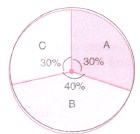
The central angle for sector A is
108°
144°
72°
150°
14.
The negative of 2 is
2
\(\frac{1}{2}\)
-2
-\(\frac{1}{2}\)
15.
(b + c) = ab + ac is called
commutative law
associative law
distributive law
none of these.
16.
\(\frac{1}{2}\) is
a natural number
a whole number
an integer
a rational number.
17.
What is the name of a regular polygon of 4 sides?
Regular hexagon
Regular Octagon
Square
Equilateral triangle
18.
What is the number of sides of a triangle?
1
2
3
4
19.
The value of x in -\(\frac{2}{3}\)=2x is
\(\frac{1}{3}\)
-\(\frac{1}{3}\)
3
-3
20.
x is an odd number. The largest odd number preceding x is
x - 1
x - 2
x-3
x-4
21.
Find the smallest number by which the number 10000 must be divided to obtain a perfect cube.
2
5
10
100
22.
Observe the following bar graph carefully and answer the following question.
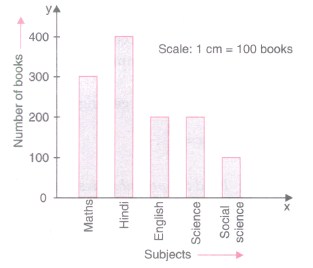
The total number of books is
1200
1400
1600
1800
23.
Observe the following bar graph carefully and answer the following question.
How many books are there of the subject whose books are maximum?
100
200
300
400
24.
What is the one's digit in the cube root of the cube number 2744?
1
2
3
4
25.
Which of the following is a perfect cube?
10,000
243
343
270000
26.
The range of the data 18, 20, 22, 19, 17,35,44, 46, 38, 40 is
24
29
46
31
27.
ABCD is a quadrilateral, in which AB = 5 cm, CD = 8 cm and the sum of angles A and D is 180°. What is the name of this quadrilateral?
Parallelogram
Trapezium
Rhombus
Cannot be determined
28.
The angles of a quadrilateral ABCD taken in an order are in the ratio 3 : 7 : 6 : 4. Then, the ABCD is a
kite
rhombus
trapezium
parallelogram
29.
Multiplicative inverse of a negative rational number is
0
-1
a negative rational number
a positive rational number
30.
By prime factorisation, find the cube roots of 1000
31.
Find the area of a square field, if its perimeter is 96 m.
32.
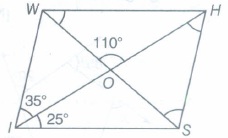
In a parallelogram WISH, find ㄥSWH, ㄥOSH and ㄥSHO.
33.
Represent \({5\over3} \ and-{5\over3}\) on the number line.
34.
In the month of July 2004, a house "holder spent his monthly salary amounting to Rs 7200 on different items as given below:
| Items | Clothing | Food | House rent | Education | Miscellaneous |
| Amount spent (in Rs) | 600 | 4000 | 1200 | 400 | 1000 |
Represent the information in the form of a pie chart.
35.
Find the smallest number, by which 6788 must be divided so that the quotient is a perfect cube.
36.
Find the sum of cubes of first four natural numbers.
37.
The following data represents the approximate percentage of water in various oceans.
Prepare a pie chart for the given data.
| Pacific | 40% |
| Atlantic | 30% |
| Indian | 20% |
| Others | 10% |
38.
Find the least number, which is a perfect square and has 7936 as one of its factors.
39.
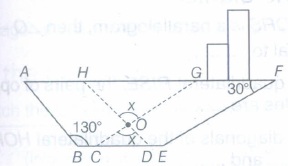
In the following figure of a ship, ABDH and CEFG are two parallelograms. Find the value of x.
40.
Is there a number which is equal to its cube but not equal to its squares? If yes find it.
41.
Leela invited some friends for tea on her birthday. Her mother placed some plates and some puris on a table to be served. If Leela places 4 puris in each plate 1 plate would be left empty. But if she places 3 puris in each plate 1puri would be left. Find the number of plates and number of puris on the table.
42.
Present the following data in the form of a grouped frequency distribution table having 6 classes of equal size (one of the class being 40-48):
| 30 | 39 | 58 | 17 | 34 | 50 | 23 | 37 |
| 42 | 49 | 55 | 59 | 19 | 28 | 47 | 49 |
| 18 | 60 | 56 | 36 | 58 | 35 | 55 | 37 |
| 25 | 34 | 39 | 61 | 53 | 33 | 36 | 53 |
| 61 | 62 | 39 | 53 | 21 | 18 | 28 | 23 |
1.
The sum of first n odd natural numbers is n2.
e.g. 1 + 3 + 5 + 7 = 16 = 42
1 + 3 + 5 = 9 = 32
\(\Rightarrow\) 1 + 3 = 4 = 22
2.
Given, number is 150.
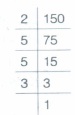
Now, prime factorisation of 150
150 = 2 x 3 x 5 x 5
The prime factors of 150 do not appear in group of triples.
Hence, 150 is not a perfect cube.
3.
We know that, the numbers end with 2, 3, 7 or 8, can never be a perfect square.
In a number 408, end digit is 8, which is one of 2, 3, 7 or 8. So, it never be a perfect square.
4.
We have, 77
One's digit of 77 = 7
Now, cube of one's digit of 77 = (7)3= 7 x 7 x 7=343
Hence,one's digit in the cube of 77 is 3.
5.
The quadrilaterals whose diagonals are perpendicular bisectors of each other can be a rhombus or a square.
6.
= \(\frac { 2 }{ 5 } \times \left( \frac { -3 }{ 7 } \right) -\frac { 1 }{ 4 } +\frac { 1 }{ 14 } \times \frac { 2 }{ 5 } \)
= \(\frac { 2 }{ 5 } \times \left( \frac { -3 }{ 7 } \right) +\frac { 1 }{ 14 } \times \frac { 2 }{ 5 } -\frac { 1 }{ 4 } \) (Using commutativity)
= \(\frac { 2 }{ 5 } \left[ \frac { -3 }{ 7 } +\frac { 1 }{ 14 } \right] -\frac { 1 }{ 4 } \) (using distributivity)
= \(\frac { 2 }{ 5 } \left[ \frac { -6+1 }{ 14 } \right] -\frac { 1 }{ 4 } =\frac { 2 }{ 5 } \times \frac { -5 }{ 14 } -\frac { 1 }{ 4 } \)
= \(\frac { -1 }{ 7 } -\frac { 1 }{ 4 } =\frac { -4-7 }{ 28 } =\frac { -11 }{ 28 } \)
7.
Firstly,find the measure of exterior angle by subtracting measureof interior angle from 180°.
8.
x=360, 360, 720,1080,1440
9.
We have 6 = z + 2
\(\Rightarrow\) 6 - 2 = z [transposing 2 from RHS to LHS]
\(\Rightarrow\) 4 = z \(\Rightarrow\) z = 4, Which is the Required solution
10.
7 x 7 = 49
11.
2 x 12 = 24
12.
Perfect square numbers end with 0, 1, 4, 5, 6 or 9 at unit's place
13.
Central angle for sector A
= \(\frac{30}{100}\)\(\times\) 360° = 360°.
14.
(c)
-2
15.
(c)
distributive law
16.
(d)
a rational number.
17.
(c)
Square
18.
(c)
3
19.
-\(\frac{2}{3}\)=2x \(\Rightarrow\)x =-\(\frac{1}{3}\)
20.
(b)
x - 2
21.
10000 = 2 \(\times\) 2\(\times\) 2 \(\times\) 2 \(\times\) 5 \(\times\) 5 \(\times\) 5 \(\times\) 5
= 23 \(\times\) 2 \(\times\) 53 \(\times\) 5.
22.
300 + 400 + 200 + 200 + 100 = 1200
23.
Hindi ⟶ 400
24.
4\(\times\)4\(\times\)4=64
25.
(c)
343
26.
(b)
29
27.
(b)
Trapezium
28.
(c)
trapezium
29.
(c)
a negative rational number
30.
10
31.
Perimeter of a square = 4 \(\times\)Side
\(\Rightarrow \ 4\times Side=96\ m\Rightarrow \ Side=\frac { 96 }{ 4 } =24\ m\)
\(\therefore \ Area\ od\ a\ square={ (Side) }^{ 2 }=Side\times Side\)
= 24 \(\times\)24 = 576 m2
32.
We have, a parallelogram WISH.
Here, WH Il lS and IW II HS
∴ ㄥWIH = ㄥIHS = 35° [alternate angle]
Similarly, ㄥHIS = ㄥIHW = 25° [alternate angle]
Now, by using angle sum property of a triangle in ΔWOH, we get
ㄥWOH + ㄥOWH + ㄥOHW = 180°
⇒ 110° + ㄥOWH + 25° =180°
[∵ ㄥOHW = ㄥIHW]
⇒ ㄥOWH =180° - (110° + 25°)
= 180° -135° = 45° = ㄥSWH
In ΔOHS, we have
ㄥHOS = 180° -110° = 70°
ㄥOHS = 35° [proved]
∴ 70° + 35° + ㄥOSH =180°
⇒ ㄥOSH =180° -105° =75°.
33.
First, we draw a number line and mark a point 0 on it to represent zero. Now, find the points A and B on the number line representing the positive integers 5 and - 5, respectively (as shown below).
Now, divide the segments OA into three equal parts such that AP = PQ = QO.
By construction
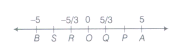
Q is one third of OA. Therefore, Q represents the rational number \({5\over3}\)
Further, B represents -5 on the number line. Now, divide OB into three equal parts, such that BS = SR = RO and OR represents one third distance of OB. Therefore, R represents the rational number - \({5\over3}\)
34.
We know that,
Central angle of a component = \((\frac{Component\quad value}{sum\quad of \quad the\quad component\quad values}\times 360)^o\)
Here, total amount = Rs 7200,
Cntral angle for an item = \((\frac{Amount\quad spent\quad on\quad the\quad item}{Total\quad amount}\times 360)^o\)
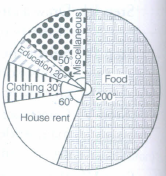
The central angles of the sectors representing different items are computed in the following table:
| Items | Amount spent (in Rs) | Central anqles |
| Clothing | 600 | \((\frac{600}{7200}\times 360)^o =30^o\) |
| Food | 4000 | \((\frac{4000}{7200}\times 360)^o =200^o\) |
| House rent | 1200 | \((\frac{1200}{7200}\times 360)^o =60^o\) |
| Education | 400 | \((\frac{400}{7200}\times 360)^o =20^o\) |
| Miscellaneous | 1000 | \((\frac{1000}{7200}\times 360)^o =50^o\) |
| Total | 7200 | 360o |
Now, to construct the pie chart representing the above data, we follow the following steps:
Step I Draw a circle of an appropriate radius.
Step II Draw a vertical radius of the circle drawn in Step I.
Step III Choose the largest central angle. Here, largest central angle is of 200°. Draw a sector with central angle 200° in such a way that its one radius coincides with the radius drawn in Step II and another radius is in its clockwise direction.
Step IV Construct other sectors representing other items in clockwise sense in descending order of magnitudes of their central angles except the sector representing miscellaneous expenses. This sector is to be drawn in the last.
Step V Shade the sectors, so obtained by different designs and label them as shown in figure given below to obtain the required pie chart.
35.
4
36.
100
37.
Central angle for oceans = \((\frac{Value\quad of\quad the\quad component}{Sum\quad of\quad the\quad components}\times 360)^o\)
For pacific ocean = 40% = \(\frac{40}{100}\times 360^o\) = 144o
For atlantic ocean = 30% = \(\frac{30}{100}\times 360^o\) = 108o
For Indian ocean = 20% = \(\frac{20}{100}\times 360^o\) = 72o
For others ocean = 10% = \(\frac{10}{100}\times 360^o\) = 36o
On the basis of above data we can draw the following pie chart:
.png)
38.
246016
39.
We have, two parallelograms ABDH and EFGC.
ㄥABD = ㄥAHD = 130°
[opposite angles of a parallelogram]
ㄥGHD = 180° - ㄥAHD = 180° - 130°
⇒ 500= ㄥGHO
Also, ㄥEFG + ㄥFGC = 180°
[adjacent angles of a parallelogram]
⇒ 30° + ㄥFGC = 180°
⇒ ㄥFGC =180° - 30° =150°
∴ ㄥHGC =180° - ㄥFGC =180° -150°
=300 = ㄥHGO
Now, in ΔHGO, by using angle sum property,
ㄥOHG + ㄥHGO + ㄥHOG =180°
⇒ 50°+ 30°+ x0 =180°
⇒ x0 =180° - 80° = 100°
40.
Let the required number be x.
Then, according to the question
x3 = x ...(1) and x2≠x ...(2)
From (1), x3 -x = 0
⇒ x(x2 - 1) = 0
⇒ x = 0, ± 1
⇒ x = 0,1,-1
If x = 0, then x2 = x.
∴ x = is inadmissible
If x = 1 then x2 = x.
∴ x = 1 is inadmissible
If x = - 1, then x2 = (- 1)2 = 1 ≠ x(= - 1)
Hence, the required number is - 1.
41.
Let the number of plates on the table be y and the number of puris be x.
Then, according to the first condition of the problem
4(y - 1) = x ...(1)
and, according to the second condition of the
problem
3y + 1= x ... (2)
From (1) and (2), we have
4(y - 1) = 3y + 1
⇒ 4y - 4 = 3y + 1
⇒ 4y - 3y = 1 + 4
⇒ y=5
Put y = 5 in (1), we get
x = 4(5) - 4 = 20 - 4 = 16
Hence, the number of plates and number of puris on the table are 5 and 16 respectively.
42.
The highest observation = 62
The lowest observation = 17
One of the class intervals = 40-48
∴ Class size = Upper class limit - Lower class limit
= 48 - 40 = 8
∴ The appropriate classes can be:
16-24, 24-32, 32-40, 40-48, 48-56, 56-64
Thus, the frequency distribution table for the above data can be shown using the Tally marks
| Groups [Class intervals] | Tally marks | Frequency |
|---|---|---|
| 16-24 | .jpg) || || |
7 |
| 24-32 | |||| | 4 |
| 32-40 | | |
11 |
| 40-48 | || | 2 |
| 48-56 | |||| |
9 |
| 56-64 | || |
7 |
| Total | 40 |

8th Standard CBSE Syllabus & Materials
8th Standard CBSE
CBSE 8th Science Particulate Nature of Matter - New Model Questions Papers Study Material - QB365 Set A
NEW8th Standard CBSE
CBSE 8th Science Pressure, Winds, Stroms and Cyclones - New Model Questions Papers Study Material - QB365 Set A
NEW8th Standard CBSE
CBSE 8th Mathematics Quadrilaterals - New Model Questions Papers Study Material - QB365 Set A
NEW8th Standard CBSE
CBSE 8th Mathematics A story of Numbers - New Model Questions Papers Study Material - QB365 Set A



NCERT Books

Syllabus

Exam Pattern

Sample Question Papers

Previous year Question Papers

Important Notes

MCQ Practice test

NCERT Exemplers

Case study Questions

Image Based Questions

Passage based Questions

HOT Questions

Value Based Questions

Model Questions Papers
NCERT ( Book Back ) Questions

Assertion and Reason
Important Questions And Answers

CBSE 8th Standard CBSE Subjects
CBSE Standards


