
 100% FREE ACCESS
8th Standard CBSE Syllabus & Materials
8th Standard CBSE
CBSE 8th Social Science Theme D - Factors of Production - New Model Questions Papers Study Material - QB365 Set A
NEW8th Standard CBSE
CBSE 8th Social Science Theme C - Universal Franchise and India's Electoral System - New Model Questions Papers Study Material - QB365 Set A
NEW8th Standard CBSE
CBSE 8th Social Science Theme B - The Rise of the Marathas - New Model Questions Papers Study Material - QB365 Set A
NEW8th Standard CBSE
CBSE 8th Social Science Theme B - Reshaping India's Political Map - New Model Questions Papers Study Material - QB365 Set A
NEW8th Standard CBSE
CBSE 8th Social Science Theme A - Natural Resources and Their Use - New Model Questions Papers Study Material - QB365 Set A
NEW8th Standard CBSE
CBSE 8th Science Keeping Time with Skies - New Model Questions Papers Study Material - QB365 Set A

Published on: 05/12/2018
CBSE Class 8 is a crucial grade in your secondary school education. So learning with effective preparation is a must. Our study materials for CBSE Class 8 follow the latest CBSE syllabus and are prepared by subject experts who have much experience in the academic industry. In this question paper, the questions are cover from the 8th Maths chapter Mensuration. Questions are prepared as per NCERT guidelines by the help of expert teachers.
By referring to our solutions, students get a clear understanding of each concept in detail. Students who have referred to our solutions have seen a significant increase in overall marks and ease in understanding the subjects. Our study materials are not only used by students but also by educational institutes in India.
In this post, we are providing you with the most important questions of the Maths exam from the chapter Mensuration. You should know answers to these questions in all likelihood to score good marks in Class 8 Maths exam.
The latest sample papers have been designed as per the latest blueprints, syllabus and examination trends. Sample papers should be practiced in examination condition at home or school and also show it to your teachers for checking or compare with the answers provided.
Download CBSE Class 8th Standard CBSE Mathematics question papers, sample papers, important questions, and previous year solved papers in PDF format. Get free study materials, NCERT solutions, and exam preparation resources for Class 8th Standard CBSE Mathematics
Questions + Answers key
Take MCQ Mathematics Test
1.
A company sells biscuits. For packing purpose, they are using cuboidal boxes: box A⟶ 3 cm\(\times\) 8 cm\(\times\)20 cm and box B ⟶ 4 cm\(\times\)12 cm\(\times\)10 cm. What size of the box will be economical for the company? Why? Can you suggest any other size (dimensions) which has the same volume but is more economical than these?
2.
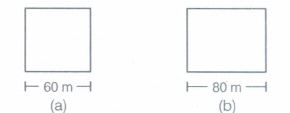
A square and a rectangular field with measurements as given in the figure have the same perimeter. Which field has a larger area?
3.
Can you think of such objects whose volume can be found by using this method?
4.
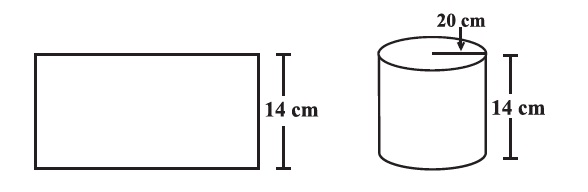
A rectangular paper of width 14 cm is rolled along its width and a cylinder of radius 20 cm is formed. Find the volume of the cylinder \((Take\ \pi=\frac{22}{7})\)
5.
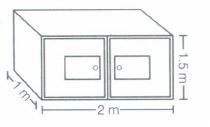
Rukhsar painted the outside of the cabinet of measure 1m\(\times\)2m\(\times\)1.5m. How much surface area did she cover, if she painted all except the bottom of the cabinet?
6.
Parallelogram is divided into two congruent triangles by drawing a diagonal across it. Can we divide a trapezium into two congruent triangles?
7.
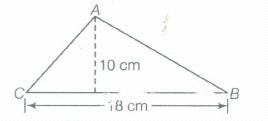
Find the area of the following figure
8.
1 cubic cm
= 1 cm x 1 cm x 1cm
= 1 cm3
= 10mm x 10mm x 10m
= ............mm3
1 cubic m = 1 m x 1 m x 1 m = 1 m3
=........ cm3
1 cubic mm= 1 mm x 1 mm x 1 mm
= 1rnm3
= 0.1 cm x 0.1 cm x 0.1 cm
= ........ cm3
9.
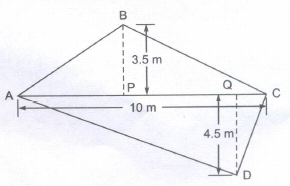
Find the area of the following quadrilateral.
10.
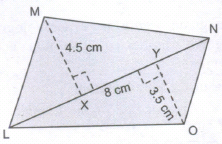
Find the area of the quadrilateral LMNO (as shown in the figure).
11.
Find the height of the cylinder whose volume is 1.54 m3 and diameter of the ball is 140 cm.
12.
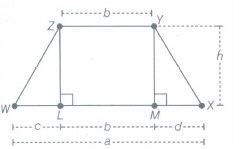
Nazma's sister also has a trapezium shaped plot. Divide it into three parts as shown in the figure. Show that the area of trapezium WXYZ = \(h\frac { (a+b) }{ 2 } \)
13.
The volume of a room is 80 m2. The area of the floor is 20 m2 . The height of the room is
1 m
2 m
3 m
4 m
14.
1 L =
10 cm3
100 cm3
1000 cm3
10000 cm3
15.
1 cm3 =
1000 mm3
100 mm3
10 mm3
\(\frac { 1 }{ 1000 } \)mm3
16.
The diagram
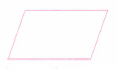
has the shape of a
rectangle
square
parallelogram
circle
17.
r and h are respectively radius and height of a cylinder. its total surface area is:
\(\pi r(r+h)\)
\(2\pi r(r+h)\)
\(2\pi h(r+h)\)
\(\pi h(r+h)\)
18.
A cube of side 5 cm is painted on all its faces. If it is sliced into 1 cubic centimetre cubes, how many 1 cubic centimetre cubes will have exactly one of their faces painted?
27
42
54
142
19.
If the height of a cylinder becomes\(\frac { 1 }{ 4 } \)of the original height and the radius is doubled, then which of the following will be true?
Volume of the cylinder will be doubled
Volume of the cylinder will remain unchanged
Volume of the cylinder will be halved
Volume of the cylinder will be\(\frac { 1 }{ 4 } \)of the original volume
20.

Find Shape, Area?
21.
A cube of side 5 cm is cut into 1 cm cubes. The percentage increase in volume after each such cutting is ____
22.
All six faces of a cuboid are_____in shape and of____area.
23.
Two cylinders of same volume have their radii in the ratio 1 : 6, then ratio of their heights is 216 :1.
24.
The areas of any two faces of a cuboid are equal
25.
The lateral surface area of a cuboid whose length is 5 m, breadth is 4 m and height is 2 m, is 36 m2.
26.
Is the volume of a cuboid equal to the product of the base area and height?
27.
What is the total surface area of a cube whose volume is 1 cu. cm?
1.
For box A,
Given, length of box = 20 cm
Breadth of box = 8 cm
and height of box = 3 cm
∴ Volume of the box = I \(\times\)b \(\times\)h = 20\(\times\)8\(\times\)3 cm3 =480 cm3
Total surface area of the box = 2(lb + bh + hl)
= 2(20\(\times\) 8 + 8\(\times\)3 + 3\(\times\)20) = 2\(\times\)(160+24+60) =2\(\times\)244 = 488 cm3
For box B,
Given, length of box = 12 cm
Breadth of box = 10 cm and height of box = 4 cm
∴ Volume of the box = I \(\times\) b \(\times\) h = 12 \(\times\) 10 \(\times\) 4 = 480 cm3
Total surface are of the box = 2 (lb + bh + hl)
= 2(120 + 40 + 48) = 2\(\times\)208 = 416cm2
It is clear from above that both boxes have same volume, but the surface area of type B box is less than that of type A box.
Thus, material required for box B is less.
∴ Box B is more economical than box A.
Now, let another box of size be 12 cm\(\times\)8 crn\(\times\)5cm
Volume of this box = 12\(\times\)8\(\times\)5 = 480 cm3
and its surface area =2(lb + bh + hl) = 2(12\(\times\)8 + 8\(\times\)5 + 5\(\times\)12)
= 2(96 + 40 + 60) = 2\(\times\)196 = 392
Clearly, surface area of this box is less than that of box B
Hence, we can suggest any other box of size 12 cm\(\times\)8 cm \(\times\)5 crn, which has the same volume buts is more economical than the given boxes.
2.
Condition is given, here a square and a rectangular field have the same perimeter.
Given, side of a square field = 60 m
∴ Perimeter of square field = 4 Side = 4\(\times\) 60m = 240 m
and area of square field = (side)2= (60)2 = 60m\(\times\) 60m
= 3600 m2
Also, given lengrh of rectangular field = 80 m
Let breadth of rectangular field be x m.
According to the question,
Perimeter of square = Perimeter of rectangle
Perimeter of rectangular field = 240 m
Also, perimeter of a rectangular field = 2 (Length + Breadth)
∴ 2(80 + x) = 240 ⇒ (80+x) = \(\frac { 240 }{ 2 } \)
⇒ 80 + x = 120
⇒ x = 120- 80 ⇒ x = 40
Now, area of rectangular field = Length \(\times\) Breadth
= 80 m x 40m = 3200 m2
Here, it is clear that, 3600 > 3200
∴ Area of square field> Area of rectangular field
Hence, square field has a larger area.
3.
Volume of godowns, reservoirs, etc., can be found by this method
4.
A cylinder is formed by rolling a rectangle about its width. Hence the width of the paper becomes height and radius of the cylinder is 20 cm.
Height of the cylinder = h = 14 cm
Radius = r = 20 cm
Volume of the cylinder = V = \(\pi\) r2 h
\(=\frac{22}{7} \times 20 \times 20 \times 14=17600 \mathrm{~cm}^{3}\)
Hence, the volume of the cylinder is 17600 cm3.
5.
Given, length of cabinet (I) = 1m
Breadth of cabinet (b) = 2 m and height of cabinet (h) =1.5 m
∴ Total painted (surface) area of cabinet = Total surface area - Area of bottom
= 2(lb + bh + hI) - Ib = Ib + 2bh + 2hl
= (1\(\times\)2+2\(\times\)2\(\times\)1.5+2\(\times\)1.5\(\times\)1)=(2 + 6 + 3)m2 = (2 + 6 + 3)m2 = 11 m2
Hence, she covers 11 m2 area of cabinet.
6.
In a parallelogram, opposite sides are parallel and equal, so by drawing a diagonal, it can be divided into two congruent triangle but in a trapezium, only one pair of opposite sides is parallel, so it cannot be divided into two congruent triangles
7.
180 cm2
8.
1 cubic cm = 1 cm x 1 cm x 1 cm
= 1cm3
= 10 mm x 10 mm x 10 mm
= 1000 mm3
1 cubic m = 1 m x 1 m x 1 m = 1 m3
= 100cm x l00cm x l00cm
= 1000000 cm3
1 cubic mm = 1 mm x 1 mm x 1 mm
= 1 mm3
= 0.1 cm x 0.1 cm x 0.1 cm
= 0.001 cm3
9.
40 m2
10.
Diagonal LN = 8 cm
Perpendicular MX = 4.5 cm
Perpendicular OY = 3.5 cm
\(\therefore\) Sum of the perpendiculars = MX + OY
= 4.5 cm + 3.5 cm = 8 cm
\(\therefore\) Area of the quadrilateral \(=\frac{1}{2}\times(diagonal)\times\)(Sum of the lengths of perpendiculars on it from opposite vertices)
\(=\frac{1}{2}\times8\times8\ cm^2=32\ cm^2\)
11.
Given,volume of the cylinder
1.54 m3= \(\frac { 154 }{ 100 } \times (100)^{ 3 }\) cm3 [∵ 1m3= (100)3 cm3]
and diameter of the base = 140 cm
∴ Radius of the base =\(\frac { 140 }{ 2 } \) =70 cm
Let height of the cylinder be h cm.
We know that, volume of the cylinder = \(\pi\)r2h
∴ 154\(\times\)(100)2 =\(\frac { 22 }{ 7 } \) \(\times\)(70)2\(\times\)h
⇒ 154\(\times\)(100)2 =\(\frac { 22 }{ 7 } \) \(\times\)70\(\times\)70\(\times\)h
⇒ 154\(\times\)(100)2 = 22\(\times\)700\(\times\)h
⇒ h = \(\frac { 154\times (100)^{ 2 } }{ 22\times 700 } =\frac { 154\times 100\times 10 }{ 22\times 700 } \) = 100 cm
Hence,the height of the cylinder is 100 cm.
12.
Here, the given trapezium is divided into three parts out of which two are triangles WLZ and XMY and one is a rectangle LMYZ.
∴ Area of trapezium WXYZ = Area of ΔWLZ + Area of rectangle LMYZ + Area of ΔXMY
= \(\left( \frac { 1 }{ 2 } \times c\times b \right) =(b\times h)+\left( \frac { 1 }{ 2 } \times d\times h \right) \)
\(\left[ \because area\ of\ triangle\ =\frac { 1 }{ 2 } \times base\times height\ and\ area\ of\ rectangle\ =\ length\ \times breadth \right] \)
=\(\frac { 1 }{ 2 } \) (ch + db) + bh
=\(\frac { h }{ 2 } \) (c + d + 2b) = \(\frac { 1 }{ 2 } \)b{(c + d + b) + b}
=\(\frac { h }{ 2 } \) (a + b) [from the figure ,c + b + d = a]
13.
Height = \(\frac { 80 }{ 20 } \) = 4 m
14.
(c)
1000 cm3
15.
(a)
1000 mm3
16.
(c)
parallelogram
17.
(b)
\(2\pi r(r+h)\)
18.
(c)
54
19.
(b)
Volume of the cylinder will remain unchanged
20.
()
Triangle;\(\frac{1}{2}\times b\times h\)
21.
None: on cutting a cube into number of cubes, we have no change in volume of the cube. So, there will be no percentage increase in the volume.
22.
()
Rectangular, different
23.
(b)
24.
(b)
25.
(a)
26.
()
Yes
27.
()
6cm2

8th Standard CBSE Syllabus & Materials
8th Standard CBSE
CBSE 8th Science Particulate Nature of Matter - New Model Questions Papers Study Material - QB365 Set A
NEW8th Standard CBSE
CBSE 8th Science Pressure, Winds, Stroms and Cyclones - New Model Questions Papers Study Material - QB365 Set A
NEW8th Standard CBSE
CBSE 8th Mathematics Quadrilaterals - New Model Questions Papers Study Material - QB365 Set A
NEW8th Standard CBSE
CBSE 8th Mathematics A story of Numbers - New Model Questions Papers Study Material - QB365 Set A



CBSE 8th Standard CBSE Subjects
CBSE Standards




