
 100% FREE ACCESS
8th Standard Syllabus & Materials
8th Standard
TN 8th Tamil இயல் 3 - கல்வி கரையில - வினைமுற்று Important Questions And Answers Study Material - QB365 Set A
NEW8th Standard
TN 8th Tamil இயல் 2 - ஈடில்லா இயற்கை - மயங்கொலிகள் Important Questions And Answers Study Material - QB365 Set A
NEW8th Standard
TN 8th Tamil இயல் 2 - ஈடில்லா இயற்கை -பட்டமரம் Important Questions And Answers Study Material - QB365 Set A
NEW8th Standard
TN 8th Tamil இயல் 2 - ஈடில்லா இயற்கை - இயற்கையை போற்றுவோம் Important Questions And Answers Study Material - QB365 Set A
NEW8th Standard
TN 8th Tamil இயல் 1 - தமிழ் இன்பம் - ஆழிக்கு இணை Important Questions And Answers Study Material - QB365 Set A
NEW8th Standard
TN 8th Tamil இயல் 2-ஈடில்லா இயற்கை - திருக்குறள் Important Questions And Answers Study Material - QB365 Set A

Published on: 03/12/2019
Geometry
Download Tamil Nadu 8th Standard Maths question papers, model tests, one-mark questions, important questions, and public exam papers in PDF format. Free study materials and answer keys for TN State Board students.
Questions + Answers key
Take MCQ Maths Test1.
Two triangles BAC and BDC right angled at A and D respectively are drawn on the same base BC and on the same side of BC. If AC and DB intersect at P. Prove that AP x PC = DP x PB.
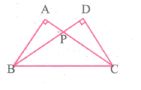
2.
In the figure with respect to \(\triangle \)BEP and \(\triangle \)CPD prove that BP x PD = EP x PC.
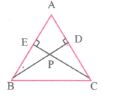
3.
In Fig, if ΔPEN ~ ΔPAD, then find x and y.
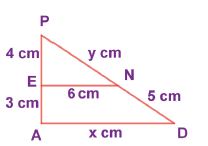
4.
Find the unknowns in the following figures
.JPG)
5.
Find the unknowns in the following figures
.JPG)
6.
In the given figure if \(\angle \)A =\(\angle \)C then prove that \(\triangle \)AOB ~\(\triangle \)COD
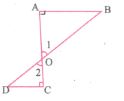
7.
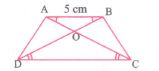
In the given figure if \(\frac { AO }{ OC } =\frac { BO }{ OD } =\frac { 1 }{ 2 } \) and AB=5cm. Find the value of DC.
8.
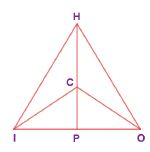
In the given figure, ∠CIP ≡ ∠COP and ∠HIP ≡ ∠HOP . Prove that IP ≡ OP.
9.
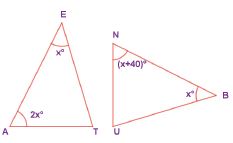
In the given figure, if ΔEAT~ΔBUN, find the measure of all angles.
10.
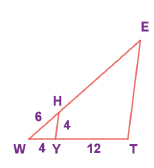
In the given figure YH||TE . Prove that ΔWHY~ΔWET and also find HE and TE.
11.
P and Q are points on sides AB and AC respectively of \(\triangle \)ABC. If AP = 3 cm PB = 6cm, AQ = 5 cm and QC = 10 cm, show that BC = 3 PQ.
12.
Construct a quadrilateral ABCD with AB = 7 cm, AD = 5 cm, CD = 5 cm, ∠BAC = 50° and ∠ABC = 60°. Also find its area.
13.
In the figure, which of the following statements is true?
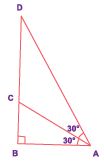
AB = BD
BD < CD
AC = CD
BC = CD
14.
If ΔABC~ΔPQR in which ∠A = 53o and ∠Q = 77o, then R is
50°
50°
70°
80°
15.
A flag pole 15 m high casts a shadow of 3 m at 10 a.m. The shadow cast by a building at the same time is 18.6 m. The height of the building is
90 m
91 m
92 m
93 m
16.
If in triangles PQR and XYZ, \(\frac{PQ}{XY}=\frac{QR}{ZX}\) then they will be similar if
∠Q = ∠Y
∠P = ∠X
∠Q = ∠X
∠P ≡ ∠Z
17.
Two similar triangles will always have ________angles
acute
obtuse
right
matching
1.
In \(\triangle \)APB and \(\triangle \)DPC
\(\angle \)A =\(\angle \)D = 90° [given]
\(\angle \)APB =\(\angle \)DPC [Vertically opposite angles]
\(\angle \)ABP =\(\angle \)DCP [Remaining angle]
∴ \(\triangle \)APB ~ \(\triangle \)DPC [AAA criteria]
\( \frac {AP }{ DP } =\frac { BP }{ PC }\) [Corresponding sides are proportional]
AP x PC = BP x DP
2.
In \(\triangle \)EPB and \(\triangle \)DPC,
\(\angle \)PEB =\(\angle \)PDC = 90° [given]
\(\angle \)EPB =\(\angle \)DPC [Vertically opposite angles]
\(\angle \)EPB =\(\angle \)PCD [∵ Remaining angles]
Thus, \(\triangle \)EPB ~ \(\triangle \)DPC [∵ By AAA criteria]
\(\frac { EP }{ DP } =\frac { PB }{ PC } \)
BP x PD = EP x PC
3.
Given that ΔPEN ~ ΔPAD,
∴ \(\frac { PE }{ PA } =\frac { EN }{ AD } \Rightarrow \frac { 4 }{ 7 } =\frac { 6 }{ x } \Rightarrow x=\frac { 42 }{ 4 } \)
Also, \(\frac { PE }{ PA } =\frac { PN }{ PD } =\frac { y }{ y+5 } \)
i.e. \(\frac { 4 }{ 7 } =\frac { y }{ y+5 } \) ⇒ 4y + 20 =7y ⇒ 7y - 4y = 20
3y = 20 ⇒ \(y=\frac { 20 }{ 3 } \)cm
4.
Now, from Fig in ΔABC \(\angle\)A = x (vertically opposite angles)
Similarly \(\angle\)B = \(\angle\)C = \(\angle\)x (Why?)
⇒ \(\angle\)A + \(\angle\)B + \(\angle\)C = 180o (angle sum property in ΔABC)
⇒ 3x = 180o
⇒ x = 60o
⇒ y = 180o − 60o = 120o
5.
Now, from Fig PQ = PR
⇒\(\angle\)Q = \(\angle\)R (angles opposite to equal sides are equal)
⇒ \(\angle\)x = \(\angle\)y
⇒\(\angle\)x+ \(\angle\)y + 50o = 180o (angle sum property in ΔPQR)
⇒ 2\(\angle\)x = 130o
⇒\(\angle\)x = 65o
⇒ \(\angle\)y = 65o
6.
In triangles \(\triangle \)AOB and \(\triangle \)COD
\(\angle \)A =\(\angle \)C ( given)
\(\angle \)AOB =\(\angle \)COD [∵ Vertically opposite angles]
\(\angle \)ABO =\(\angle \)CDO l∵ Remaining angles of MOB and ~COD]
∴\(\triangle \)AOB ~\(\triangle \)COD [∵ AAA similarity]
∴ \(\triangle \)AOB ~\(\triangle \)COD [∵ AAA similarity]
7.
In \(\triangle \)AOB and \(\triangle \)COD, we have
\(\angle \)AOB =\(\angle \)COD [∵ Vertically opposite angles]
\(\frac { AO }{ OC } =\frac { BO }{ OD } \) [given]
So by SAS criteria of similarity we have \(\triangle \)AOB ~\(\triangle \)COD
\(\frac { AO }{ OC } =\frac { BO }{ OD } =\frac { AB }{ DC } \)
\(\frac { 1 }{ 2 } =\frac { 5 }{ DC } \) [∵ AB = 5cm]
DC = 2 x 5
DC = 10 cm.
8.
\(In \ \triangle\ \mathrm{HIO}, \)
\(\angle \mathrm{HIP}=\angle \mathrm{HOP}(\text { given })\)
Then \(\triangle\) HIO is isosceles
HI = HO
In \(\triangle\) HIP and \(\triangle\) HOP,
HI = HO
\(\angle \mathrm{HIP}=\angle \mathrm{HOP}\)
Side HP is common
\(\triangle\) HIP = \(\triangle\) HOP
Then IP = OP
Hence proved
9.
\(Given \triangle \mathrm{EAT} \sim \triangle \mathrm{BUN}
\)
\(\therefore \angle \mathrm{E}=\angle \mathrm{B}, \angle \mathrm{A}=\angle \mathrm{U}, \angle \mathrm{T}=\angle \mathrm{N}\)
Sum of the angles of a triangle is 180o
\(\angle \mathrm{E}+\angle \mathrm{A}+\angle \mathrm{T}=180^{\circ}\)
x + 2x + x + 40 = 180o
4x = 180o - 40o = 140o
\(
x =\frac{140^{\circ}}{4}=35^{\circ}
\)
\(x\therefore \angle \mathrm{E} =\angle \mathrm{B}=x=35^{\circ}
\)
\(\angle \mathrm{A} =\angle \mathrm{U}=2 x
\)
\(=2 \times 35^{\circ}=70^{\circ}
\)
\(\angle \mathrm{T} =\angle \mathrm{N}=x+40^{\circ}
\)
\(=35^{\circ}+40^{\circ}=75^{\circ}
\)
10.
Given in\( \triangle \mathrm{WHY} and \ \triangle \mathrm{WET}, \)
\(\angle \mathrm{W} =\angle \mathrm{W} \)
\(\angle \mathrm{WYH} =\angle \mathrm{WTE} \)
\(\angle \mathrm{WHY} =\angle \mathrm{WET} \\ \therefore \Delta \mathrm{WHY} \sim \Delta \mathrm{WET} \)
Also \(\triangle \)WHY ~ \(\triangle \)WET
∴ Corresponding sides are proportionated
\(\frac { WH }{ WE } =\frac { HY }{ ET } =\frac { WY }{ WT } \)
\(\\ \frac { 6 }{ 6+HE } =\frac { 4 }{ ET } =\frac { 4 }{ 16 }\)
\( \\ \frac { 6 }{ 6+HE } =\frac { 4 }{ 16 }\)
\( \\ 6+HE=\frac { 6 }{ 4 } \times16\)
\(\\ 6+HE=24\)
\(\\ \therefore HE=24-6\\ HE=18\)
\(\\ Again\quad \frac { 4 }{ ET } =\frac { 4 }{ 16 } \)
\(\\ ET=\frac { 4 }{ 4 } \times 16\)
\(\\ ET=16\)
11.
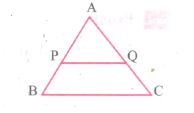
AB = AP + PB
= 3 + 6 cm = 9 cm.
AC = AQ + QC = 510 cm =15
\(\frac { AP }{AB } =\frac { 3 }{ 9 } =\frac { 1 }{ 3 } \)
\(\frac { AQ }{AC } =\frac { 5 }{15 } =\frac { 1 }{ 3 } \)
⇒\(\frac { AP }{AB } =\frac { AQ }{AC } \)
Thus in triangles APQ and ADC we have \(\frac { AP }{AB } =\frac { AQ }{AC } \) and \(\angle \)A = \(\angle \)A.
∴ By SAS criteria of similarity \(\triangle \)APQ ~\(\triangle \)ABC
⇒ \(\frac { AP }{AB } =\frac { PQ }{ BC } =\frac { AQ }{ AC } \)
⇒ \(\frac { PQ }{BC } =\frac { AQ }{ AC} \)
\(\frac { PQ }{BC } =\frac { 5 }{15 } =\frac { 1 }{ 3 } \)
\(\frac { PQ }{BC } =\frac { 1 }{ 3 } \)
⇒ BC = 3PQ
12.
Given:
AB = 7 cm, AD = 5 cm, CD = 5 cm and two angles ∠BAC = 50° and ∠ABC = 60°
.JPG)
.png)
Steps:
1. Draw a line segment AB = 7 cm.
2. At A on AB, make ∠BAY = 50° and at B on AB, make ∠ABX = 60°. Let them intersect at C.
3. With A and C as centres, draw arcs of radius 5 cm. each. Let them intersect at D.
4. Join AD and CD.
5. ABCD is the required quadrilateral.
Calculation of Area:
Area of the quadrilateral ABCD = \(\frac12\) ×d×(h1+ h2) sq.units
= \(\frac12\) x 6.4 x (3.8+5.3)
= 3.2 x 9.1 = 29.12 cm2
13.
(c)
AC = CD
14.
(a)
50°
15.
(d)
93 m
16.
(c)
∠Q = ∠X
17.
(d)
matching

8th Standard Syllabus & Materials
8th Standard
TN 8th Tamil இயல் 3 - கல்வி கரையில - பாடறிந்து ஒழுகுதல் Important Questions And Answers Study Material - QB365 Set A
NEW8th Standard
TN 8th Tamil இயல் 3-கல்வி கரையில - பல்துறைக் கல்வி Important Questions And Answers Study Material - QB365 Set A
NEW8th Standard
TN 8th Tamil இயல் 3-கல்வி கரையில - புத்தியைத் தீட்டு Important Questions And Answers Study Material - QB365 Set A
NEW8th Standard
TN 8th Tamil இயல் 2 - ஈடில்லா இயற்கை - தமிழர் மருத்துவம் ( நேர்காணல்) Important Questions And Answers Study Material - QB365 Set A



Tamilnadu Stateboard 8th Standard Subjects
Tamilnadu Stateboard Standards




