
 100% FREE ACCESS
8th Standard CBSE Syllabus & Materials
8th Standard CBSE
CBSE 8th Social Science Theme D - Factors of Production - New Model Questions Papers Study Material - QB365 Set A
NEW8th Standard CBSE
CBSE 8th Social Science Theme C - Universal Franchise and India's Electoral System - New Model Questions Papers Study Material - QB365 Set A
NEW8th Standard CBSE
CBSE 8th Social Science Theme B - The Rise of the Marathas - New Model Questions Papers Study Material - QB365 Set A
NEW8th Standard CBSE
CBSE 8th Social Science Theme B - Reshaping India's Political Map - New Model Questions Papers Study Material - QB365 Set A
NEW8th Standard CBSE
CBSE 8th Social Science Theme A - Natural Resources and Their Use - New Model Questions Papers Study Material - QB365 Set A
NEW8th Standard CBSE
CBSE 8th Science Keeping Time with Skies - New Model Questions Papers Study Material - QB365 Set A

Published on: 21/10/2025
Download CBSE Class 8th Standard CBSE Science question papers, sample papers, important questions, and previous year solved papers in PDF format. Get free study materials, NCERT solutions, and exam preparation resources for Class 8th Standard CBSE Science
Questions + Answers key
Take MCQ Science Test
1.
What is the comfortable distance to read, for a normal eye? What types of defects can a human eye have?
2.
Drop a piece of aluminium in freshly prepared solution of sodium hydroxide. Bring a matchstick near the mouth of test tube. A pop-up sound is heard.
(i) What does this pop-up sound indicate?
(ii) What do you conclude from this reaction?
3.
What is the basis of the use of yeast in the baking industry?
4.
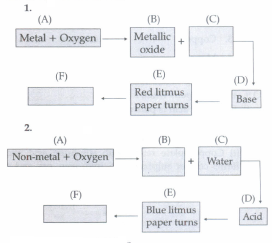
5.
Light travels fastest in vacuum. Why?
6.
Mention the name of device that is generally used by the designers of wall papers and fabrics.
7.
State the functions of rods and cones in our eye.
8.
Which of the following metals can displace the other two metals from their salt solutions? Zinc, iron, copper
9.
If you put one end of a rod of a metal in hot water, you feel hot at the other end. What does it mean? What is this property of metals called?
10.
Where do we find Rhizobium bacteria commonly?
11.
Which pathogen causes anthrax?
12.
A microorganism Z spreads malaria, that is transmitted by another microorganism Y to humans.
(a) Give the class to which microorganism Z belongs?
(b) Identify Y. Also, mention its sex.
(c) Give a preventive measure for control of this disease.
13.
The impression of an image lasts for _______ second.
14.
How do animals get proteins and other nitrogen compounds?
15.
Protozoans cause serious diseases such as _______ and ________.
16.
______ catches fire if exposed to air.
17.
Solutions of non-metallic oxides turn blue litmus paper into __________
18.
LED glows even when a.............electric current passes through it.
19.
In a movie, the still pictures in proper sequence are projected on the screen usually at the rate of ___________ pictures per second.
20.
Paramecium is a slipper- shaped ___________________
21.
What is a tester?
22.
What is the work of iris?
23.
How are metal oxides formed?
24.
Discuss all the chemical properties of (a) Metals and (b) Non-metals.
1.
The comfortable distance to read objects is 25 cm. Some persons can see objects close to them clearly, but cannot see distant objects so clearly. On the other hand some persons can not see objects close by clearly but they can see distant objects quite well. These are called Myopia and Hypermetropia respectively.
2.
(i) This 'pop-up' sound indicates the presence of hydrogen gas.
(ii) We conclude that metal reacts with sodium hydroxide to produce hydrogen gas.
3.
Yeast reproduces rapidly and produces carbon dioxide during respiration. Bubbles of gas fill the dough and increase its volume. This is the basis of the use of yeast in baking industry.
4.
1. (C) Water, (F) Blue.
2. (B)Non-metallic oxide, (F) Red
5.
Light travels fastest in vacuum than any other medium because there is no obstruction to the passage of light in vacuum.
6.
Kaleidoscope is a device that is generally used by the designers of wallpapers and fabrics.
7.
Since rods are sensitive to dim light whereas cones are sensitive to the bright light.
8.
Zinc is most reactive among three and copper is least reactive among three. Reactivity of iron is in between zinc and copper.
9.
The given observation means that heat is transmitted from one end to the other. This property of metals is called conductivity.
10.
Rhizobium bacteria commonly live in the root nodules of leguminous plants.
11.
Bacillus anthracis causes of anthrax.
12.
(a) Z is a Protozoa
(b) Y is Anopheles mosquito. It is a female.
(c) Preventive measure: Use mosquito nets and repellents.
13.
()
1/16
14.
()
Animals feeding on plants get proteins and other nitrogen compounds.
15.
()
Typhoid and Tuberculosis
16.
()
Phosphorus,
17.
()
Red
18.
()
small
19.
()
24
20.
()
Protozoa
21.
()
The device which is used to check current is called tester
22.
()
Iris controls the amount of light entering into the eye through the pupil.
23.
()
Metal oxides are formed when metals react with oxygen
24.
a) Chemical properties of metals:
(i) Metals react with oxygen to produce oxides which are alkaline in nature. e.g.,
\(\underset{Magnesium}{Mg}+\underset{Oxygen}{O_2}⟶\underset{Magnesium\ oxide}{2MgO}\)
(ii) Metallic oxides produce bases by reacting with water differently
\(\underset{Sodium\ oxide}{Na_2O}+\underset{Water}{H_2O}⟶\underset{Sodium\ hydroxide}{2NaOH}\)
(iii) Metals react with acid to produce hydrogen gas
\(\underset{Hydrochloric\ acid}{2HCI}+\underset{Sodium}{2Na}⟶\underset{Sodium\ chloride}{2NaCl}+\underset{Hydrogen}{H_2}\)
(iv) More reactive metals displace the less reactive metals from their compounds in an aqueous solution
\(\underset{Copper\ Sulpahte}{CuSO_4}+\underset{Zinc}{Zn}⟶\underset{Zinc\ Sulphate}{ZnSO_4}+\underset{Copper}{Cu}\)
(b) Chemical properties of Non-metals
(i) Non-metals react with oxygen to produce oxides which are acidic in nature
\(\underset{Sulphur}{S}+\underset{Oxygen}{O_2}⟶\underset{Sulphur\ dioxide}{SO_2}\)
\(\underset{Sulphur\ dioxide}{SO_2}+\underset{Water}{H_2O}⟶\underset{Sulphurous\ Acid}{H_2SO_3}\)
(ii) Non-metals do not react with water.
(iii) Non-metals do not show displacement reactions.

8th Standard CBSE Syllabus & Materials
8th Standard CBSE
CBSE 8th Science Particulate Nature of Matter - New Model Questions Papers Study Material - QB365 Set A
NEW8th Standard CBSE
CBSE 8th Science Pressure, Winds, Stroms and Cyclones - New Model Questions Papers Study Material - QB365 Set A
NEW8th Standard CBSE
CBSE 8th Mathematics Quadrilaterals - New Model Questions Papers Study Material - QB365 Set A
NEW8th Standard CBSE
CBSE 8th Mathematics A story of Numbers - New Model Questions Papers Study Material - QB365 Set A



NCERT Books

Syllabus

Exam Pattern

Sample Question Papers

Previous year Question Papers

Important Notes

MCQ Practice test

NCERT Exemplers

Case study Questions

Image Based Questions

Passage based Questions

HOT Questions

Value Based Questions

Model Questions Papers
NCERT ( Book Back ) Questions

Assertion and Reason
Important Questions And Answers

CBSE 8th Standard CBSE Subjects
CBSE Standards


