
 100% FREE ACCESS
8th Standard Syllabus & Materials
8th Standard
TN 8th Tamil இயல் 3 - கல்வி கரையில - வினைமுற்று Important Questions And Answers Study Material - QB365 Set A
NEW8th Standard
TN 8th Tamil இயல் 2 - ஈடில்லா இயற்கை - மயங்கொலிகள் Important Questions And Answers Study Material - QB365 Set A
NEW8th Standard
TN 8th Tamil இயல் 2 - ஈடில்லா இயற்கை -பட்டமரம் Important Questions And Answers Study Material - QB365 Set A
NEW8th Standard
TN 8th Tamil இயல் 2 - ஈடில்லா இயற்கை - இயற்கையை போற்றுவோம் Important Questions And Answers Study Material - QB365 Set A
NEW8th Standard
TN 8th Tamil இயல் 1 - தமிழ் இன்பம் - ஆழிக்கு இணை Important Questions And Answers Study Material - QB365 Set A
NEW8th Standard
TN 8th Tamil இயல் 2-ஈடில்லா இயற்கை - திருக்குறள் Important Questions And Answers Study Material - QB365 Set A

Published on: 03/12/2019
Forces and Pressure
Download Tamil Nadu 8th Standard Science question papers, model tests, one-mark questions, important questions, and public exam papers in PDF format. Free study materials and answer keys for TN State Board students.
Questions + Answers key
Take MCQ Science Test1.
If the area of contact is greater, then the ______ will be greater.
Pressure
Temperature
Friction
Force
2.
The unit for surface tension is _________
Nm
N-1m
N-1m-1
Nm-1
3.
Rain drops are spherical in nature because of _________
Frictional force
Buoyant force
Surface tension
Viscous force
4.
The unit of viscosity is
Nm2
poise
kgms–1
no unit
5.
If we apply a force against the direction of motion of a body, then the body will
stop moving
move with an increased speed
move with a decreased speed
move in a different direction
6.
Why more number of wheels are provided for a heavy goods - carrier?
7.
Why are heavy bags provided with broad straps?
8.
Define one atmosphere.
9.
Taking out paste from a tooth paste tube is an example to highlight which physical property?
10.
Give two examples to verify that a force tends to change the static condition of a body.
11.
What is known as atmospheric pressure?
12.
Cooking in a place located at a higher altitude is difficult why?
13.
What is called static pressure of the liquid?
14.
State Pascal’s law and mention its applications.
15.
How do sailors protect their ship during a heavy storm?
16.
Describe an experiment to show that liquids exert the same pressure in all directions
17.
Explain Buoyant force of a liquid
18.
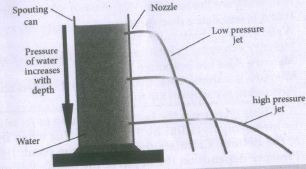
Describe an experiment to prove that the pressure in a liquid increases with depth.
19.
Give the different types of friction and explain each with an example.
1.
(c)
Friction
2.
(d)
Nm-1
3.
(c)
Surface tension
4.
(b)
poise
5.
(d)
move in a different direction
6.
i. Decreases the pressure.
ii. Increase the area of contact
7.
i) For giving a lower pressure on the shoulders
ii) Thus providing a larger area of contact with the shoulders.
8.
i) The pressure exerted by the mercury column in a barometer is considered as the pressure of magnitude 'one atmosphere'.
ii) 1 atm = pressure due to 76 cm of mercury column in a barometer = 1.01 x 10⁵ Nm-2.
9.
Pascal's law
10.
i) When a kicking force is exerted on a football at rest, it raises.
ii) When a pushing force is applied on a box at rest it moves.
11.
The amount of force or weight of the atmospheric air that acts downward on unit surface area of the surface of the earth.
12.
i. At a higher altitude, due to the lack of atmospheric pressure, the boiling point reduces.
ii. So, the water boils even at 80oC
iii. This thermal energy is not sufficient for cooking
13.
i. Liquids do not have definite shape.
ii. The force acting on unit area of the surface, on which the liquid is placed
14.
Pascal's law states that the pressure applied at any point of a liquid at rest, in a closed system will be distributed equally through all directions of the liquid.
Applications of Pascal's law:
i) In an automobile service stations, the vehicles are lifted upward using the hydraulic lift, which works as per Pascal's law.
ii) Automobile brake system works according to Pascal's law.
iii) The hydraulic press is used to make the compressed bundles of cloth or cotton so as to occupy less space.
15.
i)Pour soap powder or oil into the sea near their ship.
ii) It decreases the surface tension of sea water.
iii) It reduces the impact of the violent water current.
16.
Experiment:
i. Take a plastic bottle.
ii. Put three holes near the bottom at the same height.
iii. Fill the bottle with water.
Inference:
Water comes out from all holes with the same pressure at the same distance.
Reason:
Liquids exert the same pressure in all directions at a given depth.
17.
1. Art upward force is exerted by water on a floating or a partially submerged body.
2. This is called buoyant force and the phenomenon is known as buoyancy.
3. Force is exerted not only by liquids but also by gases.
4. Liquids and gases together called as fluids.
5. Upward force decides whether an object will sink aor float.
6. If the weight of the body is less than upward force, then the object will float. If not, it will sink.
7. Buoyant force> Weight - floats
Weight> Buoyant force - sink.
18.
Experiment:
i) Take a plasitc bottle
ii) Punch three holes on its side in the same direction but at different heights.
iii) Now pour some water into it and let it flow through the holes.
iv) Observe the flow of water.
Inference:
i) The water comes out from all the holes with a different force and falls on the table at points that are at variable distance from the bottle.
ii) Water from the lowest hole comes out with the greatest force and falls at a point that is at the maximum distance from the bottle.
iii) Water from the top most hole comes out with the least force and Falls at the point that is at the minimum distance from the bottle.
Result;
This activity confirms that the pressure in a liquid varies with the depth of the point of observation in it.
19.
Types of Friction:
Friction can be classifed into two basic types
I Static friction
II. Kinetic friction
I. Static friction:
The friction experienced by the bodies which are at rest is called static friction.
eg:- a knot in a thread.
II. Kinetic friction:
Friction existing during the motion of bodies is called kinetic friction
Kinetic friction can be classified into two types
(i) Sliding friction
(ii) Rolling friction
(i) Sliding friction:
When a body slides over the surface of another body, the friction acting between the surfaces in contact is called sliding friction
eg: Sliding on snow in a sled.
(ii) Rolling friction:
When a body rolls over another surface, the friction acting between the surfaces in contact is called rolling friction.
eg: Wheels in vehicles, trolleys, Suitcases.

8th Standard Syllabus & Materials
8th Standard
TN 8th Tamil இயல் 3 - கல்வி கரையில - பாடறிந்து ஒழுகுதல் Important Questions And Answers Study Material - QB365 Set A
NEW8th Standard
TN 8th Tamil இயல் 3-கல்வி கரையில - பல்துறைக் கல்வி Important Questions And Answers Study Material - QB365 Set A
NEW8th Standard
TN 8th Tamil இயல் 3-கல்வி கரையில - புத்தியைத் தீட்டு Important Questions And Answers Study Material - QB365 Set A
NEW8th Standard
TN 8th Tamil இயல் 2 - ஈடில்லா இயற்கை - தமிழர் மருத்துவம் ( நேர்காணல்) Important Questions And Answers Study Material - QB365 Set A



Tamilnadu Stateboard 8th Standard Subjects
Tamilnadu Stateboard Standards




