
 100% FREE ACCESS
8th Standard Syllabus & Materials
8th Standard
TN 8th Tamil இயல் 3 - கல்வி கரையில - வினைமுற்று Important Questions And Answers Study Material - QB365 Set A
NEW8th Standard
TN 8th Tamil இயல் 2 - ஈடில்லா இயற்கை - மயங்கொலிகள் Important Questions And Answers Study Material - QB365 Set A
NEW8th Standard
TN 8th Tamil இயல் 2 - ஈடில்லா இயற்கை -பட்டமரம் Important Questions And Answers Study Material - QB365 Set A
NEW8th Standard
TN 8th Tamil இயல் 2 - ஈடில்லா இயற்கை - இயற்கையை போற்றுவோம் Important Questions And Answers Study Material - QB365 Set A
NEW8th Standard
TN 8th Tamil இயல் 1 - தமிழ் இன்பம் - ஆழிக்கு இணை Important Questions And Answers Study Material - QB365 Set A
NEW8th Standard
TN 8th Tamil இயல் 2-ஈடில்லா இயற்கை - திருக்குறள் Important Questions And Answers Study Material - QB365 Set A

Published on: 25/11/2019
Download Tamil Nadu 8th Standard Science question papers, model tests, one-mark questions, important questions, and public exam papers in PDF format. Free study materials and answer keys for TN State Board students.
Questions + Answers key
Take MCQ Science Test1.
Tux Math software helps in learning the ________
painting
arithmetic
programming
graphics
2.
During menstruation, the progesterone level is ___________
decreased
increased
ceased
normal
3.
Which one of the following categories of vertebrae are correctly numbered.
Cervical-7
Thoracic-10
Lumbar - 4
Sacral - 4
4.
Cockroach moves with the help of its
leg
bone
muscular foot
whole body
5.
In water, hydrogen and oxygen are combined in the ratio of _______by mass.
1:8
8:1
2:3
1:3
6.
Carbon dioxide with water changes
blue litmus to red
red litmus to blue
blue litmus to yellow
doesn’t react with litmus
7.
Aerated water contains
air
oxygen
carbon dioxide
nitrogen
8.
Fuse is
a switch
a wire with low resistance
a wire with high resistance
a protective device for breaking an electric circuit
9.
Conduction is the heat transfer which takes place in a____________.
solid
liquid
gas
All of them
10.
Heat is a form of ________.
electrical energy
gravitational energy
thermal energy
None of these
11.
What is Tux Math?
12.
What is the shortcut key for Save option?
13.
What is the use of Text Tool?
14.
How is adolescence differ from childhood?
15.
List out the changes which occur during puberty.
16.
Differentiate tendons and ligament
17.
Define Muscle
18.
Why our backbone is slightly moveable?
19.
Write the names of the following compounds.
a) CO
b) N2O
c) NO2
d) PCl5
20.
Write the properties of anode rays.
21.
State the law of constant proportions.
22.
Write about the reaction of nitrogen with non metals.
23.
List out the uses of nitrogen
24.
What are the sources of oxygen?.
25.
What is electric circuit?
26.
What is earthing?
27.
How charges are produced by friction?
28.
Define specific heat capacity
29.
Write a note on convection.
30.
What is conduction?
31.
Explain the working of thermos flask.
32.
What can you suggest to your classmates to keep himself/herself clean and healthy?
33.
Briefly describe the menstrual cycle.
34.
What is a streamlined body? How does it help in the movement of animals that fly or swim in water?
35.
How can we prove that the electrons carry negative charge?
36.
Write the chemical formula for the following compounds
a) Aluminium sulphate
b) Silver nitrate
c) Magnesium oxide
d) Barium chloride
37.
How do astronauts breathe when they go beyond earth’s atmosphere?
38.
What is electroscope? Explain how it works?
39.
Which one of the following statements about thermal conductivity is correct? Give reason.
a) Steel > Wood > Water
b) Steel > Water > Wood
c) Water > Steel > Wood
d) Water > Wood > Steel
40.
An iron ball requires 1000 J of heat to raise its temperature by 20°C. Calculate the heat capacity of the ball.
1.
(a)
painting
2.
(c)
ceased
3.
(a)
Cervical-7
4.
(a)
leg
5.
(a)
1:8
6.
(a)
blue litmus to red
7.
(c)
carbon dioxide
8.
(d)
a protective device for breaking an electric circuit
9.
(a)
solid
10.
(c)
thermal energy
11.
12.
13.
14.
Adolescence is the period of transition from childhood to adulthood. In childhood the sex organs remain normal. In adolescence, there is development of primary and secondary sex characteristics and the child becomes an adult
15.
The changes are
1. Change in body size
2. Change in body ProPortion
3. Development of primary sex characteristics
4. Development of secondary sex characteristics
16.
| S.No | Tendons | Ligaments |
| 1 | Tendons are made up of elastic connective tissue. | Ligament is a band of strong fibrous tissue. |
| 2 | It connects bone to muscle. | It connects bone to bone. |
17.
Muscle is a band or bundle of fibrous tissue in a body that has the ability to contract, producing movement or maintaining the position of parts of the body.
18.
Our backbone which comprises of vertebrae is a cartilaginous gliding joint whịch allows limited movements. So our backbone is slightly movable.
19.
a) CO ➡ Carbon monoxide
b) N2O ➡ Nitrous Oxide
c) NO2 ➡ Nitrogen di oxide
d) PCl5 ➡ Phosphorous Penta Chloride
20.
i) Anode rays travel in straight lines.
ii) Anode rays are made up of material particles.
iii) Anode rays are deflected by electric and magnetic fields.
iv) The properties of anode rays depend upon the nature of the gas taken inside in the discharge tube.
v) The mass of the particle is the same as the atomic mass of the gas taken inside the discharge tube.
21.
Law of constant proportion: In a pure chemical compound the elements are always present in definite proportions by mass.
22.
Nitrogen reacts with non-metals like hydrogen, oxygen etc at high temperature to form their corresponding nitrogen compounds
\( 3 \mathrm{H}_{2}+\mathrm{N}_{2} \stackrel{\Delta}{\longrightarrow} 2 \mathrm{NH}_{3} \)
23.
Uses of Nitrogen
(i) Liquid nitrogen is used as a refrigerant.
(ii) It provides an inert atmosphere for conducting certain chemical reactions.
(iii) It is used to prepare ammonia (by Haber's process) which is then converted into fertilizers and nitric acid.
(iv) It is used for inflating tyres of vehicle.
(v) It is used for filling the space above mercury in high temperature thermometer to reduce the evaporation of mercury
(vi) Many explosives such as TNT, nitroglycerin and gun powder contain nitrogen.
(vii) It is used for the preservation of fresh foods, manufacture of stainless steel, reducing fire hazards and as part of the gas in incandescent light bulbs.
24.
25.
The path through which electrons flow from one terminal to another terminal of the source is called electric circuit.
26.
Earthing is the process of connecting the exposed metal parts of an electric circuit to the ground with the help of low resistance wire. It is a safety measure devised to prevent people from getting shocked if the insulation inside electrical devices fails.
27.
When two materials are rubbed together, some electrons are transferred from one material to the other, leaving them both with a net electric charge.
E.g. When a glass rod is rubbed with a silk cloth the free electrons in the glass rod are transferred to silk cloth. Thus, the glass rod acquires a positive charge and the silk cloth acquires a negative charges.
28.
Specific heat capacity of a substance is defined as the amount of heat energy required to raise the temperature of 1 kilogram of a substance by 1oC the symbol C. It's SI unit is Jkg-1K-1.
29.
The form of heat transfer from places of high temperature to places of low temperature by the actual movement of molecules is called convection. Convection takes place in liquids and gases.
30.
Conduction is the process of heat transfer in solids from the region of higher temperature to the region of lower temperature without the actual movement of atoms or molecules
31.
Thermos flask:
The thermos flask is an insulating storage vessel that keeps its content hot cooler than the surroundings for longer time.
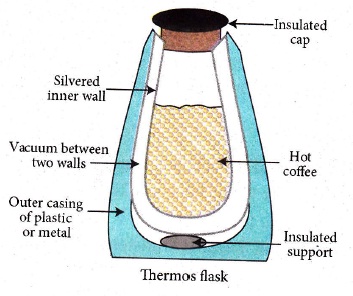
Working:
(i) A thermos flask has double wails, which are evacuated.
(ii) It is silvered on the inside.
(iii) The vacuum between the two walls prevents heat being transferred from the inside to the outside by conduction and convection.
(iv) with very little air between the walls, there is almost no transfer of heat from the inner wall to the outer wall or vice versa inner wall to the outer wall or vice versa
(v) Conduction can only occur at the points where the two walls meet, at the top of the bottle and through an insulated support at the bottom
(vi) The silvered walls reflect radiated heat buck to the liquid in the bottle.
32.
Personal hygiene habits:
(i) Shower or bath daily.
(ii) Always wash your hands before and after meals.
(iii) Keep fingernails clean and dipped.
(iv) Wash your teeth and mouth before and after each meal.
(v) Avoid touching your face, nose or mouth while preparing food.
(vi) Avoid coughing or sneezing around food and close your mouth by using hand kerchief while you cough in public places.
(vii) If you are to taste the food, use a clean spoon.
(viii) Change your clothes regularly and wash them cleanly especially undergarments.
(ix) Don't defecate in open field. Use clean toilets for defecation.
(x) If you are not well, avoid self-medication consult a doctor.
33.
(i) When a girl reaches puberty at the age of about 10, the sex hormones released into her blood cause some of the ova in her ovaries to become mature.
(ii) Usually one mature ovum is released from one of the ovaries into the oviduct once in every 28 days. This is called ovulation
(iii) Before ovulation the inner wall of uterus becomes thick and spongy, and full of tiny blood vessels. It prepares itself to receive the fertilized ovum.
(iv) If the ovum does not get fertilized then the thick and soft inner lining of uterus is no longer needed and hence it breaks. So the thick and soft inner lining of uterus along with the blood vessels and the dead ovum comes out of the vagina in the forrn of a bleeding called menstruation.
(v) Menstruation usually occurs 14 days after ovulation and usually lasts for about 3 to 5 days.
(vi) After menstruation is over, the inner lining of the uterus starts building up again so that it may become ready to receive the next ovum.
(vii) If the ovum does not get fertilized even now then menstruation takes place again. This cycle of menstruation is repeated again and again in women after every 28 days. The menstrual cycle is controlled by hormones.
34.
Streamlined body
(i) A streamlined body is the shape of the body that reduces resistance when moving
(ii) Streamlined bodies often have a teardrop shape.
(iii) Streamline shape reduces the friction of movement to a minimum thus decreasing overall drag
(iv) Streamlined body of birds help the particles of air to move upload them quickly and come together smoothly on the other side. The air does not provide much resistance to the body so that they can fly easily in air spending less energy.
(v) Streanilined body of fishes help them to move smoothly with the flow of water. Its body shape reduces friction while moving in water. It helps in the orientation of the fish movements in a particular direction.
35.
J.J. Thomson found that cathode rays were attracted by the positively charged plate and repelled by the negatively charged plate. This led him to the conclusion that the cathode rays (electrons) were made of negatively charged particles.
36.
a) Aluminium Sulphate - Al2(SO4)3
b) Silver Nitrate - AgNO3
c) Magnesium Oxide - MgO
d) Barium Chloride - BaCl2
37.
Spacesuits contain oxygen cylinders and the astronauts carryout artificial respiration to breathe when they go beyond earth's atmosphere. In long term stay in space, Electrolysis of water helps them to generate oxygen.
38.
Electroscope:
An electroscope is a scientific instrument used to detect the presence of electric charge on a body.
Types:
There are two types of electroscope.
a) Pith-ball electroscope
b) Gold-leaf electroscope.
Principle:
It works on the principle that like charges repel each other.
Structure of a gold leaf electroscope:
It is made up of a glass jar. A vertical brass rod is inserted into the jar through a cork. The top of brass rod has a horizontal brass rod or a brass disc. Two gold leaves are suspended from the brass rod inside the jar.
Working -
i) If a negatively charged object is brought near the top disc of the electroscope, it causes free electrons in the electroscope to move down into the leaves, leaving the top positive. Since both the leaves have negative charge, they repel each other and move apart.
ii) If a positive object is brought near the top disc of the electroscope, the free electrons in the electroscope start to move up towards the disc. The bottom has a net positive charge. The leaves repel other and move apart.
39.
(b) Steel > Water > Wood is the correct statement
Steel has more number of free electrons than water and wood. So it is more electropositive. It has the tendency to gain electrons. So the thermal conductivity of steel is more than water and wood. Like wise, the thermal conductivity of water is more than that of wood.
Thermal conductivity of steel - 43 w/mK
Thermal conductivity of water - 0.606 w/mK.
Thermal conductivity of wood - 0.17 w/mK.
40.
Heat energy required Q = 1000 J
Raise in temperature T = 20oC
Heat capacity C' = ?
\(\mathrm{C}^{\prime}=\frac{\mathrm{Q}}{\Delta \mathrm{T}}=\frac{1000}{20^{\circ}}=50 \mathrm{~J} /{ }^{\circ} \mathrm{C}\)
Heat capacity of the iron ball is 50 J/oC.

8th Standard Syllabus & Materials
8th Standard
TN 8th Tamil இயல் 3 - கல்வி கரையில - பாடறிந்து ஒழுகுதல் Important Questions And Answers Study Material - QB365 Set A
NEW8th Standard
TN 8th Tamil இயல் 3-கல்வி கரையில - பல்துறைக் கல்வி Important Questions And Answers Study Material - QB365 Set A
NEW8th Standard
TN 8th Tamil இயல் 3-கல்வி கரையில - புத்தியைத் தீட்டு Important Questions And Answers Study Material - QB365 Set A
NEW8th Standard
TN 8th Tamil இயல் 2 - ஈடில்லா இயற்கை - தமிழர் மருத்துவம் ( நேர்காணல்) Important Questions And Answers Study Material - QB365 Set A



Tamilnadu Stateboard 8th Standard Subjects
Tamilnadu Stateboard Standards




