
 100% FREE ACCESS
8th Standard Syllabus & Materials
8th Standard
TN 8th Tamil இயல் 3 - கல்வி கரையில - வினைமுற்று Important Questions And Answers Study Material - QB365 Set A
NEW8th Standard
TN 8th Tamil இயல் 2 - ஈடில்லா இயற்கை - மயங்கொலிகள் Important Questions And Answers Study Material - QB365 Set A
NEW8th Standard
TN 8th Tamil இயல் 2 - ஈடில்லா இயற்கை -பட்டமரம் Important Questions And Answers Study Material - QB365 Set A
NEW8th Standard
TN 8th Tamil இயல் 2 - ஈடில்லா இயற்கை - இயற்கையை போற்றுவோம் Important Questions And Answers Study Material - QB365 Set A
NEW8th Standard
TN 8th Tamil இயல் 1 - தமிழ் இன்பம் - ஆழிக்கு இணை Important Questions And Answers Study Material - QB365 Set A
NEW8th Standard
TN 8th Tamil இயல் 2-ஈடில்லா இயற்கை - திருக்குறள் Important Questions And Answers Study Material - QB365 Set A

Published on: 16/09/2019
Download Tamil Nadu 8th Standard Science question papers, model tests, one-mark questions, important questions, and public exam papers in PDF format. Free study materials and answer keys for TN State Board students.
Questions + Answers key
Take MCQ Science Test1.
Differentiate between inhalation and exhalation.
2.
Draw the structure of human eye and label its parts.
3.
Write the names of medicinal plants and explain their uses.
4.
Write any five differences between monocot and dicot plants.
5.
Write a short note on Probiotics.
6.
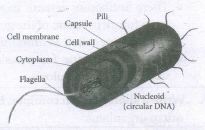
Write a short note on bacteria and its structure.
7.
Explain the three types of pollution.
8.
What is reflection? Write short notes on regular and irregular reflection?
9.
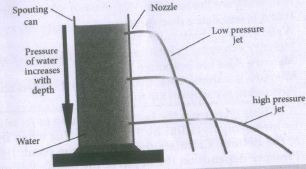
Describe an experiment to prove that the pressure in a liquid increases with depth.
10.
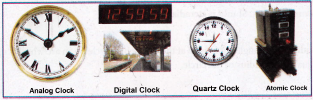
Write a short note on different types of clocks.
1.
| S.No | Inhalation | Exhalation |
|---|---|---|
| 1. | The muscles of the diaphragm | The muscles of the diaphram relax. |
| 2. | The diaphram goes downward. | The diaphram goes upwards |
| 3. | The ribs move upwards and outwards. | The ribs move downwards. |
| 4. | The volume of thoracic cavity increases. | the volume of thoracic cavity decreases. |
| 5. | air enteres the lungs through the nose | Air goes out of the lungs through the nose. |
2.
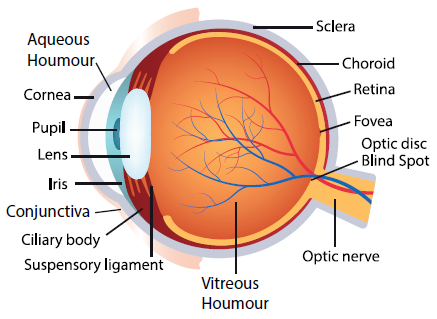
3.
(i) Acalypha indica:
1. Family - Euphorbiaceae
2. The paste obtained from the leaves is used to cure the burns on the skin.
3. The juice of this plant leaves is mixed with lemon juice to cure ringworm.
(ii) Aegle marmelos: (Vilyam)
1. Family - Rutaceae
2. Unripefruit is used to treat indigestion.
3. It is used to cure chronic, diarrhoea and dysentry.
(ii) Solanum trilobatum: (Theoduvalai)
1. Family - Solanaceae
2. Leaves and fruits of this plant cure cough and cold,
3. It is widely used in the treatment of tuberculosis and bronchial asthma.
(iv) Phyllanthus amarus:(Keechanelli)
1. Family - Euphorbiaceae
2. The entire plant is used for the treatment of jaundice.
3. It gives additional strength to human liver and used to treat other liver disorders
(v) Aloe vera: (Sothu Katrazhai)
1. Family - Liliaceae
2. Leaves of this plant is used to cure piles and inflammations on the skin.
3. It cures peptic ulcer.
4.
| S.No | Monocot | Dicot |
| 1 | Seed has one cotyledon | Seed has two cotyledon |
| 2 | Leaves have parallel venation | Leaves have reticulate venation |
| 3 | Plants have fibrous root system | Plants have tap root system |
| 4 | Flowers are trimerous and not differentiated into calyx and corolla |
Flowers are tetramerous or pentamerous. Calyx and corolla are well differentiated |
| 5 | Pollination occurs mostly by wind Eg: Grass, Paddy |
Pollination occurs mostly by insects Eg: Bean, Mango |
5.
Probiotics are live food supplements used in yoghurt and other fermented milk products. Eg. Lactobacillus acidophilus and Bifidobacterium bifidum. These bacteria improve the microbial spectrum in the gut and thus contribute to the following effects.
1. Decrease the risk of colon cancer.
2. Decrease cholesterol absorption.
3. Prevent diarrhoeal diseases by increasing the immunity power.
6.
Bacteria are single-celled prokaryotes (cells without nuclei). They are considered to be the first living organisms on earth. Bacteria are grouped under the Kingdom Monera. The study of bacteria is called Bacteriology. The size of bacteria range from 1 μm to 5 μm (micrometer). Bacteria are of two types based on respiration
i) Aerobic bacteria (requires oxygen)
ii) Anaerobic bacteria (Does not requires oxygen)
Cell Structure:
A bacterium has on outer covering known as the cell wall. Nuclear material is represented by a nucleoid without nudear membrane. An extra chromosomal DNA called plasmid is present in the cytoplasm. Protein synthesis is carried out by 70 S ribosomes. Other cell organelles (mitochondria, golgi body, endoplasmic reticulum etc.) are absent flagella aid in locomotion.
7.
| S.No | Type of pollution | Chemical substances responsible for the pollution | Effects |
|---|---|---|---|
| 1 | Air pollution | Carbon dioxide, Carbon monoxide, oxides of sulphur, oxides of nitrogen, Chlorofluorocarbons, methane etc. | Acid rain, Global warming, respiratory problems etc |
| 2 | Water pollution | Wastewater containing chemical substances (eg. dyeing industries), detergents, oil spillage etc. | Decrease in quality of water, skin diseases etc |
| 3 | Land pollution | Fertilizers like urea, various pesticides, herbicides etc | Spoilage of land, cancer, respiratory diseases etc. |
8.
Reflection of light:
i) The bouncing back of the light rays as they fall on the smooth, shiny and polished surface is called reflection.
ii) Based on the nature of the surface, reflection can be classified into two types.
i) Regular reflection
ii) Irregular reflection
Regular Reflection :
1. When a beam of light falls on a smooth surface, it gets reflected. This reflection is called regular reflection.
2. After reflection, the reflected rays will be parallel to each other.
3. The angle of incidence and angle of reflection of each ray will be equal.
4. The law of reflection is obeyed in this reflection and thus a clear image is formed,
5. It is also known as specular reflection.
6. Example: Reflection of light by a plane mirror.
Irregular Reflection :
1. In a body having a rough or irregular surface each region of the surface is inclined at different angles.
2. When light falls on such a rough surface, the light rays are reflected at different angles. This reflection is called irregular reflection.
3. The angle of incidence and the angle of reflection each ray are not equal.
4. The law of reflection is not obeyed in this reflection and thus the image is not clear.
5. It is also known as diffused reflection.
6. Example: Reflection of light from a wall.
9.
Experiment:
i) Take a plasitc bottle
ii) Punch three holes on its side in the same direction but at different heights.
iii) Now pour some water into it and let it flow through the holes.
iv) Observe the flow of water.
Inference:
i) The water comes out from all the holes with a different force and falls on the table at points that are at variable distance from the bottle.
ii) Water from the lowest hole comes out with the greatest force and falls at a point that is at the maximum distance from the bottle.
iii) Water from the top most hole comes out with the least force and Falls at the point that is at the minimum distance from the bottle.
Result;
This activity confirms that the pressure in a liquid varies with the depth of the point of observation in it.
10.
Types of clocks:
I. Types of clocks based on display
(i) Analog clocks:
1. It looks like a classic clock.
2. It has three hands such as hours hand, minutes hand and seconds hand to show the time
3. Analog clocks can be driven either mechanically or electronically.
(ii) Digital clocks:
1. A digital clock displays the time directly
2. It shows the time in numerals or other symbols.
3. It may have a 12 hours or 24 hours display,
II. Types of clocks based on working mechanism
(i) Quartz clock:
1. These clocks are activated by electronic oscillations which are controlled by a 'quartz crystal'.
2. The quartz clock is more accurate than the mechanical clock.
3. Accuracy - One second in every 109 seconds.
(ii) Atomic clock:
1. These clocks are making use of periodic vibrations occurring within the atom
2. Accuracy - One second in every 10 seconds.
3. Atomic clocks are used in Global positioning System, Global Navigation Satellite System and International time distribution services.

8th Standard Syllabus & Materials
8th Standard
TN 8th Tamil இயல் 3 - கல்வி கரையில - பாடறிந்து ஒழுகுதல் Important Questions And Answers Study Material - QB365 Set A
NEW8th Standard
TN 8th Tamil இயல் 3-கல்வி கரையில - பல்துறைக் கல்வி Important Questions And Answers Study Material - QB365 Set A
NEW8th Standard
TN 8th Tamil இயல் 3-கல்வி கரையில - புத்தியைத் தீட்டு Important Questions And Answers Study Material - QB365 Set A
NEW8th Standard
TN 8th Tamil இயல் 2 - ஈடில்லா இயற்கை - தமிழர் மருத்துவம் ( நேர்காணல்) Important Questions And Answers Study Material - QB365 Set A



Tamilnadu Stateboard 8th Standard Subjects
Tamilnadu Stateboard Standards




