
 100% FREE ACCESS
8th Standard Syllabus & Materials
8th Standard
TN 8th Tamil இயல் 3 - கல்வி கரையில - வினைமுற்று Important Questions And Answers Study Material - QB365 Set A
NEW8th Standard
TN 8th Tamil இயல் 2 - ஈடில்லா இயற்கை - மயங்கொலிகள் Important Questions And Answers Study Material - QB365 Set A
NEW8th Standard
TN 8th Tamil இயல் 2 - ஈடில்லா இயற்கை -பட்டமரம் Important Questions And Answers Study Material - QB365 Set A
NEW8th Standard
TN 8th Tamil இயல் 2 - ஈடில்லா இயற்கை - இயற்கையை போற்றுவோம் Important Questions And Answers Study Material - QB365 Set A
NEW8th Standard
TN 8th Tamil இயல் 1 - தமிழ் இன்பம் - ஆழிக்கு இணை Important Questions And Answers Study Material - QB365 Set A
NEW8th Standard
TN 8th Tamil இயல் 2-ஈடில்லா இயற்கை - திருக்குறள் Important Questions And Answers Study Material - QB365 Set A

Published on: 01/10/2019
Term 1 Light
Download Tamil Nadu 8th Standard Science question papers, model tests, one-mark questions, important questions, and public exam papers in PDF format. Free study materials and answer keys for TN State Board students.
Questions + Answers key
Take MCQ Science Test1.
Why silver metal is used to make mirror?
2.
Name the rays which involved in reflection of light.
3.
Tabulate the images formed by a convex mirror.
4.
State the Snell’s law of refraction
5.
Define the refractive index of a medium.
6.
Write a note on refraction in medium and list out the refractive index of some substances.
7.
What are the uses of convex mirrors?
8.
What is dispersion? Explain in detail.
9.
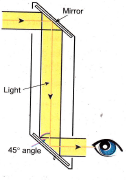
Explain the working of a periscope.
10.
What is reflection? Write short notes on regular and irregular reflection?
1.
i) Silver metal is the best reflector of light.
ii) A thin layer of silver is deposited on the side of materials like plane glass sheet to make mirrors.
2.
(i) Incident ray (ii) Reflected ray
3.
| Position of the object | Position of the image | image Size | Nature of the image |
| At infinity | At F | Highly diminished point sized | Virtual and erect |
| Between infinity and the pole (P) | Between P and F | Diminished | Virtual and erect |
4.
i) The incident ray, the reflected ray and the normal at the point of intersection all lie in the same plane.
ii) The ratio of the sine of the angle of incidence (i) to the sine of the angle of refraction (r) is equal to the refractive index of the medium, which is a constant.
\(\frac { \sin\ i }{ \sin\ r } \)= μ
5.
Refractive index of the medium is the ratio of the speed of light in the air to the speed of light in that particular medium.
μ = \(\frac { Speed\ of\ light\ in\ air\ (c) }{ Speed\ of\ light\ in\ the\ medium\ (v) } \)
6.
Refraction in medium:
i. Refraction of light depends on the speed of light in the medium.
ii. When the speed-of-light is more, bending is less
iii. When the speed of light is less, bending is more
Refractive index of some substance:
| Substances | Refractive index |
| Air Water Ether Kerosene Ordinary glass Quartz Diamond |
1.0 1.33 1.36 1.41 1.5 1.56 2.41 |
7.
i. Provide a wider field of view as they are curved outwards.
ii. Used in vehicles as rearview mirrors.
iii. Used in hallways of various buildings like hospital, hotels, schools, and stores.
iv. Mounted on a wall or ceiling where there are sharp turns.
v. Used on roads where there are sharp curves and turns.
8.
i) Splitting of white light into its seven constituent colours on passing through a transparent medium is known as dispersion of light.
ii) Dispersion occurs because light of different colours present in white light have different wavelength and they travel at different speeds in a medium.
iii) The refraction of a light ray in a medium depends on its speed.
iv) As each coloured lights has a different speed, the constituent coloured lights are refracted at different extents inside the prism.
v) Refraction of a light ray is inversely proportional to its wavelength.
vi) Thus, the red coloured light which has a large wavelength is deviated less while the violet coloured light which has a short wavelength is deviated more.
vii) Formation of rainbow is an example of dispersion of white light.
9.
Periscope:-
(i) Periscope is an instrument used for viewing bodies or ships, which are over and around another body or a submarine.
Working:-
(i) It is based on the principle of the law of reflection of light
(ii) It consists of a long outer case and inside this case mirrors or prisms are kept at each end, inclined at an angle of 45o.
(iii) Light coming from the distant body falls on the mirror at the top end of the periscope and gets reflected vertically downward.
(iv) This light is reflected again by the second mirror kept at the bottom so as to travel horizontally and reach the eye of the observer.
(v) In some complex periscopes, optic fibre is used instead of mirrors for obtaining a higher resolution.
(vi) The distance between the mirrors also varies depending on the purpose of using the periscope.
10.
Reflection of light:
i) The bouncing back of the light rays as they fall on the smooth, shiny and polished surface is called reflection.
ii) Based on the nature of the surface, reflection can be classified into two types.
i) Regular reflection
ii) Irregular reflection
Regular Reflection :
1. When a beam of light falls on a smooth surface, it gets reflected. This reflection is called regular reflection.
2. After reflection, the reflected rays will be parallel to each other.
3. The angle of incidence and angle of reflection of each ray will be equal.
4. The law of reflection is obeyed in this reflection and thus a clear image is formed,
5. It is also known as specular reflection.
6. Example: Reflection of light by a plane mirror.
Irregular Reflection :
1. In a body having a rough or irregular surface each region of the surface is inclined at different angles.
2. When light falls on such a rough surface, the light rays are reflected at different angles. This reflection is called irregular reflection.
3. The angle of incidence and the angle of reflection each ray are not equal.
4. The law of reflection is not obeyed in this reflection and thus the image is not clear.
5. It is also known as diffused reflection.
6. Example: Reflection of light from a wall.

8th Standard Syllabus & Materials
8th Standard
TN 8th Tamil இயல் 3 - கல்வி கரையில - பாடறிந்து ஒழுகுதல் Important Questions And Answers Study Material - QB365 Set A
NEW8th Standard
TN 8th Tamil இயல் 3-கல்வி கரையில - பல்துறைக் கல்வி Important Questions And Answers Study Material - QB365 Set A
NEW8th Standard
TN 8th Tamil இயல் 3-கல்வி கரையில - புத்தியைத் தீட்டு Important Questions And Answers Study Material - QB365 Set A
NEW8th Standard
TN 8th Tamil இயல் 2 - ஈடில்லா இயற்கை - தமிழர் மருத்துவம் ( நேர்காணல்) Important Questions And Answers Study Material - QB365 Set A



Tamilnadu Stateboard 8th Standard Subjects
Tamilnadu Stateboard Standards




