
 100% FREE ACCESS
8th Standard Syllabus & Materials
8th Standard
TN 8th Tamil இயல் 3 - கல்வி கரையில - வினைமுற்று Important Questions And Answers Study Material - QB365 Set A
NEW8th Standard
TN 8th Tamil இயல் 2 - ஈடில்லா இயற்கை - மயங்கொலிகள் Important Questions And Answers Study Material - QB365 Set A
NEW8th Standard
TN 8th Tamil இயல் 2 - ஈடில்லா இயற்கை -பட்டமரம் Important Questions And Answers Study Material - QB365 Set A
NEW8th Standard
TN 8th Tamil இயல் 2 - ஈடில்லா இயற்கை - இயற்கையை போற்றுவோம் Important Questions And Answers Study Material - QB365 Set A
NEW8th Standard
TN 8th Tamil இயல் 1 - தமிழ் இன்பம் - ஆழிக்கு இணை Important Questions And Answers Study Material - QB365 Set A
NEW8th Standard
TN 8th Tamil இயல் 2-ஈடில்லா இயற்கை - திருக்குறள் Important Questions And Answers Study Material - QB365 Set A

Published on: 10/12/2019
Hydrologic Cycle
Download Tamil Nadu 8th Standard Social Science question papers, model tests, one-mark questions, important questions, and public exam papers in PDF format. Free study materials and answer keys for TN State Board students.
Questions + Answers key
Take MCQ Social Science Test
1.
Some of the water remains underground and is called.
Salt water
Biological water
Swamp water
None of these
2.
______ forms when the temperature of an object drops below the point temperature.
Frost
Mist
Fog
Dew
3.
_____ is the opposite of evaporation.
Transpiration
Condensation
Infiltration
Runoff
4.
Out of fresh water, about _____ is available as ground water.
0.6%
0.01%
0.04%
2.2%
5.
The percentage of fresh water on the earth is
71
97
2.8
0.6
6.
Define “ hydrological cycle”.
7.
Explain the run-off and its types.
8.
Give a detailed explanation on different forms of precipitation.
9.
Distinguish between evaporation and transpiration.
10.
Explain the different stages involved in the hydrological cycle.
11.
Write about the formation of sleet?
12.
Write a short note on condensation?
13.
What is Infiltration?
14.
What are the main components in hydrologic cycle?
1.
(d)
None of these
2.
(d)
Dew
3.
(b)
Condensation
4.
(a)
0.6%
5.
(c)
2.8
6.
(i) Hydrological cycle is a global sun. driven process where water is transported from oceans to atmosphere, from atmosphere to land and from land back to oceans.
(ii) The water cycle can be considered as a closed system for the earth, as the quantity of water involved in the cycle is invariable.
7.
(i) Runoff is the water that is pulled by gravity across land's surface. It replenishes ground water and surface water.
Runoff is also a major contributor to the erosion which carves out canyons, gorges and related landforms.
The run off may be classified into following three types
i) Surface runoff
(i) It is the portion of rainfall, which enters the stream immediately after rainfall.
(ii) It occurs when the rainfall is longer, heavier and exceeds the rate of infiltration.
(iii) In this condition, the excess water makes a head over the ground surface, which tends to move from one place to another following land gradient and is known as overland flow.
ii) Sub-surface runoff
(i) The water that has entered the subsoil and moves laterally without joining the water-table to the streams, rivers or oceans is known as sub-surface runoff.
(ii) The sub-surface runoff is usually referred as inter flow.
iii) Base flow
(i) It is a flow of underground water from a saturated ground water zone to a water channel.
(ii) It usually appears at a downstream location where the channel elevation is lower than the ground water table.
(iii) Ground water provides the stream flow during dry periods of small or no precipitation.
8.
Precipitation refers to all forms of water that fall from clouds and reaches the earth surface. Common types of precipitation included rain, sleet, freezing rain, hail and snow.
1. Rain:
(i) The most common kind of precipitation is rain.
(ii) The precipitation in the form of water droplets is called rain.
(iii) The precipitation in which the size of rain drops are < 0.5mm in diameter is know as drizzle and the rain drops with> 0.5mmin diameter is known as rain.
2. Sleet
The precipitation which takes place in the form of mixture of water droplets and tiny particles of ice (5mm in diameter) is known as sleet.
3. Freezing rain
(i) At other times raindrops falling through cold air near the ground do not freeze in the air.
(ii) Instead, the raindrops freeze when they touch a cold surface.
(iii) This is called freezing rain and the drops of water are usually greater than 0.5mm in diameter.
4. Hail
(i) The precipitation which consists of round pellets of ice which are larger than 5mm in diameter is called hail or hail
stones.
(ii) Hail forms only in cumulonimbus clouds. during thunderstorms.
5. Snow
(i) Often water vapour in a cloud is converted directly into snow pieces due to lowering of temperature.
(ii) It appears like a powdery mass of ice.
(iii) The precipitation in the form of powdery mass of ice is known as snowfall.
(iv) It is common in the polar and high mountainous regions.
9.
| Transpiration | Evaporation | |
| 1. | It refers to the process by which the water content in the plants are released into the atmosphere in the form of water vapour. |
It refers to the process in which the liquid form of water changes into gaseous form. |
| 2. | Transpiration is a physiological process and occurs in plants. | Evaporation is a surface level process and occurs on any free surface. |
| 3. | It helps only from living bodies | It happens from any surface either living or non-living. |
| 4. | It mainly Occurs during day time. | It occurs throughout day and night. |
| 5. | The nature of the plant parts including barks and leaves also determine the transpiration rate. |
Temperature is the prime element which affects the rate of evaporation. |
| 6. | The rate of transpiration is also affected by the temperature, wind and humidity. |
Areal extent of surface water, wind and the atmospheric humidity are the other variables which affect the rate of evaporation. |
| 7. | It keeps the surface wet | It leads to dryness of surface |
10.
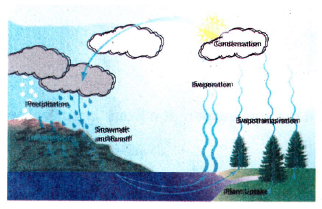
1) Evaporation :
i) Evaporation refers to the process in which the liquid form of water changes into gaseous form.
ii) Water begins to evaporate at OoC (32oF) and the process takes place very slowly.
iii) Temperature is the prime element which affects the rate of evaporation.
2) Condensation:
i) It refers to the process in which the gaseous form of water changes into liquid form.
ii) condensation generally occurs in the atmosphere when warm air rises, cools and loses its capacity to hold water vapour
3) Precipitation:
i) Precipitation refers to all forms of water that fall from clouds and reaches the earth's surface.
ii) Common types of precipitation includes rain, sleet, freezing rain, hail and snow.
iii) The most common kind of precipitation is rain.
iv) The precipitation in the form of water droplets is called rain
4) Infiltration:
i) Water entering the soil at the surface of the ground is termed as infiltration.
ii) Infiltration allows the soil temporarily to store water, making it available for plants use and organisms in the soil.
iii) Infiltration is an important process where rain water soaks into the ground, through the soil and underlying rock layers
5) Percolation:
i) Percolation is the downward movement of infiltrated,water through soil and rock layers.
ii) The percolation process represents the flow of water from unsaturated zone to the saturate d zone.
6) Runoff :
i) Runoff is the water that is pulled by gravity across land surface.
ii) It replenishes ground water and suqf3ce water as it percolates into an aquifer or moves into a river, stream or watershed.
11.
Sometimes rain drops fall through a layer of air below OOC, the freezing point of water. As they fall, the rain drops freeze into solid particles of ice. So, the mixture of water droplets and ice particles would fall on the earth surface.
12.
(i) It refers to the process in which the gaseous form of water changes into liquid form.
(ii) Condensation generally occurs in the atmosphere when warm air rises, cools and loses its capacity to hold water vapour.
13.
Water entering the soil at the surface of the ground is termed as infiltration. It allows the soil temporarily to store water, making it available for plants use and organisms in the soil.
14.
There are six main components in hydrologic cycle.
They are:
1. Evapotranspiration
2. Condensation
3. Precipitation
4. Infiltration
5. Percolation
6. Runoff.

8th Standard Syllabus & Materials
8th Standard
TN 8th Tamil இயல் 3 - கல்வி கரையில - பாடறிந்து ஒழுகுதல் Important Questions And Answers Study Material - QB365 Set A
NEW8th Standard
TN 8th Tamil இயல் 3-கல்வி கரையில - பல்துறைக் கல்வி Important Questions And Answers Study Material - QB365 Set A
NEW8th Standard
TN 8th Tamil இயல் 3-கல்வி கரையில - புத்தியைத் தீட்டு Important Questions And Answers Study Material - QB365 Set A
NEW8th Standard
TN 8th Tamil இயல் 2 - ஈடில்லா இயற்கை - தமிழர் மருத்துவம் ( நேர்காணல்) Important Questions And Answers Study Material - QB365 Set A



Tamilnadu Stateboard 8th Standard Subjects
Tamilnadu Stateboard Standards



