
 100% FREE ACCESS
8th Standard CBSE Syllabus & Materials
8th Standard CBSE
CBSE 8th Social Science Theme D - Factors of Production - New Model Questions Papers Study Material - QB365 Set A
NEW8th Standard CBSE
CBSE 8th Social Science Theme C - Universal Franchise and India's Electoral System - New Model Questions Papers Study Material - QB365 Set A
NEW8th Standard CBSE
CBSE 8th Social Science Theme B - The Rise of the Marathas - New Model Questions Papers Study Material - QB365 Set A
NEW8th Standard CBSE
CBSE 8th Social Science Theme B - Reshaping India's Political Map - New Model Questions Papers Study Material - QB365 Set A
NEW8th Standard CBSE
CBSE 8th Social Science Theme A - Natural Resources and Their Use - New Model Questions Papers Study Material - QB365 Set A
NEW8th Standard CBSE
CBSE 8th Science Keeping Time with Skies - New Model Questions Papers Study Material - QB365 Set A

Published on: 27/07/2018
Some of the important questions are prepared from this chapter HISTORY - How, When and Where.
Teachers can prepared question paper with answer key within five minutes. Please Click Here for subscribe.
Download CBSE Class 8th Standard CBSE Social Science question papers, sample papers, important questions, and previous year solved papers in PDF format. Get free study materials, NCERT solutions, and exam preparation resources for Class 8th Standard CBSE Social Science
Questions + Answers key
Take MCQ Social Science Test
1.
What was the effect of colonisation on India?
2.
How did James Mill view India?
3.
Imagine that you are a historian wanting to find out about how agriculture changed in a remote tribal area after independence. List the different ways in which you would find information on this.
4.
How will the information historians get from old newspapers be different from that found in police reports?
5.
What is the problem with the periodisation of Indian history that James Mill offers?
6.
An advertisement for Lipton tea suggested that royalty all over the world was associated with this tea. When did the advertisement appear?
1920
1925
1922
1932
7.
When New Delhi was built, the National Museum and the National Archives were both located close to the
Supreme Court
Parliament House
Viceregal Palace
Red Fort
8.
Who was the last Viceroy of India?
Lord Ripon
Lord Mountbatten
Lord William Bentinck
Lord Wellesley
9.
James Rennel produced the first map of India in
1785
1782
1885
1830
10.
The National Archives of India came up in the
1920s
1930s
1940s
1950s
11.
The first Governor-General of India was
Lord Dalhousie
Warren Hastings
Lord Canning
Lord William Bentinck
12.
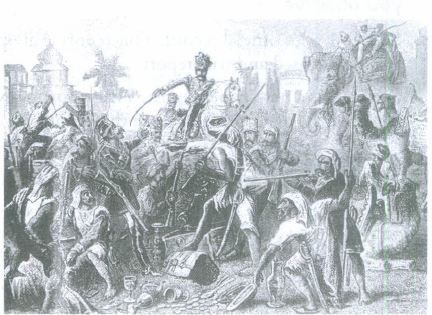
What is the caption of the painting? How did - the British painters illustrate them?
13.
Mill justified the British rule in India. Is it clear by his periodisation of history? Justify.
14.
Census operations are held _____________
15.
James Rennel prepared the _________ in 1782.
16.
The British came to India to know about its rich culture.
17.
James Mill published a newpaper in 1817.
18.
Why did the havelis decline during British rule?
19.
Where and when was the decision to shift the capital of British India to Delhi announced?
20.
Why did the trading centers of Seringapatam, Surat, and Machlipatnam lose their importance in the late 18th century?
21.
Who was James Mill?
22.
Why do many historians refer to modern period as colonial?
1.
The effect of colonisation on India are as follows:
(i) The British came to our country and established their rule, subjugating local nawabs and rajas.
(ii) The British established control over the economy and society, collected revenue to meet all their expenses, bought the goods they wanted at low prices, produced crops they needed for export.
(iii) The British rule brought about the changes in values and tastes, customer and practices. It brought about the changes in the political, economic, social and cultural sphere.
2.
James Mill in his book 'A History of British India', divided Indian history into three periods, viz., Hindu, Muslim and British. Mill thought that all Asian societies, including India, had lower level of civilization than Europe. According to him, before British came to India, Hindu and Muslim rulers controlled India. Society was then dominated by religious intolerance, caste taboos, and superstitious practices. Mill suggested that the British should conquer all the territories of India and it was necessary to introduce European manners, arts, institutions and laws for the enlightenment and happiness of the Indians.
3.
Manuscripts documents and letters survey record official documents and letters, memos. National Archives.
4.
The information in police reports tells us only about what officials thought, what they were interested in and what they wished to preserve for future generation. These records do not always help the historians understand what other people in the country felt and what lay behind their actions. However, the information from old newspapers tells us about the feelings and actions of common people of the country. This information may be affected by the personal views of the news editor, but from these, the historians can infer what common men thought about the incident.
5.
James Mill divided Indian history into three periods-Hindu, Muslim and British. But this periodisation is not proper.
There were some problems with this periodisation as follows:
(i) It is improper to refer any period of history as 'Muslim' or 'Hindu' because a variety of faiths existed Simultaneously.
(ii) It is also not justified to characterise an age through the religion of the rulers of the time. During ancient period, all the rulers did not share the same faith.
(iii) Mill, through his periodisation suggested that only British rule could civilize India. He suggested that the British should conquer all the territories in India to ensure the enlightenment as if India was not capable of progress without British help.
6.
(c)
1922
7.
(c)
Viceregal Palace
8.
(b)
Lord Mountbatten
9.
(b)
1782
10.
(a)
1920s
11.
(b)
Warren Hastings
12.
The caption of the paiting was 'Mutinous sepoys share the loot'. In the eyes of the British; the rebels were greedy, vicious and brutal. So, the British painters described them as mere looter. The British historians tended to overlook the civil and national aspects of the revolt and called it merely a sepoy mutiny.
13.
In his book, 'A History of British India', James Mill divided Indian history into three periods-. Hindu, Muslim, and British. He thought that all Asian societies were at a lower level of civilisation than Europe. Mill pointed out that before the British came to India, Hindu and Muslim despots ruled India. At that time, some factors like religious intolerance, caste taboos, and superstitious practices dominated India's social life. Mill felt that only British rule could save the Indians from the darkness. Thus, he advocated the theory of expanding colonisation, i.e. the British should conquer all the territories in India to ensure enlightenment and happiness for Indians. He strongly believed that India can be capable of progress only with the help of the British. In this way, he justified the British rule in India.
14.
()
Every ten years
15.
()
First map
16.
(b)
17.
(b)
18.
()
The havelis declined during British rule because the Mughal amirs could not maintain these large establishments.
19.
()
The decision to shift the capital of British India to Delhi was announced on 12th December 1911 at the Coronation Durbar of King George V held in Delhi.
20.
()
These trading centers lost their importance because the British started trading from the new ports of Bombay,Calcutta and Madras.
21.
()
James Mill was a Scottish economist and philosopher who wrote the famous book 'A History of British India'.
22.
()
Under British rule, people did not have equality, freedom and liberty, thus many historians referred this period as 'colonial' period.

8th Standard CBSE Syllabus & Materials
8th Standard CBSE
CBSE 8th Science Particulate Nature of Matter - New Model Questions Papers Study Material - QB365 Set A
NEW8th Standard CBSE
CBSE 8th Science Pressure, Winds, Stroms and Cyclones - New Model Questions Papers Study Material - QB365 Set A
NEW8th Standard CBSE
CBSE 8th Mathematics Quadrilaterals - New Model Questions Papers Study Material - QB365 Set A
NEW8th Standard CBSE
CBSE 8th Mathematics A story of Numbers - New Model Questions Papers Study Material - QB365 Set A



CBSE 8th Standard CBSE Subjects
CBSE Standards




