
 100% FREE ACCESS
8th Standard CBSE Syllabus & Materials
8th Standard CBSE
CBSE 8th Social Science Theme D - Factors of Production - New Model Questions Papers Study Material - QB365 Set A
NEW8th Standard CBSE
CBSE 8th Social Science Theme C - Universal Franchise and India's Electoral System - New Model Questions Papers Study Material - QB365 Set A
NEW8th Standard CBSE
CBSE 8th Social Science Theme B - The Rise of the Marathas - New Model Questions Papers Study Material - QB365 Set A
NEW8th Standard CBSE
CBSE 8th Social Science Theme B - Reshaping India's Political Map - New Model Questions Papers Study Material - QB365 Set A
NEW8th Standard CBSE
CBSE 8th Social Science Theme A - Natural Resources and Their Use - New Model Questions Papers Study Material - QB365 Set A
NEW8th Standard CBSE
CBSE 8th Science Keeping Time with Skies - New Model Questions Papers Study Material - QB365 Set A

Published on: 30/10/2019
CIV - Judiciary
Download CBSE Class 8th Standard CBSE Social Science question papers, sample papers, important questions, and previous year solved papers in PDF format. Get free study materials, NCERT solutions, and exam preparation resources for Class 8th Standard CBSE Social Science
Questions + Answers key
Take MCQ Social Science Test
1.
Supreme Court acts as Custodian of Fundamental Rights. Explain.
2.
How does the High Court act as the guardian of the Fundamental Rights?
3.
What are the qualifications and tenure of the judge of the Supreme Court of India?
4.
Describe different branches of legal system.
5.
Describe the structure of courts in India.
6.
How is independence of judiciary implemented?
7.
What are the powers and functions of High court ?
8.
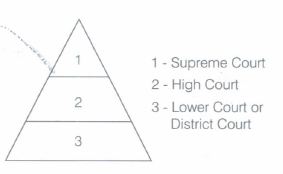
The structure of the courts from the lower to the highest level is such that it resembles a pyramid, Having read the description above, can you fill out which type of courts would exist at which level in the following diagram?

9.
What was the 'State (Delhi Administration) vs Laxman Kumar and Others (1985)' case about? Describe it in your own words.
10.
Discuss the role of PIL in Indian Judiciary. What values have you learnt from the workings of PIL in Indian judicial system?
1.
Supreme Court acts as custodian of Fundamental Rights. A citizen can move to Supreme Court directly by presenting a petition to it, without going to any lower court. It becomes the responsibility of the Supreme Court to ensure that Fundamental Rights as given in constitution must be enjoyed by every citizen of the country. For this purpose, Supreme Court can issue orders, directions and writs like Habeas Corpus, Mandamus, Prohibition, Quo Warranto and Certiorari. Article 13 (2) of Indian Constitution prohibits the state from making any law which takes away or abridges the rights granted to the citizens by Part III of the Constitution. Any law aiming at the curtailment of any of the Fundamental Rights is void to the extent it contravenes these rights. Article 32 makes right to constitutional remedies a Fundamental Right and authorises the citizens to move to the Supreme Court for the enforcement of Fundamental Rights. The Supreme Court, in order to protect the Fundamental Rights of citizens, gave some innovative judgements in important cases. Constitution has given Parliament right to impose restriction on the rights of people, but it is up to the Supreme Court to see whether these restrictions are reasonable or not. The introduction of PIL has safeguarded the rights and interests of the poor and needy.
2.
Any citizen whose rights have been violated may move to the High Court for the enforcement of the rights. Under Article 226, the High Courts have been empowered to issue writs such as Habeas Corpus, Mandamus, Prohibition, Quo Warranto and Certiorari for the enforcement of any of the Fundamental Rights. The idea is that in case of violation of a law or right, the Court may issue directions for compliance with the Constitution. All High Courts possess original jurisdiction in cases relating to divorce, will, admiralty and contempt of court. Thus, the citizens of India are secure as far as Fundamental Rights are concerned.
3.
A person is qualified for appointment as a judge only if he/she is a citizen of India and if he/she fulfils one of the following conditions:
(i) Has been a Judge of High Court for at least five years.
(ii) Has been an advocate of a High Court for at least ten years.
(iii) In the opinion of the President, is a distinguished jurist.
The Chief Justice of India and other judges of the Supreme Court hold office till they attain the age of 65 years. A judge may voluntarily resign before expiry of his term. In exceptional cases, a Supreme Court judge may be removed before the age of retirement, through impeachment.
4.
Criminal Law:
(i) Deals with conduct or acts that the law defines as offences. For example, theft, harassing a woman to bring more dowry, murder, etc.
(ii) It usually begins with the lodging of a First Information Report (FIR) with the police who investigate the crime, after which a case is filed in the court.
(iii) If found guilty, the accused can be sent to jail and can also be fined.
Civil Law:
(i) Deals with any harm or injury to rights of individuals. For example, disputes relating to sale of land, purchase of goods, rent matters, divorce cases, etc.
(ii) A petition has to be filed before the relevant court by the affected party only. In a rent matter, either the landlord or tenant can file a case.
(iii) The court gives the specific relief asked for. For instance, in a case between a landlord and a tenant, the court can order the flat to be vacated and pending rent to be paid.
5.
(i) There are three different levels of courts in our country.
(ii) There are several courts at the lower level, while there is only one at the apex level. The courts that most people interact with are called subordinate or district courts.
(iii) These are usually at the district or Tehsillevel or in towns and they hear many kinds of cases.
(iv) Each state is divided into districts that are presided over by a District Judge.
(v) Each state has a High Court which is the highest court of that state.
(vi) At the top is the Supreme Court that is located in New Delhi and is presided over by the Chief Justice of India.
(vii) The decisions made by the Supreme Court are binding on all other courts in India.
6.
There are three organs of government in our country that include-legislature, executive and judiciary. At the same time, there is separation of powers which ensures the independence of judiciary in the following ways:
(i) This means that other branches of the State-like the legislature and the executive- cannot interfere in the work of the judiciary.
(ii) The courts are not under the government and do not act on their behalf.
(iii) It is also crucial that all judges in the High Court as well as the Supreme Court, are appointed with very little interference from other branches of government.
(iv) It is the independence of the judiciary that allows the courts to playa central role in ensuring that there is no misuse of power by the legislature and the executive.
(v) It also plays a crucial role in protecting the Fundamental Rights of citizens because the citizens can approach the court if they believe that their rights have been violated.
7.
The High Court of a state has the following powers:
(i) Original Jurisdiction: The original jurisdiction of the High Court extends to all civil cases which are in respect of actions of higher value.
(ii) Appellate Jurisdiction: The appellate jurisdiction of the High Court extends to both civil and criminal cases. It comes as first or second appeal in civil cases. Appeals arise from decisions by district judges and subordinate judges in higher value cases to the High Court. The criminal appellate jurisdiction of the High Court extends to appeal from the decision of a session judge when the sentence of imprisonment exceeds 7 years.
(iii) Power of Superintendence : According to Article 277, every High Court extends the power of superintendence over all courts and tribunals, except those dealing with armed forces operating within its territorial jurisdiction.
(iv) Control over subordinate courts: The High Court is the head of judiciary in a state and a state is empowered to transfer constitutional cases from lower courts. If High Court is satisfied that a matter involves a question of law and is beyond the jurisdiction of subordinate case, it can withdraw the case and dispose it off itself.
(v) Guardian of Fundamental Rights : According to the Act, 226, the High Court is empowered to issue writs to any person or authority, including the government, if it feels that the Fundamental Rights of any individual are being infringed upon within its jurisdiction.
(vi) Court of Record: The High Court keeps a record of its own cases which act as a precedent in future cases.
8.
9.
Laxman Kumar married Sudha Goel in February 1980. On 2nd December, 1980, Sudha died in hospital due to burns. Her family filed a case in trial court.
Witnesses in this case, stated that on the night of 1st December, they had heard her scream and Sudha told them that her husband and mother in law had set her on fire. The trial court, convicted Laxman, Shakuntala and brother-in-law Subhash Chandra and sentenced all three to death. The accused then went to the High Court to appeal against this verdict and it acquitted them. Some women's groups were agitated by this verdict of the High Court and they filed a separate appeal in Supreme Court. The Supreme Court heard the arguments and found Laxman and his mother guilty and sentenced the two to life imprisonment.
10.
The legal procedures take up a lot of time and involve lots of money. Those who cannot afford to put in lots of time and money for getting justice get deprived of it. For poor people especially, the idea of going to court often becomes remote.
The system of Public Interest Litigations (PILs) introduced by the Supreme Court in the early 1980s played an important role in removing this problem.
Through PIL. any individual or organisation can approach the court on behalf of those whose rights have been violated. From this, I have learnt that now poor people can also have access to justice through PILs. I have learnt how the Judiciary of my country always works toward upholding equality and fairness.

8th Standard CBSE Syllabus & Materials
8th Standard CBSE
CBSE 8th Science Particulate Nature of Matter - New Model Questions Papers Study Material - QB365 Set A
NEW8th Standard CBSE
CBSE 8th Science Pressure, Winds, Stroms and Cyclones - New Model Questions Papers Study Material - QB365 Set A
NEW8th Standard CBSE
CBSE 8th Mathematics Quadrilaterals - New Model Questions Papers Study Material - QB365 Set A
NEW8th Standard CBSE
CBSE 8th Mathematics A story of Numbers - New Model Questions Papers Study Material - QB365 Set A



CBSE 8th Standard CBSE Subjects
CBSE Standards




