
 100% FREE ACCESS
8th Standard CBSE Syllabus & Materials
8th Standard CBSE
CBSE 8th Social Science Theme D - Factors of Production - New Model Questions Papers Study Material - QB365 Set A
NEW8th Standard CBSE
CBSE 8th Social Science Theme C - Universal Franchise and India's Electoral System - New Model Questions Papers Study Material - QB365 Set A
NEW8th Standard CBSE
CBSE 8th Social Science Theme B - The Rise of the Marathas - New Model Questions Papers Study Material - QB365 Set A
NEW8th Standard CBSE
CBSE 8th Social Science Theme B - Reshaping India's Political Map - New Model Questions Papers Study Material - QB365 Set A
NEW8th Standard CBSE
CBSE 8th Social Science Theme A - Natural Resources and Their Use - New Model Questions Papers Study Material - QB365 Set A
NEW8th Standard CBSE
CBSE 8th Science Keeping Time with Skies - New Model Questions Papers Study Material - QB365 Set A

Published on: 24/09/2019
HIS - Tribals, Dikus and the Vision of a Golden Age
Download CBSE Class 8th Standard CBSE Social Science question papers, sample papers, important questions, and previous year solved papers in PDF format. Get free study materials, NCERT solutions, and exam preparation resources for Class 8th Standard CBSE Social Science
Questions + Answers key
Take MCQ Social Science Test
1.
Describe the land settlement introduced by the British.
2.
What was Birsa's vision of a golden age? Why do you think such a vision appealed to the people of the region?
3.
What problems did shifting cultivators face under British rule?
4.
Mention the various categories of tribal people
5.
What were the problems faced by tribals during British rule?
6.
Find out from your parents, friends or teachers, the names of some heroes of other tribal revolts in the twentieth century. Write their story in your own words.
7.
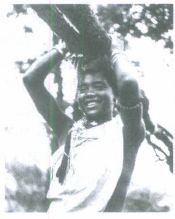
A picture of a Santhal girl carrying firewood is shown. What was the occupation of the Santhals? Why were the Santhals unhappy under the British Raj?
8.
How were the traders and moneylenders the major cause of the tribals' misery?
9.
What problems did the British face when they enacted the forest laws? How did they overcome these problems?
10.
Why did the tribals agitate under British rule?
1.
The British introduced land settlements to ensure a regular revenue source for the state. Under these settlements:
The British measured the land, defined the rights of each individual to that land and fixed the revenue demand for the state. Some peasants were declared landowners, other tenants. The tenants were to pay rent to the landowner who in turn paid revenue to the state.
2.
Birsa talked about a golden age, a satyug, an age of truth in which, like in the past, the tribal people would live a good life, construct embankments, tap natural springs, work on their lands, plant trees and orchards and practise cultivation to earn their living.
He visualised an age when the Mundas would again be free of the oppression of dikus and their ancestral rights would be restored. He talked of an age in which the tribals would not kill one another and would live an honest life.
His golden age consisted of a reformed tribal society in which there was no place for vices like liquor consumption, unclean living, witchcraft and sorcery or the influence of evil outsiders like Christian missionaries, landlords, moneylenders, traders and Europeans. They would all be driven out and the government would set-up a Munda Raj with Birsa as its head.
This vision appealed to the tribal people as all the vices and outside forces that Birsa talked about were thought of by all of them as the root causes of their misery and suffering.
3.
The problems faced by shifting cultivators under British rule were:
(i) The life of shifting cultivators was directly connected to the forest. So, when the British brought changes in forest law, their life was badly affected.
(ii) The British extended their control over all forests and declared that forests were state property.
(iii) Some forests were classified as Reserved forests for their produced timber which the British wanted. In these forests, people were not allowed to move freely and the jhum cultivators. Many cultivators had to move to other areas in search of work.
4.
Various categories of tribal people are :
(i)Jhum/Shifting cultivators who lived in North East and Central India.
(ii) The hunters and gatherers known as Khonds, who lived in forests of Orissa.
(iii) The pastoralists who moved along with their herds of cattle or sheep according to seasons.
Example:
(a) The Van Gujjars of the Punjab hills and Labadis of Andhra Pradesh were cattle herders, the Gaddis of Kullu were shepherds and Bakarwals of Kashmir herded goats.
(b) Settled cultivators such as the Munda of Chhotanagpur, Gonds, and Santhals.
5.
(i) Before British rule, tribal people had tribal chiefs who were important and had certain amount of economic power and had their own police as well as rules at some places, but they lost considerable powers when Britishers arrived.
(ii) Britishers wanted that moving tribal groups should settle down and become peasant cultivators as settled tribes were easier to control.
(iii)The Britishers tried to settle down Jhum cultivators but they were unsuccessful.
(iv) Some forest areas were declared as reserved forests which would provide timber to Britishers.
(v) The traders and money lenders started coming in forests. They wanted to buy forest products at very cheap prices which caused problem.
(vi) Britishers declared the forest as a state property.
6.
Jatra Oraon: He was a tribal freedom fighter from the Chootanagpur region, who criticised alchoholism and superstitious practices among Oraons. His religious movement gave way to a "no-rent payment" campaign. He also questioned the traditional leadership of the pahans and mahtos or the village headmen. The basic idea behind his movement was that land was a gift of god and no one could interfere with the tribal rights over land. Jatra was arrested in 1814. After his release, he abandoned his leadership of the movement and joined the Non-cooperation Movement of Gandhiji.
Rani Gaidinliu: She was born in Manipur and joined the Indian freedom struggle at an early, age of 13 with Hasipau Jodonang, who was the political and social leader of Naga. He fought to drive away the British from Manipur. He was captured and hanged ley the British. After his death, Gaidinliu assumed the leadership of the movement. She, too, was arrested in 1932 and sent to jail and released only after 1947. She was honoured with Tarnrapatra and Padma Bhushan awards. Nehruji called her "Rani of the Nagas". She died on February 17, 1933.
7.
The Santhals traditionally undertook jhum cultivation and also hunting-gathering. Both these occupations were affected by the forest laws made by the British, as the Santhals were not allowed to enter the forests at will to carry out these activities. Thus, they had to seek alternative occupations, which made them unhappy.
8.
The traders and moneylenders were the major cause of the tribals' misery as:
The tribals needed to buy some goods for their daily necessities which were not produced by them. The traders exploited them by selling them these goods at very high prices in exchange for forest produce or others goods produced by tribals. These goods were bought at very low prices by the traders for sale in other places at very high rates. In case the tribals did not have goods worth enough to exchange with traders, they borrowed cash from moneylenders at very high-interest rates, adding to the debt burden of the tribals.Both the traders and moneylenders exploited the tribal people. Thus, the tribal people believed the moneylenders and traders as evil outsiders and the cause of their misery.
9.
When the British enacted the forest laws, they faced these two problems:
(i) They faced a revolt from the jhum cultivators, as they had lost their livelihood. In addition, the tribals were not allowed to venture inside the forests to extract forest produce for sale.
(ii) The British Forest Department required labour to cut trees for making railway sleepers and labour to transport logs for use in shipbuilding and other needs.
The British overcame both problems together by establishing forest villages of tribals, where the jhum cultivators were allowed to cultivate small patches of land in forests on the condition that those who lived in the villages would have to provide labour to the Forest Department and look after the forests.
10.
The tribals agitated under British rule because:
(i) The powers and functions of tribal chiefs were reduced to keeping their lane titles and renting out their lands only.
(ii) They lost much of their economic and administrative power over their tribes and had to pay tribute to the British.
(iii) Their method of shifting cultivation was stopped and they had to settle down at fixed places to become peasant cultivators. Besides, they had to give fixed revenue to the state.
(iv) Their gathering of forest products for use or sale was stopped, as the British declared forests as Reserved meaning that the tribals could not either live in the forests or enter them at will or take out forest produce.

8th Standard CBSE Syllabus & Materials
8th Standard CBSE
CBSE 8th Science Particulate Nature of Matter - New Model Questions Papers Study Material - QB365 Set A
NEW8th Standard CBSE
CBSE 8th Science Pressure, Winds, Stroms and Cyclones - New Model Questions Papers Study Material - QB365 Set A
NEW8th Standard CBSE
CBSE 8th Mathematics Quadrilaterals - New Model Questions Papers Study Material - QB365 Set A
NEW8th Standard CBSE
CBSE 8th Mathematics A story of Numbers - New Model Questions Papers Study Material - QB365 Set A



CBSE 8th Standard CBSE Subjects
CBSE Standards




