
 100% FREE ACCESS
8th Standard CBSE Syllabus & Materials
8th Standard CBSE
CBSE 8th Social Science Theme D - Factors of Production - New Model Questions Papers Study Material - QB365 Set A
NEW8th Standard CBSE
CBSE 8th Social Science Theme C - Universal Franchise and India's Electoral System - New Model Questions Papers Study Material - QB365 Set A
NEW8th Standard CBSE
CBSE 8th Social Science Theme B - The Rise of the Marathas - New Model Questions Papers Study Material - QB365 Set A
NEW8th Standard CBSE
CBSE 8th Social Science Theme B - Reshaping India's Political Map - New Model Questions Papers Study Material - QB365 Set A
NEW8th Standard CBSE
CBSE 8th Social Science Theme A - Natural Resources and Their Use - New Model Questions Papers Study Material - QB365 Set A
NEW8th Standard CBSE
CBSE 8th Science Keeping Time with Skies - New Model Questions Papers Study Material - QB365 Set A

Published on: 05/03/2020
8th Standard CBSE Mathematics Annual Exam Model Question 2020
Download CBSE Class 8th Standard CBSE Mathematics question papers, sample papers, important questions, and previous year solved papers in PDF format. Get free study materials, NCERT solutions, and exam preparation resources for Class 8th Standard CBSE Mathematics
Questions + Answers key
Take MCQ Mathematics Test
1.
Find the least number which must be added to the numbers so as to get a perfect square. Also find the square root of the perfect square so obtained. 525
2.
What is the smallest number by which 288 must be multiplied so that the product is a perfect cube?
3.
In the adjoining figure, find x + y + z + w.
4.
Draw a square ABCD such that AB = 6.3 cm.
5.
Find the value of: \({ \left( \frac { 1 }{ 4 } \right) }^{ -2 }+{ \left( \frac { 1 }{ 3 } \right) }^{ -3 }+{ \left( \frac { 1 }{ 2 } \right) }^{ -4 }\)
6.
Shabnam takes 20 min to reach her school if she goes at a speed of 6 km/h. If she wants to reach school in 24 min, what should be her speed?
7.
Factorise \(\frac { 1 }{ 36 } { a }^{ 2 }{ b }^{ 2 }-\frac { 16 }{ 49 } { b }^{ 2 }{ c }^{ 2 }\).
8.
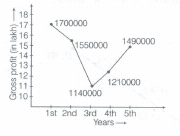
Draw the line graph using suitable scale to show the annual gross profit of a company for a period of five years.
| Year | 1st | 2nd | 3rd | 4th | 5th |
| Gross Profit (in Rs) |
1700000 | 1550000 | 1140000 | 1210000 | 1490000 |
9.
Find the values of the letters in each of the following and give reasons for the steps involved.\(\begin{matrix} \quad 4\quad A \\ +\quad 9\quad 8 \\ \_ \_ \_ \_ \_ \_ \_ \_ \_ \\ \quad C\quad B\quad 3 \\ \_ \_ \_ \_ \_ \_ \_ \_ \_ \_ \end{matrix}\)
10.
Find the length of the largest pole that can be placed in a room of dimensions 12 m\(\times\) 4 m\(\times\)3 m
11.
Simplify
\({3\over7}\times{28\over15}\div{14\over5}\)
12.
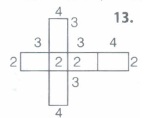
Draw the net of the following cuboid:
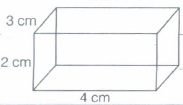
13.
From a pack of well-shuffled cards, find the probability of getting an ace of club.
14.
A shopkeeper buys 80 articles for Rs2400 and sells them for a profit of 16%. Find the selling price of one article.
15.
Identify the coefficient of each term in the expression x2y2 - 10x2y+ 5xy2 - 20.
16.
Solve the following linear equation \(\frac { x }{ 2 } -\frac { 1 }{ 5 } =\frac { x }{ 3 } +\frac { 1 }{ 4 } \)
17.
Write each of the following in standard form: 0.0016
18.
Divide as directed.
5 (2x+ 1)(3x+ 5) ÷ (2x+ 1)
19.
In which of the following cases, there are direct variation between the two given quantities?
Your height and weight.
20.
A courier-person cycles from a town to a neighbouring Suburban area to deliver a parcel to a merchant. His distance from the town at different times is shown by the following graph:
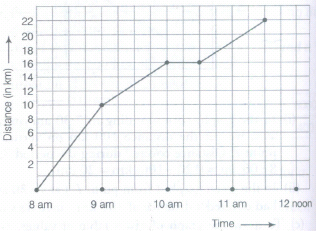
Did the person stop on his way? Explain
21.
Check the divisibility of the following numbers by 9: 294
22.
Find the cube root of 46656 by estimation method.
23.
A cuboid is of dimensions 60 cm\(\times\)54 cm\(\times\)30 cm. How many small cubes with side 6 cm can be placed in the given cuboid?
24.
Write the square, making use of the above pattern 11111112
25.
Given, P = Rs 40000 and R = 8% per annum compounded annually. Find the interest, if period is 1 yr.
26.
Multiply these binomials:(2pq + 3q2) and (3pq - 2q2)
27.
Write the rational number for each point labelled with a letter

28.
In a parallelogram, the lengths of adjacent sides are known. Do we still need measures of the angles to construct?
29.
The actual width of a classroom is 900 cm. If the scale chosen to make it drawing is 1: 30. Then, what will be the width of the room in the drawing?
30.
Three consecutive integers are such that when they are taken in increasing order and multiplied by 2, 3 and 4, respectively and added then sum is 92. Find these integers.
31.
Following are the number of members in 25 families of a village:
6, 8, 7, 7, 6, 5, 3, 2, 5, 6, 8, 7, 7, 4, 3, 6, 6, 6, 7, 5, 4, 3, 3, 2, 5.
Prepare a frequency distribution table for the data using class intervals 0 - 2, 2 - 4 etc.
32.
What is the measure of each interior angle of a regular pentagon?
33.
Draw the pattern shown on a squared paper and cut it out [Fig. (i)]. (You know that this pattern is a net of a cube). Fold it along the lines [Fig. a(ii)] and tape the edges to form a cube [(Fig. a(iii)].
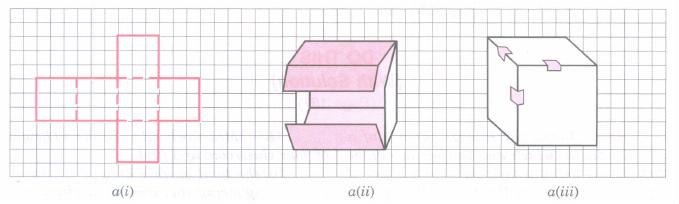
.png)
(a) What is the length, width and height of the cube? Observe that all the faces of a cube are square in shape. This makes length, height and width of a cube equal [Fig. b(i)].
(b) Write the area of each of the face. Are they equal?
(c) Write the total surface area of this cube.
(d) If each side of the cube is l , what will be the area of each face? [Fig. b(ii)]
Can we say that the total surface are of a cube of side l,is 6l2 ?
34.
Solve the following linear equations:
m-\(\frac{m-1}{2}\)=1-\(\frac{m-2}{2}\)
35.
Check for closure property under all the four operations for natural numbers.
36.
Principal = Rs 1000, Rate = 8% per annum. Fill in the following table and find which type of interest (simple or compound) change is in direct proportion with time period.
| Time period | 1 year | 2 years | 3 years |
|---|---|---|---|
| Simple Interest (in Rs \(\frac { P\times r\times t }{ 100 } \)) | |||
| Compound Interest (in Rs \(p\left( 1+\frac { r }{ 100 } \right) ^{ t }-P\) |
37.
Mr. Aditya total gross salary income is Rs 25000 per month. Due to some daily extra expenses, he is unable to save money for future emergency. Atlast he took advice from his close friend Kritik. So, he make a chart for his monthly income, choice is given below:
| Expenditure | Amount |
| Education | Rs 5000 |
| Saving | Rs 4000 |
| House rent | Rs4500 |
| Charity | Rs1500 |
| Miscellaneous | Rs 10000 |
Draw a bar graph on the basis of above given table/chart. What value depicted here?
38.
Rohan and Abhinav are best friend. Due to some financial problem, Rohan cannot celebrate his birthday in the class. Abhinav collected some money from his pocket money. He purchases some chocolates and distribute in the class on Rohan's birthday. If the cost of a chocolate is Rs.(x + 4) and he bought (x + 4) chocolates.
(i) Find the total amount paid by him in terms of x. If x = 10, find the amount paid by him.
(ii) What value depicted here?
39.
A 3-digit number 2a3 is added to the number 326 to give a three digit number 5b 9 which is divisible by 9. Find the value of a and b, then find the difference between them.
40.
The perimeters of two squares are 40 m and 96 m, respectively. Find the perimeter of another square, equal in area to the sum of the first two squares.
41.
Find the volume of a cube, whose total surface area is 486 cm2.
42.
Find the value of x, if 2x÷ 23 = 2-1
43.
Find the value of y, if 10000y=(9982)2-(18)2
44.
The following data represents the approximate percentage of water in various oceans.
Prepare a pie chart for the given data.
| Pacific | 40% |
| Atlantic | 30% |
| Indian | 20% |
| Others | 10% |
45.
A park is in the shape of a quadrilateral as shown below:
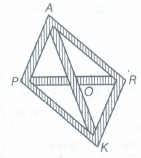
Let the vertices of park be P, A, R, K. A running track is constructed at the corner of each sides of the park as shown above.
A runner runs on the track and see that the distance covered by him from P to A and A to R is same as the distance covered by him from R to K and K to P. He also, finds that the distance of A from P is less than distance of K from P.
(a) What is the shape of the quadrilateral park?
(b) What should be the angle between the two tracks AO and OR?
(c) What type of value you depicted from the park?
46.
The diagonals of a rhombus are 8 cm and 15 cm. Find its side.
47.
Calculate the amount and compound interest on Rs 8000 for 1 yr at 9% per annum compounded half-yearly. (You could use the year by year calculation using SI formula to verify.)
48.
Look at the given map of a city.
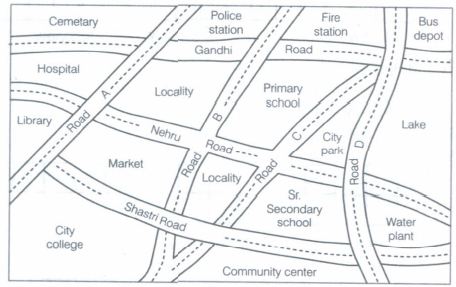
Answer the following questions:
(a) Colour the map as follows: Blue-water, Red-fire station, Orange-library, Yellow-school, Green-park, Pink-college, Purple-hospital, Brown- cemetery.
(b) Mark a green 'X' at the intersection of road 'C' and Nehru Road, Green 'V' at the intersection of Gandhi Road and road 'A'.
(c) In red, draw a short street route from library to the bus depot.
(d) Which is further East, the city park or the market?
(e) Which is further South, the primary school or the Sr. Secondary School?
49.
I have a total of Rs. 300 in coins of denomination Rs. 1, Rs.2 and Rs. 5. The number of Rs. 2 coins is 3 times the number of Rs.5 coins. The total number of coins is 160.How many coins of each denomination are with me?
50.
Is there a number which is equal to its cube but not equal to its squares? If yes find it.
51.
Take a clock and fix its minute hand at 12.
Record the angle turned through by the minute hand from its original position and the time that has passed, in the following table:
| Time Passed (T) (in minutes) |
(T1) 15 | (T2) 15 | (T3) 45 | (T4) 60 |
|---|---|---|---|---|
| Angle turned (A) (in degree) | (A1) 90 | (A2) __ | (A3) __ | (A4) __ |
| \(T\over A\) | - | - | - | - |
What do you observe about T and A? Do they increase together? Is \(T\over A\) same every time?
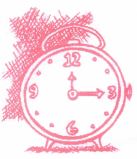
Is the angle turned through by the minute hand directly proportional to the time that has passed? Yes; From the above table, you can also see
T1 : T2 = A1 A2, because
T1 : T2 = 15 30= 1 :2
A1 : A2 = 90 180 = 1 :2
Check if T2: T3 = A2 A3 and T3 : T4 = A3 : A4
You can repeat this activity by choosing your own time interval.
52.
Present the following data in the form of a grouped frequency distribution table having 6 classes of equal size (one of the class being 40-48):
| 30 | 39 | 58 | 17 | 34 | 50 | 23 | 37 |
| 42 | 49 | 55 | 59 | 19 | 28 | 47 | 49 |
| 18 | 60 | 56 | 36 | 58 | 35 | 55 | 37 |
| 25 | 34 | 39 | 61 | 53 | 33 | 36 | 53 |
| 61 | 62 | 39 | 53 | 21 | 18 | 28 | 23 |
53.
The unit digit in the square of the number 27 is
7
2
5
9
54.
Observe the temperature time graph and answer the related question:
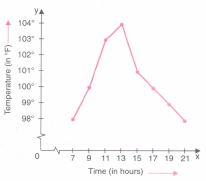
The coordinates of the origin are
(0, 0)
(1, 0)
(0, 1)
(1, 1).
55.
The area of a rectangle with length 2l2m and breadth 3lm2 is
6l3m3
l3m3
2l3m3
4l3m3.
56.
\(({ 2 }^{ 0 }+{ 4 }^{ -1 })\times { 2 }^{ 2 }\) is equal to
2
3
4
5
57.
120 copies of a book cost Rs.600. What will 400 copies cost?
Rs.1000
Rs.2000
Rs.3000
Rs.2400
58.
The factorisation of 12a2b + 15ab2 is
3ab(4a + 5b)
3a2b(4a + 5b)
3ab2(4a + 5b)
3a2b2(4a + 5b).
59.
Which of the following numbers is divisible by 5 ?
125
127
731
339.
60.
Vimla purchased a watch for Rs. 500. She sold it at a loss of 20%. Find the selling price.
Rs.500
Rs.400
Rs.300
Rs.200
61.
The measures of two angles of a quadrilateral are 110° and 100°. The remaining two angles are equal. The measure of each of the remaining two angles is
30°
60°
75°
45°
62.
The root of the equation 3y + 4 = 5y - 4 is
1
2
3
4
63.
(a + b) + c = a + (b + c) is called
commutative law for multiplication
commutative law for addition
associative law for addition
associative law for multiplication.
64.
Study the following frequency distribution table and answer the question given below:
| Daily wages (in Rs) | Number of workers |
| 290-325 | 5 |
| 325-360 | 2 |
| 360-395 | 4 |
| 395-430 | 6 |
| 430-465 | 7 |
| 465-500 | 5 |
The total number of workers is
29
22
28
21
65.
The one's digit of the cube of the number 123 is
3
6
9
7
66.
Two identical cubes each of total surface area of 6 cm2 are joined end to end. Which of the following is the total surface area of the cuboid so formed?
12 cm2
18 cm2
10 cm2
8 cm2
67.
Which of the following is the number of faces of a solid sphere?
1
2
many
none of these
68.
Which one of the following is a Pythagorian triplet?
(n2-1), 2n and (n2+ 1)
(n + 1)(n2-1) and (n2+ 1)
n, (n2-1) and (n2+ 1)
(n - 1), (n2- 1) and (n2 + 1)
1.
We have
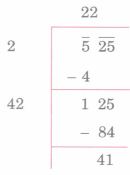
This shows that 222 < 525.
Next perfect square is 232 = 529
Hence, the number to be added is 232- 525 = 529 - 525 = 4
Therefore, the perfect square so obtained is 525 + 4 = 529
Hence, \(\sqrt { 529 } \)= 23
2.
Resolving 288 in to prime factors
we have
i.e., 288 = 2 x 2 x 2 x 2 x 2 x 3 x 3
Grouping the factors in triples, we get
288 = [2 x 2 x 2] x 2 x 2 x 3 x 3
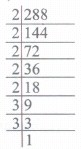
We observe that if 288 is multiplied by (2 x 3),then its prime factors will exist in triples.
Thus, the required smallest number by which 288 be multiplied to make it a perfect cube is (2 x 3), i.e., 6.
3.
Since, the sum of the measures of interior angles of a quadrilateral is 360°.
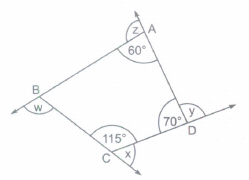
Also, 115° + 70° + 60° = 245°
\(\therefore\)245° + LABC = 360°
\(\Rightarrow\)\(\angle \)ABC = 360° - 245° = 115°
Now, x = ext. \(\angle\)BCD = 180° - \(\angle\)BCD
= 180° - 115° = 65°
Similarly, y = 180° - 70° = 110°
z = 180° - 60° = 120°
w = 180° - 115° = 65°
\(\therefore\)x +y + z + w = 65° + 110°+ 120° + 65° = 360°
4.
Steps of construction:
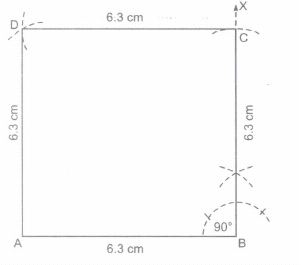
I. Draw AB = 6.3 em.
II. At B, draw \(\overrightarrow { BX } \) , such that \(\angle \)ABX = 90°
III. From \(\overrightarrow { BX } \), cut off BC = 6.3 cm.
IV. With centre C and radius = 6.3 cm, draw an arc.
V. With centre A and radius = 6.3 cm, draw another arc to intersect the previous arc at D.
VI. Join DA and CD.
Thus, ABCD is the required square.
5.
Since \({ \left( \frac { 1 }{ 4 } \right) }^{ -2 }={ \left( \frac { 4 }{ 1 } \right) }^{ 2 }={ (4) }^{ 2 }=16\)
\({ \left( \frac { 1 }{ 3 } \right) }^{ -3 }={ (3) }^{ 3 }=3\times 3\times 3=27\)
\({ \left( \frac { 1 }{ 2 } \right) }^{ -4 }={ (2) }^{ 4 }=2\times 2\times 2\times 2=16\)
\(\therefore \quad { \left( \frac { 1 }{ 4 } \right) }^{ -2 }+{ \left( \frac { 1 }{ 3 } \right) }^{ -3 }+{ \left( \frac { 1 }{ 2 } \right) }^{ -4 }=16+27+16=59\)
6.
5km/h
7.
We have \(\frac { 1 }{ 36 } { a }^{ 2 }{ b }^{ 2 }-\frac { 16 }{ 49 } { b }^{ 2 }{ c }^{ 2 }\)
= \({ b }^{ 2 }\left( \frac { { a }^{ 2 } }{ 36 } -\frac { 16{ c }^{ 2 } }{ 49 } \right) ={ b }^{ 2 }\left( \frac { { a }^{ 2 } }{ 6\times 6 } -\frac { 4\times 4 }{ 7\times 7 } { c }^{ 2 } \right) \)
= \({ b }^{ 2 }\{ \left( \frac { a }{ 6 } \right) ^{ 2 }-\left( \frac { 4c }{ 7 } \right) ^{ 2 }\} \)
= \({ b }^{ 2 }\left( \frac { a }{ 6 } +\frac { 4c }{ 7 } \right) \left( \frac { a }{ 6 } -\frac { 4c }{ 7 } \right) \)
[by using identity, (a2 - b2) = (a + b) (a - b)]
8.
The line graph of an annual gross profit of a company for a period of five years are given below:
9.
\(\begin{matrix}\quad 4\quad A \\ +\quad 9\quad 8 \\ \_ \_ \_ \_ \_ \_ \_ \_ \_ \\ \quad C\quad B\quad 3 \\ \_ \_ \_ \_ \_ \_ \_ \_ \_ \_ \end{matrix}\)
Here, we have three letters A, B, and C whose values are to be found.
Studying the addition in the one's column, we have A + 8 and we get 3 from this, i.e. a number whose one's digit is 3, for this A has to be 5.
\(\because\) A + 8 = 5 + 8 = 13
Now, for sum in ten's column, we have
1 + 4 + 9 = CB \(\Rightarrow\) 14 = CB
Here, B = 4 and C = 1
Therefore, the puzzle is solved as shown below:
\(\begin{matrix}\quad \quad 4\quad 5 \\ +\quad 9\quad 8 \\ \_ \_ \_ \_ \_ \_ \_ \_ \_ \\ \quad 14\quad 3 \\ \_ \_ \_ \_ \_ \_ \_ \_ \_ \_ \end{matrix}\)
Hence, A = 5, B = 4 and C = 1
10.
See the figure given below to understand the solution:
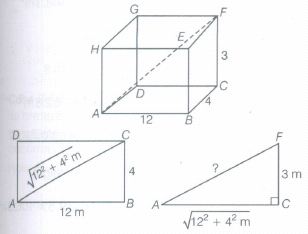
It is clear that the length of the largest pole is AF, which is forming a hypotenuse of right angle ΔACF.
Thus, AC =\(\sqrt { { AB }^{ 2 }+BC^{ 2 } } =\sqrt { 12^{ 2 }+4^{ 2 } } =\sqrt { 160 } \)m
In ΔACF ,
AF =\(\sqrt { { AC }^{ 2 }+CF^{ 2 } } =\sqrt { 160+3^{ 2 } } =\sqrt { 169 } \)=13 m
Alternate Method
Length of the largest pole = Length of diagonal of the cube
\(\sqrt { { l }^{ 2 }+b^{ 2 }+h^{ 2 } } =\sqrt { { 12 }^{ 2 }+{ 4 }^{ 2 }+{ 3 }^{ 2 } } =\sqrt { 169 } \)
11.
We have,
\({3\over7}\times{28\over15}\div{14\over5}={3\over7}\times{28\over15}\times{5\over14} \)
\(\\{3\over7}\times({28\over15}\times{5\over14})={3\over7}\times{2\over3}={2\over7}\)
12.
13.
We know that in a pack of well-shuffled cards. total cards= 52
Number of ace of club = 1
The probability of getting an ace of club = \(\frac{1}{52}\)
14.
Given, cost price of 80 articles = Rs 2400
and profit per cent = 16%
∴ Profit = 16% of cost price of BO articles
= Rs \((\frac{16}{100}\times 2400)= \)Rs (16x24)= Rs 384
Now, selling price of BO articles = Cost price of BO articles + Profit
= Rs(2400 + 384) = Rs 2784
ஃ Selling price of 1 article = \(\frac{2784}{80}\) = Rs 34.80
Hence, selling price of one article is Rs 34.80.
15.
The numerical factor of a term is called its numerical coefficient or simply coefficient. In given expressions, terms and corresponding coefficients are given in the following table
| Terms | Coefficient of terms |
| x2y2 | 1 |
| -10x2y | -10 |
| 5xy2 | 5 |
| -20 | -20 |
16.
We have \(\frac { x }{ 2 } -\frac { 1 }{ 5 } =\frac { x }{ 3 } +\frac { 1 }{ 4 } \)
The denominators on both sides are 2,5,3 and 4. Their LCM is 60.
Multiplying both sides of the given equation by 60, then we get 60 \(\left( \frac { x }{ 2 } -\frac { 1 }{ 5 } \right) =60\left( \frac { x }{ 3 } +\frac { 1 }{ 4 } \right) \)
\(60\times \frac { x }{ 2 } -60\times \frac { 1 }{ 5 } =60\times \frac { x }{ 3 } +60\times \frac { 1 }{ 4 } \)
30x - 12 = 20x +15
30x - 20x = 15 + 12
10x = 27
x = \(\frac { 27 }{ 10 } \)
Hence x =\(\frac { 27 }{ 10 } \) is the solution of the given equation.
17.
1.6 \(\times\) 10-3
18.
5 (2x+ 1)(3x+ 5) ÷ (2x+ 1)
=\(\frac{5(2x+1)(3x+5)}{(2x+1)}=5(3x+5)\)
19.
Not direct
20.
Yes, he stops between 10 am to 10: 30 am.
21.
The given number is 294.
Sum of digits = 2 +9 + 4 = 15
Now, 15 \(\div\) 9 = 1 and remainder = 6
which is not divisible by 9.
Hence, 294 is not divisible by 9.
22.
36
23.
Given, dimensions of cuboid are 60 cm\(\times\)54 cm\(\times\)30 cm
i.e.length= 60 cm, breadth = 54 cm and height = 30 cm
∴ Volume of the cuboid = l \(\times\)b \(\times\)h = 60\(\times\)54 \(\times\)30
= (60\(\times\)54\(\times\)30)cm3
Also,givenside of a small cube = 6 cm
∴ Volume of one cube = a3 = (6)3 = (6\(\times\)6 \(\times\)6) cm3
Here,small cubes are placed in cuboid, required number of smallcubes
=\(\frac { Volume\ of\ cuboid }{ Volume\ of\ one\ cube } =\frac { 60\times 54\times 30 }{ 6\times 6\times 6 } \) = 450
24.
Using the following pattern for finding the square of the given number, we get
12 = 1
112=121
1112 = 12321
11112 = 1234321
111112 = 123454321
1111112 = 12345654321
11111112 = 1234567654321
11111112 = 1234567654321
25.
Rs 3200
26.
(2pq + 3q2)\(\times\)(3pq - 2q2)
= 2pq(3pq - 2q2) + 3q2(3pq - 2q2)
= (2pq\(\times\)3pq) - (2pq\(\times\)2q2) + (3q2\(\times\)3pq)-(3q2\(\times\)2q2)
= 6p2q2 -4pq3 + 9pq3 -6q4
= 6p2q2 + (-4 + 9)pq3 - 6q4
= 6p2q2 + 5pq3 - 6q4
27.
\(A={\frac{-15}{8}},B={-14\over8},c={-11\over8},D={-8\over8}E={-7\over8}\)
28.
Yes, to construct a unique parallelogram whose two adjacent sides are given, we need the angle included between them, because if angle is not given, then we cannot find a unique parallelogram. So, we cannot construct the parallelogram with the given information.
29.
30 cm
30.
9,10,11
31.
| Class Interval | Tally Marks | Frequency |
| 0 - 2 | 0 | |
| 2 - 4 | .jpg) |
6 |
| 4-6 | |
6 |
| 6 - 8 | .jpg) |
11 |
| 8 - 10 | II | 2 |
| Total | 25 |
32.
1080
33.
(a) Length of the cube
= Width of the cube
= Height of the cube
= l
(b) Area of each face = l x l = l2
(c) Total surface area of this cube = 6l2
(d) Area of each face = l2
Yes ; we can say that the total
surface area of a cube of side l is 6l2
34.
m-\(\frac{m-1}{2}\)=1-\(\frac{m-2}{2}\)
We have m-\(\frac{m-1}{2}\)=1-\(\frac{m-2}{2}\)
It is a linear equation since it involves linear expressions only.
\(\Rightarrow\) m-\(\frac{m}{2}+\frac{1}{2}\)=1-\(\frac{m}{3}+\frac{1}{3}\)
\(\Rightarrow\) m-\(\frac{m}{2}+\frac{m}{3}\)=1+\(\frac{2}{3}+\frac{1}{2}\)
Transposing -\(\frac{m}{3}\)to LHS and \(\frac{1}{2}\)to RHS
\(\Rightarrow\) \(\frac { 6m-3m+2m }{ 6 } =\frac { 6+4-3 }{ 6 } \)
Taking LCM
\(\Rightarrow\) \(\frac { 5m }{ 6 } =\frac { 7 }{ 6 } \)
\(\Rightarrow\) m = \(\frac { 7 }{ 6 } \times \frac { 6 }{ 5 } =\frac { 7 }{ 5 } \)
Multiplying both sides by \(\frac{6}{5}\)
This is the required solution.
35.
| Operation | Numbers | Remarks |
| Addition | 3+5=8, a natural number; 4 + 6 = 10, a natural number. In general, a + b is a natural number for any two natural numbers a and b. |
Natural numbers are closed under addition. |
| Subtraction | 5 - 5 = 0, which is not a natural number. | Natural numbers are not closed under subtraction. |
| Multiplication | 3\(\times\)5 = 15, a natural number; 4\(\times\)6 = 24, a natural number. In general, if a and b are any two natural numbers, their product ab is a natural number. |
Natural numbers are closed under multiplication. |
| Division | \(3 \div 5 = \frac{3}{5}\); which is not a natural number. | Natural numbers are not closed under division. |
36.
Case of Simple Interest
[P = Rs 1000, r = 8% p.a.]
| Time period (T) | 1 year | 2 year | 3 year |
|---|---|---|---|
| Simple interest, \(SI=\frac { P\times r\times t }{ 100 } \) | Rs \(\frac { 1000\times 8\times 1 }{ 100 } \) = Rs 80 |
Rs \(\frac { 1000\times 8\times 2 }{ 100 } \) = Rs 160 |
Rs \(\frac { 1000\times 8\times 3 }{ 100 } \) =Rs 240 |
| \(\frac { SI }{ T } \) | \(\frac { 80 }{ 1 } =80\) | \(\frac { 160 }{ 2 } =80\) | \(\frac { 240 }{ 3 } =80\) |
\(\because\) In each case the ratio \(\frac { SI }{ T } \) is the same.
\(\therefore\) The simple interest changes in direct proportion with time period.
Case of compound Interest [P = Rs 1000, r = 8% p.a.]
| Time period 't' | t = 1 | t = 2 | t = 3 |
|---|---|---|---|
| For compound interest, \(A=P{ \left( 1+\frac { r }{ 100 } \right) }^{ t }\) and CI = A - P |
\({ A=1000\left( 1+\frac { 8 }{ 100 } \right) }^{ 1 }\) \(=1000\times \frac { 108 }{ 100 } =1080\) \(\therefore\) CI = 1080 - 1000 = Rs 80 |
\(A=1000{ \left( 1+\frac { 8 }{ 100 } \right) }^{ 2 }\) \(=1000\times \frac { 108 }{ 100 } \times \frac { 108 }{ 100 } \) = Rs 1166.40 CI=1166.40 - 1000 = Rs 166.40 |
\(A=1000{ \left( 1+\frac { 8 }{ 100 } \right) }^{ 3 }\) \(=1000\times \frac { 108 }{ 100 } \times \frac { 108 }{ 100 } \times \frac { 108 }{ 100 } \) = Rs 1259.712 Rs 1259.712 - Rs 1000 = Rs 259.712 |
| \(\frac { CI }{ T } \) | \(\frac { 80 }{ 1 } \) | \(\frac { 166.40 }{ 2 } \) | \(\frac { 259.712 }{ 3 } \) |
\(\because \ \frac { CI }{ T } \) is not the same in each case.
\(\therefore\) The compound interest does not change in direct proportion with time period.
37.
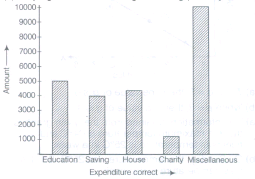
The value depicted here is that if we make a plan on expenditure, then we can save some money,
38.
Number of chocolates Abhinav bought = (x + 4)
Cost of one chocolate = Rs.(x + 4)
Total amount paid by him = Number of chocolates \(\times\) Cost of one chocolate
= Rs. ( x + 4) x (x + 4) = Rs.(x + 4)2
= Rs.{(x2 + (4)2 + 2 \(\times\) x \(\times\) 4))
[using identity, (a + b)2 = (a2 + b2 + 2ab)]
= Rs.(x2 + 4\(\times\)4+ 8x)
= Rs.(x2 + 16 + 8x)
It is given that, if x = 10 then,
the amount paid by him
= Rs. {(10)2 + 16 + 8 \(\times\)10}
= Rs.(10 x10 + 16+ 8 \(\times\)10)
= Rs.(100+16+ 80)=Rs.196
(ii) The value depicted here is that Abhinav is helpful and friendly by nature to his friend.
39.
We have, a 3-digit number 2a3, when added to the number 326, gives a 3-digit number 5b9.
We can write 2a3 and 5b9 in generalised form as.
2a3 = 2 x 100 + a x10 + 3 = 200 + 10a + 3
5b9 = 5 x 100 + b x 10 + 9 = 500 + 10b + 9
Now, it is given that
2a3 + 326 = 5b9
200 + 10a + 3 + 326 = 500 + 10b+ 9
10a + (200 + 3 + 326) = 10b + (500 + 9)
10a + (200 + 329) = 10b+ 509
10a + 529 = 10b + 509
529 - 509 = 10b -10a
20 = 10 x (b-a)
b - a = \({20 \over 10}\)
b - a = 2 .........(i)
Now, it is given that 5b9 is divisible by 9.
So, sum of digits of 5b9 will be divisible by 9, i.e
5 + b + 9 = Multiple of 9
14 + b =18 (nearest multiple of 9)
b = 18 - 14 = 4
Put b = 4 in Eq. (i), we get
b - a = 2 \(\Rightarrow\)4-a = 2
4 - 2 = a \(\Rightarrow\) 2 = a
\(\Rightarrow\) a = 2
Hence, a = 2, b = 4 and b - a = 2
40.
Let side of two squares be a1 and a2·
Then, perimeter of first square = 4a1
According to the question,
Perimeter = 40
\(\therefore\) 4a1 = 40 \(\Rightarrow\) a1 = 10
Similarly, second square's perimeter = 4a2
But according to the question,
Perimeter = 96
\(\therefore\) 4a2 = 96 \(\Rightarrow\) a2 = 24
Let a be the side of another square.
Now, sum of the areas of first and second square area of
= Area of (first square) + (Area of second square)
=\({ a }_{ 1 }^{ 2 }+{ a }_{ 2 }^{ 2 }\)
Area =(10)2 + (24)2 =100 + 576
\(\therefore\) Area = 676
\(\Rightarrow\)a2 = 676 \(\Rightarrow\) a = \(\sqrt { 676 } \)
Then, a=26 m
Another square's perimeter = 4a = 4 x 26 = 104 m
So, perimeter of another square is 104 m.
41.
729 cm3
42.
2
43.
RHS =(9982)2 -(18)2
= (9982 + 18) (9982 - 18)
[∴ a2- b2 = (a + b) (a - b)]
= 10000 x 9964
where, LHS = (10000) x y
On comparing LHS and RHS, we get
10000y=10000x9964
\(y=\frac { 10000\times 9964 }{ 10000 } =9964\)
44.
Central angle for oceans = \((\frac{Value\quad of\quad the\quad component}{Sum\quad of\quad the\quad components}\times 360)^o\)
For pacific ocean = 40% = \(\frac{40}{100}\times 360^o\) = 144o
For atlantic ocean = 30% = \(\frac{30}{100}\times 360^o\) = 108o
For Indian ocean = 20% = \(\frac{20}{100}\times 360^o\) = 72o
For others ocean = 10% = \(\frac{10}{100}\times 360^o\) = 36o
On the basis of above data we can draw the following pie chart:
.png)
45.
(a) The quadrilateral park have kite shape, since PA = AR and PK = RK
(b) In a kite, the diagonals are perpendicular to each other, so \(\angle
\)AOR = 90°.
(c) The park is having a well structured as kite shape with a running track for the runner.
46.
Let ABGD is a rhombus
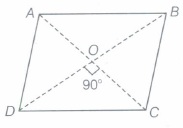
Then, BD = 8 cm, AC =15 cm
and AB = BG = CD = DA
We know that, in a rhombus, diagonals bisect each other at right angles.
So, DO = OB and AO = OC
∴ DO =4 cm and OC = 7.5 cm
Now, we see that a /lDOC is formed such that
ㄥDOC = 90°
∴ (DC)2 = (DO)2 + (OC)2
[∵ in a right angled triangle, the square of the side opposite to the right angle is equal to the sum of the squares of other two sides]
(DC)2 =(4)2 + (7.5)2 = 16+ 56.25
= 72.25 cm2
or DC = \(\sqrt { 72.25 } \) = 8.5 cm
Thus, side of the rhombus is 8.5 cm.
47.
Here, P = Rs 8000, T = 1 year, R = 9% p.a.
Interest is compounded half yearly,
\(\therefore\)T = 1 year = 2 half years
R = 9% p.a =\(9\over2\)% half yearly
\(\therefore\)Amount = p\((1+{R\over100})^n\)
= Rs 8000 x\((1+{9\over200})^2\)
= 8000 x \({209\over200}\times{209\over200}\) =Rs \({2 \times 209 \times 209\over 10}\)
= Rs \(87362\over10\)= Rs 8736.20
CI = Rs 8736.20 - Rs 8000 =Rs 736.20
48.
(a) The shaded (coloured) map according to the question is as follows:
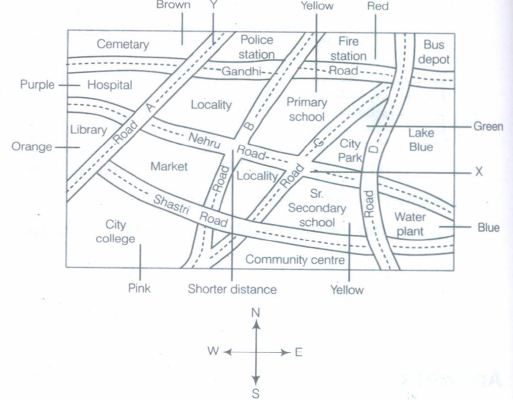
(b) Intersection of road C and Nehru road is marked by X and intersection of Gandhi road and road A is marked by Yin map given in (a) part.
(c) Short street route from library to the bus depot is Library ⟶ Nehru road ⟶ Road C ⟶ Bus depot.
(d) City Park is in the East.
(e) Sr. Secondary School is in the South.
49.
Let the number of Rs. 5 coins be x.
Then, the number of Rs. 2 coins = 3x
The total number of coins is 160 .
The number of coins of Rs. 1= 160 - (x + 3x)
= (160 - 4x)
The amount that I have from Rs. 5 coins = 5 x x = 5x
The amount that I have from Rs. 2 coins = 2 x 3x = 6x
The amount that I have from Rs. 1 coins
= 1 x (160 - 4x) = 160 - 4x
According to the question,
Total amount = 300
\(\Rightarrow\) 5x + 6x + (160 - 4x) = 300
\(\Rightarrow\) 5x +6x +160 - 4x = 300
\(\Rightarrow\) 7x + 160 = 300 [transposing 160 to RHS]
\(\Rightarrow\) 7x = 300 -160 [transposing 160 to RHS]
\(\Rightarrow\) 7x = 140
\(\Rightarrow\) x = \(\frac { 140 }{ 7 } \) = 20 [dividing both sides by 7]
Number of Rs. 5 coins = x = 20
Number of Rs. 2 coins = 3x = 3 x 20 = 60
and number of Rs.1 coins = 160 - 4x = 160 - 4 x 20
= 160 - 80 = SO
Hence, I have SO,60 and 20 coins of denomination Rs.1, Rs. 2 and Rs 5, respectively.
50.
Let the required number be x.
Then, according to the question
x3 = x ...(1) and x2≠x ...(2)
From (1), x3 -x = 0
⇒ x(x2 - 1) = 0
⇒ x = 0, ± 1
⇒ x = 0,1,-1
If x = 0, then x2 = x.
∴ x = is inadmissible
If x = 1 then x2 = x.
∴ x = 1 is inadmissible
If x = - 1, then x2 = (- 1)2 = 1 ≠ x(= - 1)
Hence, the required number is - 1.
51.
| Time Passed (T) (in minutes) |
(T1) 15 | (T2) 15 | (T3) 45 | (T4) 60 |
|---|---|---|---|---|
| Angle turned (A) (in degree) | (A1) 90 | (A2) __ | (A3) __ | (A4) __ |
| \(T\over A\) | \({15\over 90}={1\over6}\) | \({30\over 180}={1\over6}\) | \({45\over 270}={1\over6}\) | \({60\over 360}={1\over6}\) |
We observe about T and A that they increase together and is \(T\over A\) same every time.
Yes; The angle turned by the minute hand is directly proportional to the time that has passed.
On checking, we find that
T2 : T3 = A1 : A3 = 2: 3
and T3 : T4 = A3 : A4 = 3 : 4
52.
The highest observation = 62
The lowest observation = 17
One of the class intervals = 40-48
∴ Class size = Upper class limit - Lower class limit
= 48 - 40 = 8
∴ The appropriate classes can be:
16-24, 24-32, 32-40, 40-48, 48-56, 56-64
Thus, the frequency distribution table for the above data can be shown using the Tally marks
| Groups [Class intervals] | Tally marks | Frequency |
|---|---|---|
| 16-24 | .jpg) || || |
7 |
| 24-32 | |||| | 4 |
| 32-40 | | |
11 |
| 40-48 | || | 2 |
| 48-56 | |||| |
9 |
| 56-64 | || |
7 |
| Total | 40 |
53.
7 x 7 = 49
54.
0 \(\rightarrow \) (0,0)
55.
Area = (2l2m)(3lm2) = 6l3m3.
56.
(20+4-1)x22 = \(\left( 1+\frac { 1 }{ 4 } \right) \)x4 = \(\frac { 5 }{ 4 } \)x4 = 5
57.
\({120\over 600}={400\over ?}⇒?=2000\)
58.
12a2 b + 15ab2 = 3ab(4a + 5b).
59.
One's digit of 125 is 5.
60.
100 - 20 = 80
∵ If C.P. is 100, then S.P. = Rs. 80
∴ If C.P. is Rs. 500, then S.P.
= \(\frac { 80 }{ 500 } \times \)500 = Rs.400.
61.
Required measure = \({360^\circ-(110^\circ+100^\circ)\over 2}=75^\circ\)
62.
3y + 4 = 5y - 4 \(\Rightarrow\) 5y - 3y = 4 + 4
\(\Rightarrow\) 2y = 8 y=\(\frac{8}{2}\)=4
63.
(c)
associative law for addition
64.
Required number = 5 + 2 + 4 + 6 + 7 + 5 = 29.
65.
3 \(\times\)3 \(\times\) 3 = 27.
66.
(c)
10 cm2
67.
(a)
1
68.
(a)
(n2-1), 2n and (n2+ 1)

8th Standard CBSE Syllabus & Materials
8th Standard CBSE
CBSE 8th Science Particulate Nature of Matter - New Model Questions Papers Study Material - QB365 Set A
NEW8th Standard CBSE
CBSE 8th Science Pressure, Winds, Stroms and Cyclones - New Model Questions Papers Study Material - QB365 Set A
NEW8th Standard CBSE
CBSE 8th Mathematics Quadrilaterals - New Model Questions Papers Study Material - QB365 Set A
NEW8th Standard CBSE
CBSE 8th Mathematics A story of Numbers - New Model Questions Papers Study Material - QB365 Set A



CBSE 8th Standard CBSE Subjects
CBSE Standards




