
 100% FREE ACCESS
8th Standard CBSE Syllabus & Materials
8th Standard CBSE
CBSE 8th Social Science Theme D - Factors of Production - New Model Questions Papers Study Material - QB365 Set A
NEW8th Standard CBSE
CBSE 8th Social Science Theme C - Universal Franchise and India's Electoral System - New Model Questions Papers Study Material - QB365 Set A
NEW8th Standard CBSE
CBSE 8th Social Science Theme B - The Rise of the Marathas - New Model Questions Papers Study Material - QB365 Set A
NEW8th Standard CBSE
CBSE 8th Social Science Theme B - Reshaping India's Political Map - New Model Questions Papers Study Material - QB365 Set A
NEW8th Standard CBSE
CBSE 8th Social Science Theme A - Natural Resources and Their Use - New Model Questions Papers Study Material - QB365 Set A
NEW8th Standard CBSE
CBSE 8th Science Keeping Time with Skies - New Model Questions Papers Study Material - QB365 Set A

Published on: 16/08/2019
Comparing Quantities
Download CBSE Class 8th Standard CBSE Mathematics question papers, sample papers, important questions, and previous year solved papers in PDF format. Get free study materials, NCERT solutions, and exam preparation resources for Class 8th Standard CBSE Mathematics
Questions + Answers key
Take MCQ Mathematics Test
1.
A shirt is marked at Rs 850 and is sold for Rs 765. What is the discount and discount percent?
2.
Given, P = Rs 40000 and R = 8% per annum compounded annually. Find the interest for 2nd year.
3.
The marked price of an article is Rs 500. The shopkeeper gives a discount of 5% and still makes a profit of 25%. Find the cost price of article.
4.
Convert the following ratios to percentages. 2:3
5.
A picnic is being planned in a school for 20 Class VIII girls which are 40% of the total number of students. Find the ratio of girls to the number of boys in the class.
6.
Fabina borrows Rs 12500 at 12% per annum for 3 yr at simple interest and Radha borrows the same amount for the same time period at 10%per annum, compounded annually. Who pays more interest and by how much?
7.
If the cost price of 11 articles is equal to the selling price 10 articles, find the gain per cent.
8.
If Chameli had Rs 600 left after spending 75% of her money, how much did she have in the beginning?
9.
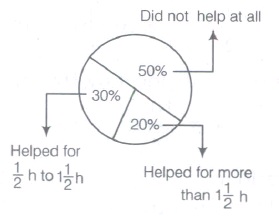
In a primary school, the parents were asked about the number of hours, they spend per day in helping their children to do homework. There were 90 parents, who helped for \(\frac{1}{2}\)h to \(\frac{1}{2}\)h.The distribution of parents according to the time for which, they said they helped is given in the adjoining figure, 20%helped for more than1\(\frac{1}{2}\)h per day, 30%helped for \(\frac{1}{2}\)h to 1\(\frac{1}{2}\)h, 50%did not help at all.
Using this, answer the following:
(i) How many parents were surveyed?
(ii) How many said that they did not help?
(iii) How many said that they helped for more than 1\(\frac{1}{2}\)h?
10.
Madhu's room measures 6 m x 3 m. Her carpet covers 8 m2. What per cent of floor is covered by the carpet?
11.
The population of a place increased to 54000 in 2003 at a rate of 5% per annum. Whal would be its population in 2005?
12.
Rahul bought an air cooler for Rs 3300 including a tax of 10%. Find the price of the air cooler before VAT was added.
13.
A shop gives 10%discount. What would be the sale price of each of these a pair of shoes marked at Rs 650?
14.
What per cent of 500 is 35?
15.
VAT is always calculated on which of the following?
s. p
c.p
marked price
none of these
16.
Asurn is taken for 2 yr at 16% per annum, If interest is compounded after every three months, the number of times for which interest is charged in 2 yr is
8
4
6
9
17.
The buying price of 5 kg guava, at the rate Rs 20 per kg with 5% sales tax on the purchase, is
Rs 22
Rs 23
Rs 24
None of these
18.
Sachin purchases a bat for Rs 660 including sales tax. If the rate of sales tax is 10%, then the selling price of the bat is
Rs 580
Rs 590
Rs 600
Rs 610
19.
By selling 50 items, a shopkeeper lost the amount equal to the selling price of 10 items. His loss per cent is
\(\frac{30}{7}\)%
\(\frac{40}{3}\)%
\(\frac{25}{3}\)%
\(\frac{50}{3}\)%
20.
Selling price of 9 articles is equal to the cost price of 15 articles. In this case, profit is ___________
21.
The original price of a washing machine which was bought for Rs 13500 inclusive of 8% VAT is __________
22.
3500 is greater than 500 by __________ %
23.
___________ is a reduction on the marked price of the article.
24.
The compound interest on Rs 50000 at4% per annum for 2 yr compounded annually is Rs 4080.
25.
The sale price is regular price minus the discount.
26.
40% of [100 - 20% of 300] is equal to 64.
27.
The compound interest on a sum of Rs P for T years at R% per annum compounded annually is given by the formula P\((1+\frac{R}{100})^{n}\)
28.
To calculate the growth of bacteria, if the rate of growth is known. The formula for calculation of amount in compound interest can be used.
29.
If the interest compounded half yearly the rate of interest becomes ___________
30.
Profit or loss is always calculated on____________Price
31.
VAT is calculated on _____________price
32.
The amount due is equal to the principal plus the
33.
The time period after which the interest /s added each time to form a new principal is called the
34.
The formula for calculating the compound interest is \(P[1-{R\over 100}]^n or\ P[1+{R\over 100}]^n ?\)
1.
Marked price of the shirt = Rs 850
Selling price of the shirt = Rs 765
\(\therefore\) Discount = [Marked price] - [Selling price]
= Rs 850 - Rs 765 = Rs 85
Now, d.iscount per cent =\({85\over 850}\times 100\%=10\%\)
2.
Rs 3456
3.
Rs 380
4.
Given ratio = 2 :3
∴ Percentage =\((\frac{2}{3}\times100)=(\frac{200}{3})=66\frac{2}{3}\)%
5.
Let the total number of students be x. Then, 40% of x are girls.
Therefore, 40% of x = 20 \(\Rightarrow \frac{40}{100}\times x\) = 20 \(\Rightarrow x=\frac{20\times100}{40}=50\)
So, the number of boys = 50 - 20 =30
Ratio of number of girls to the number of boys = 20 : 30 = \(\frac{20}{30}=\frac{2}{3}\)
Hence,\(\frac{2}{3}\)is written as 2: 3 and read as 2 is to 3.
6.
In case of Fabina,
principal (P1) = Rs 12500, rate (R1 ) =12%, time (T1 ) =3 yr
∴ Simple interest=\(\frac{P_1\times R_1\times T_1}{100}=\frac{12500\times12\times3 }{100}\)
= 125x12x3 = Rs 4500
In case of Radha,
Principal (P2) =Rs 12500, Rate (R2) =10%, Time (n) =3 yr
∴ Amount (A) = P2\((1+\frac{R_2}{100})=12500(1+\frac{10}{100})^{3}\)
= 12500\((\frac{100+10}{100})^{3}=12500(\frac{110}{100})^{3}\)
= 12500\((\frac{11}{10})^{3}=12500\times \frac{11}{10}\times \frac{11}{10}\times \frac{11}{10}\)
= \(\frac{25\times 11\times 11\times 11}{2}=\frac{33275}{2}\)= Rs 16637.50
ஃ Compound interest =Amount (A) - Principal (P)
= Rs (16637.50 -12500) =Rs 4137.50
Hence, Fabina has to pay more interest at
Rs (4500-4137.5) i.e. Rs 362.50.
7.
10%
8.
Let Chameli had total money be Rs x.
Percentage of money spent by Chameli = 75%
Chameli had left money after spending = (100 - 75)%
= 25%
But money left = Rs 600 [given]
∴ 25% of x = 600
⇒ \(\frac{25}{100}\times x=600 \Rightarrow x=\frac{600\times100}{25}=2400\)
Hence, Chameli had Rs 2400 in the beginning.
Alternate Method
Let total money with Chameli at the beginning be Rs 100.
Expenditure money = 75% of total money
\(= Rs(\frac{75}{100}\times100)=Rs 75\)
Money left = Rs 100 - Rs 75=Rs 25
Now, if saving is Rs 25, then money at the beginning = Rs 100
If saving is Rs 1, then money at the beginning = Rs \(\frac{100}{25}\)
If saving is Rs 600, then money at the beginning
\(= Rs (\frac{100}{25}\times 600)=Rs(4\times 600)= Rs 2400\)
Hence, total money at the beginning with Chameli was Rs 2400.
9.
(i) Here, 90 parents helped their children for \(\frac{1}{2}\)h to 1\(\frac{1}{2}\) h.
Given, percentage = 30%
Let x parents be surveyed.
Then, 30% of x helped for \(\frac{1}{2}\)h to 1\(\frac{1}{2}\)h = 90
∴ 30% of x = 90
⇒ \(\frac{30}{100} \times x=90\)
⇒ \(x=\frac{90\times100}{30}=300\)
Hence, the number of parents were 300.
(ii) Here, 50% parents did not help at all.
So, number of parents did not help = 50% of 300
= \(\frac{50}{100}\times100=50\times3=150\)
Hence, 150 parents did not help.
(iii)Here, 20% parents helped for more than 1\(\frac{1}{2}\)h.
So, number of parents who helped for more than 1\(\frac{1}{2}\)h
= 20% of 300=\(\frac{20}{100} \times300=20\times3\)
= 60
Hence, 60 parents helped for more than 1\(\frac{1}{2}\)h.
10.
Area of floor = (6 x 3)m2 = 18m2
Area covered by carpet = 8 m2
When 18m2 area will covered by carpet, then floor will be covered = 100%
or when 1m2 area covered by carpet. then floor will be covered =\(\frac{100}{18}\)%
So, when 8m2 area covered by carpet, then floor will be covered =\((\frac{100}{18}\times 8)\)% = 44.44%
11.
For population in 2005, i.e. 2 yr after 2003,
Initial population = 54000, i.e. in the year 2003
Time (n) = 2 year, Rate of increase = 5%
Let population in 2005 be A.
∴ \(A=P(1+\frac{R}{100})^{n}=54000(1+\frac{5}{100})^{2}\)
= \(54000(\frac{100+5}{100})^{2}=54000(\frac{105}{100})^{2}\)
= \(54000\times \frac{105}{100}\times \frac{105}{100}=27\times21\times21\times105\) = 59535
Hence, the population in 2005 is 59535.
12.
The price includes the VAT (The Value Added Tax). A 10% VAT means, if the price without VAT is Rs 100, then
price including VAT is RS. 110.
Now, when price including VAT is Rs 110, original price is Rs 100.
Hence, when price including tax is 3300, the original price = Rs \(\frac{100}{110}\times 3300\)=Rs 3000
13.
We know that,
Discount = Marked price - Sale price
Sale price = Marked price - Discount
∵ Marked price = Rs 650 [given]
Discount = 10% of Rs 650 =\(\frac{10}{100}\times 650\)=65
∴ Sale price = Marked price - Discount = Rs (650 - 65) = Rs 585
14.
7%
15.
(a)
s. p
16.
(a)
8
17.
(d)
None of these
18.
(c)
Rs 600
19.
(d)
\(\frac{50}{3}\)%
20.
()
6\(\frac{2}{3}\%\)
21.
()
Rs 12500
22.
()
600
23.
()
Discount
24.
(a)
25.
(a)
26.
(b)
27.
(b)
28.
(a)
29.
()
Half
30.
()
Cost price
31.
()
Selling price
32.
()
Accrued interest
33.
()
Conversion period
34.
()
\(\ P[1+{R\over 100}]^n \)

8th Standard CBSE Syllabus & Materials
8th Standard CBSE
CBSE 8th Science Particulate Nature of Matter - New Model Questions Papers Study Material - QB365 Set A
NEW8th Standard CBSE
CBSE 8th Science Pressure, Winds, Stroms and Cyclones - New Model Questions Papers Study Material - QB365 Set A
NEW8th Standard CBSE
CBSE 8th Mathematics Quadrilaterals - New Model Questions Papers Study Material - QB365 Set A
NEW8th Standard CBSE
CBSE 8th Mathematics A story of Numbers - New Model Questions Papers Study Material - QB365 Set A



CBSE 8th Standard CBSE Subjects
CBSE Standards




