
 100% FREE ACCESS
8th Standard CBSE Syllabus & Materials
8th Standard CBSE
CBSE 8th Social Science Theme D - Factors of Production - New Model Questions Papers Study Material - QB365 Set A
NEW8th Standard CBSE
CBSE 8th Social Science Theme C - Universal Franchise and India's Electoral System - New Model Questions Papers Study Material - QB365 Set A
NEW8th Standard CBSE
CBSE 8th Social Science Theme B - The Rise of the Marathas - New Model Questions Papers Study Material - QB365 Set A
NEW8th Standard CBSE
CBSE 8th Social Science Theme B - Reshaping India's Political Map - New Model Questions Papers Study Material - QB365 Set A
NEW8th Standard CBSE
CBSE 8th Social Science Theme A - Natural Resources and Their Use - New Model Questions Papers Study Material - QB365 Set A
NEW8th Standard CBSE
CBSE 8th Science Keeping Time with Skies - New Model Questions Papers Study Material - QB365 Set A

Published on: 21/09/2019
Cubes and Cube Roots
Download CBSE Class 8th Standard CBSE Mathematics question papers, sample papers, important questions, and previous year solved papers in PDF format. Get free study materials, NCERT solutions, and exam preparation resources for Class 8th Standard CBSE Mathematics
Questions + Answers key
Take MCQ Mathematics Test
1.
Find the cube root of 13824 by prime factorisation method.
2.
By prime factorisation, find the cube roots of 1331
3.
By prime factorisation, find the cube roots of 1000
4.
By prime factorisation, find the cube roots of 74088
5.
Is 68600 a perfect cube? If not, find the smallest number by which 68600 must be multiplied to get a perfect cube
6.
If the surface area of a cube is 486 cm2. Find its volume
7.
The volume of a cubical box is 64 cm3, What is its side?
8.
Is 216 a perfect cube? What is the number whose cube is 216?
9.
Show that -1728 is a perfect cube. Also, find the number whose cube is -1728.
10.
Is 31944 a perfect cube? If not then by which smallest natural number should 31944 be divided so that the quotient is a perfect cube?
11.
Is 1372 a perfect cube? If not, find the smallest natural number by which 1372 must be multiplied so that the product is a perfect cube.
12.
Find the cube of \(\left( 2+\frac { 3 }{ 5 } \right) \).
13.
Using prime factorisation, find the cube root of 5832.
14.
Find the cube root of 614125 through estimation.
15.
Is 68600 a perfect cube? If not, find the smallest number by which 68600 must be multiplied to get a perfect cube.
1.
13824 = 2 x 2 x 2 x 2 x 2 x 2 x 2 x 2 x 2 x 3 x 3 x 3 = 23 x 23 x 23 x 33.
Therefore, \(\sqrt[3]{13824}=\) 2 x 2 x 2 x 3 = 24
2.
11
3.
10
4.
42
5.
5
6.
A cube has 6 equal surfaces.
Let side of the cube be x.
\(\therefore\)Area of a surface =x2
\(\Rightarrow\) Area of the given cube = 6x2
\(\therefore\)6x2= 486 \(\Rightarrow x^2={486\over6}=81\)
\(\Rightarrow x =\sqrt{81}=9\)
Thus, the volume of the given cube = 729 cm3 .
7.
Let 'x' be the side of the cube.
\(\therefore x^3=64 or \sqrt[3]{x^3}=\sqrt[3]{64}\)
\(\Rightarrow \ x =\sqrt[3]{2\times2\times2\times2\times2\times2}=\sqrt[3]{2^3\times2^3}\)
=2x2=4
Thus, the required side of the cube is 4 cm.
8.
We have
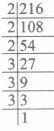
i.e., Resolving 216 into prime factors we have:
216 = 2 x 2 x 2 x 3 x 3 x 3
i.e., 216 can be resolved in to such prime factor which can be grouped into triple of equal of factor and no factor is left over.
\(\therefore\)216 is a perfect cube.
Now, 216 = 23 x 33 \(\Rightarrow\) 216 = (2 x 3)3 = 63
\(\Rightarrow \sqrt[3]{216 }\) = \(\sqrt[3]{6^3}\)\(\Rightarrow \sqrt[3]{216 }\) = 6
Thus, the required number is 6, whose cube is 216.
9.
We have
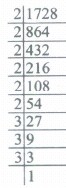
i.e., 1728 = 2 x 2 x 2 x 2 x 2 x 2 x 3 x 3 x 3
\(\Rightarrow\) 1728 = 23 x 23 X 33
\(\Rightarrow\) 1728 = (2 x 2 x 3)3
\(\Rightarrow \sqrt[3]{1728}\) = 2 x 2 x 3 = 12
Since 1728 is a perfect cube.
\(\therefore\) -1728 is also a perfect cube.
Also\(\sqrt[3]{1728} =-12\)
\(\Rightarrow\) -1728 is a perfect cube of -12.
10.
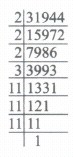
We have 31944 = 2 x 2 x 2 x 3
x11x11x11
Since, the prime factors of 31944 do not appear in triples as 3 is left over.
\(\therefore\)31944 is not a perfect cube.
Obviously, 31944 \(\div\) 3 will be a perfect cube
i.e., [31944] \(\div\) 3
= [2 x 2 x 2 x 3 x 11 x 11 x11] \(\div\) 3
or 10648 = 2 x 2 x 2 x 11 x 11 x 11
\(\therefore\) 10648 is a perfect cube.
Thus, the required least number = 3.
11.
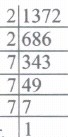
We have 1372 = 2 x 2 x 7 x 7 x 7
Since, the prime factor 2 does not appear in a group of triples.
\(\therefore\) 1372 is not a perfect cube.
Obviously, to make it a perfect cube we need one more 2 as its factor
i.e., [1372] x 2 = [2 x 2 x 7 x 7 x 7] x 2
or 2744 = 2 x 2 x 2 x 7 x 7 x 7
which is a perfect cube.
Thus, the required smallest number = 2.
12.
\(\frac { 2197 }{ 125 } \)
13.
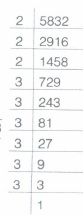
The prime factorisation of 5832
5832 = 2 x 2 x 2 x 3 x 3 x 3 x 3 x 3 x 3
Therefore, \(\sqrt [ 3 ]{ 5832 } \)
= \(\sqrt [ 3 ]{ \underline { 2\times 2\times 2 } \underline { 3\times 3\times 3 } \underline { 3\times 3\times 3 } } \)
= 2 x 3 x 3
=18
14.
Given, number is 614125.
So, groups of 614125 are
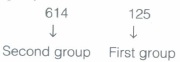
In the first group, the number 125 ends with 5. We know that, 5 comes at the unit's place of a number only when its cube ends in 5.
So, 5 will come at unit's place.
Now, in the second group, the number is 614
∵ (8)3 = 512 and (9)3=729
and 512 < 614 < 729
So, ten's place of required cube root is 8.
Hence, \(\sqrt [ 3 ]{ 614125 } \) = 85
15.
Given, number is 68600.
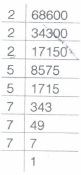
Now, prime factorisation of 68600
68600 = 2 x 2 x 2 x 5 x 5 x 7 x 7 x 7
The prime factor 5 does not have triples.
∴ 68600 is not a perfect cube
So, if we multiply the number 68600 by 5, then we get a perfect cube.
i.e., 68600 x 5 = 343000
= 2 x 2 x 2 x 5 x 5 x 5 x 7 x 7 x 7
= 2 x 5 x 7 =70

8th Standard CBSE Syllabus & Materials
8th Standard CBSE
CBSE 8th Science Particulate Nature of Matter - New Model Questions Papers Study Material - QB365 Set A
NEW8th Standard CBSE
CBSE 8th Science Pressure, Winds, Stroms and Cyclones - New Model Questions Papers Study Material - QB365 Set A
NEW8th Standard CBSE
CBSE 8th Mathematics Quadrilaterals - New Model Questions Papers Study Material - QB365 Set A
NEW8th Standard CBSE
CBSE 8th Mathematics A story of Numbers - New Model Questions Papers Study Material - QB365 Set A



CBSE 8th Standard CBSE Subjects
CBSE Standards




