
 100% FREE ACCESS
8th Standard CBSE Syllabus & Materials
8th Standard CBSE
CBSE 8th Social Science Theme D - Factors of Production - New Model Questions Papers Study Material - QB365 Set A
NEW8th Standard CBSE
CBSE 8th Social Science Theme C - Universal Franchise and India's Electoral System - New Model Questions Papers Study Material - QB365 Set A
NEW8th Standard CBSE
CBSE 8th Social Science Theme B - The Rise of the Marathas - New Model Questions Papers Study Material - QB365 Set A
NEW8th Standard CBSE
CBSE 8th Social Science Theme B - Reshaping India's Political Map - New Model Questions Papers Study Material - QB365 Set A
NEW8th Standard CBSE
CBSE 8th Social Science Theme A - Natural Resources and Their Use - New Model Questions Papers Study Material - QB365 Set A
NEW8th Standard CBSE
CBSE 8th Science Keeping Time with Skies - New Model Questions Papers Study Material - QB365 Set A

Published on: 22/09/2018
Revision Test I
Download CBSE Class 8th Standard CBSE Mathematics question papers, sample papers, important questions, and previous year solved papers in PDF format. Get free study materials, NCERT solutions, and exam preparation resources for Class 8th Standard CBSE Mathematics
Questions + Answers key
Take MCQ Mathematics Test
1.
Which of the following is neither positive nor a negative rational number?
1
0
Such a rational number does not exist
None of the above
2.
Which of the following is the multiplicative identity for rational numbers?
1
-1
0
None of these
3.
Which of the following is the identity element?
1
-1
0
None of these
4.
What should be subtracted from \(\frac { -3 }{ 4 } \) to get - 1?
\(\frac { 1 }{ 4 } \)
\(-\frac { 1 }{ 4 } \)
1
\(-\frac { 3 }{ 4 } \)
5.
What should be added to \(\frac { -3 }{ 4 } \) to get -1?
\(\frac { 1 }{ 4 } \)
\(\frac { -1 }{ 4 } \)
1
\(\frac { -3 }{ 4 } \)
6.
The reciprocal of \({-3\over8 } \times {-24\over 13}\) is
\(9\over 13\)
\(-9\over 13\)
\(-13 \over 9\)
\(13\over9\)
7.
Which of the following statements is always true?
\(\frac{x-y}{2}\) is a rational number between x and y
\(\frac{x+y}{2}\) is a rational number between x and y
\(\frac{x\times y}{2}\) is a rational number between x and y
\(\frac{x\div y}{2}\) is a rational number between x and y
8.
\(\frac{x+y}{2}\) is a rational number
between x and y
less than x and y both
greater than x and y both
less than x but greater than y
9.
Three rational numbers lying between\(\frac{-5}{4}\) and \(\frac{1}{2}\)are
-1, 0 ,\(\frac{4}{3}\)
\(\frac{-3}{4},\frac{-1}{2},\frac{1}{4}\)
\(\frac{-3}{4},\frac{4}{3},\frac{1}{4}\)
\(\frac{-7}{4},-1,0\)
10.
Which of the following is not true?
\(\frac{10}{11}+\frac{11}{12}=\frac{11}{12}+\frac{10}{11}\)
\(\frac{10}{11}\times \frac{11}{12}=\frac{11}{12}\times \frac{10}{11}\)
\(\frac{10}{11}+ \frac{11}{12}=\frac{11}{12}\div \frac{10}{11}\)
\(\frac{10}{11}\div \frac{11}{12}=\frac{11}{12}\times \frac{10}{11}\)
11.
If \({a\over b}\) is a rational number, then b can be any whole number
12.
\({2\over3}-{5\over4}={5\over4}-{2\over3}\)
13.
\(-4\over5\) is greater than \(-5\over4\)
14.
Every rational number has a reciprocal
15.
The product of a non-zero rational number and its reciprocal is 0.
16.
Zero is a rational number
17.
All the fractions are not rational numbers but all the rational numbers are fractions
18.
All the integers are rational numbers.
19.
All the whole numbers are integers
20.
All the natural numbers are whole numbers.
21.
Find the multiplicative inverse of the following \(-13\over19\)
22.
Find the multiplicative inverse of the following -13
23.
Verify that -(-x) = x,for x = \(-13\over17\)
24.
Verify that -(-x) = x, for x = \(11\over15\)
25.
Write the additive inverse of the following \(19\over-6\)
26.
Write the additive inverse of the following \({2\over-9}\)
27.
Write the additive inverse of the following \(-6\over-5\)
28.
Write the additive inverse of the following \(-5\over9\)
29.
Write the additive inverse of the following \(2\over8\)
30.
Using appropriate properties, find \({2\over5}\times({-3\over7})-{1\over6}\times{3\over2}+{1\over14}\times{2\over5}\)
31.
Is the rational numbers closed under multiplication, Justify?
32.
If 51x3 is a multiple of 9, where x is a digit, then what is the value of x?
33.
Show that -1728 is a perfect cube. Also, find the number whose cube is -1728.
34.
Write a Pythagorean triplet whose one member is 15.
35.
Simplify: \({ \left[ { \left( \frac { -4 }{ 5 } \right) }^{ -2 } \right] }^{ 2 }\)
36.
Find three rational numbers between -3 and - 4
37.
On a number line the rational number equidistant from a and -1 is:
38.
The product of (-3) and the negative reciprocal of 11/2, is:
39.
The reciprocal of (-1) is:
40.
The product of a rational number (other than zero) and its reciprocal is:
41.
The rational number having no reciprocal is
42.
A machine fills 540 bottles in six hours. How many bottles will it fill in five hours?
43.
A mixture of paint is prepared by mixing 1 part of green pigments with 6 parts of the base. In the following table, find the parts of base needed to be added.
| Parts of green pigment | 1 | 4 | 5 | 6 |
| Parts of base | 6 | x1 | x2 | x3 |
44.
Complete the following crossword puzzle using the given direction.
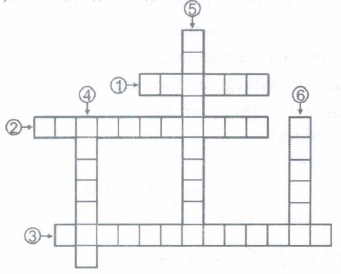
Direction:
Across:
(1) The product of number by itself two times, is called its _______
(2) If three numbers a, band c are such that a2 + b2= c2 then they are called _____ Triplets.
(3) A number is a when it is a product of the same two numbers.
Down: (4) The numbers 2n, n2-1 and n2 + 1 where n is a natural number show Pythagorean______.
(5) Finding is the inverse operation of squaring a number.
(6) A number which divides a _______ given number exactly is called a or divisor of that number.
45.
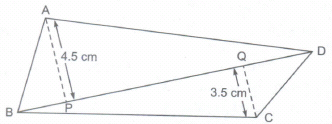
Find the length of the diagonal BD when, the area of the quadrilateral is 32 cm2.
46.
Leela invited some friends for tea on her birthday. Her mother placed some plates and some puris on a table to be served. If Leela places 4 puris in each plate 1 plate would be left empty. But if she places 3 puris in each plate 1puri would be left. Find the number of plates and number of puris on the table.
47.
Take a clock and fix its minute hand at 12.
Record the angle turned through by the minute hand from its original position and the time that has passed, in the following table:
| Time Passed (T) (in minutes) |
(T1) 15 | (T2) 15 | (T3) 45 | (T4) 60 |
|---|---|---|---|---|
| Angle turned (A) (in degree) | (A1) 90 | (A2) __ | (A3) __ | (A4) __ |
| \(T\over A\) | - | - | - | - |
What do you observe about T and A? Do they increase together? Is \(T\over A\) same every time?
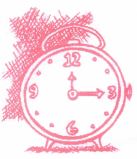
Is the angle turned through by the minute hand directly proportional to the time that has passed? Yes; From the above table, you can also see
T1 : T2 = A1 A2, because
T1 : T2 = 15 30= 1 :2
A1 : A2 = 90 180 = 1 :2
Check if T2: T3 = A2 A3 and T3 : T4 = A3 : A4
You can repeat this activity by choosing your own time interval.
1.
(b)
0
2.
(a)
1
3.
(c)
0
4.
(a)
\(\frac { 1 }{ 4 } \)
5.
(b)
\(\frac { -1 }{ 4 } \)
6.
(d)
\(13\over9\)
7.
(b)
\(\frac{x+y}{2}\) is a rational number between x and y
8.
(a)
between x and y
9.
(b)
\(\frac{-3}{4},\frac{-1}{2},\frac{1}{4}\)
10.
(c)
\(\frac{10}{11}+ \frac{11}{12}=\frac{11}{12}\div \frac{10}{11}\)
11.
(b)
12.
(b)
13.
(a)
14.
(b)
15.
(b)
16.
(a)
17.
(b)
18.
(a)
19.
(a)
20.
(a)
21.
we have, \(-13\over19\)
\(\therefore\)The multiplicative inverse of \(-13\over19\) is\(19\over-13\)
22.
We have, -13
\(\therefore\)The multiplicative inverse of -13 is \(-1\over13\)
23.
We have, x = \(-13\over17\)
\(LHS =-(-x)=-\{-({-13\over17})\}=-\{{13\over17}\}\)
=-\({13\over17}\) = x = RHS
So, - (-x) = x is verified for x = \({13\over17}\).
24.
We have, x =\(11\over15\)
LHS = -(-x) = -\(({11\over15})={11\over15}=X=RHS\)
S0, - (-x) = x is verified for x =\(11\over15\)
25.
we have, \(19\over-6\) so, additive inverse of \(19\over-6\) is \(19\over6\)
26.
we have, \({2\over-9}\) so, additive inverse of \({2\over-9}\) is \({2\over9}\)
27.
we have,\(-6\over-5\)=\({6\over5}\) so, additive inverse of \(({-6\over-5})\) is \(-6\over5\)
28.
we have, \(-5\over9\) so, additive inverse of \(-5\over9\) is \(5\over9\)
29.
we have, \(2\over8\) so, additive inverse of \(2\over8\) is \(-2\over8\)
30.
= \(\frac { 2 }{ 5 } \times \left( \frac { -3 }{ 7 } \right) -\frac { 1 }{ 4 } +\frac { 1 }{ 14 } \times \frac { 2 }{ 5 } \)
= \(\frac { 2 }{ 5 } \times \left( \frac { -3 }{ 7 } \right) +\frac { 1 }{ 14 } \times \frac { 2 }{ 5 } -\frac { 1 }{ 4 } \) (Using commutativity)
= \(\frac { 2 }{ 5 } \left[ \frac { -3 }{ 7 } +\frac { 1 }{ 14 } \right] -\frac { 1 }{ 4 } \) (using distributivity)
= \(\frac { 2 }{ 5 } \left[ \frac { -6+1 }{ 14 } \right] -\frac { 1 }{ 4 } =\frac { 2 }{ 5 } \times \frac { -5 }{ 14 } -\frac { 1 }{ 4 } \)
= \(\frac { -1 }{ 7 } -\frac { 1 }{ 4 } =\frac { -4-7 }{ 28 } =\frac { -11 }{ 28 } \)
31.
Rational numbers are closed under multiplication, e.g.\({2\over 12}\times{1\over 12}={2\over 144}\) , which is a rational number.
32.
We have the sum of the digits of 51x3
= 5+1+x+3=9+x
Since, 51x3 is divisible by 9.
∴ (9 + x) must be divisible by 9.
∴ (9 + x) must be equal to 0 or 9 or 18 or 27
or ... But x is a digit, then
9+x=9 ⇒ x=0
9 + x = 18 ⇒ x = 9
x = 27 ⇒ x = 18, which is not possible.
∴ The required value of x = 0 or 9.
33.
We have
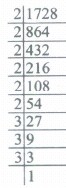
i.e., 1728 = 2 x 2 x 2 x 2 x 2 x 2 x 3 x 3 x 3
\(\Rightarrow\) 1728 = 23 x 23 X 33
\(\Rightarrow\) 1728 = (2 x 2 x 3)3
\(\Rightarrow \sqrt[3]{1728}\) = 2 x 2 x 3 = 12
Since 1728 is a perfect cube.
\(\therefore\) -1728 is also a perfect cube.
Also\(\sqrt[3]{1728} =-12\)
\(\Rightarrow\) -1728 is a perfect cube of -12.
34.
Since, a Pythagorean triplet is given by 2n,
n2 - 1 and n2 + 1.
\(\therefore\) 2n = 15 or n =\(\frac{15}{2}\)s not an integer.
So, let us assume th~t
n2 - 1 = 15
or n2 = 15 + 1 = 16
or n2 = 42, i.e. n = 4
Now, the required Pythagorean triplet is
2n, n2 - 1 and n2 + 1
or 2(4), 42 - 1 and 42 +
or 8, 15 and 17
35.
Since, \({ \left( \frac { a }{ b } \right) }^{ m }=\frac { { a }^{ m } }{ { b }^{ m } } \quad and\quad { (a }^{ m })^{ n }={ a }^{ mn }\)
\(\therefore \quad { \left[ { \left( \frac { -4 }{ 5 } \right) }^{ -2 } \right] }^{ 2 }={ \left( \frac { -4 }{ 5 } \right) }^{ -2\times 2 }={ \left( \frac { -4 }{ 5 } \right) }^{ -4 }={ \left( \frac { 5 }{ -4 } \right) }^{ 4 }\)
\(=\frac { 5\times 5\times 5\times 5 }{ (-4)\times (-4)\times (-4)\times (-4) } =\frac { 625 }{ 256 } \)
Thuss, \({ \left[ { \left( \frac { -4 }{ 5 } \right) }^{ -2 } \right] }^{ 2 }=\frac { 625 }{ 256 } \)
36.
We have
A rational number between -3 and -4
= \(\frac { (-3)+(-4) }{ 2 } =\frac { -7 }{ 2 } \)
A rational number between (-3) and \(\frac { -7 }{ 2 } \)
\(\left[ \left( -3 \right) +\left( \frac { -7 }{ 2 } \right) \right] \div 2=\left[ \frac { -6+(-7) }{ 2 } \right] \times \frac { 1 }{ 2 } \)
= \(\frac { -13 }{ 2 } \times \frac { 1 }{ 2 } =\frac { -13 }{ 4 } \)
A rational number between \(\left( \frac { -7 }{ 2 } \right) \) and (-4)
= \(\left[ \frac { -7 }{ 2 } +(-4) \right] \div 2=\left[ \frac { -7+(-8) }{ 2 } \right] \div 2\)
= \(\frac { -15 }{ 2 } \times \frac { 1 }{ 2 } =\frac { -15 }{ 4 } \)
Thus, the three rational numbers
\(\left( \frac { -7 }{ 2 } \right) ,\left( \frac { -13 }{ 4 } \right) \) and \(\left( \frac { -15 }{ 4 } \right) \) are between (-3) and (-4).
37.
()
\(-\frac { 1 }{ 2 } \)
38.
()
2
39.
()
-1
40.
()
1
41.
()
0
42.
| Numbers of bottles filled | Number of hours |
| 540 x |
6 5 |
Let the required number of bottles to be filled in 5 hours be x
Since, more number of bottles, more number of hours would be required.
\(\therefore\) The given quantities very directly
\(\therefore \ \frac { 540 }{ x } =\frac { 6 }{ 5 } \Rightarrow 6\times x=5\times 540\)
\(\Rightarrow \ x=\frac { 5\times 540 }{ 6 } =5\times 90=450\)
Thus, the required number of bottles = 450
43.
Here, as the base increased, the required number of green pigments will also increase.
\(\therefore\) The quantity vary directly:
i.e.,\(\frac { 1 }{ 6 } =\frac { 4 }{ { x }_{ 1 } } =\frac { 5 }{ { x }_{ 2 } } =\frac { 6 }{ { x }_{ 3 } } \)
\(\therefore\) \(\frac { 4 }{ { x }_{ 1 } } =\frac { 1 }{ 6 } \Rightarrow 1\times { x }_{ 1 }=4\times 6\Rightarrow { x }_{ 1 }=24\)
\(\frac { 1 }{ 6 } =\frac { 5 }{ { x }_{ 2 } } \Rightarrow 1\times { x }_{ 2 }=5\times 6\)
\(\Rightarrow { x }_{ 2 }=\frac { 5\times 6 }{ 1 } =30\)
\(\frac { 1 }{ 6 } =\frac { 6 }{ { x }_{ 3 } } \Rightarrow 1\times { x }_{ 3 }=6\times 6\)
\(\Rightarrow \ { x }_{ 3 }=\frac { 6\times 6 }{ 1 } =36\)
Thus, the required unknown quantities are: x1 = 24, x2 = 30, and x3 = 36.
44.
1.SQUARE
2.PYTHAGOREAN
3.PERFECT SQUARE
4.TRIPLET
5.SQUARE ROOT
6.FACTOR
45.
Let the length of the diagonal BD be x cm
\(\because\) Area of a quadrilateral \(=\frac{1}{2}\times(diagonal)\times\) (Sum of the length of perpendiculars on the diagonal from the opposite vertices)
\(\therefore\) Area of the quadrilateral ABCD
\(=\frac{1}{2}\times BD\times(AP+CQ)\)
\(=\frac{1}{2}\times x\ cm\times(4.5\ cm+3.5\ cm)\)
\(=\frac{1}{2}\times x\times 8\ cm^2\)
Since area of the quadrilateral ABCD = 32 cm2
\(\therefore \frac{1}{2}x\times 8=32\Rightarrow x=\frac{32\times2}{8}\ cm=8\ cm\)
Thus, the required length of the diagonal BD = 8 cm.
46.
Let the number of plates on the table be y and the number of puris be x.
Then, according to the first condition of the problem
4(y - 1) = x ...(1)
and, according to the second condition of the
problem
3y + 1= x ... (2)
From (1) and (2), we have
4(y - 1) = 3y + 1
⇒ 4y - 4 = 3y + 1
⇒ 4y - 3y = 1 + 4
⇒ y=5
Put y = 5 in (1), we get
x = 4(5) - 4 = 20 - 4 = 16
Hence, the number of plates and number of puris on the table are 5 and 16 respectively.
47.
| Time Passed (T) (in minutes) |
(T1) 15 | (T2) 15 | (T3) 45 | (T4) 60 |
|---|---|---|---|---|
| Angle turned (A) (in degree) | (A1) 90 | (A2) __ | (A3) __ | (A4) __ |
| \(T\over A\) | \({15\over 90}={1\over6}\) | \({30\over 180}={1\over6}\) | \({45\over 270}={1\over6}\) | \({60\over 360}={1\over6}\) |
We observe about T and A that they increase together and is \(T\over A\) same every time.
Yes; The angle turned by the minute hand is directly proportional to the time that has passed.
On checking, we find that
T2 : T3 = A1 : A3 = 2: 3
and T3 : T4 = A3 : A4 = 3 : 4

8th Standard CBSE Syllabus & Materials
8th Standard CBSE
CBSE 8th Science Particulate Nature of Matter - New Model Questions Papers Study Material - QB365 Set A
NEW8th Standard CBSE
CBSE 8th Science Pressure, Winds, Stroms and Cyclones - New Model Questions Papers Study Material - QB365 Set A
NEW8th Standard CBSE
CBSE 8th Mathematics Quadrilaterals - New Model Questions Papers Study Material - QB365 Set A
NEW8th Standard CBSE
CBSE 8th Mathematics A story of Numbers - New Model Questions Papers Study Material - QB365 Set A



CBSE 8th Standard CBSE Subjects
CBSE Standards




