
 100% FREE ACCESS
8th Standard CBSE Syllabus & Materials
8th Standard CBSE
CBSE 8th Social Science Theme D - Factors of Production - New Model Questions Papers Study Material - QB365 Set A
NEW8th Standard CBSE
CBSE 8th Social Science Theme C - Universal Franchise and India's Electoral System - New Model Questions Papers Study Material - QB365 Set A
NEW8th Standard CBSE
CBSE 8th Social Science Theme B - The Rise of the Marathas - New Model Questions Papers Study Material - QB365 Set A
NEW8th Standard CBSE
CBSE 8th Social Science Theme B - Reshaping India's Political Map - New Model Questions Papers Study Material - QB365 Set A
NEW8th Standard CBSE
CBSE 8th Social Science Theme A - Natural Resources and Their Use - New Model Questions Papers Study Material - QB365 Set A
NEW8th Standard CBSE
CBSE 8th Science Keeping Time with Skies - New Model Questions Papers Study Material - QB365 Set A

Published on: 10/10/2019
Mensuration
Download CBSE Class 8th Standard CBSE Mathematics question papers, sample papers, important questions, and previous year solved papers in PDF format. Get free study materials, NCERT solutions, and exam preparation resources for Class 8th Standard CBSE Mathematics
Questions + Answers key
Take MCQ Mathematics Test
1.
cuboid is of dimensions 50 cm x 45 cm x 30 cm. How many small cubes with sides 5 cm can be places in the given cuboid?
2.
A road roller makes 250 complete revolution to move once over to level a road.
Find the area of the road levelled if the diameter of the road roller is 84 cm and length is 1 m.
3.
A closed cylindrical tank of radius 7 cm and height 5 m is made from a sheet of metal. If the breadth of the rectangular sheet is 10 m, then find the length of the sheet.
4.
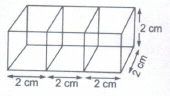
The edge of a cube is 2 cm. Find the total surface area of the cuboid formed by three such cubes joined edge to edge.
5.
The area of a rhombus and that of a square are equal. The side of the square is 6 cm. If one of the diagonal of the rhombus is 4 cm, then find the length of its other diagonal.
6.
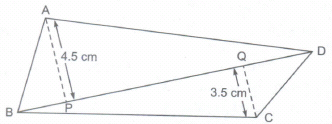
Find the length of the diagonal BD when, the area of the quadrilateral is 32 cm2.
7.
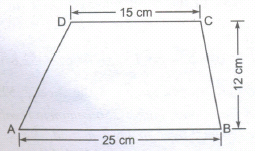
Find the area of the following trapezium.
8.
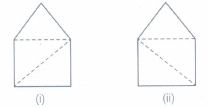
There is a pentagonal shaped park as shown. the figure. For finding its area, Jyoti and Kavita divided it in two different ways.
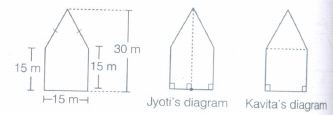
Find the area of this park using both ways. Can you suggest some other way of finding its area?
9.
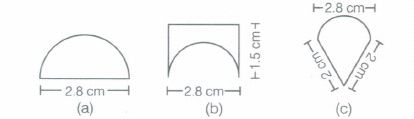
An ant is moving around a few food-pieces of different shapes scattered on the floor. For which food-piece would the ant have to take a longer round? Remember, circumference of a circle can be obtained by using the expression C = 2\(\pi \) r,where r is the radius of the circle.
10.
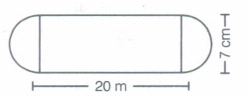
The shape of a garden is rectangular in the middle and semi-circular at the ends as shown in the diagram. Find the area and the perimeter of this garden. Length of rectangle is 20- (3.5+ 3.5) m.
1.
Volume of a cuboid = Length \(\times\) Breadth \(\times\) Height
Here, Length of the cuboid = 50 cm
Breadth of the cuboid = 45 cm
Height of the cuboid = 30 cm
\(\therefore\) Volume of the cuboid = 50 x 45 x 30 cm3
Volume of the small cube = Side \(\times\) Side \(\times\) Side = 5 \(\times\) 5 \(\times\) 5 cm3
Let the number of the required small cubes be x
\(\therefore\)x\(\times\) (5 \(\times\) 5 \(\times\) 5) = 50 \(\times\) 45 \(\times\) 30
\(\Rightarrow x=\frac{50\times45\times30}{5\times5\times5}=10\times9\times6=540\)
Thus, 540 small cubes can be placed in the given cuboid.
2.
A road roller is a cylinder such that Radius \(\frac{84}{2}\ cm=42\ cm\)
Length (h) = 1m = 100 cm
\(\because\) Lateral surface area of a cylinder = 2\(\pi\)rh
\(\therefore\) Lateral surface area of the road roller \(=2\times\frac{22}{7}\times 42\times 100\ cm^2\)
\(=2\times 22\times 6\times 100\ cm^2\)
\(\therefore\) Area of road levelled in 1 revolution = 26400 cm2
\(\Rightarrow\) Area of road levelled in 250 revolutions
\(=250\times 26400\ cm^2=\frac{250\times26400}{100\times100}m^2\)
\(=\frac{25\times264}{10}m^2=\frac{6600}{10}m^2=660 m^2\)
3.
Here, Radius (r) = 7 cm
Height (h) = 5 cm
Since, total surface area of the closed cylinder = 2\(\pi\)r (r + h)
\(\therefore\) Total surface area of the cylindrical tank
\(=2\times\frac{22}{7}\times(7)\times(7+5)m^2\)
\(2\times22\times12 m^2=528\ m^2\)
Let length of the sheet required be'l' m
\(\therefore\) Area of the rectangular sheet = I x 10 m2
\(\Rightarrow l\times 10=528\Rightarrow l=\frac{528}{10}m=52.8 m\)
Thus, the required length of the sheet = 52.8 m.
4.
The edge (side) of the given cube = 2 cm
Since, three such cubes are joined, then
Total length (/)= (2 + 2 + 2) cm = 6 cm
Breadth (b) = 2 cm
Height (h) = 2 cm
\(\therefore\) Total surface area of the resultant cuboid
= 2[lb + bh + hI]
= 2[6 x 2 + 2 x 2 + 2 x 6] cm2
= 2[12 + 4 + 12] cm2
= 2[28] cm2 = 56 cm2
Thus, the required total surface area of the cuboid = 56 cm2.
5.
Here, side of the square = 6 cm
\(\therefore\) Area of the square = Side x Side
= 6 cm x 6 cm = 36 cm2
Since, [Area of the rhombus]
= [Area of the square]
\(\therefore\) Area of the rhombus = 36 cm2
One of the diagonal of the rhombus = 4 cm
Let the other diagonal of the rhombus be
\(\therefore\) Area of rhombus
\(\therefore\frac{1}{2}\times Product \ of\ the\ diagonals\)
\(\therefore\) Area of the rhombus \(=\frac{1}{2}\times 4\times d\)
Now, \(\frac{1}{2}\times 4\times d=36\Rightarrow d=\frac{36\times 2}{4}=18\)
Thus, the required length of the rhombus = 18 cm.
6.
Let the length of the diagonal BD be x cm
\(\because\) Area of a quadrilateral \(=\frac{1}{2}\times(diagonal)\times\) (Sum of the length of perpendiculars on the diagonal from the opposite vertices)
\(\therefore\) Area of the quadrilateral ABCD
\(=\frac{1}{2}\times BD\times(AP+CQ)\)
\(=\frac{1}{2}\times x\ cm\times(4.5\ cm+3.5\ cm)\)
\(=\frac{1}{2}\times x\times 8\ cm^2\)
Since area of the quadrilateral ABCD = 32 cm2
\(\therefore \frac{1}{2}x\times 8=32\Rightarrow x=\frac{32\times2}{8}\ cm=8\ cm\)
Thus, the required length of the diagonal BD = 8 cm.
7.
Here, parallel sides are 25 cm and 15 cm.
Height (i.e. distance between the parallel sides) = 12 cm
\(\because\) Area of a trapezium ABCD
\(=\frac{1}{2}\times(Sum\ of\ parallel\ sides)\times \ Height\)
\(\therefore\) Area of the trapezium ABCD
\(=\frac{1}{2}\times(25\ cm+15\ cm)\times12\ cm\)
\(=\frac{1}{2}\times40\times12\ cm^2=240\ cm^2\)
Thus, the required area of the trapezium ABCD = 240 cm2.
8.
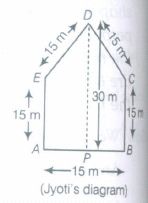
Let ABCDE be a given pentagonal shaped park.
Given, length of each side of regular peatagon = 15 m
Now, Jyoti divide it into two congruent trapeziums by joining DP, where P is the mid-point of AB. Here, AE and DP are parallel sides and AP is perpendicular distance.
Given, length of DP = 30 m
and length of AP = \(\frac { AB }{ 2 } =\frac { 15 }{ 2 } m\)
∴ Area of pentagonal park ABCDE
= 2 \(\times\)Area of trapezium APDE
[∵ both trapeziums are congruent, so their area will be same]
= 2\(\times\) [\(\frac { 1 }{ 2 } \)\(\times\)sum of parallel sides \(\times\) perpendicular distance between parallel sides]
\(2\times \left[ \frac { 1 }{ 2 } \times (30+15)\times \frac { 15 }{ 2 } \right] =2\times \frac { 1 }{ 2 } \times 45\times \frac { 15 }{ 2 } \)
\(\frac { 45\times 15 }{ 2 } =\frac { 675 }{ 2 } \) = 337.5 m2
Now, Kavita divide it into two parts by joining EC our of which one is ΔDEC and other is a square ABCE
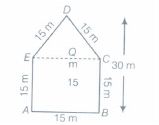
Then, altitude of ΔDEC = DQ = 30 m-15 m = 15 m
∴ Area of pentagon ABCDE
= Area of ΔDEC + Area of square ABCE
= \(\frac { 1 }{ 2 } \)\(\times\)EC \(\times\)DQ+AB \(\times\)BC
=\(\frac { 1 }{ 2 } \) \(\times\)15 \(\times\)15 +15\(\times\) 15
= \(\frac { 225 }{ 2 } +225=\frac { 225+450 }{ 2 } =\frac { 675 }{ 2 } \) =337.5 m2
Hence,area of park using both ways is serve, i.e. 337.5 m2
Yes,we can find the area of pentagonal park to two another ways by drawing the figure given below and then find its area:
9.
(a)Here, the food-piece is in the shape of semi-circle and diameter of semi-circle = 2.8 cm
∴ Radius of semi circle = \(\frac { Diameter }{ 2 } =\frac { 2.8 }{ 2 } \) = 1.4cm
Perimeter of a semi- circle = \(\frac { 2\pi r }{ 2 } =\pi r\)
∴ Perimeter of given food-piece =\(\pi\) r+ Diameter of semi circle
= \(\left( \frac { 22 }{ 7 } \times 1.4+2.8 \right) \)cm=(4.4+2.8)cm =7.2 cm
(b)Here, given piece of food has semi-circular shape in one side.
So perimeter od semi-circular part
\(\pi r=\frac { 22 }{ 7 } \times 1.4\) =4.4 cm \(\left[ \because radius\quad =\frac { 2.8 }{ 2 } =1.4cm \right] \)
∴ Perimeter of given food piece
= 4.4 cm + 1.5 cm + 2.8 cm + 1.5 cm = 10.2 cm
(c)Here, given piece of food has semi-circular shape on the upper side.
So, perimeter of semi-circular part = \(\pi\)r
= \(\frac { 22 }{ 7 } \times 1.4\) =4.4 cm
∴ Perimeter of given food-piece
= 4.4 cm + 2 cm + 2 cm = 8.4 cm
Now 10.2> 8.4> 7.2
So, it is clear that, the ant would has to take a longer round for food-piece in figure (b), since it has larger perimeter.
10.
Given, the shape of a garden is rectangular in middle and semi-circular at both ends.
Also, diameter of circular part = 7 m
∴ Radius of circular part = \(\frac { 7 }{ 2 } \)= 3.5 m
Then, length of rectangular part = 20m -(3.5+3.5)m and breadth of rectangular part = 7 m
Now,area of one semi-circular part = \(\frac { 1 }{ 2 } { \pi r }^{ 2 }\)
where, r is the radius of semi-circle.
∴ Area of both semi-circular parts = \(2\times \frac { 1 }{ 2 } { \pi r }^{ 2 }={ \pi r }^{ 2 }\)
= \(\frac { 22 }{ 7 } \times \left( \frac { 7 }{ 2 } \right) ^{ 2 }\) \(\left[ \because \pi =\frac { 22 }{ 7 } \right] \)
= \(\frac { 22 }{ 7 } \times \frac { 49 }{ 7 } =\frac { 77 }{ 2 } \) m2
Area of rectangular part = Length \(\times\) Breadth
= 13m\(\times\) 7m = 91m2
∴ Area of garden = Area of both circular parts + Area of rectangular part
=\(\frac { 77 }{ 2 } \) + 91 m2
=\(\left( \frac { 77+182 }{ 2 } \right) { m }^{ 2 }\)= 129.5 m2
Now, Perimeter of one semi-circle part = \(\frac { 2\pi r }{ 2 } =\pi r\)
∴ Perimeter of both semi-circle parts = \(2\times \frac { 22 }{ 7 } \times \frac { 7 }{ 2 } \) =22m
Here, rectangular part is in between two semi-circular parts, so for perimeter of garden, we will take only length of rectangular part.
∴ Perimeter of garden = Perimeter of both circular parts + 22 \(\times\) Length of rectangular part
= 22 + 2 \(\times\)13 = (22+26) m = 48m

8th Standard CBSE Syllabus & Materials
8th Standard CBSE
CBSE 8th Science Particulate Nature of Matter - New Model Questions Papers Study Material - QB365 Set A
NEW8th Standard CBSE
CBSE 8th Science Pressure, Winds, Stroms and Cyclones - New Model Questions Papers Study Material - QB365 Set A
NEW8th Standard CBSE
CBSE 8th Mathematics Quadrilaterals - New Model Questions Papers Study Material - QB365 Set A
NEW8th Standard CBSE
CBSE 8th Mathematics A story of Numbers - New Model Questions Papers Study Material - QB365 Set A



CBSE 8th Standard CBSE Subjects
CBSE Standards




