
 100% FREE ACCESS
8th Standard CBSE Syllabus & Materials
8th Standard CBSE
CBSE 8th Social Science Theme D - Factors of Production - New Model Questions Papers Study Material - QB365 Set A
NEW8th Standard CBSE
CBSE 8th Social Science Theme C - Universal Franchise and India's Electoral System - New Model Questions Papers Study Material - QB365 Set A
NEW8th Standard CBSE
CBSE 8th Social Science Theme B - The Rise of the Marathas - New Model Questions Papers Study Material - QB365 Set A
NEW8th Standard CBSE
CBSE 8th Social Science Theme B - Reshaping India's Political Map - New Model Questions Papers Study Material - QB365 Set A
NEW8th Standard CBSE
CBSE 8th Social Science Theme A - Natural Resources and Their Use - New Model Questions Papers Study Material - QB365 Set A
NEW8th Standard CBSE
CBSE 8th Science Keeping Time with Skies - New Model Questions Papers Study Material - QB365 Set A

Published on: 01/01/2019
Class 8 Model Question
Download CBSE Class 8th Standard CBSE Mathematics question papers, sample papers, important questions, and previous year solved papers in PDF format. Get free study materials, NCERT solutions, and exam preparation resources for Class 8th Standard CBSE Mathematics
Questions + Answers key
Take MCQ Mathematics Test
1.
All sides of a ________ are equal and all angles are right angles
2.
52 = 25, then square root of 25 =______.
3.
The standard form of \(\frac{1}{10000000000}\) is ____________
4.
Volume of a cylinder with radius r and height h is_____
5.
The numbers _________________and ________________ are their own reciprocals
6.
Present ages of Aasha and Rekha are in the ratio 4: 5. Eight years from now, the ratio of their ages will be 5: 6. Find their present ages.
7.
Complete the following crossword puzzle using the given directions for Across [from left to right} and Down [from top to bottom).
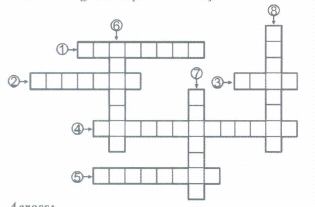
Across:
(1) The points where, the sides of a polygon meet are called _________
(2) A polygon made by six sides is called a __________
(3) The side joining two vertices is called a ____________
(4) 'A four sided polygon is called a ____________
(5) A five sided polygon is called a _________
Down:
(6) A parallelogram having all of its four sides equal is called a ____________
(7) A simple closed figure made of only line segments is called a __________
(8) The line segment joining the opposite sides of a polygon (except triangle) is called a ___________ of the polygon.
8.
Find three rational numbers between \(\frac { 1 }{ 2 } \) and (-2)
9.
If 53a is divisible by 9, then find the value of a.
10.
Verify the following expressions:
(i) (ab + bc) (ab - bc) + (bc + ca) (bc - ca)+(ca + ab)(ca -ab) = 0
(ii) (a + b + c)(a2 + b2 + c2 - ab - bc - ca)= a3 + b3 + c3 - 3abc
11.
A swimming pool can be filled in 8 h by 3 equal pumps. How many such pumps are required, if the pool is to be filled in 6 h?
12.
Study the following graph and answer the question that follows.
Number of candidates (in thousand) qualified in the written test for admission to two different institutions.
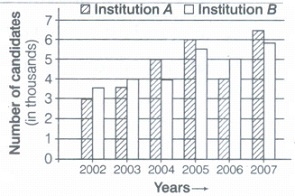
(a) What is the difference between the total number of candidates qualified in written test in the year 2006 for admission to institutions A and B together and the number of candidates qualified in written test in the year 2003 for admission to institute A?
(b) What was the total number of candidates qualified in the written test for admission to institution A over all the years together?
13.
By using suitable identity, evaluate \({ x }^{ 2 }+\frac { 1 }{ { x }^{ 2 } } ,if\ x+\frac { 1 }{ x } =5\quad \)
14.
At a stock clearance sale, all items are on sale at 45% discount. If i buy a pant marked at Rs 600,then how much money would I need to pay?
15.
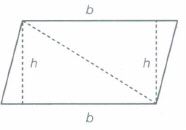
We know that parallelogram is also a quadrilateral. Let us also split such a quadrilateral into two triangles, find their areas and hence that of the parallelogram. Does this agree with the formula that you know already?
16.
What will be the unit digit of the squares of the following numbers?
12796
17.
Find any seven rational numbers between \(\frac { 5 }{ 8 } \) and \(\frac { -5 }{ 6 } \)
18.
Divide the given polynomial by the given monomial
\((5x^{2}-6x)\div 3x\)
19.
The volume of a cubical box is 13.824 m3. then find the length of each side of the box.
20.
Multiply the following:
15 xy2, 17 yz2
21.
The perimeter of a parallelogram is 94 m. If the longer side is 8 m greater than the two times of the shorter side, then find the length of the sides of the parallelogram.
22.
The perimeter of a rectangle is 17 cm. If its width is \(3{3\over 4}\) cm, then find its length.
23.
Find the base area of a cuboid whose volume and height are 900 cm3and 5 em respectively.
24.
Factotise the following expressions. q2 - 10q +21
25.
Maria invested Rs 8000 in a business. She would be paid interest at 5% per annum compounded annually. Find the interest for the 3rd year.
26.
Every rhombus is a rectangle.
27.
The distance of the point (3, 5) from the Y-axis. is 5
28.
A 2-digit number ab is always divisible by 2, if b is an even number.
29.
There are five perfect cubes between 1 to 100
30.
The negative of 0 does not exist.
31.
The smallest number by which 1000 should be divided so as to get a perfect square is
5
10
100
1000
32.
The area of the figure is
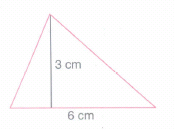
9 cm2
18 cm2
12 cm2
15 cm2
33.
Apala types 200 words in half an hour. How many words will she type in 12 minutes?
80
50
100
60
34.
The coefficient in the term 7xy is
7
3
1
2
35.
ABCD is a parallelogram as shown. Find x and y.
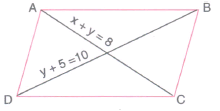
1, 7
2, 6
3, 5
4, 4
36.
Observe the histogram and answer the question given below:
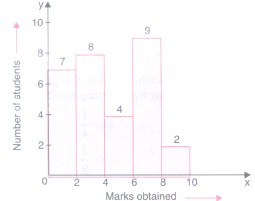
The total number of students is
10
20
25
30
37.
The reciprocal of \(\frac{1}{x} (x \ne 0)\) is
x
\(\frac{1}{x}\)
1
0.
38.
The one's digit of the cube of the number 50 is
1
0
5
4
39.
Which of the following are the factors of a2 + ab + bc + ca
(b + c) (c + a)
(a + b) (a + c)
a(a + b + c)
(a + b) (b + c)
40.
The exterior angle of a regular polygon is one fifth of its interior angle. Which one of the followings is the number of sides of the polygon?
18
8
12
9
41.
Regroup the terms and factorise: z - 19 + 19xy - xyz
42.
What do we call an equation that is true for every value of the variable in it?
43.
There are 2401 students in a school. P.T. teacher wants to stand them in such a manner that number of rows and columns are the same. Find the number of rows.
44.
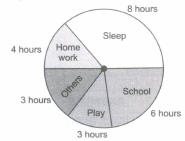
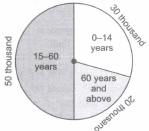
Read the following circle graphs and answer the questions given below:
(a) The time spent by a child during a day:
(i) On which activity maximum number of hours are spent?
(ii) On which two activities does he spend equal number of hours?
(iii) Find the central angles for each sector of activities
(b) Age group of people in a town:
(i) In which age group are the maximum number of people?
(ii) How many people are there is the '0-14 years' group?
(iii) Find the central angle of the sector corresponding to the age group 15-60 years'.
45.
Is 0 a rational number?
1.
()
square
2.
()
5
3.
()
10-10
4.
Volume of a cylinder with radius r and height h is \(\pi\)r2h
5.
()
The numbers 1and -1 are their own reciprocals
6.
32 years and 40 years
7.
(l)\(\rightarrow\)VERTICES
(2)\(\rightarrow\)HEXAGON
(3)\(\rightarrow\)EDGE
(4)\(\rightarrow\)QUADRILATERAL
(5)\(\rightarrow\)PENTAGON
(6)\(\rightarrow\)RHOMBUS
(7)\(\rightarrow\)POLYGON
(8)\(\rightarrow\)DIAGONAL
8.
We have
A rational number between \(\frac { 1 }{ 2 } \)
= \(\left[ \frac { 1 }{ 2 } +(-2) \right] \div 2=\left[ \frac { 1-4 }{ 2 } \right] \div 2\)
= \(\left[ \frac { -3 }{ 2 } \right] \times \frac { 1 }{ 2 } =\frac { -3 }{ 4 } \)
A rational number between \(\frac { 1 }{ 2 } \) and \(\left( \frac { -3 }{ 4 } \right) \)
= \(\left[ \frac { 1 }{ 2 } +\left( \frac { -3 }{ 4 } \right) \right] \div 2\)
\(\left[ \frac { 2-3 }{ 4 } \right] \times \frac { 1 }{ 2 } =\frac { -1 }{ 4 } \times \frac { 1 }{ 2 } =\frac { -1 }{ 8 } \)
A rational number between \(\left( \frac { -3 }{ 4 } \right) \) and (-2)
= \(\left[ \left( \frac { -3 }{ 4 } \right) +(-2) \right] \div 2=\left[ \frac { (-3)+(-8) }{ 4 } \right] \times \frac { 1 }{ 2 } \)
= \(\frac { -11 }{ 4 } \times \frac { 1 }{ 2 } =\frac { -11 }{ 8 } \)
Thus, the three rational numbers
\(\left( \frac { -3 }{ 4 } \right) ,\left( \frac { -1 }{ 8 } \right) \) and \(\left( \frac { -11 }{ 8 } \right) \) are between \(\frac { 1 }{ 2 } \) and (-2)
9.
a = 1
10.
(i) (ab + bc) (ab - bc) + (bc + ca) (be - ca)+(ca+ab)(ca-ab)=0
LHS = (ab + bc)(ab - bc) + (bc + ca)(bc - ca)+ (ca + ab)(ca - ab)
= {(ab)2 -(bc)2} + {(bc)2 -(ca)2} + {(ca)2 - (ab)2}
[by using identity, (A2 - B2) = (A + B)(A - B)]
= a2b2 -b2c2 + b2c2-c2a2 + c2a2-a2b2
= a2b2 -a2b2 + b2c2 -b2c2 + c2a2 -c2a2
= 0= RHS
LHS = RHS
(ii) (a + b +c)(a2 + b2 + c2 -ab-bc -ca)
= a3 + b3 + c3 - 3abc
LHS
= (a + b + c) \(\times\) (a2 + b2 + c2- ab - bc - ca)
= a3 + ab2 + ac2 -a2b - abc - ca2+ ba2 + b3 + bc2- ab2 - b2c - abc+ ca2 + b2c + c3 - abc - bc2 - ac2
= a3 + b3 + c3-abc - abc - abc + ab2- ab2+ ac2 -ac2 + a2b -a2b + ca2 -ca2+ bc2 - bc2 + b2c - b2c
= a3 + b3 + c3- 3abc = RHS
LHS = RHS
11.
4 pumps
12.
(a) 5500
(b) 28000
13.
Given,\(\ x+\frac { 1 }{ x } =5\)
\(\ \left( x+\frac { 1 }{ x } \right) ^{ 2 }=25\)
\(\left( x+\frac { 1 }{ x } \right) ^{ 2 }={ x }^{ 2 }+2\times x\times \frac { 1 }{ x } +\left( \frac { 1 }{ x } \right) ^{ 2 }\quad \)
(a+ b)2 =a2 + 2ab + b2. Here, a = x and \(b=\frac { 1 }{ x } \)
\(={ x }^{ 2 }+2+\left( \frac { 1 }{ { x }^{ 2 } } \right) ={ x }^{ 2 }+\left( \frac { 1 }{ { x }^{ 2 } } \right) +2\)
\(\left( x+\frac { 1 }{ x } \right) ^{ 2 }=25\)
\(\quad { x }^{ 2 }+\frac { 1 }{ { x }^{ 2 } } +2=25\)
\({ x }^{ 2 }+\frac { 1 }{ { x }^{ 2 } } =25-2=23\)
14.
Rs 330
15.
Let ABCD be a given quadrilateral, which is a parallelogram. Join the diagonal BD of the parallelogram ABCD and it divides the parallelogram into two ΔABD and ΔBCD.
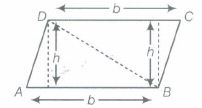
Then, area of parallelogram ABCD = Area of ABD + Area of ΔBCD.
= \(\frac { 1 }{ 2 } \)\(\times\)AB\(\times\) h + CD\(\times\) h
= \(\frac { 1 }{ 2 } \)\(\times\) b \(\times\)h + b \(\times\)h
= \(\frac { bh }{ 2 } +\frac { bh }{ 2 } =\frac { bh+bh }{ 2 } =\frac { 2bh }{ 2 } \) = bh sq units
We know that,
Area of parallelogram = Base \(\times\) Height
= b \(\times\)h = bh sq units
We also know that, a parallelogram can also be a trapezium.
∴ Area of trapezium ABCD =\(\frac { 1 }{ 2 } \) \(\times\)(Sum of parallel lines) \(\times\)(Perpendicular distance between the parallel sides)
=\(\frac { 1 }{ 2 } \)\(\times\) (b + h) \(\times\)h
=\(\frac { 1 }{ 2 } \) \(\times\)2b\(\times\)h = bh sq units
Hence, we can say that the above relation agrees with formula that we know already.
16.
Since 6 x 6 = 36
\(\therefore\) The unit digit of (12796) will be 6.
17.
Let us connvert the given rational numbers having the same denominations
We have \(\frac { 5 }{ 8 } =\frac { 5\times 3 }{ 8\times 3 } =\frac { 15 }{ 24 } \) and \(\frac { -5 }{ 6 } \)
= \(\frac { -5\times 4 }{ 6\times 4 } =\frac { -20 }{ 24 } \)
Now, the rational numbers between \(\frac { -20 }{ 24 } \) and \(\frac { 15 }{ 24 } \) are \(\frac { -19 }{ 24 } ,\frac { -18 }{ 24 } ,\frac { -17 }{ 24 } ,....\frac { -1 }{ 24 } ,\frac { 0 }{ 24 } ,\frac { 1 }{ 24 } ,\frac { 2 }{ 24 } ,\frac { 3 }{ 24 } ,...,\frac { 14 }{ 24 } \)
We can take any seven of these
18.
\((5x^{2}-6x)\div 3x\)=\(\frac{5x^{2}-6x}{3x}=\frac{5x^{2}}{3x}-\frac{6x}{3x}\)
\(=\frac{5}{3}x-2=\frac{5x-6}{3}=\frac{1}{3}(5x-6)\)
19.
2.4 m
20.
255xy3z2
21.
Length of longer side = 34 m
Length of shorter side = 13 m
22.
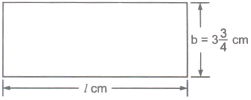
Let the length of the rectangle = 1 cm
\(\therefore\) Since width of the rectangle (b) = \(3{3\over 4}\) and perimeter = 17 cm
We know that perimeter of a rectangle = 2(l + b) cm
Then, \(2(l+3{3\over 4})=17\) or \(2(l+{15\over 4})=17\)
or \(2l+(2\times {15\over 4})=17\) or \(2l+{15\over 2}=17\)
or \(2l=17-{15\over 2}\) (Transposing \({15\over 2}\) to RHS)
or \(2l={35-15\over 2}={19\over 2}\)
Dividing both side by 2, we have
\(i={19\over 2}\times {1\over 2}={19\over 4}=4{3\over 4}\) cm
\(\therefore\) Length of the rectangle = \(4{3\over 4}\)cm.
23.
180 cm2
24.
Here, ab = 21 and a + b = -10
Possible values of a and b are 7, 3 or -7, -3.
But 7 +3 = 10 \(\neq \) - 10 [not possible]
\(\therefore\) a= -7, b = -3
Now q2 - 10q + 21 = q2 +(-7-3)q + 21
= q2 - 7q - 3q + 21
=q (q -7)-3(9 - 7) = (q-7)(q -3)
Hence, required factors of given expression are(q - 7) and (q -3).
25.
Principal for the third year, (P) = Amount at the end of twoyears = Rs 8820, rate (R) = 5%, time (T) = 1yr
∴ Simple interest = \(\frac{P\times R\times T}{100}=\frac{8820\times5\times1}{100}\)
=\(\frac{882}{2}\) = Rs 441
Hence, interest for the third year is Rs 441.
26.
(b)
27.
(b)
28.
(a)
29.
(b)
30.
(a)
31.
1000 ÷ 10 = 100 = 102
32.
Area = \(\frac { 6\times 3 }{ 2 } \)= 9 cm2
33.
\({30\over200}={12\over?}⇒?=80\)
34.
Coefficient = 7.
35.
x + y = 8
y + 5 = 10 \(\Rightarrow\) y = 5
\(\therefore\) x + 5 =.8 \(\Rightarrow\) x = 3.
36.
Total number of students = 7 + 8 + 4 + 9 + 2 = 30.
37.
(a)
x
38.
0\(\times\)0\(\times\)0=0.
39.
(b)
(a + b) (a + c)
40.
(c)
12
41.
()
(xy-1)(19-z)
42.
()
identity
43.
()
Let the number of rows be x
So, the number of columns = x
Therefore, number of students = x × x = x2
Thus, x2 = 2401 gives x = \(\sqrt{2401}=\) 49
The number of rows = 49.
44.
()
(i) Sleep (ii) Play and others
(iii) Sleep 120°, school 90°, home work 60°; play 45°, others 45°
45.
()
Yes

8th Standard CBSE Syllabus & Materials
8th Standard CBSE
CBSE 8th Science Particulate Nature of Matter - New Model Questions Papers Study Material - QB365 Set A
NEW8th Standard CBSE
CBSE 8th Science Pressure, Winds, Stroms and Cyclones - New Model Questions Papers Study Material - QB365 Set A
NEW8th Standard CBSE
CBSE 8th Mathematics Quadrilaterals - New Model Questions Papers Study Material - QB365 Set A
NEW8th Standard CBSE
CBSE 8th Mathematics A story of Numbers - New Model Questions Papers Study Material - QB365 Set A



CBSE 8th Standard CBSE Subjects
CBSE Standards




