
 100% FREE ACCESS
8th Standard CBSE Syllabus & Materials
8th Standard CBSE
CBSE 8th Social Science Theme D - Factors of Production - New Model Questions Papers Study Material - QB365 Set A
NEW8th Standard CBSE
CBSE 8th Social Science Theme C - Universal Franchise and India's Electoral System - New Model Questions Papers Study Material - QB365 Set A
NEW8th Standard CBSE
CBSE 8th Social Science Theme B - The Rise of the Marathas - New Model Questions Papers Study Material - QB365 Set A
NEW8th Standard CBSE
CBSE 8th Social Science Theme B - Reshaping India's Political Map - New Model Questions Papers Study Material - QB365 Set A
NEW8th Standard CBSE
CBSE 8th Social Science Theme A - Natural Resources and Their Use - New Model Questions Papers Study Material - QB365 Set A
NEW8th Standard CBSE
CBSE 8th Science Keeping Time with Skies - New Model Questions Papers Study Material - QB365 Set A

Published on: 05/03/2020
8th Standard CBSE Mathematics Public Exam Important Question 2019-2020
Download CBSE Class 8th Standard CBSE Mathematics question papers, sample papers, important questions, and previous year solved papers in PDF format. Get free study materials, NCERT solutions, and exam preparation resources for Class 8th Standard CBSE Mathematics
Questions + Answers key
Take MCQ Mathematics Test
1.
Is Example 7 (Textbook), a case of direct variation?
2.
Using suitable identity, find 9832 - 172
3.
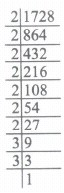
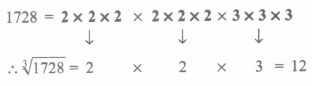
Find the cube root of 1728.
4.
Factorise each of the following algebraic expressions. (m -2n)(2p -q)+ (m -2n)(2p -q)
5.
Without division state, whether the given number is divisible by 2 or not.14567
6.
Find the greatest number of five digit, which is a perfect square.
7.
Which of the following are in inverse proportion?
(i) The number of workers on a job and the time to complete the job.
(ii) The time taken for a journey and the distance travelled in a uniform speed.
(iii) Area of cultivated land and the crop harvested.
(iv) The time taken for a fixed journey and the speed of the vehicle.
(v) The population of a country and the area of land per person.
8.
Simplify and express the result in power notation with positive exponent.
\((-3)^{4}\times (\frac{5}{3})^{4}\)
9.
By selling an article for Rs 112000, a girl gains 40%.Find the cost price of the article.
10.
Find the multiplicative inverse of \({-11\over13}\)
11.
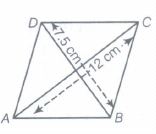
The diagonals of a rhombus are 7.5 cm and 12 cm. Find its area.
12.
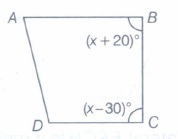
Find the value of x in the trapezium ABCD given below.
13.
From a pack of well-shuffled cards, what is the probability of getting a red jack?
14.
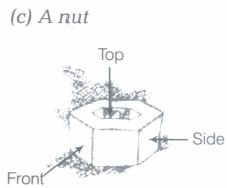
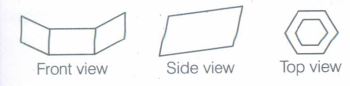
Draw the front view, side view and top view of the given objects.
15.
We saw that 5 measurements of a quadrilateral can determine a quadrilateral uniquely. Do you think any five measurements of the quadrilateral can do this?
16.
Solve the following equations \(\frac { 2x }{ 3 } =18\)
17.
Solve the following linear equations:
m-\(\frac{m-1}{2}\)=1-\(\frac{m-2}{2}\)
18.
Solve: x2 + 10x + 21 = x2 + 4x + 81
19.
Find the smallest number by which 704 must be divided to obtain a perfect cube.
20.
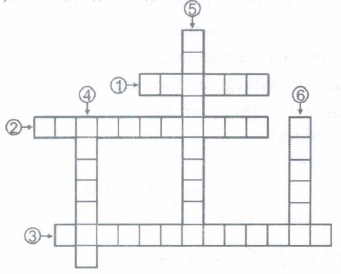
Complete the following crossword puzzle using the given direction.
Direction:
Across:
(1) The product of number by itself two times, is called its _______
(2) If three numbers a, band c are such that a2 + b2= c2 then they are called _____ Triplets.
(3) A number is a when it is a product of the same two numbers.
Down: (4) The numbers 2n, n2-1 and n2 + 1 where n is a natural number show Pythagorean______.
(5) Finding is the inverse operation of squaring a number.
(6) A number which divides a _______ given number exactly is called a or divisor of that number.
21.
The sum of (x + 5) observations is (x4 - 625) Find the mean of the observations.
22.
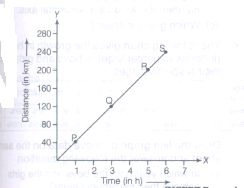
Study the distance-time graph given below for a car to travel to certain places and answer the questions that follow.
(a)How far does the car travel in 2 h?
(b) How much time does the car take to reach R?
(c) How long does the car take to cover 80 km?
(d) How far is Q from the starting point?
(e) When does the car reach the place S after starting?
23.
If Shyam read 12 pages daily and finish the book in 16 days. How many days he take to finish the book if he read 16 pages daily?
24.
Consider a quantity of a radioactive substance. The fraction of this quantity that remains after t half-lives can be found by using the expression 3-t.
(a) What fraction of substance remains after 7 half-lives?
(b) After how many half-lives, will the fraction be \(\frac{1}{243}\) of the original?
25.
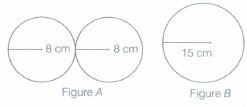
Below are the drawing two of cross-sections of two different pipes used to fill the swimming pools. Figure A is combination of 2 pipes each having radius of 8 cm. Figure B is a pipe having a radius of 15 cm. If the force of the flow of water coming out of the pipes is the same in both the cases, which will fill the swimming pool faster?
26.
Find the values of P, Y and Z, if \(\begin{matrix} \quad \quad P\ P \\\ \ \quad \times \ P \\\_ \_ \_ \_ \_ \_ \_ \_\\ \quad Z\ P\ Y \\ \_ \_ \_ \_ \_ \_ \_ \_\_ \end{matrix}\)
27.
Find the probability of getting a head in a throw of a coin.
28.
The value of p for 512- 492= 100p is 2, Is it true or false
29.
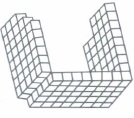
Count the number of cubes in the following shapes.
30.
The four angles of a quadrilateral are in the ratio 3 : 8 : 4 : 5. Find the angles.
31.
Calculate the amount and compound interest on Rs 10000 for 1 yr at 8% per annum compounded half-yearly.
32.
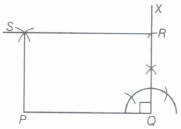
How will you construct a rectangle PQRS, if you know only the lengths PQ and QR?
33.
Solve the following equation \({7y+4\over y+2}={-4\over 3}\)
34.
If the surface area of a cube is 486 cm2. Find its volume
35.
Find the values of A and B in the following product:
\(\begin{matrix} B\ A\\ \times \ 3\\ \_\_\_\_\_ \\10\ A\\ \_\_\_\_\_ \end{matrix}\)
36.
Divide x3 y3 + x2y3 - xy4+ xy by xy using the cancellation method and common factor method.
37.
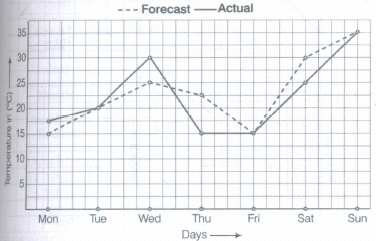
The following graph shows the temperature forecast and the actual temperature for each day of a week.
(a) On which days was the forecast temperature the same as the actual temperature?
(b) What was the maximum forecast temperature during the week?
(c) What was the minimum actual temperature during the week?
(d) On which day did the actual temperature differ the most from the forecast temperature?
38.
A river 2 m deep and 45 m wide is flowing at the rate of 3 km/h. Find the amount of water (in cubic metres) that runs into the sea per minute.
39.
By repeated subtraction of odd number starting from 1, find whether the following numbers are perfect squares or not. If the number is a perfect square, then find its square root. 121
40.
Following are the car parking charges near a railway station up to
| 4 hours | Rs.60 |
| 8 hours | Rs.100 |
| 12 hours | Rs.140 |
| 24 hours | Rs.180 |
Check if the parking charges are in direct proportion to the parking time.
41.
Simplify \(\frac{3^{-5}\times 10^{-5} \times 125}{5^{-7}\times 6^{-5}}\)
42.
Simplify
\({3\over7}\times{28\over15}\div{14\over5}\)
43.
Express the following as a percentage. \(3 \frac{2}{15}\)
44.
At a birthday party, the children spin a wheel get a gift.
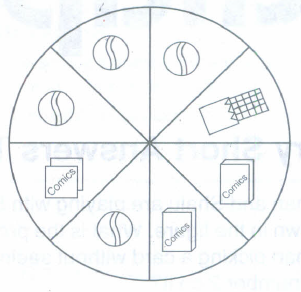
Find the probability of getting a comics.
45.
Multiply the following:
-7pq2r3,-26p3qr2
46.
Find the number of faces in the given shapes.

47.
Draw the following. A rectangle with adjacent sides of lengths 5 cm and 4 cm.
48.
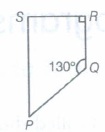
Find the measure of ㄥP and ㄥS, if \(\bar { SP } ||\bar { RQ } \) in the following figure. If you find mㄥR is there more than one method to find mㄥP?
49.
The base radius and height of a right circular cylinder are 14 cm and 5 em respectively. Its curved surface is
220 cm2
440 cm2
1232 cm2
2\(\pi\) x 14 x (14+5) cm2
50.
The number of digits in the square root of 100 is
1
2
3
4
51.
Observe the runs-over graph and answer the related question:
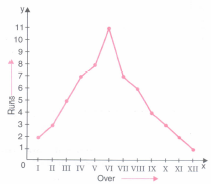
What is the difference of runs scored in IV and V overs?
1
2
3
4
52.
How many terms are there in the expression 7x2 + 5x - 5?
1
2
3
5
53.
In 102, the exponent is
1
2
10
1
54.
The number 10 \(\times\) 7 + 5 in usual form is
57
75
55
77
55.
The common factor of 14a2b and 35a4b2 is.
a4b2
35a4b2
14a2b
7a2b
56.
Mithlesh purchased a T.V. for Rs.10000 and sold it for Rs.8000. Find her loss %.
10%
20%
40%
60%
57.
Which of the following statements is false?
Natural numbers are closed under subtraction
Whole numbers are not closed under subtraction
Integers are closed under subtraction
Rational numbers are closed under subtraction.
58.
Find the smallest number by which the number 1296 must be divided to obtain a perfect cube.
6
2
4
3
59.
If an increase in one quantity brings about a corresponding decrease in the other and vice versa, then the two quantities vary:
directly
inversely
sometimes directly and sometimes inversely
none of these.
60.
Which of the following is the sum of all the interior angles of a ploynomial of sides 'n'?
(n + 2) \(\times\) 180°
(n + 2) \(\times\)x 90°
(n - 2) \(\times\) 190°
(n - 2)\(\times\) 180°
61.
Rahul, Varun and Yash are playing a game of spinning a coloured wheel. Rahul wins if spinner lands on red. Varun wins, if spinner lands on blue and Yash wins, if it lands on green. Which of the following spinner should be used to make the game fair?
.png)
.png)
.png)
.png)
62.
If a and b are positive integers, then solution of the equation ax = b has to be always
positive
negative
One
Zero
63.
In a solid, if F = V = 5, then the number of edges in this shape is
6
4
2
8
64.
The measure of each exterior angle of a regular polygon of 12 sides is
30°
45°
24°
60°
65.
Is there a number which is equal to its cube but not equal to its squares? If yes find it.
66.
Take a clock and fix its minute hand at 12.
Record the angle turned through by the minute hand from its original position and the time that has passed, in the following table:
| Time Passed (T) (in minutes) |
(T1) 15 | (T2) 15 | (T3) 45 | (T4) 60 |
|---|---|---|---|---|
| Angle turned (A) (in degree) | (A1) 90 | (A2) __ | (A3) __ | (A4) __ |
| \(T\over A\) | - | - | - | - |
What do you observe about T and A? Do they increase together? Is \(T\over A\) same every time?
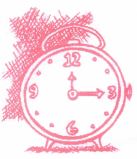
Is the angle turned through by the minute hand directly proportional to the time that has passed? Yes; From the above table, you can also see
T1 : T2 = A1 A2, because
T1 : T2 = 15 30= 1 :2
A1 : A2 = 90 180 = 1 :2
Check if T2: T3 = A2 A3 and T3 : T4 = A3 : A4
You can repeat this activity by choosing your own time interval.
67.
Present the following data in the form of a grouped frequency distribution table having 6 classes of equal size (one of the class being 40-48):
| 30 | 39 | 58 | 17 | 34 | 50 | 23 | 37 |
| 42 | 49 | 55 | 59 | 19 | 28 | 47 | 49 |
| 18 | 60 | 56 | 36 | 58 | 35 | 55 | 37 |
| 25 | 34 | 39 | 61 | 53 | 33 | 36 | 53 |
| 61 | 62 | 39 | 53 | 21 | 18 | 28 | 23 |
1.
Yes ! it is a case of direction variation as
\(\frac { 100 }{ 10 } =\frac { 200 }{ 20 } =\frac { 300 }{ 30 } =\frac { 500 }{ 50 } =\frac { 1000 }{ 100 } \)
=10(constant)
2.
9832 – 172 = (983 + 17) (983 – 17)
[Here a = 983, b =17, a2 – b2 = (a + b) (a – b)]
Therefore, 9832 – 172 = 1000 x 966 = 966000
3.
By prime factorisation, we have
4.
2(m - 2n)(2p -q)
5.
The given number is 14567. Unit's digit of this number is an odd number. Hence, this number is not divisible by 2.
6.
99856
7.
(i) If the number of workers increases, then time to complete the job would decrease. So, it is the case of inverse proportion.
(ii) For longer distance, more time would be required. So, it is not the case of inverse proportion.
(iii) For more area of cultivated land, more crops would-he harvested. So, area of cultivated land and the crop harvested are not in inverse proportion.
(iv) If speed of a vehicle is more, then time to cover a fixed journey would be less. So, it is a case of inverse proportion.
(v) For more population, less area per person would be there. So, it is a case of inverse proportion
8.
We have, \((-3)^{4}\times (\frac{5}{3})^{4}\)
=\((-1\times 3)^{4}\times (\frac{5}{3})^{4}\) [∵ -a =-1хa]
=\((-1)^{4}\times3^{4}\times \frac{5^{4}}{3^{4}}\)
[∵ \((a\times b)^{m}=a^{m}\times b^{m}, (\frac{a}{b})^{m}=\frac{a^{m}}{b^{m}}\)]
= 1 x 54 = (5)4 [∵ (-1)4=1]
which is the required form.
9.
Let the cost price of the article be Rs x.
Then, x + 40% of x = 1120000
⇒ x + \(\frac{40}{100}\)xx =1 12000
⇒ \(\frac{100x+40x}{100}=112000\)
⇒ 140x = 112000x100
∴ x = \(\frac{112000\times 100}{140}=80000\)
Hence, the cost price is Rs 80000.
10.
The multiplicative inverse of \({-11\over13}\) is \({-13\over11}\)
11.
Given d1 = 7.5 cm and d2 = 12cm
We know that ,
Area of rhombus =\(\frac { 1 }{ 2 } \times \) d1\(\times\)d2
=\(\frac { 1 }{ 2 } \times \) 7.5\(\times\) 12 = 7.5\(\times\) 6 = 45m2
Hence area of a rhombus is 45 m2
12.
In the trapezium ABCD, we have
AB II CD
Also,sum of interior angles B and C is 180°
∴ (x + 20)° + (x - 30)° =180°
⇒ 2x0 -100 =180°
⇒ 2x0 = 190°
⇒ x0 = 95°
13.
In a pack of well-shuffled cards, there are
number of black face cards = 6; number of red jack = 2;
number of red card of ace = 2; number of black kings = 2 ;
number of ordinary card = 52
whereas, in a pack, there are total 52 cards.
\(\therefore\) Probability of getting
a red jack = \(\frac{2}{52}=\frac{1}{26}\)
14.
The front view, side view and top view of a nut are as follow:
15.
In case of a quadrilateral, it is necessary to have atleast the knowledge of five parts to be able to construct it uniquely. We shall need data about specified parts of the quadrilateral as follows:
(a) When four sides and one diagonal are given.
(b) When two diagonals and three sides are given.
(c) When two adjacent sides and three angles are given.
(d) When three sides and two included angles are given.
(e) When some special properties are given.
16.
We have \(\frac { 2x }{ 3 } =18\Rightarrow \frac { 2x }{ 3 } \times 3=18\times 3\)[multiplying both side by 3]
\(\Rightarrow\) 2x =18 x 3
\(\Rightarrow\) 2x = 54
\(\Rightarrow\) \(\frac { 2x }{ 2 } =\frac { 54 }{ 2 } \) [dividing both sides by 2]
\(\Rightarrow\) x = \(\frac { 54 }{ 2 } \), 27 which is the required solution
17.
m-\(\frac{m-1}{2}\)=1-\(\frac{m-2}{2}\)
We have m-\(\frac{m-1}{2}\)=1-\(\frac{m-2}{2}\)
It is a linear equation since it involves linear expressions only.
\(\Rightarrow\) m-\(\frac{m}{2}+\frac{1}{2}\)=1-\(\frac{m}{3}+\frac{1}{3}\)
\(\Rightarrow\) m-\(\frac{m}{2}+\frac{m}{3}\)=1+\(\frac{2}{3}+\frac{1}{2}\)
Transposing -\(\frac{m}{3}\)to LHS and \(\frac{1}{2}\)to RHS
\(\Rightarrow\) \(\frac { 6m-3m+2m }{ 6 } =\frac { 6+4-3 }{ 6 } \)
Taking LCM
\(\Rightarrow\) \(\frac { 5m }{ 6 } =\frac { 7 }{ 6 } \)
\(\Rightarrow\) m = \(\frac { 7 }{ 6 } \times \frac { 6 }{ 5 } =\frac { 7 }{ 5 } \)
Multiplying both sides by \(\frac{6}{5}\)
This is the required solution.
18.
x = 10
19.
13
20.
1.SQUARE
2.PYTHAGOREAN
3.PERFECT SQUARE
4.TRIPLET
5.SQUARE ROOT
6.FACTOR
21.
Given, number of observations = (x + 5)
Sum of the observations =(x4- 625)
\(Mean\ of\ the\ observations=\frac { sum\ of\ the\ observations }{ number\ of\ observations } =\frac { \left( { x }^{ 4 }-625 \right) }{ \left( x+5 \right) } \)
We have to factorise (x4 - 625)
= (x2)2 _ 25 x 25
= (x2)2 -(25)2
= (x2 + 25) (x2- 25)
[by using identity, (a2 - b2) = (a + b)(a - b)where, a = x2 ,b = 25]
= (x2 + 25)(x2 - 5 \(\times\) 5)
= (x2 + 25) {(x)2 -(5)2}
= (x2 + 25)(x + 5)(x - 5)
\(\frac { \left( { x }^{ 4 }-625 \right) }{ \left( x+5 \right) } =\frac { \left( { x }^{ 2 }+25 \right) \left( x+5 \right) \left( x-5 \right) }{ \left( x+5 \right) } \)
= (x2 + 25)(x - 5)
Hence, the mean of the observations is (x2 + 25) (x - 5).
22.
(a) From the given graph, the car travel in 2 h is 80km.
(b) 5 h taken by car to reach R.
(c) 2 h taken by car to cover 80 km.
23.
12 days
24.
The fraction of substance remains after 7 half- lives =3-7=\(\frac{1}{3^{7}}\)
ஃ \(3^{-x}=\frac{1}{243}=\frac{1}{3\times3\times3\times3\times3}=\frac{1}{3^{5}}\)
⇒ \(3^{-x}=3^{-5}\)
⇒ \((3)^{-x}=(3)^{-5}\)
⇒ -x=-5 [∵ bases are same]]
Hence, after 5 half-lives, the fraction will be \(\frac{1}{243}\) of the original.
25.
Area of figure A, for radius 8 cm
=\(\pi\)r2h = \(\frac { 22 }{ 7 } \times \)8\(\times\)8=201.14 cm2
Since, there are two pipes.
∴ Area = 2\(\times\)201.14 = 402.28 cm2
Now, area of figure B, for radius 15 cm
=\(\pi\)r2 =\(\frac { 22 }{ 7 } \times \) 15\(\times\)15 = 707.14 cm2
Hence, pipe B fill the swimming pool faster.
26.
P = 9, Y = 1 and Z = 8
27.
\(\frac{1}{2}\)
28.
Given,512-492=100p
2601-2401=100p
200 =100p
\(p=\frac { 200 }{ 100 } =2\)
So, it is true
Alternate Method
512- 492 =100p
(51- 49)(51 + 49) =100p
2 x100 =100p
200 =100p
\(p=\frac { 200 }{ 100 } =2\)
29.
113
30.
54°, 144°, 72°, 90°
31.
Here, P = Rs 10000, T = 1 year
R = 8% p.a. compounded half yearly.
\(\therefore\) R = 8% p.a. = 4% per half yearly
T = 1 year \(\rightarrow\) n = 2 x 1 = 2
Now, amount = P\((1+{R\over 100})^n\)
= Rs 10,000\((1+{4\over 100})^2\)= Rs 10,000 \(({26\over25})^2\)
= Rs 10 000 x \({26\over25}\) x \({26\over25}\)
= Rs16 x 26 x 26 = Rs10816
CI = Rs 10816 - Rs 10000 = Rs 816
32.
We know that, the length PQ and QR of a rectangle PQRS. Also, we know that in a rectangle opposite sides have equal length and each of the angle is 90°.
Thus, we have PQ=RS and QR=PS and \(\angle \)PQR = 90°.
Steps of construction
Step I Draw PQ.
Step II Makes \(\angle \)PQX=90°.
Step III Cut QR from QX
Step IV From P cut-off an arc equal to QR.
Step V From R, cut-off an arc equal to PQ.
Step VI Mark S as the intersection point of both the arcs. Join PS and RS to get the required rectangle PQRS.
33.
\({7y+4\over y+2}={-4\over 3}\)
By cross-multiplication, we have
3 x (7y + 4) = - 4 x (y + 2)
or 21y + 12 = - 4y - 8
Transposing 12 to RHS and (-4y) to LHS,
we have
21y + 4y = -8 - 12
or 25y = -20 or y = \({-20\over 25}={-4\over 5}\)
(Dividing both sides by 25)
\(\therefore y={-4\over 5}\)
34.
A cube has 6 equal surfaces.
Let side of the cube be x.
\(\therefore\)Area of a surface =x2
\(\Rightarrow\) Area of the given cube = 6x2
\(\therefore\)6x2= 486 \(\Rightarrow x^2={486\over6}=81\)
\(\Rightarrow x =\sqrt{81}=9\)
Thus, the volume of the given cube = 729 cm3 .
35.
A = 5, B = 3
36.
We have to divide x3 y3 + x2y3 - xy4+ xy by xy.
Method I Cancellation method
We will divide each term of polynomial by given monomial.
\(\frac{x_3y_3+x_2y_3-xy_4+xy}{xy}=\frac{x^{3}y^{3}}{xy}+\frac{x^{2}y^{3}}{xy}-\frac{xy^{4}}{xy}+\frac{xy}{xy}=x^{2}y^{2}+xy^{2}-y^{3}+1\)
Method II Common factor method
We will express each term of polynomial in factor form, then we will separate common factors.
\(x^{3}y^{3}+x^{2}y^{3}-xy^{4}+xy=x\times x\times x\times y\times y\times y\times+x \times x \times y \times y \times y -x\times y \times y \times y \times y+x \times y\)
= \(xy(x \times x \times y \times y+x \times y \times y-y \times y\times y+1 )\)
Then, \((x^{3}y^{3}+x^{2}y^{3}-xy^{4}+xy)\div xy=\frac{xy(x\times x \times y \times y+x \times y \times y - y \times y \times y+1)}{xy}\)
=\((x^{2}\times y^{2}+x \times y^{2}-y^{3}+1)=(x^{2}y^{2}+xy^{2}-y^{3}+1)\)
37.
(a) From the given graph, it is clear that the forecast temperature was the same as the actual temperature on Tuesday, Friday and Sunday. (This is indicated by the point at which both graphs meet).
(b) From the given graph, we can say that the maximum forecast temperature during the week was 35°C.
(c) From the given graph, we can say that the minimum actual temperature during the week was 15°C.
| (d) | Days | Difference between the actual and forecast temperature |
| Monday | 17.5 - 15 = 2.5o C | |
| Tuesday | 20 - 20 = 0°C | |
| Wednesday | 30 - 25 = 5°C | |
| Thursday | 22.5 - 15 = 7.5°C | |
| Friday | 15 - 15 = 0°C | |
| Saturday | 30 - 25 = 5° C | |
| Sunday | 35 - 35 = 0° C |
Since the maximum difference between temperatures is 7.5o C.
Hence, the actual temperature differed the most from the forecast temperature on Thursday.
38.
We have, h = 2 m and b = 45 m
Since, in 60 min length of water flowing = 3 km
∴ 1 min, the length of water flowing =\(\frac { 3\times 1000 }{ 60m } \)=50 m
∴ Amount of the water flowing= 1\(\times\)b\(\times\)h = 50\(\times\)45\(\times\)2 = 4500 m3
39.
Given number is 121.
Now, we subtract successive odd numbers starting from 1 as follows:
121 - 1 = 120,
117 - 5 = 112,
120 - 3 = 117,
112 - 7 = 105,
105 - 9 = 96, 96 -11 = 85,
85 -13 = 72, 72 -15 = 57,
57-17 = 40, 40 - 19 = 21, 21 - 21 = 0
We observe that the number 121 reduced to zero after subtracting first 11 odd numbers. So, 121 is a perfect square.
\(\therefore \ \sqrt { 121 } =11\)
Hence, the square root of 121 is 11.
40.
Let the parking charges be x and time be y.
If x = Rs. 60 and y = 4 h, then
\(\frac { x }{ y } =\frac { 60 }{ 4 } =\frac { 60\div 4 }{ 4\div 4 } =\frac { 15 }{ 1 } \) [HCF of 60 and 4 = 4]
If x = Rs.100 and y = 8 h, then
\(\frac { x }{ y } =\frac { 100 }{ 8 } =\frac { 100\div 4 }{ 8\div 4 } =\frac { 25 }{ 2 } \) [HCF of 100 and 8 = 4]
If x = Rs.140 and y = 12 h, then
\(\frac { x }{ y } =\frac { 140 }{ 12 } =\frac { 140\div 4 }{ 12\div 4 } =\frac { 35 }{ 3 } \) [HCF of 140 and 12 = 4]
If x = 180 and y = 24 h, then
\(\frac { x }{ y } =\frac { 180 }{ 24 } =\frac { 180\div 12 }{ 24\div 12 } =\frac { 15 }{ 2 } \) [HCF of 180 and 24 = 12]
Since,all the values of ratio \(\frac { x }{ y } \) are not same, so the parking charges are not in direct proportion to the parking time.
41.
We have, \(\frac{3^{-5}\times 10^{-5} \times 125}{5^{-7}\times 6^{-5}}\)
=\(\frac{(3)^{-5}\times (2\times5)^{5}\times 125}{(5)^{-7}\times(2\times3)^{-5}}\) \([\because (a\times b)^{m}=a^{m}\times b^{m}]\)
=\(\frac{(5)^{-5}\times (5)^{3}}{(5)^{-7}}\) [\(\because 125=5\times5\times5=5^{3}\)]
=\(\frac{5^{7}\times 5^{3}}{5^{5}}\) [\(\because a^{-m}=\frac{1}{a^{m}}\)]
=\(\frac{5^{7+3}}{5^{5}}\) [\(\because a^{m}\times a^{n}=a^{m+n}\)]
=\(\frac{5^{10}}{5{5}}=5^{10-5}=5^{5}\) [\(\because \frac{a^{m}}{a^{n}}=a^{m-n}\)]
42.
We have,
\({3\over7}\times{28\over15}\div{14\over5}={3\over7}\times{28\over15}\times{5\over14} \)
\(\\{3\over7}\times({28\over15}\times{5\over14})={3\over7}\times{2\over3}={2\over7}\)
43.
313.3%
44.
The probability of getting a comics = \(\frac{Number\quad of\quad events\quad of\quad getting\quad a\quad comics}{Total\quad number\quad of\quad events}=\frac{3}{8}\)
45.
We have, -7 pq2r3 x (-26 p3 qr2)
= (-7) x (- 26) x p x q2 x r3 x p3 x q x r2
=182p4 q3 r5
46.
Number of faces is equal to 14
47.
We know that in a ·rectangle, opposite sides are parallel and D equal and each angle is of 90°. Firstly, we draw a rough sketch of rectangle PQRS, which helps us in deciding steps of construction.
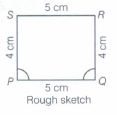
Steps of construction
Step I Draw PQ = 5 cm.
Step II At Q, draw a ray QX making \(\angle \)PQX = 90°.
Step III Cut QR = 4 cm from ray QX.
Step IV At P, draw a ray PY making \(\angle \)QPY = 90°.
Step V Cut PS = 4 cm from PY.
Step VI Join SR.
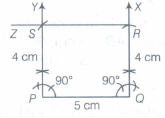
Thus, PQRS is the required rectangle.
48.
Given,PQRS is a trapezium in which
ㄥQ = 130°, ㄥR = 90° and \(\bar { SP } ||\bar { RQ } \)
Since, \(\bar { SP } ||\bar { RQ } \) and PQ is a transversal, so
ㄥP + ㄥQ = 180°
[∵ interior angles on the same side]
⇒ ㄥP + 130° =180°
⇒ ㄥP = 180° - 130° = 50°
Similarly, ㄥS + ㄥR = 180° [∵ SR is a transversal]
⇒ ㄥS + 900=180°
⇒ ㄥS = 180° - 90° = 90°
Hence, the measure of ㄥP = 50° and ㄥS = 90° .
We may find ㄥP by one more method, which is given below: We know that, the sum of all the angles of a quadrilateral is 180°.
∴ ㄥP + ㄥQ + ㄥR + ㄥS = 360°
⇒ ㄥP +130° +90° +90° = 360°
⇒ ㄥP +310° = 360°
⇒ ㄥP = 360° - 310° = 50°
Hence, the measure of ㄥP is 50°.
49.
Curved surface = 2 x \(\frac { 22 }{ 7 } \times 14\times 5\)
= 440 cm2
50.
\(n = 3,{n\over2}=2\)
51.
8-7=1
52.
7x2, 5x, - 5.
53.
(b)
2
54.
(b)
75
55.
14a2b = 2 x 7 x a x a x b
35a4b2 = 5 x 7 x a x a x a x a x b x b.
56.
Loss = 10000 - 8000 = 2000
∴ Loss% = \(\frac { 2000 }{ 10000 } \times \) 100% = 20%.
57.
(a)
Natural numbers are closed under subtraction
58.
1296 = 2\(\times\) 2\(\times\) 2 \(\times\) 2 \(\times\) 3 \(\times\) 3 \(\times\) 3 \(\times\) 3
= 23 \(\times\) 2\(\times\) 33 \(\times\) 3.
59.
(b)
inversely
60.
(d)
(n - 2)\(\times\) 180°
61.
(d)
62.
(a)
positive
63.
(d)
8
64.
65.
Let the required number be x.
Then, according to the question
x3 = x ...(1) and x2≠x ...(2)
From (1), x3 -x = 0
⇒ x(x2 - 1) = 0
⇒ x = 0, ± 1
⇒ x = 0,1,-1
If x = 0, then x2 = x.
∴ x = is inadmissible
If x = 1 then x2 = x.
∴ x = 1 is inadmissible
If x = - 1, then x2 = (- 1)2 = 1 ≠ x(= - 1)
Hence, the required number is - 1.
66.
| Time Passed (T) (in minutes) |
(T1) 15 | (T2) 15 | (T3) 45 | (T4) 60 |
|---|---|---|---|---|
| Angle turned (A) (in degree) | (A1) 90 | (A2) __ | (A3) __ | (A4) __ |
| \(T\over A\) | \({15\over 90}={1\over6}\) | \({30\over 180}={1\over6}\) | \({45\over 270}={1\over6}\) | \({60\over 360}={1\over6}\) |
We observe about T and A that they increase together and is \(T\over A\) same every time.
Yes; The angle turned by the minute hand is directly proportional to the time that has passed.
On checking, we find that
T2 : T3 = A1 : A3 = 2: 3
and T3 : T4 = A3 : A4 = 3 : 4
67.
The highest observation = 62
The lowest observation = 17
One of the class intervals = 40-48
∴ Class size = Upper class limit - Lower class limit
= 48 - 40 = 8
∴ The appropriate classes can be:
16-24, 24-32, 32-40, 40-48, 48-56, 56-64
Thus, the frequency distribution table for the above data can be shown using the Tally marks
| Groups [Class intervals] | Tally marks | Frequency |
|---|---|---|
| 16-24 | .jpg) || || |
7 |
| 24-32 | |||| | 4 |
| 32-40 | | |
11 |
| 40-48 | || | 2 |
| 48-56 | |||| |
9 |
| 56-64 | || |
7 |
| Total | 40 |

8th Standard CBSE Syllabus & Materials
8th Standard CBSE
CBSE 8th Science Particulate Nature of Matter - New Model Questions Papers Study Material - QB365 Set A
NEW8th Standard CBSE
CBSE 8th Science Pressure, Winds, Stroms and Cyclones - New Model Questions Papers Study Material - QB365 Set A
NEW8th Standard CBSE
CBSE 8th Mathematics Quadrilaterals - New Model Questions Papers Study Material - QB365 Set A
NEW8th Standard CBSE
CBSE 8th Mathematics A story of Numbers - New Model Questions Papers Study Material - QB365 Set A



CBSE 8th Standard CBSE Subjects
CBSE Standards




