
 100% FREE ACCESS
8th Standard CBSE Syllabus & Materials
8th Standard CBSE
CBSE 8th Social Science Theme D - Factors of Production - New Model Questions Papers Study Material - QB365 Set A
NEW8th Standard CBSE
CBSE 8th Social Science Theme C - Universal Franchise and India's Electoral System - New Model Questions Papers Study Material - QB365 Set A
NEW8th Standard CBSE
CBSE 8th Social Science Theme B - The Rise of the Marathas - New Model Questions Papers Study Material - QB365 Set A
NEW8th Standard CBSE
CBSE 8th Social Science Theme B - Reshaping India's Political Map - New Model Questions Papers Study Material - QB365 Set A
NEW8th Standard CBSE
CBSE 8th Social Science Theme A - Natural Resources and Their Use - New Model Questions Papers Study Material - QB365 Set A
NEW8th Standard CBSE
CBSE 8th Science Keeping Time with Skies - New Model Questions Papers Study Material - QB365 Set A

Published on: 05/03/2020
8th Standard CBSE Mathematics Public Exam Sample Question 2020
Download CBSE Class 8th Standard CBSE Mathematics question papers, sample papers, important questions, and previous year solved papers in PDF format. Get free study materials, NCERT solutions, and exam preparation resources for Class 8th Standard CBSE Mathematics
Questions + Answers key
Take MCQ Mathematics Test
1.
Solve: \(-{15\over 4}-17x=9+10x\)
2.
What is the smallest number by which 288 must be multiplied so that the product is a perfect cube?
3.
Write the following in standard form: 34500000.
4.
"Construct a quadrilateral ABCD, given that BC = 4.5 cm, AD = 5.5 cm, CD = 5 cm, the diagonal AC = 5.5 cm and diagonal BD = 7 cm.
5.
What is the least number of planes that can enclose a solid? Name the simplest regular polyhedron and verify Euler's formula for it.
6.
Make a line graph for the area of a square as per the given table:
| Side (in cm) | 1 | 2 | 3 | 4 |
| Area (in cm2) | 1 | 4 | 9 | 16 |
Is it a linear graph?
7.
Factorise the following expressions.p2 - 10p + 25
8.
If 21y5 is a multiple of 9, where y is a digit, what is the value of y?
9.
Observe the following tables and find which pair of variables (here, x and y) are in inverse proportion.
| x | 50 | 40 | 30 | 20 |
| y | 5 | 6 | 7 | 8 |
10.
Find the smallest square number that is divisible by each of the numbers 8, 15 and 20.
11.
160m3 of water is to be used to irrigate a rectangular field, whose area is 800 m2. What will be the height of the water level in the field?
12.
Following Histogram shows the number of people owning the different number of books.
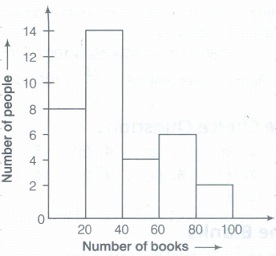
The total number of people surveyed is.
13.
Lemons were bought at Rs 48 per dozen and sold at the rate of Rs 48 per 10. Find the gain or loss per cent.
14.
Write five rational numbers which are less than -4
15.
Can you think of two more such situations, where we may need to multiply algebraic expressions?
16.
Examine the table. (Each figure is divided into triangles and the sum of the angles deduced from that).
| Figure |  |
 |
 |
 |
| Side | 3 | 4 | 5 | 6 |
| Angle sum | 1800 | 2 x 1800-(4-2) x 1800 | 3 x 1800=(5-2) x 1800 | 4 x 1800=(6-2) x 1800 |
What can you say about the angle sum of a convex polygon with number of sides?
(a) 7 (b) 8 (c) 10 (d) n
17.
The area of this triangle and the area of the trapezium WXYZ are same (How?). Get the expression for the area of trapezium by using the expression for the area of triangle.
18.
Is \(-\frac{3}{8}+\frac{1}{7}=\frac{1}{7}+(\frac{-3}{8})\)?
19.
If Rajat can finish a work in n days then amount of work done by him in one day is (1-n) or \(\frac { 1 }{ n } \)?
20.
18% of a class took part in a karate competition. If 18 students have taken part in it, then what is the total number of students in the class?
21.
An icosahedron is having 20 triangular faces and 12 vertices. Find the number of its edges.
22.
Write the x-coordinate (abscissa) of each of the given points.
(5, 7)
23.
Divide the following algebraic expressions:
(49x2 -36r)÷(7x+ 6y)
24.
Check the divisibility of the following number by 2: 39
25.
Find the number of digits in the square root of each of the following numbers (without any calculation). 4489
26.
Solve, [32+(182)1/2]1/3
27.
Express the following numbers in usual form.
3.02 x 10⁻⁶
28.
A coin is tossed three times. Find the number of possible outcomes.
29.
Is it possible to construct a quadrilateral ABCD in which AB = 3 cm, BC = 5 cm, \(\angle \)B = 120°, \(\angle \)C = 105°, \(\angle \)A = 160°? If not, why?
30.
Find the product:\(\left( -\frac { 10 }{ 3 } p{ q }^{ 3 } \right) \times \left( \frac { 6 }{ 5 } { p }^{ 3 }q \right) \)
31.
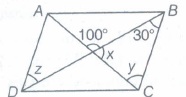
In the following figure, ABCD is a parallelogram. Find the values of x, y and z.
32.
Jitendra left one-third of his property to his son, one-fourth to his daughter and the remaining to his wife. If the wife's share was worth Rs. 320000, then how much money did Jitendra have?
33.
Solve the following linear equations:
m-\(\frac{m-1}{2}\)=1-\(\frac{m-2}{2}\)
34.
An item marked at Rs 18000, is available for Rs 16740. Find the discounts given and the discount per cent.
35.
Solve: \(x-{x\over 9}-{x\over 12}-{x\over 36}=56\)
36.
Principal = Rs 1000, Rate = 8% per annum. Fill in the following table and find which type of interest (simple or compound) change is in direct proportion with time period.
| Time period | 1 year | 2 years | 3 years |
|---|---|---|---|
| Simple Interest (in Rs \(\frac { P\times r\times t }{ 100 } \)) | |||
| Compound Interest (in Rs \(p\left( 1+\frac { r }{ 100 } \right) ^{ t }-P\) |
37.
The graph given below, shows the marks obtained out of 10 by Sonia in two different tests. Study the graph and answer the questions that follow:
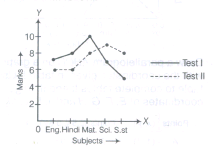
(a) What information is represented by the axes?
(b) In which subject did she score the highest in test I?
(c) In which subject did she score the least in test II?
(d) In which subjects did she score the same marks in both the tests?
(e) What are the marks scored by her in English in test II?
(f)ln which test was the performance better?
(g) In which subject and which test did she score full marks?
38.
Find the square root of 324 by the method of repeated subtraction.
39.
If 32x-1÷ 9 = 27, find the value of x.
40.
Evaluate {52+(122)1/2}3
41.
Horse stable is in the form of a cuboid, whose external dimensions are 70 m\(\times\)35 m\(\times\)40 m, surrounded by a cylinder halved vertically through diameter 35 m and it is open from one rectangular face 70 m\(\times\)40 m. Find the cost of painting the exterior of the stable at the rate of Rs 2 per m2. Also, verify your answer.
42.
Factorise p3-3p2+2p-6-6pq+3q
43.
Find the cost of \(8{1\over3}\) metre of cloth at Rs \(2{5\over3}\) per meter
44.
Evaluate using suitable identities
(i) (48)2
(ii) 1812-192
(iii) 497x 505
(iv) 2.07x1.93
45.
A solid has 40 faces and sixty edges. Find the number of vertices.
46.
Find A and B in the given addition, if
2 B
+ A B
8 A
47.
(a)From a pack of cards, the following cards are kept face down.
.png)
Suhail wins if he picks up a face card. Find the probability of Suhail winning?
b)Now, the following cards are added to the above cards:
.png)
Whatis the probability of Suhail winning now?
Reshmawins, if she picks up a 4. What is the probability of Reshma winning? [queen, king and jack cards are called face cards.]
48.
Two adjacent angles of a parallelogram are in the ratio 2:3. Find its angles.
49.
Construct a rhombus, whose one side is 4 cm and a diagonal is equal to 6 cm.
50.
The smallest number by which 28 should be multiplied so as to get a perfect square is
2
4
3
7
51.
The volume of a cuboid of length l, breadth b and height h is
lbh
lb + bh + hl
2 (lb + bh + hl)
2(l+b)h
52.
The number of like terms in 9x3, 16x2y, - 8x3, 12xy2, 6x3 is
3
2
4
5
53.
The multiplicative inverse of 10-10 is
10
\({1\over 10}\)
10-10
1010
54.
The factorisation of X2 + x +\(\frac{1}{4}\)is
\(\left( \frac { x }{ 2 } -1 \right) ^{ 2 }\)
\(\left( \frac { x }{ 2 } +1 \right) ^{ 2 }\)
\(\left(x+ \frac{ 1 }{ 2 } \right) ^{ 2 }\)
\(\left(x- \frac{ 1 }{ 2 } \right) ^{ 2 }\)
55.
In a mixture the amount of zinc is 45%. Find the amount of zinc in 400 g mixture.
60g
120g
180g
200g
56.
The root of the equation 9z - 15 = 9 - 3z is
1
2
3
4
57.
Study the following frequency distribution table and answer the question given below:
| Daily wages (in Rs) | Number of workers |
| 290-325 | 5 |
| 325-360 | 2 |
| 360-395 | 4 |
| 395-430 | 6 |
| 430-465 | 7 |
| 465-500 | 5 |
Which two classes have the same frequency?
290-325 and 465-500
290-325 and 325-360
430-465 and 465-500
325-360 and 360-395.
58.
The one's digit of the cube of the number 242 is
2
4
6
8
59.
The ratio of girls to boys in a class is 2:3. The actual strength of the class is:
12
15
16
18
60.
Which of the following parallelograms has all sides equal and diagonals bisect each other at 10. right angle?
square
rectangle
rhombus
trapezium.
61.
If the base of a prism is a polygon of 'n' sides, then which of the following is the number of faces of the prism?
n + 2
n + 1
n
n - 1
62.
Which of the following is the reciprocal of p?
-p
p
\(\frac { 1 }{ p } \)
\(\frac { -1 }{ p } \)
63.
The interior angle of a regular polygon is 108°. Which one of the followings is the number of sides of the polygon?
5
6
8
12
64.
Comparison of parts of a whole may be done by a
bar graph
pie chart
linear graph
line graph
65.
If abc is a 3-digit number, then the number abc- a - b - c is divisible b
9
90
10
11
66.
Is there a number which is equal to its cube but not equal to its squares? If yes find it.
67.
Take a clock and fix its minute hand at 12.
Record the angle turned through by the minute hand from its original position and the time that has passed, in the following table:
| Time Passed (T) (in minutes) |
(T1) 15 | (T2) 15 | (T3) 45 | (T4) 60 |
|---|---|---|---|---|
| Angle turned (A) (in degree) | (A1) 90 | (A2) __ | (A3) __ | (A4) __ |
| \(T\over A\) | - | - | - | - |
What do you observe about T and A? Do they increase together? Is \(T\over A\) same every time?
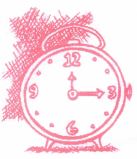
Is the angle turned through by the minute hand directly proportional to the time that has passed? Yes; From the above table, you can also see
T1 : T2 = A1 A2, because
T1 : T2 = 15 30= 1 :2
A1 : A2 = 90 180 = 1 :2
Check if T2: T3 = A2 A3 and T3 : T4 = A3 : A4
You can repeat this activity by choosing your own time interval.
68.
Present the following data in the form of a grouped frequency distribution table having 6 classes of equal size (one of the class being 40-48):
| 30 | 39 | 58 | 17 | 34 | 50 | 23 | 37 |
| 42 | 49 | 55 | 59 | 19 | 28 | 47 | 49 |
| 18 | 60 | 56 | 36 | 58 | 35 | 55 | 37 |
| 25 | 34 | 39 | 61 | 53 | 33 | 36 | 53 |
| 61 | 62 | 39 | 53 | 21 | 18 | 28 | 23 |
1.
\(-{17\over 36}\)
2.
Resolving 288 in to prime factors
we have
i.e., 288 = 2 x 2 x 2 x 2 x 2 x 3 x 3
Grouping the factors in triples, we get
288 = [2 x 2 x 2] x 2 x 2 x 3 x 3
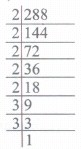
We observe that if 288 is multiplied by (2 x 3),then its prime factors will exist in triples.
Thus, the required smallest number by which 288 be multiplied to make it a perfect cube is (2 x 3), i.e., 6.
3.
34500000 - 345 \(\times\) 100000
= 3.45 \(\times\) 100 \(\times\) 100000
= 3.45 \(\times\) 102 \(\times\) 105
= 3.45 \(\times\) 102+5
= 3.45 \(\times\) 107
Thus, 34500000 = 3.45 \(\times\) 107
4.
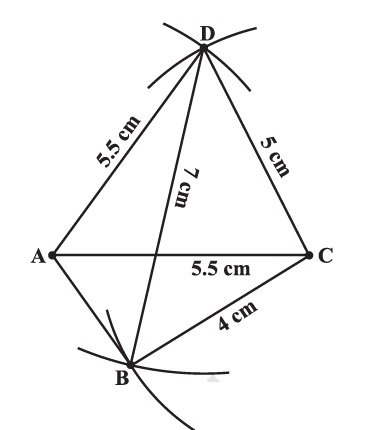
Step 1: Draw D ACD using SSS construction
Step 2: With D as centre, draw an arc of radius 7 cm. (B is somewhere on this arc)
Step 3: With C as centre, draw an arc of radius 4.5 cm (B is somewhere on this arc also)
Step 4: Since B lies on both the arcs, B is the point intersection of the two arcs. Mark B and complete ABCD. ABCD is the required quadrilateral.
5.
At least 4 planes can form to enclose a solid. Tetrahedron is the simple polyhedron. Following figure represents a simplest solid, called tetrahedron.
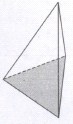
A tetrahedron has:
4 triangular faces, i.e., F = 4
4 vertices, i.e., V = 4
6 edges, i.e., E = 6
Now, substituting the values of F, V and E in Euler's formula, i.e.
F +V = E + 2
We have
4 +4 = 6 + 2
⇒ 8 = 8
which is true.
Thus, Euler's formula is verified for a tetrahedron.
6.
The line graph for the area of a square as per the given table.
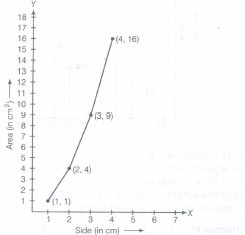
No, it is not a linear graph because when we join the points, then there is not a straight line formed.
7.
p2 -l0p + 25 = (p)2 -l0p + (5f = p2 - 2(5)p + 52
This expression is of the form a 2 - 2ab + b2 .
On comparing, we get a = p and b = 5
Since, a2 - 2ab + b2 = (a - b)2
\(\therefore\) p2 -10p+25=(p-5)2 or (p-5)p-52
8.
Given, 21y 5 is a multiple of 9, i.e. 21y5 is divisible by 9.
We know that a number is divisible by 9 if the sum of its digits is divisible by 9.
So, sum of digits of 21y 5 = 2 + 1+ y + 5 = 8 + y
Therefore, (8 +y) should be 0, 9, 18,27, ... , etc.
Since x is a digit.
\(\therefore\) 8 + y = 9 \(\Rightarrow\) y = 9 - 8 \(\Rightarrow\) y=1
Hence, the value of y is 1.
9.
When x1 = 50, y1 = 5, then x1y1 = 50 x 5 = 250
When x2 = 40, y2 = 6, then x2y2 = 40 x 6 = 240
When x3 = 30, y3 = 7, then x3y3 = 30 x 7 = 210
When x4 = 20, y4 = 8, then x4y4 = 20 x 8 = 160
It is clear that 250 t:- 240 t:- 210 t:-160
i.e. x1y1 ≠ x2y2 ≠ x3y3 ≠ x4y4
So, x and y are not in inverse proportion.
10.
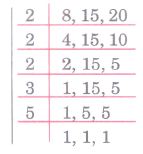
The least number divisible by each one of 8, 15 and 20 is their L.C.M.
The L.C.M. of 8, 15 and 20 is
2\(\times\)2\(\times\)2\(\times\)3\(\times\)5 = 120
Now prime factorisation of 120 is
120 =\(\underline { 2\times 2 } \)\(\times\)2\(\times\)3\(\times\)5
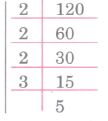
The prime factors 2, 3 and 5 are not in pairs. Therefore, 120 is not a perfect square
In order to get a perfect square, each factor of 120 must be paired. So, we need to make pairs of 2, 3 and 5. Therefore 120 should be multiplied by 2\(\times\)3\(\times\)5; i.e. 30.
Hence, the required smallest square number is 120\(\times\)30 = 3600
11.
Volume of water = 160 m3
Area of rectangular field = 800 m2
Let h be the height of water level in the field.
Now, volume of water = Volume of cuboid formed on the field by water
⇒ 160= Area of base x Height
⇒ 160 = 800\(\times\)h
∴ h = \(\frac { 160 }{ 800 } \)=0.2 m
Hence, the required height is 0.2 m.
12.
34
13.
Cost price of 12 lemons = Rs 48
or CP of 1 lemon =\(\frac{48}{12}\)=Rs 4
SP of 10 lemons = Rs 48
∴ SP of 1 lemon =Rs \(\frac{48}{10}\)=Rs 4.8
Since SP > CP, there are profit.
Now, Profit %=\(\frac{profit}{CP}\times 100=\frac{SP-CP}{CP}\times 100 \)
=\((\frac{4.8-4.0}{4.0})\times 100=\frac{0.8}{4}\times 100\)
= 0.8x25 = 20%
14.
Five rational numbers less than -4 are
\({-9\over2},{-10\over2}(=-5),{-11\over2},{-12\over2}(=-6),{-13\over2}\)
15.
Yes, two situation are as follows:
Distance covered by a car
(i) Distance = Speed (s) x Time (t)
[If the speed of car is increased by 2 units, i.e. (s + 2)and time is decreased by 1, i.e. (t -1), then distance
= (s + 2) x (t -1)
(ii) \(SimpleInterest=\frac { Principal\times Rate\times Time }{ 100 } \)
\(=SI=\frac { P\times R\times T }{ 100 } \)
PxRxT = 51x100
\(\Rightarrow P=\frac { SI\times 100 }{ R\times T } \)
\(\Rightarrow R=\frac { SI\times 100 }{ P\times T } \quad \Rightarrow T=\frac { SI\times 100 }{ P\times R } \)
16.
From the given table, we observe that the sum of angles
(interior angles) of a polygon having m sides is (m - 2) x 180°.
(a) Here, number of sides of a polygon (m) = 7
∴ Sum of the angles of a polygon of 7 sides
= (7 - 2) x 180° = 5 x 180° = 900°
(b) Here, number of sides of a polygon (m) = 8 .
∴ Sum of the angles of a polygon of 8 sides
= (8 - 2) x 180° = 6 x 180° = 1080°
(c) Here, number of sides of a polygon (m) = 10
∴ Sum of the angles of a polygon of 10 sides
= (10 - 2) x 180° = 8 Xx 180° = 1440°
(d) Here, number of sides of a polygon (m) = n
∴ Sum of the angles of a polygon of n sides
= (n-2) x 180°.
17.
The area of this triangle and the area of the trapezium WXYZare same because this triangle has been formed by adding the triangle ZYA(cut out from trapezium WXYZ) to the remaining part WXAZof the trapezium WXYZ such that Y coincides with X and Z coincides with B.
So, we get the expression for the area of trapezium by using the expression for the area of triangle.
18.
\(-\frac{3}{8}+\frac{1}{7}=\frac{-13}{56}\)
\(\frac{1}{7}+(\frac{-3}{8}) = \frac{-13}{56}\)
So, \(-\frac{3}{8}+\frac{1}{7}\)=\(\frac{1}{7}+(\frac{-3}{8})\).
19.
\(\frac { 1 }{ n } \)
20.
100
21.
Here,
Number of faces (F) = 20
Number of vertices (V) = 12
Let the number of edges be E.
∴ Using Euler's formula, we have
F + V = E + 2
⇒ 20 + 12 = E + 2
⇒ 32 = E + 2
⇒ E = 32 - 2 = 30
Thus, the required number of edges = 30.
22.
Given, (5, 7)
In this point, x-coordinate (abscissa) is 5, i.e.
(x = 5).
23.
(7x - 6y)
24.
No
25.
Given number is 4489.
Here, number of digits, n = 4 [even]
\(\therefore\) Number of digits in the square root of 4489
\(=\frac { n }{ 2 } =\frac { 4 }{ 2 } =2\)
Hence, the number of digits in the square root of 4489 is 2 digits.
26.
3
27.
We have,3.02 x 10-6 = \(\frac{3.02}{10{6}}=\frac{3.02}{1000000}\)
= 0.00000302 \([\because a^{-m}=\frac{1}{a^{m}}]\)
28.
6
29.
No, as we know that the sum of measures of angles of a quadrilateral is 360°.
Here, \(\angle\)A + \(\angle\)B + \(\angle\)C =120° + 105° + 160°
= 385° > 360°
So, it is not possible to have such a quadrilateral.
30.
we have,\(\left( -\frac { 10 }{ 3 } p{ q }^{ 3 } \right) \times \left( \frac { 6 }{ 5 } { p }^{ 3 }q \right) \)
\(=\left\{ \left( -\frac { 10 }{ 3 } \right) \times \frac { 6 }{ 5 } \right\} \times \left( p\times { p }^{ 3 } \right) \times \left( { q }^{ 3 }\times q \right) \)
\(=-\frac { 10 }{ 3 } \times \frac { 6 }{ 5 } \times \left( { p }^{ 4 } \right) \times \left( { q }^{ 4 } \right) =-4{ p }^{ 4 }{ q }^{ 4 }\)
31.
x= 80°, y = 70°, z = 30°
32.
768000
33.
m-\(\frac{m-1}{2}\)=1-\(\frac{m-2}{2}\)
We have m-\(\frac{m-1}{2}\)=1-\(\frac{m-2}{2}\)
It is a linear equation since it involves linear expressions only.
\(\Rightarrow\) m-\(\frac{m}{2}+\frac{1}{2}\)=1-\(\frac{m}{3}+\frac{1}{3}\)
\(\Rightarrow\) m-\(\frac{m}{2}+\frac{m}{3}\)=1+\(\frac{2}{3}+\frac{1}{2}\)
Transposing -\(\frac{m}{3}\)to LHS and \(\frac{1}{2}\)to RHS
\(\Rightarrow\) \(\frac { 6m-3m+2m }{ 6 } =\frac { 6+4-3 }{ 6 } \)
Taking LCM
\(\Rightarrow\) \(\frac { 5m }{ 6 } =\frac { 7 }{ 6 } \)
\(\Rightarrow\) m = \(\frac { 7 }{ 6 } \times \frac { 6 }{ 5 } =\frac { 7 }{ 5 } \)
Multiplying both sides by \(\frac{6}{5}\)
This is the required solution.
34.
Rs 1260;7%
35.
x = 72
36.
Case of Simple Interest
[P = Rs 1000, r = 8% p.a.]
| Time period (T) | 1 year | 2 year | 3 year |
|---|---|---|---|
| Simple interest, \(SI=\frac { P\times r\times t }{ 100 } \) | Rs \(\frac { 1000\times 8\times 1 }{ 100 } \) = Rs 80 |
Rs \(\frac { 1000\times 8\times 2 }{ 100 } \) = Rs 160 |
Rs \(\frac { 1000\times 8\times 3 }{ 100 } \) =Rs 240 |
| \(\frac { SI }{ T } \) | \(\frac { 80 }{ 1 } =80\) | \(\frac { 160 }{ 2 } =80\) | \(\frac { 240 }{ 3 } =80\) |
\(\because\) In each case the ratio \(\frac { SI }{ T } \) is the same.
\(\therefore\) The simple interest changes in direct proportion with time period.
Case of compound Interest [P = Rs 1000, r = 8% p.a.]
| Time period 't' | t = 1 | t = 2 | t = 3 |
|---|---|---|---|
| For compound interest, \(A=P{ \left( 1+\frac { r }{ 100 } \right) }^{ t }\) and CI = A - P |
\({ A=1000\left( 1+\frac { 8 }{ 100 } \right) }^{ 1 }\) \(=1000\times \frac { 108 }{ 100 } =1080\) \(\therefore\) CI = 1080 - 1000 = Rs 80 |
\(A=1000{ \left( 1+\frac { 8 }{ 100 } \right) }^{ 2 }\) \(=1000\times \frac { 108 }{ 100 } \times \frac { 108 }{ 100 } \) = Rs 1166.40 CI=1166.40 - 1000 = Rs 166.40 |
\(A=1000{ \left( 1+\frac { 8 }{ 100 } \right) }^{ 3 }\) \(=1000\times \frac { 108 }{ 100 } \times \frac { 108 }{ 100 } \times \frac { 108 }{ 100 } \) = Rs 1259.712 Rs 1259.712 - Rs 1000 = Rs 259.712 |
| \(\frac { CI }{ T } \) | \(\frac { 80 }{ 1 } \) | \(\frac { 166.40 }{ 2 } \) | \(\frac { 259.712 }{ 3 } \) |
\(\because \ \frac { CI }{ T } \) is not the same in each case.
\(\therefore\) The compound interest does not change in direct proportion with time period.
37.
(a) Subjects and marks obtained (out of 10) by Sonia in two tests.
(b) In Maths, she scored the highest in test I.
(c) In English and Hindi, she scored the least in test II.
(d) In Hindi and Maths, she scored the same marks in both tests.
(e) She scored 6 marks in English in test II.
(f) Same performance in both tests.
(g) Test I, in maths, she scored full marks i.e. 10 marks.
38.
Here, 324 -1 = 323,323 - 3 = 320
320 - 5 = 315,315 -7 = 308
308 - 9 = 299, 299 - 11 = 288
288 -13 = 275,275 -15 = 260
260 - 17 = 243, 243 - 19 = 224
224 - 21 = 203,203 - 23 =180
180 - 25 =155, 155 - 27 =128
128 - 29 = 99, 99 - 31 = 68
68 - 33 = 35, 35 - 35 = 0
So, to get 0, we use 18 steps.
Hence, square root of 324 is 18.
39.
3
40.
Given, {52 + (122)1/2}3
Now, (5)2 = 25
(122)1/2=(12) 2 x 1/2 =(12)1 =12
So, (25 + 12)3 =(37)3 = 50653
41.
We know that, the dimensions of cuboid, l=70 m, b = 35 m, h = 40 m,
diameter of cylinder is 35 m and cost of painting is Rs. 2 per m2
Area of cylindrical to be painted
\(\frac { 1 }{ 2 } \)\(\times\)Total surface area =\(\frac { 1 }{ 2 } \) [2\(\pi\) r(r+h)]
= \(\frac { 1 }{ 2 } \left[ 2\times \frac { 22 }{ 7 } \times \frac { 35 }{ 2 } \left( \frac { 35 }{ 2 } +70 \right) \right] \)=4812.5 m2
Area of cuboid to be painted = Area of three walls = lh+2bh
= 70\(\times\)40 + 2\(\times\)40\(\times\)35 = 2800 + 2800
= 5600 m2
Total area to be painted = 4812.5 + 5600=10412.5 m2
∵ Cost of painting per m2 = Rs. 2
∴ Cost of painting 10412.5 2 = Rs. 10412.5\(\times\)2 = Rs. 20825
Verification Verify your answer by adopting some other plan i.e. here in this problem instead of taking area in two steps, let us find in one step.
Area to be painted= Area of three walls + Area of cylindrical part
= 2bh+lh +\(\frac { 1 }{ 2 } \)[2\(\pi\)rh+2\(\pi\)r2]
= h[2b+l]+ [\(\pi\)R(r+h)]
= 40 [2\(\times\)35+70]+ \(\frac { 22 }{ 7 } \frac { 35 }{ 2 } \left( \frac { 35 }{ 2 } +70 \right) \)
= 40 [140] + 55\(\times\)87.5
= 5600+ 4812.5=10412.5m2
∴ Final cost (similar as in previous method) = Rs. 20825
42.
(p-3)(p2+2-q)
43.
Rs \(275\over9\)
44.
(i)(48)2=(50-2)2
Since, (a - b)2 = a2 - 2ab + b2
(50-2)2=(50)2-2x50x2+(2)2
= 2500 - 200 + 4 (a-b)2=a2-2ab+b2
= 2504 - 200 = 2304
(ii) 1812 -192 =(181-19)(181+ 19)
where, a = 50 and b = 2
= 162 x 200 = 32400
(iii) 497 x 505 =(500 - 3)(500 + 5)
= 5002 + (-3 + 5) x 500 + (-3)(5)
[.: (x + a)(x + b) = x2 + (a +. b) x + ab]
= 250000 + 1000 -15 = 250985
(iv) 2.07 x1.93 = (2 + 0.07)(2 - 0.07)
= 22 -(0.07)2
[.: where, a = 50 and b = 2]
= 3.9951
45.
22
46.
We have, if
2 B
+ A B
8 A
In column II, we see that sum of 2 and A is equal to 8, A cannot be a 2-digit number. Clearly, A =6.
\(\because\) 2 + 6 = 8
Now, we study the column I.
Since, B + B = 6, \(\Rightarrow\) 2B = 6 \(\Rightarrow\) B =3
Hence, A = 6 and B =3.
\(\therefore\) 23
+ 63
86
47.
(a) P (Suhail winning) = \(\frac{1}{7}\)
(b) P (Suhail winning now) = \(\frac{4}{15}\)
[\(\therefore\) there are 4 face cards]
P (Reshma winning) = \(\frac{4}{15}\)
[\(\therefore\) there are four 4 numbers card]
48.
72°, 108°
49.
Let PQRS be the required rectangle, where PQ = 4 cm and PR = 6 cm. Draw a rough sketch of rectangle PQRS
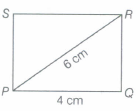
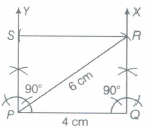
Steps of construction
Step I Draw a line PQ = 4 cm.
Step II Make line QX such that \(\angle\) PQX = 90°
Step III With P as a centre draw an arc of length 6 cm, which intersects ray QX at R.
Step IV Draw another ray PY such that \(\angle\)QPY = 90°.
Step V With R as a centre and radius 4 cm draw an arc, which intersect line PY 5. Then, PORS is the required rhombus.
50.
28 x 7 = 196 = 142
51.
(a)
lbh
52.
9x3, - 8x3, 6x3.
53.
10-10. 1010 = 10-10+ 10 = 100 = 1.
54.
x2 +x +\(\frac{1}{4}\)=x2 + 2(X)\((\frac{1}{2})\)+\((\frac{1}{2})^2\)
=\((x+\frac{1}{2})^2\)
55.
Amount of zinc = 400 \(\times \frac { 45 }{ 100 } \)= 180 g.
56.
9z - 15 = 9 - 3z \(\Rightarrow\) 9z + 3z = 9 + 15
\(\Rightarrow\) 12z = 24 \(\Rightarrow\) z =\(\frac{24}{12}\)=2
57.
Frequency of class 290-325 = Frequency of class 465-500 = 5.
58.
2 \(\times\)2 \(\times\) 2 = 8.
59.
(b)
15
60.
(c)
rhombus
61.
(a)
n + 2
62.
(c)
\(\frac { 1 }{ p } \)
63.
64.
(b)
pie chart
65.
(a)
9
66.
Let the required number be x.
Then, according to the question
x3 = x ...(1) and x2≠x ...(2)
From (1), x3 -x = 0
⇒ x(x2 - 1) = 0
⇒ x = 0, ± 1
⇒ x = 0,1,-1
If x = 0, then x2 = x.
∴ x = is inadmissible
If x = 1 then x2 = x.
∴ x = 1 is inadmissible
If x = - 1, then x2 = (- 1)2 = 1 ≠ x(= - 1)
Hence, the required number is - 1.
67.
| Time Passed (T) (in minutes) |
(T1) 15 | (T2) 15 | (T3) 45 | (T4) 60 |
|---|---|---|---|---|
| Angle turned (A) (in degree) | (A1) 90 | (A2) __ | (A3) __ | (A4) __ |
| \(T\over A\) | \({15\over 90}={1\over6}\) | \({30\over 180}={1\over6}\) | \({45\over 270}={1\over6}\) | \({60\over 360}={1\over6}\) |
We observe about T and A that they increase together and is \(T\over A\) same every time.
Yes; The angle turned by the minute hand is directly proportional to the time that has passed.
On checking, we find that
T2 : T3 = A1 : A3 = 2: 3
and T3 : T4 = A3 : A4 = 3 : 4
68.
The highest observation = 62
The lowest observation = 17
One of the class intervals = 40-48
∴ Class size = Upper class limit - Lower class limit
= 48 - 40 = 8
∴ The appropriate classes can be:
16-24, 24-32, 32-40, 40-48, 48-56, 56-64
Thus, the frequency distribution table for the above data can be shown using the Tally marks
| Groups [Class intervals] | Tally marks | Frequency |
|---|---|---|
| 16-24 | .jpg) || || |
7 |
| 24-32 | |||| | 4 |
| 32-40 | | |
11 |
| 40-48 | || | 2 |
| 48-56 | |||| |
9 |
| 56-64 | || |
7 |
| Total | 40 |

8th Standard CBSE Syllabus & Materials
8th Standard CBSE
CBSE 8th Science Particulate Nature of Matter - New Model Questions Papers Study Material - QB365 Set A
NEW8th Standard CBSE
CBSE 8th Science Pressure, Winds, Stroms and Cyclones - New Model Questions Papers Study Material - QB365 Set A
NEW8th Standard CBSE
CBSE 8th Mathematics Quadrilaterals - New Model Questions Papers Study Material - QB365 Set A
NEW8th Standard CBSE
CBSE 8th Mathematics A story of Numbers - New Model Questions Papers Study Material - QB365 Set A



CBSE 8th Standard CBSE Subjects
CBSE Standards




