
 100% FREE ACCESS
8th Standard CBSE Syllabus & Materials
8th Standard CBSE
CBSE 8th Social Science Theme D - Factors of Production - New Model Questions Papers Study Material - QB365 Set A
NEW8th Standard CBSE
CBSE 8th Social Science Theme C - Universal Franchise and India's Electoral System - New Model Questions Papers Study Material - QB365 Set A
NEW8th Standard CBSE
CBSE 8th Social Science Theme B - The Rise of the Marathas - New Model Questions Papers Study Material - QB365 Set A
NEW8th Standard CBSE
CBSE 8th Social Science Theme B - Reshaping India's Political Map - New Model Questions Papers Study Material - QB365 Set A
NEW8th Standard CBSE
CBSE 8th Social Science Theme A - Natural Resources and Their Use - New Model Questions Papers Study Material - QB365 Set A
NEW8th Standard CBSE
CBSE 8th Science Keeping Time with Skies - New Model Questions Papers Study Material - QB365 Set A

Published on: 03/10/2019
Rational Numbers
Download CBSE Class 8th Standard CBSE Mathematics question papers, sample papers, important questions, and previous year solved papers in PDF format. Get free study materials, NCERT solutions, and exam preparation resources for Class 8th Standard CBSE Mathematics
Questions + Answers key
Take MCQ Mathematics Test
1.
Check for closure property under all the four operations for natural numbers.
2.
Complete the following crossword puzzle using given directions.
Across:
(1) The negative of a rational number is called its ______.
(2) A number of the form where p and q are integers and q \(\neq \) 0, is called a ________.
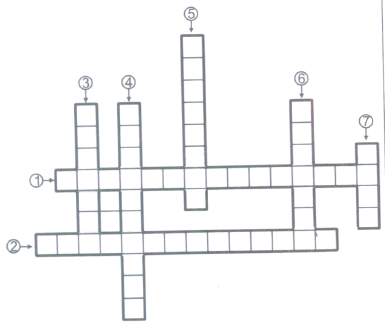
(3) The________ of a rational number and its product is 1.
(4) The multiplicative inverse of a number is also called its _____.
(5) Zero is also called the________ identity for rational numbers.
(6) If the product of two rational numbers is 1, then they are called multiplicative_______ of each other.
(7) The rational number is________ the additive identity for rational numbers.
3.
Find three rational numbers between \(\frac { 1 }{ 2 } \) and (-2)
4.
One fruit salad recipe requires \(1\over2\) of sugar. Another recipe for the same fruit salad requires 2 tablespoons of sugar. If 1 tablespoon is equivalent to \(1\over16\) cup. Then, how much more sugar does the first recipe require?
5.
The table shows the portion of some common materials that are recycled.
| Material | Recycled |
| Paper | \({5\over11}\) |
| Aluminium cans | \({5\over8}\) |
| Glass | \({2\over5}\) |
| Scrap | \({3\over4}\) |
(a) Is the rational number expressing the amount of paper recycled more than \({1\over2}\)or less than \({1\over2}\) ?
(b) Which items have a recycled amount less than \({1\over2}\) ?
(c) Is the quantity of aluminium cans recycled more (or less) than half of the quantity of aluminium cans?
(d) Arrange the rate of recycling the materials from the greatest to the smallest.
(e) What do you understand from recycling and how it is useful?
6.
Huma, Hubna, and Seema received a total of Rs 2016 as monthly allowance from their mother, such that Seema gets \(1\over2\) of what Huma gets and Hubna gets times Seema's share. How much money do the three sisters get, individually?
7.
Write 4 rational numbers between 2 and 3.
8.
If the product of two rational numbers is \(3{5\over4}\) and one of the rational number is \(3{5\over6}\) then find the other rational number
9.
Use the distributivity of multiplication of rational numbers over addition to simplify:
\({3\over5}\times[{35\over24}+{10\over1}]\)
1.
| Operation | Numbers | Remarks |
| Addition | 3+5=8, a natural number; 4 + 6 = 10, a natural number. In general, a + b is a natural number for any two natural numbers a and b. |
Natural numbers are closed under addition. |
| Subtraction | 5 - 5 = 0, which is not a natural number. | Natural numbers are not closed under subtraction. |
| Multiplication | 3\(\times\)5 = 15, a natural number; 4\(\times\)6 = 24, a natural number. In general, if a and b are any two natural numbers, their product ab is a natural number. |
Natural numbers are closed under multiplication. |
| Division | \(3 \div 5 = \frac{3}{5}\); which is not a natural number. | Natural numbers are not closed under division. |
2.
(1) \(\rightarrow\) Additive Inverse
(2) \(\rightarrow\) Rational Inverse
(3) \(\rightarrow\) Product
(4) \(\rightarrow\) Reciprocal
(5) \(\rightarrow\) Additive
(6) \(\rightarrow\) Inverse
(7) \(\rightarrow\) Zero
3.
We have
A rational number between \(\frac { 1 }{ 2 } \)
= \(\left[ \frac { 1 }{ 2 } +(-2) \right] \div 2=\left[ \frac { 1-4 }{ 2 } \right] \div 2\)
= \(\left[ \frac { -3 }{ 2 } \right] \times \frac { 1 }{ 2 } =\frac { -3 }{ 4 } \)
A rational number between \(\frac { 1 }{ 2 } \) and \(\left( \frac { -3 }{ 4 } \right) \)
= \(\left[ \frac { 1 }{ 2 } +\left( \frac { -3 }{ 4 } \right) \right] \div 2\)
\(\left[ \frac { 2-3 }{ 4 } \right] \times \frac { 1 }{ 2 } =\frac { -1 }{ 4 } \times \frac { 1 }{ 2 } =\frac { -1 }{ 8 } \)
A rational number between \(\left( \frac { -3 }{ 4 } \right) \) and (-2)
= \(\left[ \left( \frac { -3 }{ 4 } \right) +(-2) \right] \div 2=\left[ \frac { (-3)+(-8) }{ 4 } \right] \times \frac { 1 }{ 2 } \)
= \(\frac { -11 }{ 4 } \times \frac { 1 }{ 2 } =\frac { -11 }{ 8 } \)
Thus, the three rational numbers
\(\left( \frac { -3 }{ 4 } \right) ,\left( \frac { -1 }{ 8 } \right) \) and \(\left( \frac { -11 }{ 8 } \right) \) are between \(\frac { 1 }{ 2 } \) and (-2)
4.
Given, sugar required for one fruit salad =\({1\over2}\) cup
Sugar required for another salad = 2\(\times{1\over16}={2\over16}cup\)
\(\therefore\) Required sugar =\({1\over2}-{2\over16}={18-2\over16}={6\over16}={3\over8}cup\)
5.
\((a) \because {1\over2}={1\over2}\times{11\over11}={11\over22} and {5\over11}={5\over11}\times{2\over2}={10\over22}\)
So, paper recycled is less than \({1\over2}\)
\((b) Similarly ,{5\over8}is \ greater \ than {1\over2}(={4\over8})\)
\(\\ Also, {2\over5}={2\times2\over5\times2}={4\over10}<{1\over2}(={5\over10})\)
\(\\ and {3\over4}>{1\over2}(={2\over4}) \)
So, the quantity of paper and glass recycled is less than \({1\over2}\)
(c) Quantity of cans = \({5\over8}(={10\over16})\) is more than half of the quantity of aluminium cans
\(={5\over8}\times {1\over2}={5\over16}\)
(d) Scrap> Aluminium cans> Paper> Glass
(e) Recycling is the process, which reduce our wastage and create the same matter from the used part of the matter and hence, it is very useful
6.
Seema gets allowance = \(1\over2\)of Huma's share
Hubna gets allowance =\(1{2\over3}\) of Seema's share
\(={5\over3}of \ seema's \ share\)
\(\\={5\over3}of {1\over2}of \ Huma's \ sh are \)
\(\\ [\because Seema's \ share ={1\over2}of \ Huma's share]\)
\(\\ ={5\over3}\times{1\over2}={5\over6}of \ Huma's \ share\)
But Huma, Hubna and Seema get total share
= Rs 2016
\(\therefore\) Huma's share + Hubna's share + Seema's share
= Rs 2016
1 of Huma's share + \(5\over6\)of Huma's share +\(1\over2\) of Huma's share =Rs 2016
\(So,({1+{5\over6}+{1\over2}}) of \ huma's \ share=Rs2016\)
\(\\ \Rightarrow ({6+5+3\over6})of \ Huma's s\ share \)
\(\\ \Rightarrow {14\over6}of \ Huma's \ share = RS2016\)
\(\\ \therefore Huma's \ share =Rs2016\div {14\over6}\)
\(\\ =Rs2016\times{6\over14}=144\times6=864=432 and \ Hubna's \ share ={5\over6}of 864=5\times144=720\)
7.
\({11\over5},{12\over5},{13\over5},{14\over5}\)
8.
\(51\over46\)
9.
\(6{7\over8}\)

8th Standard CBSE Syllabus & Materials
8th Standard CBSE
CBSE 8th Science Particulate Nature of Matter - New Model Questions Papers Study Material - QB365 Set A
NEW8th Standard CBSE
CBSE 8th Science Pressure, Winds, Stroms and Cyclones - New Model Questions Papers Study Material - QB365 Set A
NEW8th Standard CBSE
CBSE 8th Mathematics Quadrilaterals - New Model Questions Papers Study Material - QB365 Set A
NEW8th Standard CBSE
CBSE 8th Mathematics A story of Numbers - New Model Questions Papers Study Material - QB365 Set A



CBSE 8th Standard CBSE Subjects
CBSE Standards




