
 100% FREE ACCESS
8th Standard CBSE Syllabus & Materials
8th Standard CBSE
CBSE 8th Social Science Theme D - Factors of Production - New Model Questions Papers Study Material - QB365 Set A
NEW8th Standard CBSE
CBSE 8th Social Science Theme C - Universal Franchise and India's Electoral System - New Model Questions Papers Study Material - QB365 Set A
NEW8th Standard CBSE
CBSE 8th Social Science Theme B - The Rise of the Marathas - New Model Questions Papers Study Material - QB365 Set A
NEW8th Standard CBSE
CBSE 8th Social Science Theme B - Reshaping India's Political Map - New Model Questions Papers Study Material - QB365 Set A
NEW8th Standard CBSE
CBSE 8th Social Science Theme A - Natural Resources and Their Use - New Model Questions Papers Study Material - QB365 Set A
NEW8th Standard CBSE
CBSE 8th Science Keeping Time with Skies - New Model Questions Papers Study Material - QB365 Set A

Published on: 01/01/2019
Class 8 Revision Test
Download CBSE Class 8th Standard CBSE Mathematics question papers, sample papers, important questions, and previous year solved papers in PDF format. Get free study materials, NCERT solutions, and exam preparation resources for Class 8th Standard CBSE Mathematics
Questions + Answers key
Take MCQ Mathematics Test
1.
The diagonals of a rhombus bisect each other at _________
2.
(___)2 = 112 + 113
3.
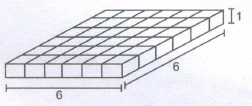
Find Length, Breadth, Height, Volume.
4.
The value of(4-1 + 2-1 + 3-1)1 is _____________
5.
| Numbers | Commutative for | |||
| Addition | Subtraction | Multiplication | Division | |
| Natural numbers | ___________ | ___________ | __________ | No |
6.
Is it possible to have a right circular cylinder to have volume numerically equal to its curved surface area? If yes state when.
7.
Here is a keyboard of a harmonium.
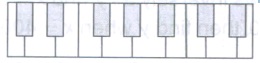
(a) Find the ratio of white keys to black keys on the keyboard.
(b) What is the ratio of black keys to all keys on the given keyboard?
(c) This pattern of keys is repeated on larger keyboard. How many black keys would you expect to find on a keyboard with 14 such patterns?
(d) Why do we use musical instruments in daily life? What is the value depicted from it?
8.
\(2\over5\) of total number of students of a school come by car, while \({1\over4}\)of students come by bus to school. All the other students walk to school of which\(1\over3\) walk on their own and the rest are escorted by their parents. If 224 students come to school walking on their own, how many students study in that school?
9.
Factorise (m8-n8) and after this divide by (m4+n4)
10.
The difference between the squares of two consecutive numbers is 31. Find the numbers.
11.
If the CP of 25 pens is equal to the SP of 30 note pens books, then find the loss per cent if he sells 30 pens.
12.
Evaluate using suitable identities.
(i) (48)2
(ii) 1812-192
(iii) 497 x 505
(iv) 2.07 x 1.93
13.
Two sticks each of length 7 cm are crossing each other such that they bisect each other at right angles. What shape is formed by joining their end points? Give reason.
14.
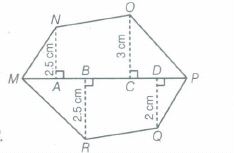
Find the area of polygon MNOPQR, if MP = 9 cm, MD = 7 cm, MC =6cm, MB = 4 cm, MA = 2 cm. NA, OC, QD and RBare perpendiculars to diagonal MP.
15.
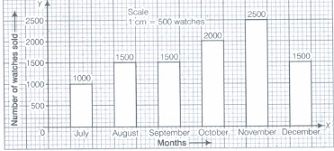
Draw an appropriate graph to represent the given information.
| Months | July | August | September | October | November | December |
|---|---|---|---|---|---|---|
| Number of watches sold |
1000 | 1500 | 1500 | 2000 | 2500 | 1500 |
16.
The area of a square of side a is
a
a2
2a
4a
17.
Which of the following is a binomial?
3xy
4l + 5m
2x + 3y - 5
4a - 7ab + 3b + 12.
18.
a + b = b + a is called
commutative law of addition
associative law of addition
distributive law of addition
none of these.
19.
Observe the following bar graph carefully and answer the following question.
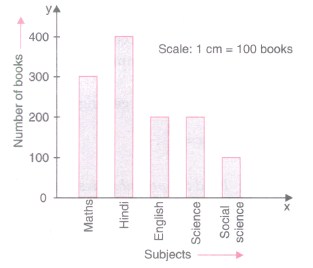
The total of the number of books of English and Science is
200
100
400
0
20.
Which of the following is the common factor of21 x2y and 35 xy2?
7
xy
7 xy
none of these
21.
Which of the following is a perfect cube?
10,000
243
343
270000
22.
Which of the following is a regular quadrilateral?
rectangle
square
rhombus
trapezium
23.
Which of the following cannot be a perfect square?
441
198
676
All of these
24.
If the weight of 9 sheets of thick paper is 30 g, how many sheets of the same paper would weigh \(1\frac{1}{4}kg?\)
375
250
925
300
25.
Which of the following is not true for an exterior angle of a regular polygon with n sides?
Each exterior angle = \(\frac { { 360 }^{ 0 } }{ n } \)
Exterior angle = 180° - Interior angle
n = \(\frac { { 360 }^{ 0 } }{ Exterior\quad angle } \).
Each exterior angle = \(\frac { (n-2)\times 180^{ 0 } }{ n } \)
26.
Every parallelogram is a rectangle
27.
The y-coordinate of any point lying on the X-axis will be zero.
28.
Number of the form 3N \(\div\)2 will leave remainder 2 when divided by 3.
29.
The cube of a two digits number may have seven or more digits.
30.
If x and y are negative rational numbers, then so is (x + y).
31.
Factotise the following expressions. q2 - 10q +21
32.
A real estate agent receives Rs 50000 as commission, which is 4% of the selling price? At what price, does the agent sell the property?
33.
If a triangle has two equal sides and each 4 m less than three times the third side. Find the dimensions of the triangle, if its perimeter is 55 m.
34.
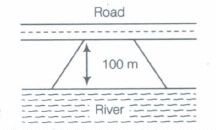
Mohan wants to buy a trapezium shaped field. Its side along the river is parallel and twice the side along the road. If the area of this field is 10500 m2 and the perpendicular distance between the two parallel sides is 100 m, find the length of the side along the river.
35.
Is \([(10)\div 2] \div (-5) = (-10) \div [2 \div (-5)] ?\)
36.
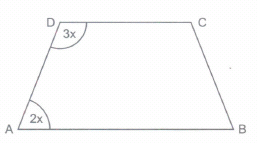
If ABCD is an isosceles trapezium such that m\(\angle\)CDA = 3x and m\(\angle\)BAD = 2x. Find all angles of the trapezium.
37.
Factorise: ax + bx - ay - by
38.
Find the smallest number that must be subtracted from 682 to make it a perfect cube.
39.
Add the following:
9ax, 3by - cz, -5by + ax + 3cz
40.
Which of the following numbers would have digit 6 at unit's place? 242
41.
Factorise: 5xy + 3x
42.
What do we call an equation that is true for every value of the variable in it?
43.
Using the long division method find the square root of the following numbers.
529
44.
What is the probability of a number selected from the numbers 1, 2, 3, .... , 20 such that it is a prime number?
45.
Find ten rational numbers between \(\left( -\frac { 2 }{ 3 } \right) \) and \(\frac { 2 }{ 3 } \)
1.
()
right angles
2.
()
(15)2
3.
()
l=6,b=6,h=1,v=36
4.
()
\(\frac{12}{13}\)
5.
()
| Numbers | Commutative for | |||
| Addition | Subtraction | Multiplication | Division | |
| Natural numbers | yes e.g \((2+3=3+2)\Rightarrow 5=5,\) which is true. |
No e.g \((2-3\neq 3-2)\\ \Rightarrow -1\neq1\) which is not true. |
Yes e.g \((2\times 3=3\times2)\\ \Rightarrow 6=6 \\ \) which is true. |
No e.g \((2\div 4 \neq 4\div 2)\\ \Rightarrow {2\over 4}\neq {4\over 2}\) which is not true. |
6.
Let the radius of the base and height of the right circular cylinder be r units and h units respectively.
Then,
Volume of the cylinder = πr2h cubic units
Curved surface area of the cylinder = 2πrh square units
If volume = curved surface area, then πr2h = 2πrh ⇒ r = 2
Hence, it is possible only when radius of the base is 2 units.
7.
In the given figure, number of white keys =10
Number of black keys = 7
Number of total keys = 10 + 7 = 17
(a) Required ratio = \(\frac{Number of white keys}{Number of black keys}=\frac{10}{7}\)=10:7
(b) Required ratio = \(\frac{Number of black keys}{Number of total keys}=\frac{7}{17}=7:17\)
(c) In 1 pattern, number of black keys = 7 In 14 such patterns, number of black keys =7x14=98
(d) On playing musical instruments, we get mental peace and positive energy.
8.
The number of students come by car =\({2\over5}\) of all Number of students come by bus =\({1\over4}\) of all
\(\therefore\) Number of students walk to school
\(=[1-({2\over5}+{1\over4})]\) of all \(=[1-({8+5\over20})]\) of all
\(=[1-{13\over20}]\) of all = \(({20-13\over20})\) of all\(={7\over20}\) of all
Now, number of students walk to school on their own
=\({1\over3}\)of number of students walk to school
=\({1\over3} \ of {1\over7} of \ all\)
Since, 224 students come to school on their own
\(\therefore 224={1\over3}of{7\over20}of \ all \Rightarrow 224={1\over3}\times{7\over20}of \ all \)
So, number of all the students, who study in the school.
\(=224\div{1\over3}\div{7\over20}\\ =224 \times3\times{20\over7}=32\times3\times20\\ = 96\times 20=1920 students\)
9.
(m+n)(m-n)(m2+n2)
10.
15,16
11.
16\(\frac{2}{3}\%\)
12.
(48)2=(50-2)2
Since, (a - b)2 = a2 - 2ab + b2
(50-2)2=(50)2-2x50x2+(2)2
= 2500 - 200 + 4
[(a-b)2=a2-2ab+b2]
= 2504 - 200 = 2304
(ii) 1812 -192 =(181-19)(181 + 19)
where, a = 50 and b = 2
= 162 x 200 = 32400
(iii) 497 x 505 =(500 - 3)(500 + 5)
= 5002 + (-3 + 5) x 500 + (-3)(5)
[.: (x + a)(x + b) = x2 + (a +b) x + ab]
= 250000 + 1000 -15 = 250985
(iv) 2.07 x1.93 = (2 + 0.07)(2 - 0.07)
= 22 -(0.07)2
[.: where, a = 50 and b = 2]
= 3.9951
13.
Let AC and BD be two sticks, each of the length 7 cm. On joining their end points A, B, C and D, we will get a shape of a rhombus.
[since, in a rhombus diagonals bisect each other all right angles.]
Now, we will see whether it is a square or not.
Let O is the intersection point of AC and BD.
Now, we see that AO = BO = CO = DO
Since, both AC and BD are of equal length and are bisected by O.
Further, in ΔABO, we see that
ㄥAOB= 90°
and AO =OB
which implies that ㄥOAB = ㄥOBA = x [say]
∴ 90° + x + x = 180°
[angle sum property of a triangle]
⇒ 2x = 90° ⇒ x = 45°
Similarly, we see that ㄥOBC, ㄥOCB, ... etc are 45°.
So, finally we can say that the shape, so obtained will be of a square.
14.
It is clear, from the figure that polygon MNOPQR is divided into six parts, out of which four are triangles and two are trapeziums.
Area of polygon MNOPQR =Area of ΔMAN +Area of trapezium ACON + Area of ΔOCP + Area of ΔPDQ+ Area of trapezium DBRQ +Area of ΔRBM ...(i)
Now, area of ΔMAN = MA AN =\(\frac { 1 }{ 2 } \times \) 2 \(\times\)2.5
= 2.5 cm2
Area of trapezium ACON = \(\frac { 1 }{ 2 }\)(AN+OC) \(\times\)AC
= \(\frac { 1 }{ 2 }\)(AN+OC) \(\times\) (MC-MA) [∵ AC=MC-MA]
=\(\frac { 1 }{ 2 } \times \) (2.5+3) \(\times\)(6-2) =\(\frac { 1 }{ 2 } \times \) 5.5 \(\times\)4
=5.5 \(\times\)2 = 11cm2
Area of ΔOCP =\(\frac { 1 }{ 2 } \times \) CP\(\times\)OC
=\(\frac { 1 }{ 2 }\) (MP-MC)\(\times\) OC
= \(\frac { 1 }{ 2 }\)(9-6)\(\times\) 3 =\(\frac { 1 }{ 2 } \times \) 3 \(\times\)3 [∵ CP=MP-MC]
= \(\frac { 9 }{ 2 } \)=4.5 cm2
Area of ΔPDQ =\(\frac { 1 }{ 2 } \times \) PD\(\times\) DQ
= \(\frac { 1 }{ 2 } \times \)(MP-MD)\(\times\) DQ
=\(\frac { 1 }{ 2 } \times \) (9-7)\(\times\) 2 =2cm2
Area of trapezium DBRQ =\(\frac { 1 }{ 2 } \times \) (DQ+BR)\(\times\)BD
=\(\frac { 1 }{ 2 } \times \) (DQ+BR)\(\times\) (MD-MB) [∵ BD =MD-MB]
=\(\frac { 1 }{ 2 } \times \) (2+2.5)\(\times\) (7-4)
=\(\frac { 1 }{ 2 } \times \) 4.5 \(\times\)3 =\(\frac { 13.5 }{ 2 } \)= 6.75 cm2
Area of ΔRBM =\(\frac { 1 }{ 2 } \times \) MB\(\times\) BR =\(\frac { 1 }{ 2 } \times \) 4\(\times\) 2.5 =5cm2
On putting all these values in Eq. (i), we get
Area of polygon MNOPQR
=(2.5+11 +4.5+ 2 +6.75 + 5)cm2
= 31.75 cm2
Hence, area of polygon MNOPQR is 31.75 cm2
15.
Here, to represent the given information, we draw the bar graph. So, draw two perpendicular axes OX and OY. Take months on OX and number of watches sold on OY. Choose a suitable scale for OX and OY and drawbars of equal width with equal gaps in between.
Thus, we get the following bar graph
16.
17.
4l + 5m contains two terms.
18.
(a)
commutative law of addition
19.
200 + 200 = 400
20.
(c)
7 xy
21.
(c)
343
22.
(b)
square
23.
(b)
198
24.
(a)
375
25.
(d)
Each exterior angle = \(\frac { (n-2)\times 180^{ 0 } }{ n } \)
26.
(b)
27.
(a)
28.
(a)
29.
(b)
30.
(a)
31.
Here, ab = 21 and a + b = -10
Possible values of a and b are 7, 3 or -7, -3.
But 7 +3 = 10 \(\neq \) - 10 [not possible]
\(\therefore\) a= -7, b = -3
Now q2 - 10q + 21 = q2 +(-7-3)q + 21
= q2 - 7q - 3q + 21
=q (q -7)-3(9 - 7) = (q-7)(q -3)
Hence, required factors of given expression are(q - 7) and (q -3).
32.
Rs 1250000
33.
23m, 23m,9m
34.
According to the question, the side along the river is parallel to and twice the side along the road.
Let the length of side along the road be x m
Then, the length of side along the river = 2x m
Given, perpendicular distance between the two parallel sides =100 m
and area of the trapezium shaped field = 10500 m2
⇒\(\frac { 1 }{ 2 } \times \) (Sum of parallel sides) Heigth = 10500
⇒\(\frac { 1 }{ 2 } \times \) (2x+2) 100= 10500 ⇒ 3\(\times\) 50 =10500
⇒ 3x = \(\frac { 10500 }{ 50 } =\frac { 1050 }{ 5 } \)
∴ x =\(\frac { 1050 }{ 3\times 5 } \) = 70 and 2x = 2 0 =140
Hence, the length of the side along the river is 140 m.
35.
\([(10)\div 2] \div (-5) = (-5) \div (-5) = 1\)
\( (-10) \div [2 \div (-5)] =(-10) \div (- \frac{2}{5})\) = 25
∵ 1 ≠ 25
∴ No ; \([(10)\div 2] \div (-5) \ne (-10) \div [2 \div (-5)].\)
36.
108o, 72o, 108o, 72o
37.
ax + bx - ay - by
= x[a + b] + (-y)[a + b]
=(x - y)[a + b]
38.
170
39.
10ax - 2by + 2cz
40.
Since, number 24 ends with digit 4, so the number getting from the square of 24, will be the end of the digit 6.
41.
()
x(5y + 3)
42.
()
identity
43.
()
23
44.
()
2/5
45.
()
\(\frac { -5 }{ 9 } ,\frac { -4 }{ 9 } ,\frac { -3 }{ 9 } ,\frac { -2 }{ 9 } ,\frac { -1 }{ 9 } ,0,\frac { 1 }{ 9 } ,\frac { 2 }{ 9 } ,\frac { 3 }{ 9 } ,\frac { 4 }{ 9 } \)

8th Standard CBSE Syllabus & Materials
8th Standard CBSE
CBSE 8th Science Particulate Nature of Matter - New Model Questions Papers Study Material - QB365 Set A
NEW8th Standard CBSE
CBSE 8th Science Pressure, Winds, Stroms and Cyclones - New Model Questions Papers Study Material - QB365 Set A
NEW8th Standard CBSE
CBSE 8th Mathematics Quadrilaterals - New Model Questions Papers Study Material - QB365 Set A
NEW8th Standard CBSE
CBSE 8th Mathematics A story of Numbers - New Model Questions Papers Study Material - QB365 Set A



CBSE 8th Standard CBSE Subjects
CBSE Standards




