
 100% FREE ACCESS
8th Standard CBSE Syllabus & Materials
8th Standard CBSE
CBSE 8th Social Science Theme D - Factors of Production - New Model Questions Papers Study Material - QB365 Set A
NEW8th Standard CBSE
CBSE 8th Social Science Theme C - Universal Franchise and India's Electoral System - New Model Questions Papers Study Material - QB365 Set A
NEW8th Standard CBSE
CBSE 8th Social Science Theme B - The Rise of the Marathas - New Model Questions Papers Study Material - QB365 Set A
NEW8th Standard CBSE
CBSE 8th Social Science Theme B - Reshaping India's Political Map - New Model Questions Papers Study Material - QB365 Set A
NEW8th Standard CBSE
CBSE 8th Social Science Theme A - Natural Resources and Their Use - New Model Questions Papers Study Material - QB365 Set A
NEW8th Standard CBSE
CBSE 8th Science Keeping Time with Skies - New Model Questions Papers Study Material - QB365 Set A

Published on: 21/07/2018
Model Question Paper 3
Download CBSE Class 8th Standard CBSE Mathematics question papers, sample papers, important questions, and previous year solved papers in PDF format. Get free study materials, NCERT solutions, and exam preparation resources for Class 8th Standard CBSE Mathematics
Questions + Answers key
Take MCQ Mathematics Test
1.
Let abc be a 3-digit number. Then, abc + bca + cab is not divisible by
a + b + c
3
37
9
2.
If the sum of digits of a number is divisible by three, then the number is always divisible by
2
3
6
9
3.
If abc is a 3-digit number, then the number abc- a - b - c is divisible b
9
90
10
11
4.
Let abc be a 3-digit number, then abc-cba is not divisible by
9
11
18
33
5.
If 5A + 15 is equal to B3. Then, the value of A+B is
15
16
8
7
6.
The perimeter of a trapezium is 104 cm and its each non-parallel side is equal to 40 cm with its height of 16 cm. Its area is
128 cm2
256 cm2
512 cm2
64 cm2
7.
By selling 50 items, a shopkeeper lost the amount equal to the selling price of 10 items. His loss per cent is
\(\frac{30}{7}\)%
\(\frac{40}{3}\)%
\(\frac{25}{3}\)%
\(\frac{50}{3}\)%
8.
Product of the monomials, -15p, -13q2, pq is
-165p2q3
195p2q3
195p3q2
-195p3q2
9.
Area of a rectangle with length 5ab and breadth 13ac2 is
65a2bc
35a2bc2
65a2bc2
65abc2
10.
If 8x -13 = 25 + 16x, then x is
a fraction
an integer
a rational number
Cannot be solved
11.
The Solution of the equation ax+b = 0 is
\(x=\frac { a }{ b } \)
x = -b
\(x=\frac { -b }{ a } \)
\(x=\frac { b }{ a } \)
12.
Which of the following is not a parallelogram?
Square
Rectangle
Trapezium
Rhombus
13.
Which of the following is a regular quadrilateral?
Rhombus
Rectangle
Parallelogram
Square
14.
We have 4 congruent equilateral triangles. What do we need more to make a pyramid?
An equilateral triangle
A square with same side length as of triangle
2 squares with side length same as triangle
2 equilateral triangles with side length same as triangle
15.
Which of the following is not true?
\(\frac{10}{11}+\frac{11}{12}=\frac{11}{12}+\frac{10}{11}\)
\(\frac{10}{11}\times \frac{11}{12}=\frac{11}{12}\times \frac{10}{11}\)
\(\frac{10}{11}+ \frac{11}{12}=\frac{11}{12}\div \frac{10}{11}\)
\(\frac{10}{11}\div \frac{11}{12}=\frac{11}{12}\times \frac{10}{11}\)
16.
In the point (2, 3), 3 denotes the y-coordinate.
17.
If AB + 7C = 102, where B \(\neq\) 0, C \(\neq\) 0, then A + B + C =14.
18.
If 213x 27 is divisible by 9, then the value of x is 0.
19.
\(\sqrt [ 3 ]{ 8+27 } =\sqrt [ 3 ]{ 8 } +\sqrt [ 3 ]{ 27 } \)
20.
Cube roots of 8 are +2 and -2.
21.
(-8)-2 x(-8)-3 =(-8)-5
22.
The reciprocal of \((\frac{3}{2})^{3}\) is not equal to \((\frac{3}{2})^{-3}\)
23.
\({2\over3}-{5\over4}={5\over4}-{2\over3}\)
24.
\(-4\over5\) is greater than \(-5\over4\)
25.
Every rational number has a reciprocal
26.
The value of \((\frac{1}{2^{3}})^{2}\) is equal to __________
27.
_________ is used to compare parts to a whole.
28.
Data available in an unorganised form is called ________ data.
29.
3500 is greater than 500 by __________ %
30.
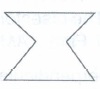 is a closed curve entirely made up of line segments. The another name for this shape is _____
31.
The diagonals of the quadrilateral HOPE are _____ and ____
32.
Rational number \({-3\over5}\) lies between consecutive integers -1 and ______________________
33.
The reciprocal of \({-15\over17}\) is _________________
34.
| Numbers | Closed under | |||
| Addition | Subtraction | Multiplication | Division | |
| Whole numbers | ___________ | ___________ | Yes | __________ |
35.
| Numbers | Closed under | |||
| Addition | Subtraction | Multiplication | Division | |
| Integers | ___________ | Yes | __________ | No |
36.
Find the square roots of the following numbers by the prime factorisation method.529
37.
Find the values of the letters in each of the following and give reasons for the steps involved.\(\begin{matrix} \quad 4\quad A \\ +\quad 9\quad 8 \\ \_ \_ \_ \_ \_ \_ \_ \_ \_ \\ \quad C\quad B\quad 3 \\ \_ \_ \_ \_ \_ \_ \_ \_ \_ \_ \end{matrix}\)
38.
Find the values of the letters in each of the following and give reasons for the steps involved. \(\begin{matrix}\quad 3\quad A \\ +\quad 2\quad 5 \\ \_ \_ \_ \_ \_ \_ \_ \_ \_ \\ \quad \quad B\quad 2 \\ \_ \_ \_ \_ \_ \_ \_ \_ \_ \_ \end{matrix}\)
39.
Evaluate \({5\over7}+{-2\over3}+{-3\over7}+{5\over3}\)
40.
Simplify \(\frac{25\times t^{-4}}{5^{-3}\times 10\times 10^{-8}}(t\ne0)\)
41.
In a hypothetical sample of 20 people, the amount of money (in thousand of rupees) with each was found to be as follows:
114, 108, 100, 98, 101, 109, 117, 119, 126, 131, 136, 143, 156, 169, 182, 195, 207, 219, 235, 118
Find in which class intervals, the number of people were maximum and minimum
| Class interval | Tally marks | Frequency |
| 50 - 100 | II | 2 |
| 100 - 150 | .png) |
11 |
| 150 - 200 | III | 4 |
| 200 - 250 | III | 3 |
42.
Multiply the multiplicative inverse of -2 with its reciprocal.
43.
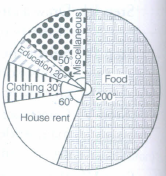
In the month of July 2004, a house "holder spent his monthly salary amounting to Rs 7200 on different items as given below:
| Items | Clothing | Food | House rent | Education | Miscellaneous |
| Amount spent (in Rs) | 600 | 4000 | 1200 | 400 | 1000 |
Represent the information in the form of a pie chart.
44.
Study the following frequency distribution table and answer the questions given below
Frequency Distribution of Daily Income of 550 workers of a factory
| Class Interval (Daily income in Rs) |
Frequency (Number of workers) |
| 100-125 | 45 |
| 125-150 | 25 |
| 150-175 | 55 |
| 175-200 | 125 |
| 200-225 | 140 |
| 225-250 | 55 |
| 250-275 | 35 |
| 275-300 | 50 |
| 300-325 | 20 |
| Total | 550 |
(i) What is the size of the class intervals?
(ii) Which class has the highest frequency?
(iii) Which class has the lowest frequency?
(iv) What is the upper limit of the class interval 250 - 275?
(v) Which two classes have the same frequency?
45.
Read the following bar graph and answer the following questions.
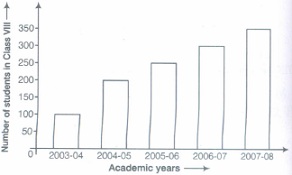
(i) What is the information given by the bar graph?
(ii) In which year is the increase in the number of students maximum?
(iii) In which year is the number of students maximum?
(iv) State whether true of false:
'The number of students during 2005 - 06 is twice that of 2003 - 04.'
46.
Insert '<' or '>' in the box given below:
\(\\ 7.32\times { 10 }^{ 5 }\ 5.29\times { 10 }^{ 6 }\)
47.
Evaluate \((\frac{32}{243})^{-3/5}\)
48.
Evaluate 3-2
49.
Find the multiplicative inverse of the following \(-13\over19\)
50.
Find the multiplicative inverse of the following -13
51.
Verify that -(-x) = x, for x = \(11\over15\)
52.
Write the additive inverse of the following \(19\over-6\)
53.
Write the additive inverse of the following \({2\over-9}\)
54.
Write the additive inverse of the following \(-6\over-5\)
55.
Using appropriate properties, find \({2\over5}\times({-3\over7})-{1\over6}\times{3\over2}+{1\over14}\times{2\over5}\)
56.
1.96
57.
\(\left( \sqrt [ 2 ]{ 25 } \right) ^{ 3 }+\sqrt [ 3 ]{ 6859 } \)
58.
The number divisible by 6
59.
Additive inverse of -\({1\over13}\)is
60.
Multiplicative inverse of-13 is
1.
(d)
9
2.
(b)
3
3.
(a)
9
4.
(c)
18
5.
(a)
15
6.
(c)
512 cm2
7.
(d)
\(\frac{50}{3}\)%
8.
(b)
195p2q3
9.
(c)
65a2bc2
10.
(c)
a rational number
11.
(c)
\(x=\frac { -b }{ a } \)
12.
(c)
Trapezium
13.
(d)
Square
14.
(b)
A square with same side length as of triangle
15.
(c)
\(\frac{10}{11}+ \frac{11}{12}=\frac{11}{12}\div \frac{10}{11}\)
16.
(a)
17.
(a)
18.
(b)
19.
(b)
20.
(b)
21.
(a)
22.
(b)
23.
(b)
24.
(a)
25.
(b)
26.
()
\(\frac{1}{64}\)
27.
With a pie chart, we can compare parts to a whole.
28.
Unorganised form of the data is raw data.
29.
()
600
30.
Concave polygon; given, figure is a closed curve with two angles more than 180°. So, another name of this shape is concave polygon.
31.
The diagonals of the quadrilateral HOPE are HP and OE.
32.
()
Zero
33.
()
\({-17\over15},{-15\over17}\times{-17\over15}=1\)
34.
()
| Numbers | Closed under | |||
| Addition | Subtraction | Multiplication | Division | |
| Whole numbers | yes e.g (0+5=5)Whole numbers | No e.g (5-7=-2)Not a Whole numbers | Yes e.g (3x7=21)Whole numbers | No e.g (5\(\div\)8) Not a Whole numbers |
35.
()
| Numbers | Closed under | |||
| Addition | Subtraction | Multiplication | Division | |
| Integers | Yes e.g (-6+5=-1) Integers |
Yes(7-5=2) Integers |
yes (5x8=40) Integers |
No (5\(\div\)8)\(\neq\)Integers |
36.
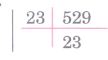
The prime factorisation of 529 is
529 = 23\(\times\)23
By pairing the prime factors, we get
529 = \(\underline { 23\times 23 } \)
So, \(\sqrt { 529 } \) = 23
37.
\(\begin{matrix}\quad 4\quad A \\ +\quad 9\quad 8 \\ \_ \_ \_ \_ \_ \_ \_ \_ \_ \\ \quad C\quad B\quad 3 \\ \_ \_ \_ \_ \_ \_ \_ \_ \_ \_ \end{matrix}\)
Here, we have three letters A, B, and C whose values are to be found.
Studying the addition in the one's column, we have A + 8 and we get 3 from this, i.e. a number whose one's digit is 3, for this A has to be 5.
\(\because\) A + 8 = 5 + 8 = 13
Now, for sum in ten's column, we have
1 + 4 + 9 = CB \(\Rightarrow\) 14 = CB
Here, B = 4 and C = 1
Therefore, the puzzle is solved as shown below:
\(\begin{matrix}\quad \quad 4\quad 5 \\ +\quad 9\quad 8 \\ \_ \_ \_ \_ \_ \_ \_ \_ \_ \\ \quad 14\quad 3 \\ \_ \_ \_ \_ \_ \_ \_ \_ \_ \_ \end{matrix}\)
Hence, A = 5, B = 4 and C = 1
38.
\(\begin{matrix}\quad 3\quad A \\ +\quad 2\quad 5 \\ \_ \_ \_ \_ \_ \_ \_ \_ \_ \\ \quad \quad B\quad 2 \\ \_ \_ \_ \_ \_ \_ \_ \_ \_ \_ \end{matrix}\)
Here, we have two letters A and B whose values are to be found.
Studying the addition in the one's column, we have A + 5 and we get 2 from this, i.e. a number whose one's digit is 2, for this A has to be 7.
\(\because\) A + 5 = 7 + 5 =12
Now, for sum in ten's column, we have
1 + 3 + 2 = B \(\Rightarrow\) B = 6
Therefore, the puzzle is solved as shown below:
\(\begin{matrix}\quad 3\quad 7 \\ +\quad 2\quad 5 \\ \_ \_ \_ \_ \_ \_ \_ \_ \_ \\ \quad \quad 6\quad 2 \\ \_ \_ \_ \_ \_ \_ \_ \_ \_ \_ \end{matrix}\)
Hence, A = 7 and B = 6
39.
\(9\over7\)
40.
We have, \(\frac{25\times t^{-4}}{5^{-3}\times 10\times 10^{-8}}\)
=\(\frac{25\times(5)^{3}\times t^{8}}{10\times t^{4}} \quad [\because a^{-m}=\frac{1}{a^{m}}]\)
=\(\frac{25\times125\times t^{8-4}}{10} \quad [\because \frac{a^{m}}{a^{n}}=a^{m-n}]\)
=\(\frac{25\times125}{10}\times t^{4}\)
=\(\frac{5\times 125}{2}\times t^{4}=\frac{625}{2}t^{4}\)
41.
In class interval 100 - 150, the number of peeps is 11 i.e. maximum and in-class interval 50 - 100 the number of people is 2, i.e. minimum.
42.
\(1\over4\)
43.
We know that,
Central angle of a component = \((\frac{Component\quad value}{sum\quad of \quad the\quad component\quad values}\times 360)^o\)
Here, total amount = Rs 7200,
Cntral angle for an item = \((\frac{Amount\quad spent\quad on\quad the\quad item}{Total\quad amount}\times 360)^o\)
The central angles of the sectors representing different items are computed in the following table:
| Items | Amount spent (in Rs) | Central anqles |
| Clothing | 600 | \((\frac{600}{7200}\times 360)^o =30^o\) |
| Food | 4000 | \((\frac{4000}{7200}\times 360)^o =200^o\) |
| House rent | 1200 | \((\frac{1200}{7200}\times 360)^o =60^o\) |
| Education | 400 | \((\frac{400}{7200}\times 360)^o =20^o\) |
| Miscellaneous | 1000 | \((\frac{1000}{7200}\times 360)^o =50^o\) |
| Total | 7200 | 360o |
Now, to construct the pie chart representing the above data, we follow the following steps:
Step I Draw a circle of an appropriate radius.
Step II Draw a vertical radius of the circle drawn in Step I.
Step III Choose the largest central angle. Here, largest central angle is of 200°. Draw a sector with central angle 200° in such a way that its one radius coincides with the radius drawn in Step II and another radius is in its clockwise direction.
Step IV Construct other sectors representing other items in clockwise sense in descending order of magnitudes of their central angles except the sector representing miscellaneous expenses. This sector is to be drawn in the last.
Step V Shade the sectors, so obtained by different designs and label them as shown in figure given below to obtain the required pie chart.
44.
(i) Size of class interval = Upper-class limit - Lower class limit
= 125 - 100 = 25
(ii) The class 200-225 has the highest frequency i.e. 140.
(iii) The class 300-325 has the lowest frequency i.e. 20.
(iv) The upper limit of the class interval 250-275 is 275.
(v) The class interval 150 - 175 and 225 - 250 have the same frequency i.e. 55.
45.
From the given bar graph, we find that,
i) The information given by the bar graph is the number of students in Class VIII in various academic years in the school.
(ii)In the year 2004-05, increase in the number of students is maximum.
(iii) The number of students is maximum in the year 2007 - 08.
(iv) False, because the number of students during 2005-06 is more than twice that of 2003-04.
46.
<
47.
\(\frac{27}{8}\)
48.
3-2=\(\frac{1}{3^{2}}=\frac{1}{9}\) [∵ \(a^{-m}=\frac{1}{a^{m}}\)]
49.
we have, \(-13\over19\)
\(\therefore\)The multiplicative inverse of \(-13\over19\) is\(19\over-13\)
50.
We have, -13
\(\therefore\)The multiplicative inverse of -13 is \(-1\over13\)
51.
We have, x =\(11\over15\)
LHS = -(-x) = -\(({11\over15})={11\over15}=X=RHS\)
S0, - (-x) = x is verified for x =\(11\over15\)
52.
we have, \(19\over-6\) so, additive inverse of \(19\over-6\) is \(19\over6\)
53.
we have, \({2\over-9}\) so, additive inverse of \({2\over-9}\) is \({2\over9}\)
54.
we have,\(-6\over-5\)=\({6\over5}\) so, additive inverse of \(({-6\over-5})\) is \(-6\over5\)
55.
= \(\frac { 2 }{ 5 } \times \left( \frac { -3 }{ 7 } \right) -\frac { 1 }{ 4 } +\frac { 1 }{ 14 } \times \frac { 2 }{ 5 } \)
= \(\frac { 2 }{ 5 } \times \left( \frac { -3 }{ 7 } \right) +\frac { 1 }{ 14 } \times \frac { 2 }{ 5 } -\frac { 1 }{ 4 } \) (Using commutativity)
= \(\frac { 2 }{ 5 } \left[ \frac { -3 }{ 7 } +\frac { 1 }{ 14 } \right] -\frac { 1 }{ 4 } \) (using distributivity)
= \(\frac { 2 }{ 5 } \left[ \frac { -6+1 }{ 14 } \right] -\frac { 1 }{ 4 } =\frac { 2 }{ 5 } \times \frac { -5 }{ 14 } -\frac { 1 }{ 4 } \)
= \(\frac { -1 }{ 7 } -\frac { 1 }{ 4 } =\frac { -4-7 }{ 28 } =\frac { -11 }{ 28 } \)
56.
()
1.4
57.
()
144
58.
()
966
59.
()
180
60.
()
-\({1\over13}\)

8th Standard CBSE Syllabus & Materials
8th Standard CBSE
CBSE 8th Science Particulate Nature of Matter - New Model Questions Papers Study Material - QB365 Set A
NEW8th Standard CBSE
CBSE 8th Science Pressure, Winds, Stroms and Cyclones - New Model Questions Papers Study Material - QB365 Set A
NEW8th Standard CBSE
CBSE 8th Mathematics Quadrilaterals - New Model Questions Papers Study Material - QB365 Set A
NEW8th Standard CBSE
CBSE 8th Mathematics A story of Numbers - New Model Questions Papers Study Material - QB365 Set A



CBSE 8th Standard CBSE Subjects
CBSE Standards




