
 100% FREE ACCESS
8th Standard CBSE Syllabus & Materials
8th Standard CBSE
CBSE 8th Social Science Theme D - Factors of Production - New Model Questions Papers Study Material - QB365 Set A
NEW8th Standard CBSE
CBSE 8th Social Science Theme C - Universal Franchise and India's Electoral System - New Model Questions Papers Study Material - QB365 Set A
NEW8th Standard CBSE
CBSE 8th Social Science Theme B - The Rise of the Marathas - New Model Questions Papers Study Material - QB365 Set A
NEW8th Standard CBSE
CBSE 8th Social Science Theme B - Reshaping India's Political Map - New Model Questions Papers Study Material - QB365 Set A
NEW8th Standard CBSE
CBSE 8th Social Science Theme A - Natural Resources and Their Use - New Model Questions Papers Study Material - QB365 Set A
NEW8th Standard CBSE
CBSE 8th Science Keeping Time with Skies - New Model Questions Papers Study Material - QB365 Set A

Published on: 13/08/2019
Understanding Quadrilaterals
Download CBSE Class 8th Standard CBSE Mathematics question papers, sample papers, important questions, and previous year solved papers in PDF format. Get free study materials, NCERT solutions, and exam preparation resources for Class 8th Standard CBSE Mathematics
Questions + Answers key
Take MCQ Mathematics Test
1.
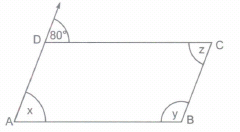
In the following figure, ABeD is a parallelogram. Find measures of x, y and z.
2.
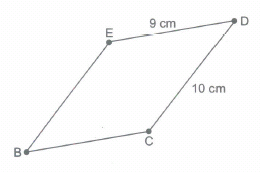
Find the perimeter of the parallelogram BCDE.
3.
If ABCDEF is a regular hexagon, then determine each angle of ΔAFC?
4.
If sum of all interior angles of a regular polygon is 18 right angles. Then, find the number of sides of the polygon.
5.
Find the measure of each interior angle of a regular polygon with 12 sides.
6.
In a quadrilateral ABCD, DO and CO are the bisectors of \(\angle\)D and \(\angle\)C respectively. Prove that \(\angle\)COD = \(\frac { 1 }{ 2 } \)[\(\angle\)A + \(\angle\)B].
7.
In the adjoining figure, find x + y + z + w.
8.
Take four congruent cardboard copies of any quadrilateral ABCD, with angles as shown in figure (i). Arrange the copies as shown in the figure, where ㄥ1, ㄥ2, ㄥ3 and ㄥ4 meet at a point in figure (ii).
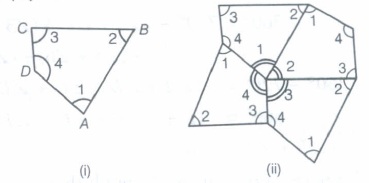
What can you say about the sum of the angles ㄥ1, ㄥ2, ㄥ3and ㄥ4?
9.
Complete the following crossword puzzle using the given directions for Across [from left to right} and Down [from top to bottom).
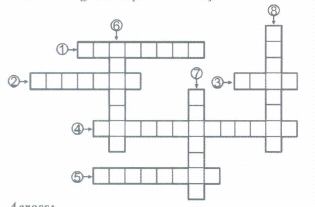
Across:
(1) The points where, the sides of a polygon meet are called _________
(2) A polygon made by six sides is called a __________
(3) The side joining two vertices is called a ____________
(4) 'A four sided polygon is called a ____________
(5) A five sided polygon is called a _________
Down:
(6) A parallelogram having all of its four sides equal is called a ____________
(7) A simple closed figure made of only line segments is called a __________
(8) The line segment joining the opposite sides of a polygon (except triangle) is called a ___________ of the polygon.
10.
Given here are some figures.
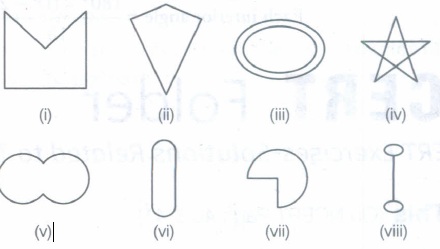
Classify each of them on the basis of the following.
(a) Simple curve
(b) Simple closed curve
(c) Polygon
(d) Convex polygon
(e) Concave polygon
11.
The measures of two angles of a quadrilateral are 110° and 100°. The remaining two angles are equal. The measure of each of the remaining two angles is
30°
60°
75°
45°
12.
The angle sum of a convex polygon with number of sides n is
(n - 2) 180°
(n + 2) 180°
(2n - 4) 180°
(2n + 4) 180°
13.
The sum of the measures of all the three angles of a triangle is
90°
180°
360°
720°
14.
Which of the following is the sum of an exterior angle and its adjacent interior angle?
A straight angle
A right angle
A complete angle
Reflex angle
15.
The sides of a pentagon are produced in order. Which of the following is the sum of its exterior angles?
540o
180o
720o
360o
16.
Which of the following is a regular quadrilateral?
rectangle
square
rhombus
kite.
17.
The maximum number of obtuse angles that a quadrilateral can have, is
1
2
3
4
18.
For which of the following quadrilaterals, diagonals are perpendicular to each other?
Parallelogram
Trapezium
Rectangle
Kite
19.
If the diagonals of a parallelogram bisect each other at right angles, then it will be a
rhombus
rectangle
kite
trapezium
20.
The number of diagonals in a polygon of n sides is
n(n-3)
\(\frac { n(n-3) }{ 2 } \)
n(n-2)
\(\frac { n(n-2) }{ 2 } \)
21.
A square has sides of equal length and angles of equal measure, so it is a ________ polygon.
22.
A rhombus is a quadrilateral with _________ of equal length.
23.
All angles of rectangle are equal and are ________ angles.
24.
If one diagonal of a rectangle is 8 cm long, length of the other diagonal is _______
25.
_______ is a regular quadrilateral.
26.
What do we call a trapezium having its nonparallel sides equal?
27.
If the sum of all the exterior angles of a quadrilateral is 360° then what is the sum of all the exterior angles of an octagon?
1.
x = 80o, y = 100o, z = 80o
2.
38 cm
3.
ㄥA = 90°, ㄥF = 60°, ㄥC = 30°
4.
11
5.
We have, n=12
Each interior angle = \(\frac { { 180 }^{ 0 }\times (n-2) }{ n } =\frac { { 180 }^{ 0 }\times (12-2) }{ 12 } =\frac { { 1800 }^{ 0 } }{ 12 } \)=1500
6.
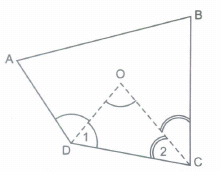
In \(\Delta\)COD, we have \(\angle\)COD + \(\angle\)1 + \(\angle\)2 = 180o
\(\Rightarrow\) \(\angle\)COD = 180o - [\(\angle\)1 + \(\angle\)2]
\(\Rightarrow\)\(\angle\)COD = 180o - \(\left[ \frac { 1 }{ 2 } \angle D+\frac { 1 }{ 2 } \angle C \right] \)
\(\Rightarrow\) \(\angle\)COD = 180o - \(\frac { 1 }{ 2 } \left[ \angle D+\angle C \right] \)
But \(\angle\)A + \(\angle\)B + \(\angle\)C + \(\angle\)D = 360o
\(\Rightarrow\) \(\angle\)C + \(\angle\)D = 360o - (\(\angle\)A + \(\angle\)B )
\(\therefore\)\(\angle\)COD = 180o - \(\frac { 1 }{ 2 } \)[360o - (\(\angle\)A + \(\angle\)B)
= 180o - \(\frac { 1 }{ 2 } \)[360o] + \(\frac { 1 }{ 2 } \)[\(\angle\)A + \(\angle\)B]
= 180o - 180o + \(\frac { 1 }{ 2 } \)(\(\angle\)A + \(\angle\)B) = \(\frac { 1 }{ 2 } \)(\(\angle\)A + \(\angle\)B)
Thus, \(\angle\)COD = \(\frac { 1 }{ 2 } \)[\(\angle\)A + \(\angle\)B]
7.
Since, the sum of the measures of interior angles of a quadrilateral is 360°.
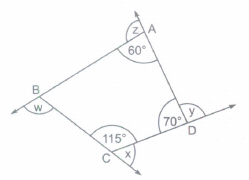
Also, 115° + 70° + 60° = 245°
\(\therefore\)245° + LABC = 360°
\(\Rightarrow\)\(\angle \)ABC = 360° - 245° = 115°
Now, x = ext. \(\angle\)BCD = 180° - \(\angle\)BCD
= 180° - 115° = 65°
Similarly, y = 180° - 70° = 110°
z = 180° - 60° = 120°
w = 180° - 115° = 65°
\(\therefore\)x +y + z + w = 65° + 110°+ 120° + 65° = 360°
8.
On arranging the four copies of congruent cardboard as shown in the given figure, we see that ㄥ1, ㄥ2, ㄥ3 and ㄥ4 meet at a point.
We know that, at a point, we get a complete angle whose value is 360°.
So, the sum of the angles ㄥ1, ㄥ2, ㄥ3 and ㄥ4 is 360°.
i.e, mㄥ1 + mㄥ2 + mㄥ3 + mㄥ4 = 360° ... (i)
Also, ㄥ1 = ㄥA, ㄥ2 = ㄥB, ㄥ3 = ㄥC and ㄥ4 = ㄥD
From Eq. (i), we get
ㄥA + ㄥB + ㄥC + ㄥD = 360°
Hence, the sum of the measures of the four angles of a quadrilateral is 360°.
9.
(l)\(\rightarrow\)VERTICES
(2)\(\rightarrow\)HEXAGON
(3)\(\rightarrow\)EDGE
(4)\(\rightarrow\)QUADRILATERAL
(5)\(\rightarrow\)PENTAGON
(6)\(\rightarrow\)RHOMBUS
(7)\(\rightarrow\)POLYGON
(8)\(\rightarrow\)DIAGONAL
10.
(a) Simple curve A plane figure formed by joining a number of points without lifting a pencil from the paper and without returing any portion of the drawing other than single points is called a simple curve or curve. In the given figures, simple curves are figures (i), (ii), (v), (vi) and (vii).
(b) Simple closed curve A closed curve, which does not intersect itself, is called a simple closed curve. In the given figures, simple closed curves are figures (i), (ii), (v), (vi) and (vii).
(c) Polygon A polygon is a closed curve formed by the line segments such that
(i) no two line segments intersect except at their end points.
(ii) no two line segments with a common end points are coincide. In other words, a simple dosed curve made upto only line segments is called a polygon. In the given figures, polygons are figures (i) and (ii).
(d) Convex polygon A convex polygon is a polygon in which each interior angle has a measure less than 180°. In other words, a polygon is convex, if noportion of their diagonals in their exterior. In the given figures, convex polygon is figure (ii).
(e) Concave polygon A concave polygon is a polygon, which atleast one interior angle has measure more than 180°, i.e. atleast one segment connecting two vertices is outside the polygon. In the given figure, concave polygons are figures (i) and (iv).
11.
Required measure = \({360^\circ-(110^\circ+100^\circ)\over 2}=75^\circ\)
12.
(a)
(n - 2) 180°
13.
(b)
180°
14.
(a)
A straight angle
15.
(d)
360o
16.
(b)
square
17.
(c)
3
18.
(d)
Kite
19.
20.
(b)
\(\frac { n(n-3) }{ 2 } \)
21.
()
regular
22.
()
sides
23.
()
right
24.
8 cm; [∵ in a rectangle, diagonals are of equal length]
25.
Square; since, in a square all the sides and angles are equal.
26.
()
An isosceles trapezium
27.
()
360o

8th Standard CBSE Syllabus & Materials
8th Standard CBSE
CBSE 8th Science Particulate Nature of Matter - New Model Questions Papers Study Material - QB365 Set A
NEW8th Standard CBSE
CBSE 8th Science Pressure, Winds, Stroms and Cyclones - New Model Questions Papers Study Material - QB365 Set A
NEW8th Standard CBSE
CBSE 8th Mathematics Quadrilaterals - New Model Questions Papers Study Material - QB365 Set A
NEW8th Standard CBSE
CBSE 8th Mathematics A story of Numbers - New Model Questions Papers Study Material - QB365 Set A



CBSE 8th Standard CBSE Subjects
CBSE Standards




