
 100% FREE ACCESS
8th Standard CBSE Syllabus & Materials
8th Standard CBSE
CBSE 8th Social Science Theme D - Factors of Production - New Model Questions Papers Study Material - QB365 Set A
NEW8th Standard CBSE
CBSE 8th Social Science Theme C - Universal Franchise and India's Electoral System - New Model Questions Papers Study Material - QB365 Set A
NEW8th Standard CBSE
CBSE 8th Social Science Theme B - The Rise of the Marathas - New Model Questions Papers Study Material - QB365 Set A
NEW8th Standard CBSE
CBSE 8th Social Science Theme B - Reshaping India's Political Map - New Model Questions Papers Study Material - QB365 Set A
NEW8th Standard CBSE
CBSE 8th Social Science Theme A - Natural Resources and Their Use - New Model Questions Papers Study Material - QB365 Set A
NEW8th Standard CBSE
CBSE 8th Science Keeping Time with Skies - New Model Questions Papers Study Material - QB365 Set A

Published on: 10/10/2019
Visualising Solid Shapes
Download CBSE Class 8th Standard CBSE Mathematics question papers, sample papers, important questions, and previous year solved papers in PDF format. Get free study materials, NCERT solutions, and exam preparation resources for Class 8th Standard CBSE Mathematics
Questions + Answers key
Take MCQ Mathematics Test
1.
A solid has 20 faces and double edges to its faces. Find the number of vertices.
2.
The scale on a map is 1 m: 9 m. Find the distance on the map for an actual distance of 63 m.
3.
The actual width of a store room is 320 cm. If the scale chosen to make its drawing is 1:4, then find the width of the room in the drawing.
4.
A solid has 40 faces and sixty edges. Find the number of vertices.
5.
A polyhedron has 20 faces and 12 vertices. Find the edges of the polyhedron.
6.
Use isometric dot paper, to sketch a rectangular prism with length 4 units, height 2 units and width 3 units
7.
The following is the map of a town. Based on it answer the questions.
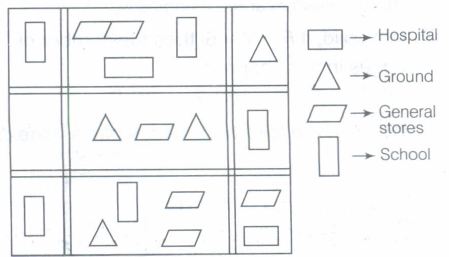
(a) Find the number of hospitals in the town,
(b) Find the ratio of the number of general stores to the ground,
(c) According to the map, find the number of schools in the town,
(d) What is the value depicted by the map of a particular location?
8.
Using Euler’s formula find the unknown
| Faces | ? | 5 | 20 |
| Vertices | 6 | ? | 12 |
| Edges | 12 | 9 | ? |
9.
What happens to F, V and E, if some parts are sliced off from a solid? (To start with, you may take a plasticine cube, cut a corner off and investigate.)
10.
Tabulate the number of faces, edges and vertices for the following polyhedrons: (Here, 'V' stands for number of vertices, 'F' stands for number of faces and 'E' stands for number of edges).
| Solid | F | V | E | F+V | E+2 |
| Cuboid | |||||
| Triangular pyramid | |||||
| Triangular prism | |||||
| Pyramid with square base | |||||
| Prism with square base |
What do you infer from the last two columns? In each case, do you find F + V = E + 2, i.e. F + V - E = 2?
1.
22
2.
7 m
3.
80 cm
4.
22
5.
30
6.
7.
(a) The total number of hospitals in the town is 2.
(b) Number of general stores in the town = 6
Number of grounds in the town = 4
∴ Required ratio = 6 : 4 = 3 : 2
(c) Number of schools in the town = 5
(d) With the map, we can reach the destination in an easier way. A map depicts the location of a particular object/place in relation to other objects/places.
8.
(i) Here, F = ?,V = 6, E = 12
By Euler's formula, we have
F + V-E = 2
On putting the values of V and E, we get
F + 6 - 12 = 2 ⇒ F - 6 = 2 ⇒ F = 2 + 6 = 8
Hence, the number of faces is 8.
(ii) Here, F = 5, V =?,E = 9
By Euler's formula, we have
F + V - E = 2
On putting the values of F and E, we get
5 + V - 9 = 2 ⇒ V - 4 = 2
⇒ V = 2 + 4 ⇒ V = 6
Hence, the number of vertices is 6.
(iii) Here, F = 20, V = 12, E =?
By Euler's formula, we have
F + V - E = 2
On putting the values of F and V, we get
20 + 12 - E = 2 ⇒ 32 - E = 2
⇒ 32 - 2 = E ⇒ E =30
Hence, number of edges is 30.
9.
Suppose, ABCDEFGH is a cube.
which has 6 faces, 8 vertices and 12 edges.
I.e. V = 8, F = 6 and E = 12
Then, V + F - E = 8 + 6-12 = 2
So, the Euler's formula is verified.
Now, suppose we sliced off a Δxyz from this cube, then
Number of faces F1= Number of faces of cube + One face of Δxyz
= 6 + 1 = 7
∴ Number of vertices V1= Vertices of cubes - One vertex of cube + 3 vertices of Δxyz
= 8 - 1 + 3 = 10
Number of edges E1 = Number of edges of cube + Number of edges of Δxyz
= 12 + 3 = 15
Now, F1 + V1 - E1 = 7 + 10 - 15 = 17 - 15 = 2
∴ Euler's formula is also verified for this figure.
Thus, we can say that, if some parts are sliced off form a solid; then number of vertices, edges and faces will be changed but still the Euler's formula is verified.
10.
On tabulating the number of faces, edges and vertices for the following polyhedrons, we have
| Solid | F | V | E | F + V | E+2 |
| Cuboid | 6 | 8 | 12 | 6 + 8=14 | 12 + 2 = 14 |
| Triangular pyramid | 4 | 4 | 6 | 4 + 4 = 8 | 6 + 2 = 8 |
| Triangular prism | 5 | 6 | 9 | 5+ 6 = 11 | 9 + 2 = 11 |
| Pyramid with square base | 5 | 5 | 8 | 5 + 5 =10 | 8 + 2 = 10 |
| Prism with square base | 6 | 8 | 12 | 6 + 8 =14 | 12 + 2 = 14 |
Thus, for each solids, we have
F + V = E + 2 or F + V - E = 2
i.e. Euler's formula is verified.

8th Standard CBSE Syllabus & Materials
8th Standard CBSE
CBSE 8th Science Particulate Nature of Matter - New Model Questions Papers Study Material - QB365 Set A
NEW8th Standard CBSE
CBSE 8th Science Pressure, Winds, Stroms and Cyclones - New Model Questions Papers Study Material - QB365 Set A
NEW8th Standard CBSE
CBSE 8th Mathematics Quadrilaterals - New Model Questions Papers Study Material - QB365 Set A
NEW8th Standard CBSE
CBSE 8th Mathematics A story of Numbers - New Model Questions Papers Study Material - QB365 Set A



CBSE 8th Standard CBSE Subjects
CBSE Standards




