
 100% FREE ACCESS
8th Standard CBSE Syllabus & Materials
8th Standard CBSE
CBSE 8th Social Science Theme D - Factors of Production - New Model Questions Papers Study Material - QB365 Set A
NEW8th Standard CBSE
CBSE 8th Social Science Theme C - Universal Franchise and India's Electoral System - New Model Questions Papers Study Material - QB365 Set A
NEW8th Standard CBSE
CBSE 8th Social Science Theme B - The Rise of the Marathas - New Model Questions Papers Study Material - QB365 Set A
NEW8th Standard CBSE
CBSE 8th Social Science Theme B - Reshaping India's Political Map - New Model Questions Papers Study Material - QB365 Set A
NEW8th Standard CBSE
CBSE 8th Social Science Theme A - Natural Resources and Their Use - New Model Questions Papers Study Material - QB365 Set A
NEW8th Standard CBSE
CBSE 8th Science Keeping Time with Skies - New Model Questions Papers Study Material - QB365 Set A

Published on: 19/08/2019
Visualising Solid Shapes
Download CBSE Class 8th Standard CBSE Mathematics question papers, sample papers, important questions, and previous year solved papers in PDF format. Get free study materials, NCERT solutions, and exam preparation resources for Class 8th Standard CBSE Mathematics
Questions + Answers key
Take MCQ Mathematics Test
1.
In the formula F + V - E = 2, on putting F = 40 and E = 60, find the value of V.
2.
Height of a building is 18 m and this building is represented by 18 cm on a map. What is the scale used for the map?
3.
Look at the map given below:
Houses
B Town, India
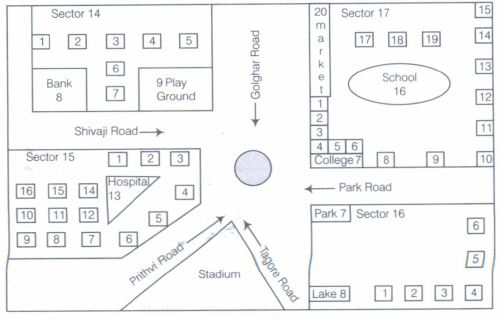
On which road, bank is situated?
4.
The width and length of a rectangular board is 50 cm and 60 cm, respectively. A student has to draw its image on his notebook. While drawing the image on notebook, he takes the scale 1 : 10, then what is the length and width of the rectangular board on the notebook?
5.
Draw two figures for each 1-D, 2-D and 3- D.
6.
Draw the front, side and top views of the given shapes.
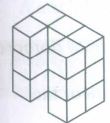
7.
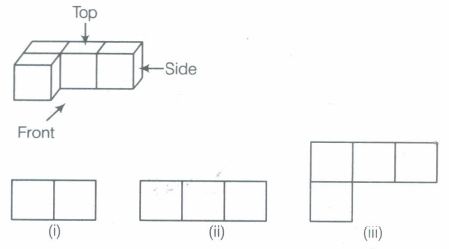
For each given solid, identify the top view, front view and side view.
8.
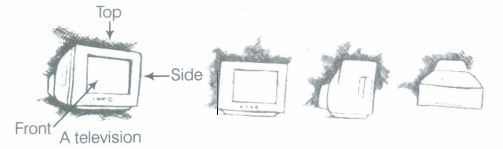
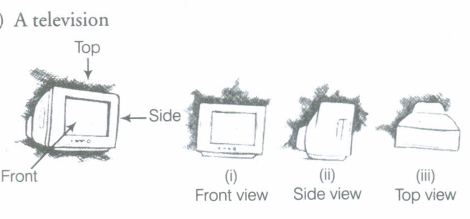
The given solid, the three views are given. Identify for each solid the corresponding top, front and side views.
9.
Look at the given map of a city.
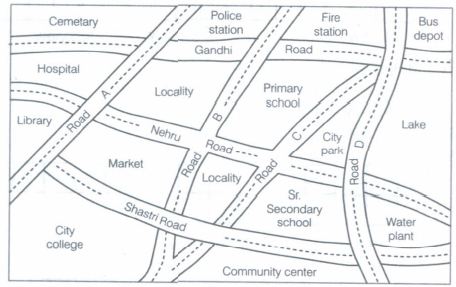
Answer the following questions:
(a) Colour the map as follows: Blue-water, Red-fire station, Orange-library, Yellow-school, Green-park, Pink-college, Purple-hospital, Brown- cemetery.
(b) Mark a green 'X' at the intersection of road 'C' and Nehru Road, Green 'V' at the intersection of Gandhi Road and road 'A'.
(c) In red, draw a short street route from library to the bus depot.
(d) Which is further East, the city park or the market?
(e) Which is further South, the primary school or the Sr. Secondary School?
10.
What is Euler's formula? Verify the Euler's formula for a pentagonal prism.
11.
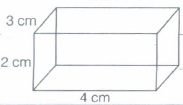
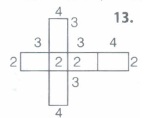
Draw the net of the following cuboid:
12.
Mr. David travelling by bus between city A and B. Due to some technical problem in GPS of bus, the driver get confused. Then the driver asked to all the passengers 'Does anyone have a manual map of distance between city A and B. Mr. David reply with polite manner 'Yes, I have'. He gave him manual map. In the manual map, the distance between city A and B on a map is given as 6 cm. If the scale represents 1 cm = 300 km, then find the actual distance between city A and B. What value depict from this question?
13.
Verify which of the following are the faces, edges and, vertices of a polyhedron.
(i) Faces = 10, edges = 20 and vertices = 15
(ii) Faces = 7, edges = 5and vertices = 4
(iii) Faces = 4, edges = 6 and vertices = 4
(iv) Faces= 5, edges = 4 and vertices = 3
14.
Can a polyhedron have 10 faces, 20 edges and 15 vertices?
15.
Which of the following is the number of vertices of sphere?
0
1
2
4
16.
 is the ________ view of above solid.
front
side
top
17.
Side of a square garden is 40 m. If the scale used to draw its picture is 1 cm: 8 m, then the perimeter of the square in the picture is
15 cm
25 cm
20 cm
32 cm
18.
Which of the following is a regular polyhedron?
Cube
Triangular prism
Square prism
Cuboid
19.
Which of the following 3-D shapes does not have a vertex?
Pyramid
Cone
Sphere
Prism
20.
Which of the following will not form a polyhedron?
3 triangles
2 triangles and 3 parallelogram
8 triangles
1 pentagon and 5 triangles
21.
A cuboid has ______ faces, ______ edges and vertices.
22.
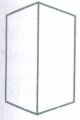 is the ....... view of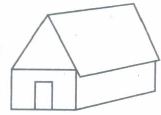
23.
A ........ has 7 faces.
24.
Square prism is also called a ............
25.
Total number of regular polyhedron is 4.
26.
A polyhedron with least number of faces is known as triangular pyramid.
27.
A polyhedron has 3 faces.
28.
A prism is a polyhedron that has two parallel, congruent bases, whereas a pyramid is a polyhedron that has one base.
29.
If a pyramid has a hexagonal base, then the number of vertices is 7.
30.

31.
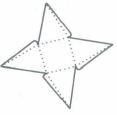
32.
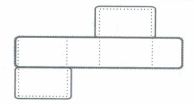
33.

34.

1.
Since,
F + V - E = 2
∴ 40 + V - 60 = 2
[∵ F = 40 and E = 60, given]
⇒ V = 2 + 20 = 22
2.
∵ Scale of map=\(\frac { Size\ drawn }{ Actual\ size } \)
\(=\frac { 18cm }{ 1800cm } \quad [\because 1m=100cm]\)
\(=\frac { 1 }{ 100 } [\therefore 18m=1800cm]\)
Thus, the scale is 1 : 100
3.
Shivaji road
4.
Length = 6 cm and width = 5 cm
5.
6.
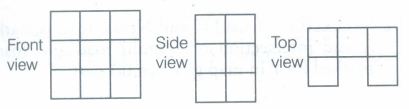
7.
The given solid and its top view, front view and side view are as follow:
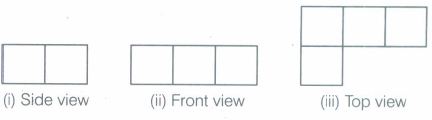
8.
Each solid and its corresponding top front and side views are given below:
9.
(a) The shaded (coloured) map according to the question is as follows:
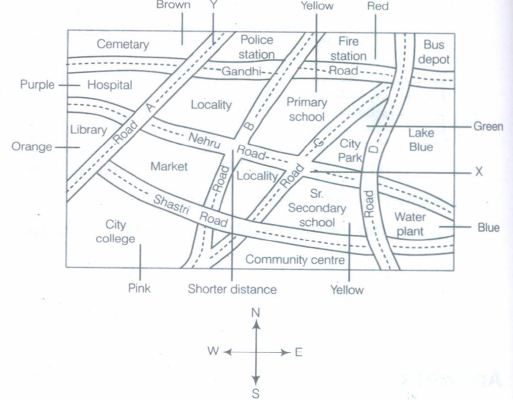
(b) Intersection of road C and Nehru road is marked by X and intersection of Gandhi road and road A is marked by Yin map given in (a) part.
(c) Short street route from library to the bus depot is Library ⟶ Nehru road ⟶ Road C ⟶ Bus depot.
(d) City Park is in the East.
(e) Sr. Secondary School is in the South.
10.
If a polyhedron is having number of faces as F, number of edges as E and the number of vertices as V, then the relationship
F+ V=E+2
is known as Euler's formula. Following figure is a solid pentagonal prism.
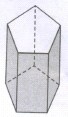
It has:
Number of faces (F) = 7
Number of edges (E) = 15
Number of vertices (V) = 10
Substituting the values of F, E and V in the relation,
F+ V=E+2
We have
7 + 10 = 15 + 2
⇒ 17 = 17
which is true, the Euler's formula is verified.
11.
12.
Given, Actual distance represented by 1cm = 300km
Actual distance represented by 6 cm
= 6 x 300 = 1800km
So, actual distance between city A and city B is 1800 km.
The value depicted here is civilised manner of interaction to other and presence of mind.
13.
Only option (iii) satisfy F + V = E + 2.
So, it is the required answer.
14.
Given, F = 10, E = 20 and V = 15
By Euler's formula, we have F + V - E = 2
On putting these values in LHS, we get
LHS = F + V - E = 10 +15 - 20 = 25 - 20 = 5 ≠ 2
∴ LHS ≠ RHS
So, Euler's formula is not verified.
Hence, such a polyhedron is not possible.
15.
(a)
0
16.
(a)
front
17.
(c)
20 cm
18.
(a)
Cube
19.
(c)
Sphere
20.
(a)
3 triangles
21.
()
6, 12, 8
22.
()
The given figure is the top view of hut.
23.
()
A pentagonal prism have 7 faces. Since, in a prism, there are two parallel congruent bases.
24.
()
∵ A prism is a polyhedron that has two parallel, congruent bases. The bases can be any polygon. So, a square prism is called a cube.
25.
(b)
26.
(a)
27.
(b)
28.
(a)
29.
(a)
30.
()
| Type of shapes | Name of the shapes |
| 2-Dimensional | Square |
31.
()
Square pyramid
32.
()
Cuboid
33.
()
Cube
34.
()
Cone

8th Standard CBSE Syllabus & Materials
8th Standard CBSE
CBSE 8th Science Particulate Nature of Matter - New Model Questions Papers Study Material - QB365 Set A
NEW8th Standard CBSE
CBSE 8th Science Pressure, Winds, Stroms and Cyclones - New Model Questions Papers Study Material - QB365 Set A
NEW8th Standard CBSE
CBSE 8th Mathematics Quadrilaterals - New Model Questions Papers Study Material - QB365 Set A
NEW8th Standard CBSE
CBSE 8th Mathematics A story of Numbers - New Model Questions Papers Study Material - QB365 Set A



CBSE 8th Standard CBSE Subjects
CBSE Standards




