
 100% FREE ACCESS
8th Standard CBSE Syllabus & Materials
8th Standard CBSE
CBSE 8th Social Science Theme D - Factors of Production - New Model Questions Papers Study Material - QB365 Set A
NEW8th Standard CBSE
CBSE 8th Social Science Theme C - Universal Franchise and India's Electoral System - New Model Questions Papers Study Material - QB365 Set A
NEW8th Standard CBSE
CBSE 8th Social Science Theme B - The Rise of the Marathas - New Model Questions Papers Study Material - QB365 Set A
NEW8th Standard CBSE
CBSE 8th Social Science Theme B - Reshaping India's Political Map - New Model Questions Papers Study Material - QB365 Set A
NEW8th Standard CBSE
CBSE 8th Social Science Theme A - Natural Resources and Their Use - New Model Questions Papers Study Material - QB365 Set A
NEW8th Standard CBSE
CBSE 8th Science Keeping Time with Skies - New Model Questions Papers Study Material - QB365 Set A

Published on: 22/09/2018
Top Important Question
Download CBSE Class 8th Standard CBSE Mathematics question papers, sample papers, important questions, and previous year solved papers in PDF format. Get free study materials, NCERT solutions, and exam preparation resources for Class 8th Standard CBSE Mathematics
Questions + Answers key
Take MCQ Mathematics Test
1.
Which of the following is neither positive nor a negative rational number?
1
0
Such a rational number does not exist
None of the above
2.
Which of the following is the multiplicative identity for rational numbers?
1
-1
0
None of these
3.
Which of the following is the identity element?
1
-1
0
None of these
4.
What should be subtracted from \(\frac { -3 }{ 4 } \) to get - 1?
\(\frac { 1 }{ 4 } \)
\(-\frac { 1 }{ 4 } \)
1
\(-\frac { 3 }{ 4 } \)
5.
What should be added to \(\frac { -3 }{ 4 } \) to get -1?
\(\frac { 1 }{ 4 } \)
\(\frac { -1 }{ 4 } \)
1
\(\frac { -3 }{ 4 } \)
6.
The reciprocal of \({-3\over8 } \times {-24\over 13}\) is
\(9\over 13\)
\(-9\over 13\)
\(-13 \over 9\)
\(13\over9\)
7.
Which of the following statements is always true?
\(\frac{x-y}{2}\) is a rational number between x and y
\(\frac{x+y}{2}\) is a rational number between x and y
\(\frac{x\times y}{2}\) is a rational number between x and y
\(\frac{x\div y}{2}\) is a rational number between x and y
8.
\(\frac{x+y}{2}\) is a rational number
between x and y
less than x and y both
greater than x and y both
less than x but greater than y
9.
Three rational numbers lying between\(\frac{-5}{4}\) and \(\frac{1}{2}\)are
-1, 0 ,\(\frac{4}{3}\)
\(\frac{-3}{4},\frac{-1}{2},\frac{1}{4}\)
\(\frac{-3}{4},\frac{4}{3},\frac{1}{4}\)
\(\frac{-7}{4},-1,0\)
10.
Which of the following is not true?
\(\frac{10}{11}+\frac{11}{12}=\frac{11}{12}+\frac{10}{11}\)
\(\frac{10}{11}\times \frac{11}{12}=\frac{11}{12}\times \frac{10}{11}\)
\(\frac{10}{11}+ \frac{11}{12}=\frac{11}{12}\div \frac{10}{11}\)
\(\frac{10}{11}\div \frac{11}{12}=\frac{11}{12}\times \frac{10}{11}\)
11.
The list price of a frock is Rs 220. A discount of 20% is announced on it. What is the amount of discount on it and its sale price?
12.
An item marked at Rs 840 is sold for Rs 714. What is the discount and discount %?
13.
18% of a class took part in a karate competition. If 18 students have taken part in it, then what is the total number of students in the class?
14.
Find the whole quantity if 5% of the quantity is 80.
15.
Rahul got 150 marks out of 200 and Prabha got 180 marks out of 300. Whose performance is better?
16.
Write the additive inverse of the following \(-6\over-5\)
17.
Write the additive inverse of the following \(-5\over9\)
18.
Write the additive inverse of the following \(2\over8\)
19.
Using appropriate properties, find \({2\over5}\times({-3\over7})-{1\over6}\times{3\over2}+{1\over14}\times{2\over5}\)
20.
Is the rational numbers closed under multiplication, Justify?
21.
A sum of Rs 10,000 is borrowed at a rate of interest 15% p.a. for 2 years. Find the simple interest on this sum and the amount to be paid at the end of 2 years.
22.
Find the population of a city after 2 years, which is at present is 20 lakh, if the rate of increase is 5% p.a.
23.
Factorise: 27x3 - 21x2 + 15x4
24.
Find using distributivity. \(\{ {9\over16}\times {4\over12} \} +\{ {9\over 16}\times {-3\over 9} \}\)
25.
Find using distributivity. \( \{{7\over5}\times ({-3\over12}) \}+ \{{7\over16}\times {5\over12} \}\)
26.
In computing the area of a square. Shekhar used the formula for area of a square, while his friend Maroof used the formula for the perimeter of a square. Interestingly their answers were numerically same. Tell me the number of units of the side of the square they worked on.
27.
Complete the following crossword puzzle using the given direction.
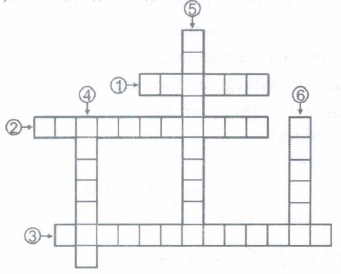
Direction:
Across:
(1) The product of number by itself two times, is called its _______
(2) If three numbers a, band c are such that a2 + b2= c2 then they are called _____ Triplets.
(3) A number is a when it is a product of the same two numbers.
Down: (4) The numbers 2n, n2-1 and n2 + 1 where n is a natural number show Pythagorean______.
(5) Finding is the inverse operation of squaring a number.
(6) A number which divides a _______ given number exactly is called a or divisor of that number.
28.
A road roller makes 250 complete revolution to move once over to level a road.
Find the area of the road levelled if the diameter of the road roller is 84 cm and length is 1 m.
29.
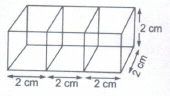
The edge of a cube is 2 cm. Find the total surface area of the cuboid formed by three such cubes joined edge to edge.
30.
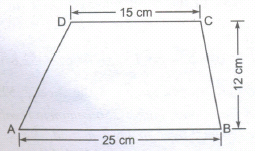
Find the area of the following trapezium.
31.
The table shows the portion of some common materials that are recycled.
| Material | Recycled |
| Paper | \({5\over11}\) |
| Aluminium cans | \({5\over8}\) |
| Glass | \({2\over5}\) |
| Scrap | \({3\over4}\) |
(a) Is the rational number expressing the amount of paper recycled more than \({1\over2}\)or less than \({1\over2}\) ?
(b) Which items have a recycled amount less than \({1\over2}\) ?
(c) Is the quantity of aluminium cans recycled more (or less) than half of the quantity of aluminium cans?
(d) Arrange the rate of recycling the materials from the greatest to the smallest.
(e) What do you understand from recycling and how it is useful?
32.
Using and associativity of addition of rational numbers, express the following as a rational number.
\({5\over2}+{-3\over7}+{1\over2}+{4\over7}\)
33.
On a number line the rational number equidistant from a and -1 is:
34.
The product of (-3) and the negative reciprocal of 11/2, is:
35.
The reciprocal of (-1) is:
36.
The product of a rational number (other than zero) and its reciprocal is:
37.
The rational number having no reciprocal is
38.
(a + b)+ c= a + (b+ c) is called
39.
axb=bxa is called
40.
a+b=b+a is called
41.
a x (bx c) = (a x b)x c is called
42.
a(b+ c) = ab + ac is called
1.
(b)
0
2.
(a)
1
3.
(c)
0
4.
(a)
\(\frac { 1 }{ 4 } \)
5.
(b)
\(\frac { -1 }{ 4 } \)
6.
(d)
\(13\over9\)
7.
(b)
\(\frac{x+y}{2}\) is a rational number between x and y
8.
(a)
between x and y
9.
(b)
\(\frac{-3}{4},\frac{-1}{2},\frac{1}{4}\)
10.
(c)
\(\frac{10}{11}+ \frac{11}{12}=\frac{11}{12}\div \frac{10}{11}\)
11.
Marked price is same as the list price.
20% discount means that on RS. 100 (MP), the discount is RS. 20.
By unitary method, on RS.1 the discount will be RS. \(\frac{20}{100}\)
On RS. 220, discount = RS. \(\frac{20}{100} \times 220=\ Rs. 44\)
The sale price = (RS. 220 – RS. 44) or RS. 176
Rehana found the sale price like this —
A discount of 20% means for a MP of RS. 100, discount is RS. 20. Hence the sale price is RS. 80. Using unitary method, when MP is RS. 100, sale price is RS. 80;
When MP is RS. 1, sale price is RS.\(\frac{80}{100}\)
Hence when MP is RS. 220, sale price = RS. \(\frac{80}{100} \times 220=\text { RS. } 176\)
12.
Discount = Marked Price – Sale Price
= RS. 840 – RS. 714
= RS. 126
Since discount is on marked price, we will have to use marked price as the base.
On marked price of RS. 840, the discount is RS. 126.
\(\text { Discount }=\frac{126}{840} \times 100 \%=15 \%\)
13.
100
14.
1600
15.
Rahul
16.
we have,\(-6\over-5\)=\({6\over5}\) so, additive inverse of \(({-6\over-5})\) is \(-6\over5\)
17.
we have, \(-5\over9\) so, additive inverse of \(-5\over9\) is \(5\over9\)
18.
we have, \(2\over8\) so, additive inverse of \(2\over8\) is \(-2\over8\)
19.
= \(\frac { 2 }{ 5 } \times \left( \frac { -3 }{ 7 } \right) -\frac { 1 }{ 4 } +\frac { 1 }{ 14 } \times \frac { 2 }{ 5 } \)
= \(\frac { 2 }{ 5 } \times \left( \frac { -3 }{ 7 } \right) +\frac { 1 }{ 14 } \times \frac { 2 }{ 5 } -\frac { 1 }{ 4 } \) (Using commutativity)
= \(\frac { 2 }{ 5 } \left[ \frac { -3 }{ 7 } +\frac { 1 }{ 14 } \right] -\frac { 1 }{ 4 } \) (using distributivity)
= \(\frac { 2 }{ 5 } \left[ \frac { -6+1 }{ 14 } \right] -\frac { 1 }{ 4 } =\frac { 2 }{ 5 } \times \frac { -5 }{ 14 } -\frac { 1 }{ 4 } \)
= \(\frac { -1 }{ 7 } -\frac { 1 }{ 4 } =\frac { -4-7 }{ 28 } =\frac { -11 }{ 28 } \)
20.
Rational numbers are closed under multiplication, e.g.\({2\over 12}\times{1\over 12}={2\over 144}\) , which is a rational number.
21.
On RS. 100, interest charged for 1 year is RS. 15.
So, on RS. 10,000, interest charged = \(\frac{15}{100} \times 10000=\ RS. 1500\)
Interest for 2 years = RS. 1500 x 2 = RS. 3000
Amount to be paid at the end of 2 years = Principal + Interest
= RS. 10000 + RS. 3000 = RS. 13000
22.
\(\because\) Present population (P) = 20 lakh = 20,00,000
Rate of increased (R) = 5% p.a.
Time = 2 years \(\Rightarrow\) n = 2
\(\therefore\)Population after 2 years = P\([1+{R\over100}]^n\)
= 20,00,000 \([1+{5\over100}]^2=2000000[{21\over20}]^2\)
= 2000000 x \({21\over20}\times {21\over20}\)
= 5000 x 21 x 21 = 22,05,000
Thus, the population of the city after 2 years
= 22,05,000
23.
We have 27x3 = 3 x 3 x 3 \(\times \)x\(\times \)x\(\times \)x
21x2 = 3\(\times \)7\(\times \)x\(\times \)x
15x4 = 3 x 5 \(\times \) x \(\times \) x \(\times \) x \(\times \) x
We get common factors as 3, x and x.
i.e., 3 \(\times \) x \(\times \)x or 3x2
∴27x3 =: 3x2 x 3 \(\times \) x \(\times \) 3 = 3x2 \(\times \)9x
21x2=\({ 3x }^{ 2 }\times 7={ 3x }^{ 2 }\times 7\)
\({ 15x }^{ 4 }=3x^{ 2 }\times 5x\times x={ 3x }^{ 2 }\times { 5x }^{ 2 }\)
\(\Rightarrow { 27x }^{ 3 }-{ 21x }^{ 2 }+{ 15x }^{ 4 }\)
\(\Rightarrow { (3x }^{ 2 }\times 9x)-({ 3x }^{ 2 }\times 7)+{ (3x }^{ 2 }\times { 5x }^{ 2 })\)
\({ 3x }^{ 2 }[9x-7+{ 5x }^{ 2 }]\)
24.
We have,\(\{ {9\over16}\times {4\over12} \} +\{ {9\over 16}\times {-3\over 9} \} = {9\over16} \times [{4\over12}+({-3\over9})] \)
[by distributivity, taking \( {9\over16}\) as common factor]
\(={9\over16}\times[{4\over12}-{3\over9}]={9\over16}\times[{12-12\over36}]\)
\([\because LCM \ of\ 12\ and \ 9=36]\)
\(={9\over16}\times {0\over36}\)
\(= {9\over16}\times0=0\)
25.
We have, \( \{{7\over5}\times ({-3\over12}) \}+ \{{7\over16}\times {5\over12} \}={7\over5}\times[{-3\over12}+{5\over12}]\)
[by distributivity, taking \({7\over5}\) as common factor]
\(={7\over5}\times[{-3+5 \over 12}]= {7\over5}\times {2\over 12}={7\over30}\)
26.
Let the number of units of the side of the square be x.
Then,
area of the square = x2 square units
perimeter of the square = 4x units
According to the question,
x2 = 4x
⇒ x2 -4x = 0
⇒ x(x - 4) = 0
⇒ x = 0, 4
x = 0 is inadmissible
∴ x = 4
Hence, the number of units of the side of the square is 4.
27.
1.SQUARE
2.PYTHAGOREAN
3.PERFECT SQUARE
4.TRIPLET
5.SQUARE ROOT
6.FACTOR
28.
A road roller is a cylinder such that Radius \(\frac{84}{2}\ cm=42\ cm\)
Length (h) = 1m = 100 cm
\(\because\) Lateral surface area of a cylinder = 2\(\pi\)rh
\(\therefore\) Lateral surface area of the road roller \(=2\times\frac{22}{7}\times 42\times 100\ cm^2\)
\(=2\times 22\times 6\times 100\ cm^2\)
\(\therefore\) Area of road levelled in 1 revolution = 26400 cm2
\(\Rightarrow\) Area of road levelled in 250 revolutions
\(=250\times 26400\ cm^2=\frac{250\times26400}{100\times100}m^2\)
\(=\frac{25\times264}{10}m^2=\frac{6600}{10}m^2=660 m^2\)
29.
The edge (side) of the given cube = 2 cm
Since, three such cubes are joined, then
Total length (/)= (2 + 2 + 2) cm = 6 cm
Breadth (b) = 2 cm
Height (h) = 2 cm
\(\therefore\) Total surface area of the resultant cuboid
= 2[lb + bh + hI]
= 2[6 x 2 + 2 x 2 + 2 x 6] cm2
= 2[12 + 4 + 12] cm2
= 2[28] cm2 = 56 cm2
Thus, the required total surface area of the cuboid = 56 cm2.
30.
Here, parallel sides are 25 cm and 15 cm.
Height (i.e. distance between the parallel sides) = 12 cm
\(\because\) Area of a trapezium ABCD
\(=\frac{1}{2}\times(Sum\ of\ parallel\ sides)\times \ Height\)
\(\therefore\) Area of the trapezium ABCD
\(=\frac{1}{2}\times(25\ cm+15\ cm)\times12\ cm\)
\(=\frac{1}{2}\times40\times12\ cm^2=240\ cm^2\)
Thus, the required area of the trapezium ABCD = 240 cm2.
31.
\((a) \because {1\over2}={1\over2}\times{11\over11}={11\over22} and {5\over11}={5\over11}\times{2\over2}={10\over22}\)
So, paper recycled is less than \({1\over2}\)
\((b) Similarly ,{5\over8}is \ greater \ than {1\over2}(={4\over8})\)
\(\\ Also, {2\over5}={2\times2\over5\times2}={4\over10}<{1\over2}(={5\over10})\)
\(\\ and {3\over4}>{1\over2}(={2\over4})\)
So, the quantity of paper and glass recycled is less than \({1\over2}\)
(c)Quantity of cans = \({5\over8}(={10\over16})\) is more than half of the quantity of aluminium cans
\(={5\over8}\times {1\over2}={5\over16}\)
32.
\(22\over7\)
33.
()
\(-\frac { 1 }{ 2 } \)
34.
()
2
35.
()
-1
36.
()
1
37.
()
0
38.
()
Commutative property for addition
39.
()
Commutative property for multiplication
40.
()
Commutative property for addition
41.
()
Associative property for multiplication
42.
()
Distributive property for addition

8th Standard CBSE Syllabus & Materials
8th Standard CBSE
CBSE 8th Science Particulate Nature of Matter - New Model Questions Papers Study Material - QB365 Set A
NEW8th Standard CBSE
CBSE 8th Science Pressure, Winds, Stroms and Cyclones - New Model Questions Papers Study Material - QB365 Set A
NEW8th Standard CBSE
CBSE 8th Mathematics Quadrilaterals - New Model Questions Papers Study Material - QB365 Set A
NEW8th Standard CBSE
CBSE 8th Mathematics A story of Numbers - New Model Questions Papers Study Material - QB365 Set A



CBSE 8th Standard CBSE Subjects
CBSE Standards




